




Kfar Shuba: Israel questions mayor
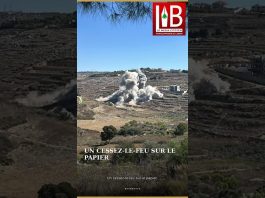
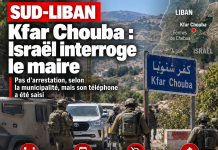
An Israeli patrol entered the Kfar Shuba area on Saturday intercepted the municipality's president, Kassem al-Qadri, while inspecting a reservoir supplying the area with water. He was interrogated and his phone seized before he could leave. The municipality denied on Sunday the first reports of his arrest. The incident, however, raises the question of the practical exercise of Lebanese sovereignty in areas subject to Israeli incursions.

Iran Derangement Syndrom Syndrome
Iran Derangement Syndrom or the Story of the Financing of Propaganda to normalize relations between Israel and Lebanon. "The words of the bastards arm the arms of the fools" (Theories of Theories, p. 149) Charles Dantzig. Banker Antoine Sehnaoui and Jeremy Chaabane, media advisor to Bahaa Hariri, the eldest son of the old [...]

In Nabatiyah, Aoun suspends negotiations with Israel
Joseph Aoun visited Nabatiyah on 12 September 2026 with the heads of the security apparatus, a few days after Israeli strikes had hit the city and public institutions. The President affirmed that there would be no new negotiations with Israel "for the moment" and reaffirmed four priorities: withdrawal, prisoners, return of displaced persons and reconstruction. This visit comes at a time when its diplomatic strategy is being increasingly criticized in Lebanon for lack of sufficient Israeli counterparts.

A church and its medieval frescoes
A church and its medieval frescoes, this Charbel is not the 19th century Lebanese monk: it is Charbel Edessian, a priest martyred with his sister Bebaia..

In Lebanon, more than 60% of the economy would now escape the declared circuits
The undeclared economy now accounts for more than 60 per cent of activity in Lebanon, according to an estimate reported by the press. Behind this threshold is a profound transformation: cash payments, under-reporting, informal trade and the decline of organised enterprises reduce the state's tax base. In an economy heavily dependent on imports, this trend also weakens customs revenues, distorts statistics and increases competition between declared players and parallel channels.

Lebanon: An explosion shakes the South like an earthquake
Lebanon: An explosion shakes the South like an earthquake On 10 September 2026 at 21:08, a massive explosion under Ali al-Taher hill was felt as a real earthquake of magnitude..

Nabih Berri: « The framework agreement has fallen »
Nabih Berri delivers Friday, September 11, one of his most pessimistic diagnoses on the Lebanese situation. The Speaker of the Chamber said he was not optimistic and considered that "the framework agreement has fallen." He is now judging diplomatic initiatives with their results on the ground, while deaths and destruction continue in southern Lebanon. Berri also maintains sustained support for the Lebanese army, which he presents as a fundamental institution for the construction of the State.
Lebanon: Government bans sale of real estate in occupied areas
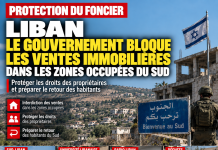
The Lebanese Council of Ministers has approved a bill to prevent sales and other real estate disposal in the areas of southern Lebanon occupied by the Israeli army. The measure must protect the rights of owners, while some residents still cannot return to their villages normally. The Government also advanced on temporary housing, Lebanese University, Lebanese Radio, waste and public sector compensation.
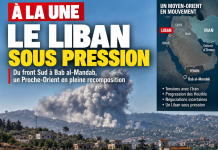
Press review: Lebanon under pressure from the southern front in the Middle East in...
Lebanon faces increasing pressure in the South after the destruction of Ali al-Taher, while Nabatiyeh becomes a major test for state sovereignty. Between uncertain negotiations, Israeli escalation, tensions with Iran and advanced Houthis, the Lebanese crisis is part of a much wider regional recomposition now.

South Lebanon: Mansouri school largely destroyed
What was feared since Wednesday was produced in Mansouri. On Friday morning, 11 September, Israeli forces detonated most of the public school in the town of Tyre District. The destruction occurred after 24 hours, with dynamiting of houses and infrastructure, raids and artillery fire in several areas of southern Lebanon. In Ali al-Taher, a massive explosion even generated waves recorded by Lebanese seismological stations.

11-September: Where were you 25 years ago?
Where were you on September 11, 2001? Twenty-five years after the attacks on the United States, this intimate question allows us to measure the transformations of an era. Wars in Afghanistan and Iraq, terrorism, conflicts in Ukraine and the Middle East, conspiracy theories, social networks, political polarization and ultra-droit progression accompanied this first quarter of century. The world has made tremendous technological progress, but it still seems unable to get rid of its old reflexes of violence and division.
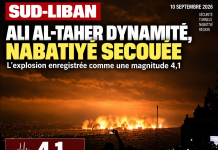
South Lebanon: Ali al-Taher explosion shakes Nabatiyé with an earthquake caused by 4.1 on...
An explosion of exceptional power shook Nabatiyah and his region on Thursday evening during the destruction of the tunnels of Ali al-Taher. At 2108 hours the seismic networks recorded a signal of magnitude 4.1 near Nabatiyah. The event must not be interpreted as a natural earthquake: it comes at the time when Israel is neutralizing the vast underground complex which it had announced had taken operational control a few days earlier.

Bayeux Tapestry enters the British Museum
"The Tapestry of Bayeux entered the British Museum "Wondered between 1067 and 1079, probably commanded by Odon de Bayeux, half brother of William the Conqueror.
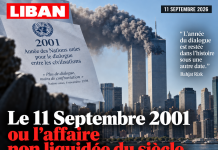
September 11, 2001 or the unliquidated case of the century.
Michel Edmond Ghanem On 4 November 1998, the UN General Assembly adopted without a vote a resolution proclaiming the year 2001 as the United Nations Year of Dialogue among Civilizations. The text had been proposed a few weeks earlier by Iranian President Mohammad Khatami, in explicit response to Samuel Huntington, including Le Choc des [...]



