

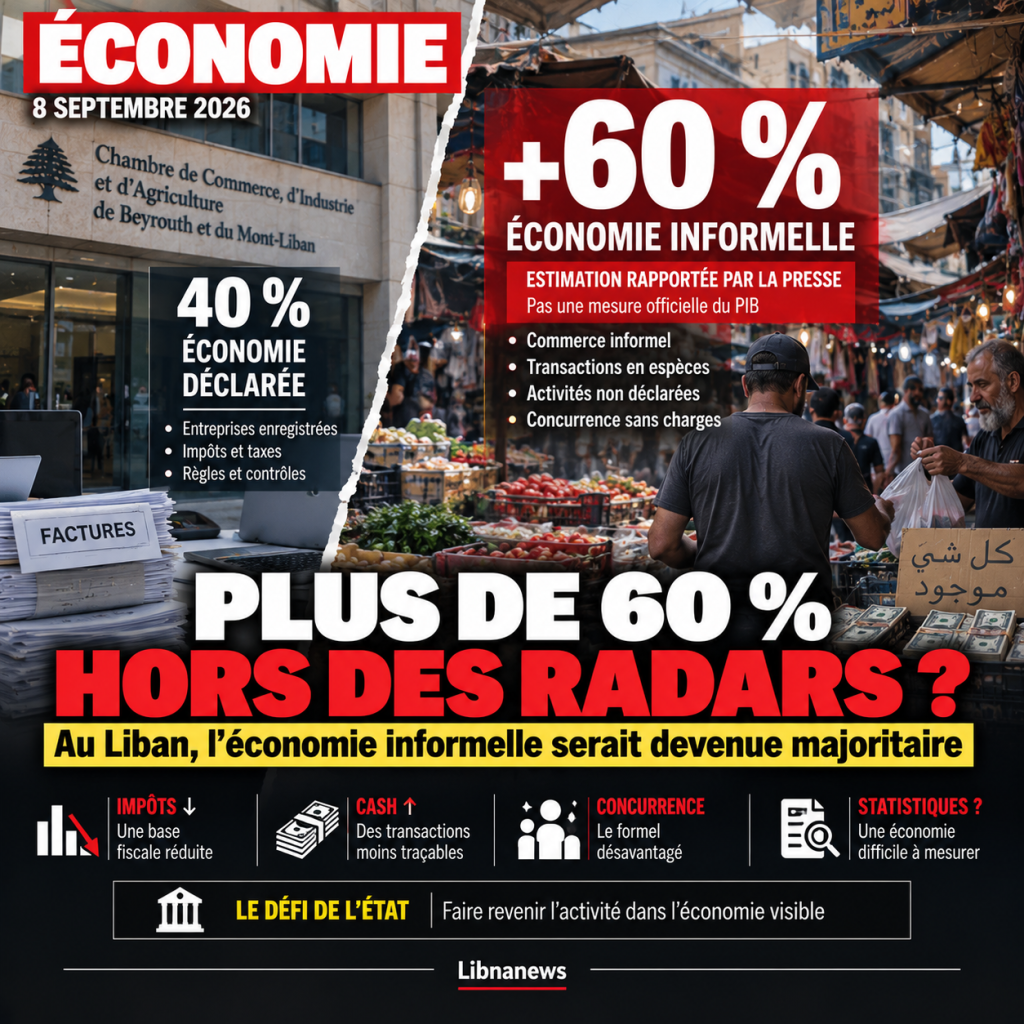
An informal economy that would have crossed the 60% threshold
The undeclared economy now accounts for more than 60 per cent of total economic activity in Lebanon. The estimate, reported by the Lebanese press on 8 September 2026, gives a new dimension to the economic crisis. It means that the activity which is totally or partially excluded from official channels would have become the majority. However, the figure should be interpreted with caution. It does not correspond to a new official measure of gross domestic product published by the Central Statistical Office. This is an estimate of the importance of the informal economy. Its scope remains considerable. If the order of magnitude is correct, the Lebanese problem no longer concerns only the existence of a parallel sector. It concerns an economy in which the declared sector may have become a minority. Such a development profoundly alters the relationship between the state, businesses and taxpayers. It means that a very large proportion of transactions, revenues or activities can escape tax returns, contributions and statistics to varying degrees. Not all informal activities are illegal. A small family business may engage in a lawful activity without declaring all its income. A worker may be paid in cash without an official contract. A trade may be registered but only declare part of its sales. However, other channels may be directly involved in fraud, smuggling or illegal trade. The 60% figure therefore brings together very different realities. It reveals above all the extent of the economic zone which the State struggles to see, measure and tax.
This increase cannot be separated from the crisis opened in 2019. The collapse of the banking system has profoundly altered the daily functioning of the economy. Cash payments have taken a much larger place. Dollarization has become widespread in many sectors. Enterprises and households have had to develop solutions outside a financial system which has become unable to provide normal intermediation. The book crisis reinforced this development. For several years, economic actors have had to deal with several exchange rates and changing rules. The World Bank has regularly described the Lebanese crisis as one of the most serious contemporary economic crises. This break has produced a lasting effect: much of the activity has adapted by reducing its dependence on official institutions. This mechanism has enabled businesses and families to continue to operate. It has also made a growing part of the economy more difficult to measure. Informity has thus become both a survival strategy and a structural weakness. This allows an individual actor to reduce its costs, on a large scale, can reduce government resources. The phenomenon becomes particularly problematic when it ceases to be temporary. An economy can absorb a period of high informationality during a crisis. It faces much more difficulties when it becomes the norm.
Cash has profoundly transformed economic circuits
The importance of species is one of the keys to this transformation. The banking crisis destroyed much of the confidence in bank accounts and payments. Depositors have lost normal access to their funds. Companies have had to find other ways to pay their suppliers and employees. Cash dollars have gradually occupied a central position. This liquidity saving has facilitated transactions in a paralysed financial environment. It also reduced their traceability. A bank payment leaves a trace. A cash settlement can be much more difficult to identify when it is not accompanied by an invoice or declaration. The proliferation of these transactions therefore creates an environment conducive to the development of the undeclared economy. It complicates the work of the tax administration. It also reduces the quality of available income and sales information. The State may know the existence of an enterprise without knowing its actual activity. A company may report part of its turnover while performing other cash transactions. Thus, informality does not always oppose two clearly separated categories. It can be within even registered enterprises.
Dollarization reinforces this phenomenon. A significant portion of private prices, rents and wages are now expressed or paid in dollars. This adjustment has reduced the effect of monetary instability on some transactions. It has also created an economy where the circulation of physical currencies occupies a considerable place. When these flows do not go through the banking system, their measurement becomes difficult. Monetary statistics only give a partial picture of the amount of money actually used in trade. The same problem arises for the tax administration. Cash income may be underreported. Wages paid without full return reduce contributions. Unbilled sales reduce tax revenues. A very liquid economy is not necessarily informal. But when bank confidence is low and controls are limited, cash facilitates the transition from a declared activity to a less visible activity.
Over 60% of informal activity means a deeply reduced tax base
The first consequence for the State is revenue. An administration can only tax correctly what it can identify. If a majority of the activity is totally or partially exempt from reporting, the actual tax base becomes much narrower than the economy itself. The government can then increase the rates applied to the identified taxpayers. This method quickly produces an imbalance. Reported enterprises and employees bear an increasing share of the effort, while those who remain outside the system contribute less. The increase in taxes can then create a new incentive to join informality. The mechanism becomes circular. Low collection results in greater pressure on visible actors. This pressure makes formality more expensive. Some of the actors then seek to reduce their statements, which further weakens the collection.
This situation is particularly serious for Lebanon. The country must finance public services weakened by several years of crisis. Governments need resources. Infrastructure requires investment. Public wages must be financed. The army and the security forces also need resources. At the same time, the State is trying to restore the confidence of its international partners. A largely informal economy complicates each of these objectives. It reduces the government’s ability to increase its revenues on a sustainable basis without raising the levies on those already declared. It also makes budget forecasts less reliable. An administration that does not know exactly the size of its economic base works with reduced visibility.
The tax loss is not limited to income tax. An undeclared transaction may escape multiple levies. Goods entered without full declaration may avoid customs duties. Its sale without invoice can reduce the value added tax collected. Revenues generated can then be underreported. If employees are employed without an official contract, contributions may also disappear. Only one informal activity can produce several successive losses for public finances. On the scale of an economy of which more than 60% would be concerned, the potential effect becomes considerable.
Reported enterprises face structurally unequal competition
The development of informality also directly affects the organized private sector. A declared company bears costs that some competitors may avoid. She pays her taxes. It covers administrative costs. It must follow accounting and commercial procedures. According to its sector, it must also meet standards and obtain authorizations. These obligations have a cost. They are normally compensated by the benefits of an organised system: access to credit, legal certainty, public services, contract protection and infrastructure. The Lebanese crisis has reduced many of these benefits without removing obligations. The result is a growing imbalance between declared enterprises and informal activities.
The reported decline in the number of members of the Chamber of Commerce, Industry and Agriculture of Beirut and Mount Lebanon is another signal of this development. The Lebanese press on 8 September 2026 advanced a switch from about 14,000 to 8,000. These figures must be attributed to the source who reports them, as the accessible public data of the House do not allow the series to be directly confirmed on the same basis. If they are comparable, they represent a decrease of almost 43%. Such a contraction may reflect closures, cessations of membership or a shift to less structured forms of activity. In each case, it indicates a fragility of the formal fabric.
Competition becomes particularly difficult when consumers themselves have lost purchasing power. A relatively small price difference can determine a purchase. A trader who pays all his obligations can then be penalized against an actor who avoids a part of it. In the short term, the consumer may benefit from a lower price. In the longer term, the system encourages businesses to reduce their own reporting to remain competitive. Informality thus produces its own expansion. The more important it is, the more costly it is to comply fully with the rules.
Imports make the phenomenon even more costly
The structure of Lebanese trade amplifies the problem. The country relies heavily on imports for many essential goods and consumer products. The Lebanese press of 8 September 2026 claims that imports account for more than 90% of part of the economic cycle mentioned. This percentage must also be seen in its context and cannot be equated with 90 per cent of gross domestic product. Nevertheless, it highlights a well-known feature of the Lebanese model: a strong dependence on foreign goods.
In this configuration, borders and customs are central to revenue collection and traceability. Imported goods must be registered, valued and subject to the required levies. When a product enters through an irregular circuit or with incomplete reporting, the state may lose revenue from the first step. If the same product is then sold in an informal circuit, the loss continues. The problem therefore becomes cumulative.
This dependence on imports also creates direct competition between declared goods and products introduced under different conditions. The importer who complies with the procedures integrates duties and taxes into its price. The person who bypasses them can have an important advantage. Companies working in the legal framework are then confronted with competition which is not only based on economic efficiency. It depends on the ability to avoid certain obligations.
Finally, the phenomenon affects the quality of commercial data. Customs statistics are used to track officially registered imports. They cannot measure flows beyond the control with the same accuracy. The greater the gap between real trade and registered trade, the more the state loses the ability to assess domestic demand. This weakness complicates economic and trade policies.
An economy that has become difficult to measure
An informal economy above 60% also poses a major statistical problem. Official indicators are constructed from observable data. Administrations use tax declarations, surveys, customs information, business data and other sources. When transactions move massively outside these circuits, the margin of uncertainty increases. Gross domestic product can be estimated using statistical methods, but the precise structure of activity becomes more difficult to know.
This uncertainty affects almost all indicators. The actual number of jobs may differ significantly from the jobs reported. Actual earnings may be higher than those recorded. Sales can be underestimated. Real consumption may not correspond to visible flows in banking systems. Even productivity becomes more difficult to measure when hours worked and production are not properly recorded.
For policymakers, this weakness has concrete consequences. Effective economic policy requires knowledge of the sectors that are moving forward and those that are declining. Businesses that create jobs must be identified and household incomes measured. It is also important to know where the main sources of potential revenue are. When more than half of the economy becomes partially invisible, these decisions are based on an incomplete picture.
Formalisation cannot be based solely on controls
Reducing an informal economy of this magnitude cannot only be achieved through inspections and sanctions. Part of the phenomenon results directly from the weakness of the State. Small businesses can remain informal because procedures are complex or costly. Workers can accept undeclared jobs for lack of alternatives. In these situations, only increased sanctions could move activity without resolving its cause.
Formalisation therefore implies making the economy declared more attractive. Registration procedures must be simple. Tax rules must be predictable. Companies must be able to understand their obligations. Above all, they must perceive an advantage to operate in the official system. Access to finance, foreign markets, trade certificates and effective justice can provide these incentives.
The United Nations Development Programme, on 16 February 2026, announced with the Ministry of Economy and Trade the establishment of the first national trade assistance centre. The scheme includes micro, small and medium-sized enterprises. It must provide them with information on procedures and trade. Chambers of commerce participate in this mechanism. This type of initiative addresses part of the problem by reducing the administrative cost of formalisation.
However, controls are still essential when informality is the responsibility of structured networks, fraud or smuggling. Treatment cannot be the same for an undeclared self-employed person and for an organization that brings in large quantities of goods avoiding rights. Public policy must therefore distinguish between the informality of survival and organised escape. The first calls for incentives and simplification. The second requires checks, investigations and sanctions.
The risk of a minority official economy
The advanced 60% threshold finally changes the nature of the problem. Where informality represents a small part of the activity, the State may seek to reduce it from a dominant formal sector. When the undeclared economy becomes the majority, the ratio is the opposite. Formal enterprises may begin to appear as the exception in certain sectors. Economic standards then gradually change. Payment without an invoice becomes banal. Pay in cash becomes normal. Underreporting can be seen as a survival condition rather than an anomaly.
This normalization represents a greater danger than the only tax loss. It changes the behaviour of economic actors. A company that sees its competitors permanently avoid certain charges may be tempted to imitate them. An employee accustomed to undeclared payments loses some of the protections associated with formal work. The state, for its part, is increasingly dependent on a small number of identifiable taxpayers.
The estimate of more than 60% reported on September 8, 2026 should therefore be considered a signal, not a definitive statistical measure. It describes an economy, much of which now operates outside the circuits that the state directly controls. It joins other signs of contraction in the organized sector, including the decline reported by members of the Beirut and Mount Lebanon Chamber of Commerce. At the same time, import dependence increases potential losses when goods escape declared channels. The issue now concerns the state’s ability to bring part of this activity back into the visible economy, without further weakening the small enterprises that have found in the informality a way to go through the crisis.




