






Change is in the simultaneousity of projects
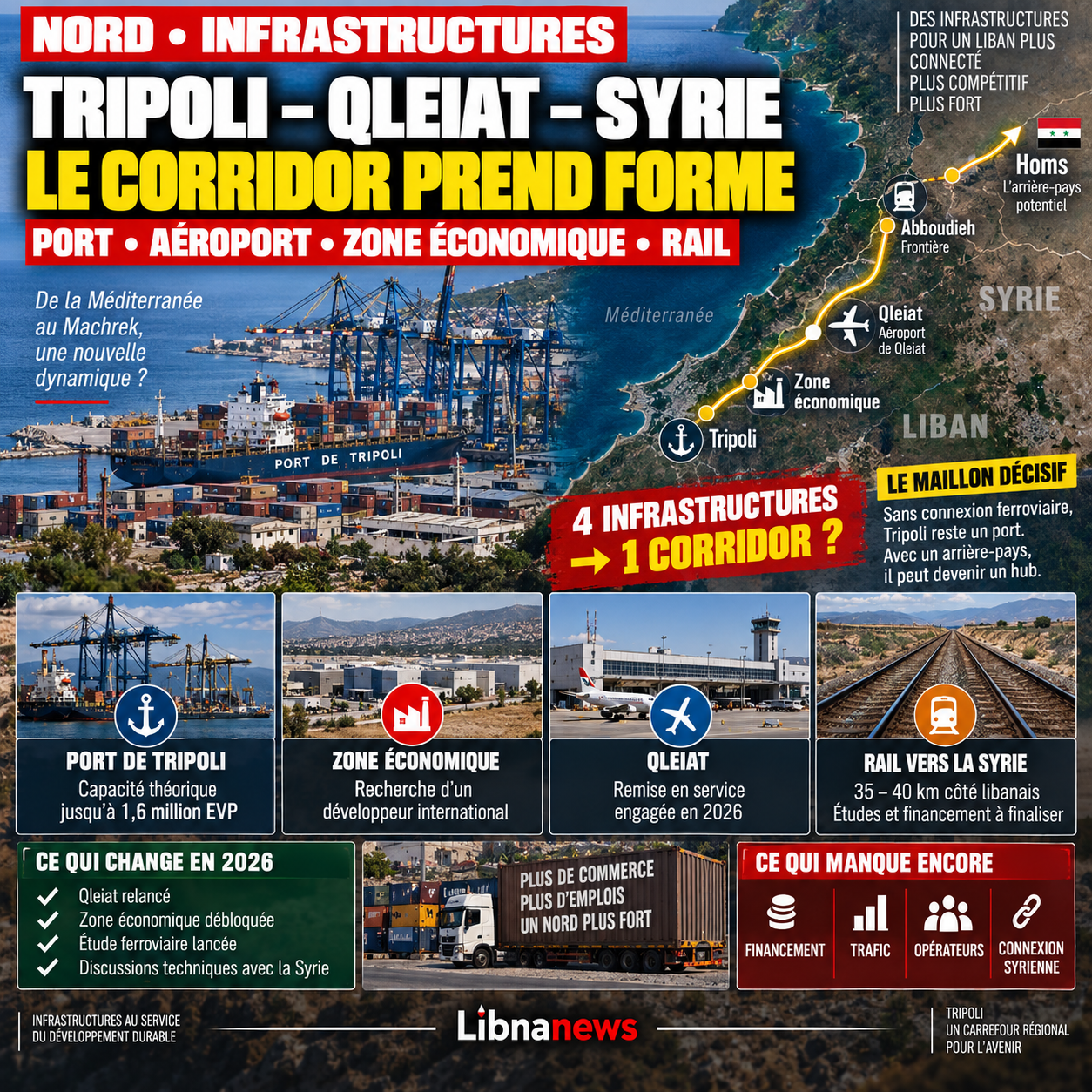
For years, the port of Tripoli, the special economic zone, the airport of Qleiat and the old railway to Syria were mentioned separately. Each had his own calendar, promises, studies and delays. In 2026, the situation began to change. For the first time in a long time, these four infrastructures are moving forward simultaneously and are now presented by the government as elements of the same set.
Nawaf Salam himself integrated into his economic discourse. In New York, the Prime Minister quoted the port of Tripoli, the special economic zone, the airport of Qleiat, the railway and the regional connection projects in the same sequence. A few months earlier, the Minister of Public Works and Transport, Fayez Rassamny, had adopted the same logic: the port, the economic zone, the airport and the railway link with Syria must function as a system and not as four independent equipment.
This rapprochement is much more important than reviving a particular site. He drew up a geographical strategy: to make Northern Lebanon a platform linking the Mediterranean to Syria, and eventually to markets beyond Syria.
The project remains far from complete. Some infrastructures are operational, others are in the process of being put back into service, and others are still in the study stage. But a number of decisions taken between May and September 2026 show that we have gone beyond the stage of general declarations. The question now is whether these projects can really be assembled before funding difficulties, political rivalries and regional instability once again disperse them.
The port already has a large infrastructure for much more than the North market
The port of Tripoli is the natural starting point for this system. Its interest lies not only in its geographical location. A significant part of the investment needed to change the scale has already been made in previous years.
The development plan of the port provides for a dock of about 1,050 meters and depths to accommodate large container carriers. Its design provides an ultimate capacity of up to about 1.6 million equivalents 20 feet, the unit used to measure container traffic. Large areas were also reserved for storage, warehouses and logistics.
Yet the most revealing detail of the plan is elsewhere. A 50-metre wide corridor was reserved for four future railway tracks. A specific area of around 15,000 square metres is foreseen for rail containers.
Rail is therefore not an idea grafted in 2026 on a port designed exclusively for trucks. The possibility of a rail connection was already part of its development architecture.
This is precisely what can change its function. Without a rail hinterland, Tripoli remains mainly a Lebanese port. With a connection to Syria, it can become a transit port.
The economic difference is considerable.
The Lebanese market is too small to justify port capacity alone. Access to Homs, Hama and, in the longer term, to trade networks to Iraq or the Gulf would give the port a much wider hinterland.
The real potential market lies behind the Syrian border
Tripoli is located a few dozen kilometers from Syria. This proximity has always been his main theoretical advantage vis-à-vis Beirut.
A cargo landed in Tripoli can be directed north of Syria without crossing the Beyrouthin agglomeration and then up all Lebanese territory. For some Syrian destinations, the journey is naturally shorter.
But geographical proximity is not enough. A trade corridor requires efficient roads or rails, fast customs procedures, insurance, a functional border and sufficient demand on the other side.
That is why the resumption of economic relations with Damascus changes the equation. Nawaf Salam’s visit to Syria has reactivated several cases, including the railway link. In May, Fayez Rassamny signed the specifications for launching the feasibility study of the line between Tripoli and Abboudieh.
The Lebanese section represents about 35 to 40 kilometres. The route must start from the port, cross the economic system of the North and reach the border. The objective discussed with the Syrian authorities is then to connect this line to the Syrian network towards Homs.
This last point is essential. A railway that stops at Abboudieh would have limited interest. The value of the project depends on the continuity beyond the border.
In September, Syrians and Lebanese moved to the route inspection
The railway project underwent a new phase a few days before 23 September. A Syrian technical delegation visited Lebanon to discuss with its counterparts the route between the port of Tripoli and the border.
Discussions focused on the connection of the Lebanese network to the Syrian network via the Akkari station and then to Homs. The teams inspected the route and identified the technical obstacles to be addressed.
Both sides agreed to continue the technical and economic studies. In particular, a joint workshop should examine feasibility, cost, sources of funding and modalities of implementation.
This means that there is still no definitive budget and that no complete railway works have been allocated. Presenting the Tripoli-Homs train as a funded project ready to build would therefore be premature.
But the nature of the case has changed. For decades, the renaissance of the Lebanese railway was mainly a matter of discourse. In 2026 there was a specification, a study procedure, a priority route and technical discussions with the country to which the line was to be connected.
The choice to start with Tripoli rather than with a complete reconstruction of the Lebanese rail network reflects an economic logic: first create a relatively short freight line with a natural customer, the port, and an identifiable outlet, Syria.
The World Bank was already considering Tripoli as the gateway to Syria and Iraq
The idea is not new. International work on Lebanese infrastructure had already identified the link between the port of Tripoli and the Syrian border as one of the few railway projects with relatively clear economic justification.
The reasoning was already that of a hinterland beyond Lebanon. Tripoli could serve the regions of Homs and Hama, then potentially flows to Iraq.
This perspective explains why the Syrian question is inseparable from the project.
The port will not become a large regional centre simply because its docks have been enlarged. He needs traffic. Part of this traffic must necessarily come from outside the Lebanese market.
Syrian reconstruction can create this demand, but it does not constitute an automatic guarantee. The Syrian ports of Latakia and Tartous exist and will also seek to capture the flows. Turkish roads offer another access route to northern Syria. Jordanian ports and regional land corridors also participate in this competition.
Tripoli will therefore have to be cheaper, faster or more reliable on some routes to become a real Syrian gateway.
The special economic zone is the room that must prevent Tripoli from becoming a simple transit dock
If the project consisted only of disembarking containers before sending them immediately to Syria, local benefits would remain limited. The port would receive revenue and transport would create activity, but much of the economic value would leave Tripoli with the goods.
The special economic zone must precisely avoid this scenario.
Established legally in 2008, it has for years remained far from its original ambitions. Its function is to welcome industrial, logistical and export activities within a fiscal, customs and administrative framework designed to attract investors.
The project entered into a more concrete phase in 2026. In September, the Council of Ministers approved studies on the area’s industrial and logistics centre and authorized its administration to launch the qualification procedure to select an international developer and operator.
This decision is more important than a new study. It allows us to look for a private actor able to develop and operate the site.
The aim is to launch an international procedure. The selection of an operator could occur in 2027 if the calendar is respected.
After almost two decades of waiting, therefore, the economic zone only arrives now when its model will have to face the market.
The area will have to produce something other than tax benefits
Its success will not depend solely on exemptions for businesses.
An economic zone works when it reduces the total cost of an activity. This requires rapid customs procedures, reliable electricity, developed land, warehouses, digital connection, fluid roads and a direct relationship with the port.
In the case of Tripoli, rail and Qleiat can add two additional benefits.
A company located in the area could import components by boat, process or assemble in Lebanon, and then re-export its production. It could also use Tripoli as a storage and redistribution center to Syria.
This is where the real added value of the project lies. Lebanon would not only win on the passage of a container. It would gain from the operations performed between its arrival and departure: storage, processing, packaging, maintenance, services, insurance, transport and financing.
However, this will require attracting real industrial activities. An area filled only with warehouses would create less jobs and less value.
Qleiat adds to the device a function that the port and rail cannot fulfil
The third element is the René Moawad airport in Qleiat.
After about three decades without regular civilian activity, its return to service actually began in June 2026. The Government then approved the licences for scheduled international flights in July.
The first phase is based on a transitional formula for exploitation and rehabilitation. The projections published around the project suggest a gradual increase in capacity of up to 600,000 passengers after several years.
The airport should not be compared only with the Beirut airport. His interest in the Northern apparatus is different.
For high-value freight, urgent parts, certain agri-food products or the travel of investors and executives, proximity between an airport, an industrial area and a port can become an advantage.
Qleiat can also directly serve Akkar and Tripoli without imposing a passage through Beirut.
The government also insists that the site should complement rather than replace the Rafic Hariri airport.
This shade is important. Qleiat will not immediately become a major regional air centre. Its initial value lies more in the diversification of access to the country and its integration into the northern economic system.
The railway route shows that the four infrastructures actually start to be thought together
The rail project is particularly revealing because its layout must articulate the different components.
The line studied departs from the port and is heading towards the Syrian border. Discussions mentioned connections with the Special Economic Zone and Qleiat. The September technical inspections examined a route through these infrastructures.
This gives the project some consistency that was missing from previous announcements.
The port provides maritime access. The economic zone provides the land and industrial framework. Qleiat brings air access. The rail connects the whole to Syria.
This system can then be supplemented by existing roads.
It is this combination that justifies the expression of economic corridor. None of the four projects, taken individually, is sufficiently transformative. However, their connection can change the economic function of the North.
The port itself now wants to change its profession
The new port administration no longer presents its objective as simply an increase in the number of ships.
After approximately 11 months of management, it focuses on digitisation, governance and value-added logistics services. The ambition is to transform Tripoli into one of the main ports of the Eastern Mediterranean and into a gateway to the Mashrek.
This ambition is considerable in terms of current traffic and must therefore be confronted with reality.
A large modern port does not only live on its docks. It depends on the time it takes to exit a container, the reliability of its procedures, the cost of handling, land connections and administrative predictability.
Digitalisation thus becomes a commercial issue. Each document that can be processed prior to the arrival of the vessel potentially reduces the time taken to immobilize the goods.
Governance plays the same role. A shipowner or logistics operator builds his roads over several years. He must know that rules and costs will not change arbitrarily.
The port can have excellent depths and nevertheless lose traffic if land-based procedures remain slow.
The theoretical capacity of 1,6 million containers only makes sense if the traffic follows
The harbour management plan provides for considerable final capacity. But a capacity is not a traffic.
This is an essential distinction in major Lebanese infrastructure projects. Building docks does not guarantee their use. Developing an economic zone does not guarantee the arrival of factories. Rehabilitating an airport does not automatically create airlines. Laying a rail does not create the goods that will circulate on it.
The Northern project will therefore have to be judged on the application.
Which shipowners wish to use Tripoli as a gateway to Syria? Which industries are planning to settle in the economic zone? What volume of Syrian cargo could actually be diverted from Latakia or Tartous? Which carriers are ready to use the rail? What flights can be profitable in Qleiat?
These market studies are as important as the work.
The risk would be to build several infrastructures simultaneously on the basis of the same traffic hypothesis and then discover that this demand had been overestimated.
Syria is both the main opportunity and the main risk
The whole model is based in part on the Syrian opening.
A Syrian reconstruction will require materials, machinery, equipment, consumer goods and logistical services. Tripoli is geographically well positioned to capture some of it.
But this opportunity is subject to variables that Lebanon does not control: Syrian political stability, customs regime, international sanctions, road safety, functioning Syrian ports and trade policy in Damascus.
Lebanon must therefore avoid building a model dependent exclusively on Syrian reconstruction.
The economic zone should also attract market-oriented activities in Lebanon, the Mediterranean and the Arab countries. The port will have to develop transhipment and logistics services independent of Syria. Qleiat will have to have its own clientele.
Syria can accelerate the corridor. It must not become its only justification.
Rail financing remains the big hole in the project
The least advanced point remains precisely the one that must physically connect the system: the railway.
Studies are underway. The route is being examined. Syrian cooperation exists. But the final cost and funding are not yet fixed.
The rehabilitation of a track that has been abandoned for decades does not consist of replacing a few rails. The land right-of-way must be checked, certain sections rebuilt, level crossings treated, signs installed and technical features defined for interconnection with the Syrian network.
Rolling stock also raises questions.
It will be necessary to decide whether the line is used exclusively for freight or whether it should also carry passengers. The needs of a container train are not those of a regional passenger service.
The more the project is charged with different objectives, the more its cost increases.
The most rational decision could therefore be to start with port freight, which has the most identifiable economic model.
The legal question of ports also remains open
Joseph Aoun referred to the need to amend certain laws governing ports. This seems technical, but it can determine Tripoli’s ability to attract an operator and investments.
The Lebanese port institutional framework was constructed by strata. Port authorities have special regimes, while relations between the State, boards of directors, private operators and supervisory authorities do not always meet the standards used in major international ports.
Legal modernisation may be necessary for concessions, pricing, transparency, competition and operator liability.
It will be particularly important if Tripoli seeks to attract international capital into its infrastructure.
An investor doesn’t just look at the dock. He looks at the contract that gives him access to the wharf and the court that will apply this contract.
Can Tripoli compete with Beirut without triggering a port war?
The development of Tripoli is sometimes presented as an alternative to the port of Beirut. This opposition is too simple.
The Lebanese market probably has no interest in financing two ports with exactly the same functions and a limited national volume.
The economic logic would rather be that of specialization and complementarity.
Beirut retains its major role for the capital and centre of the country. Tripoli has a geographical advantage towards Syria and the north. It also has more space for some logistical developments.
The economic zone reinforces this difference.