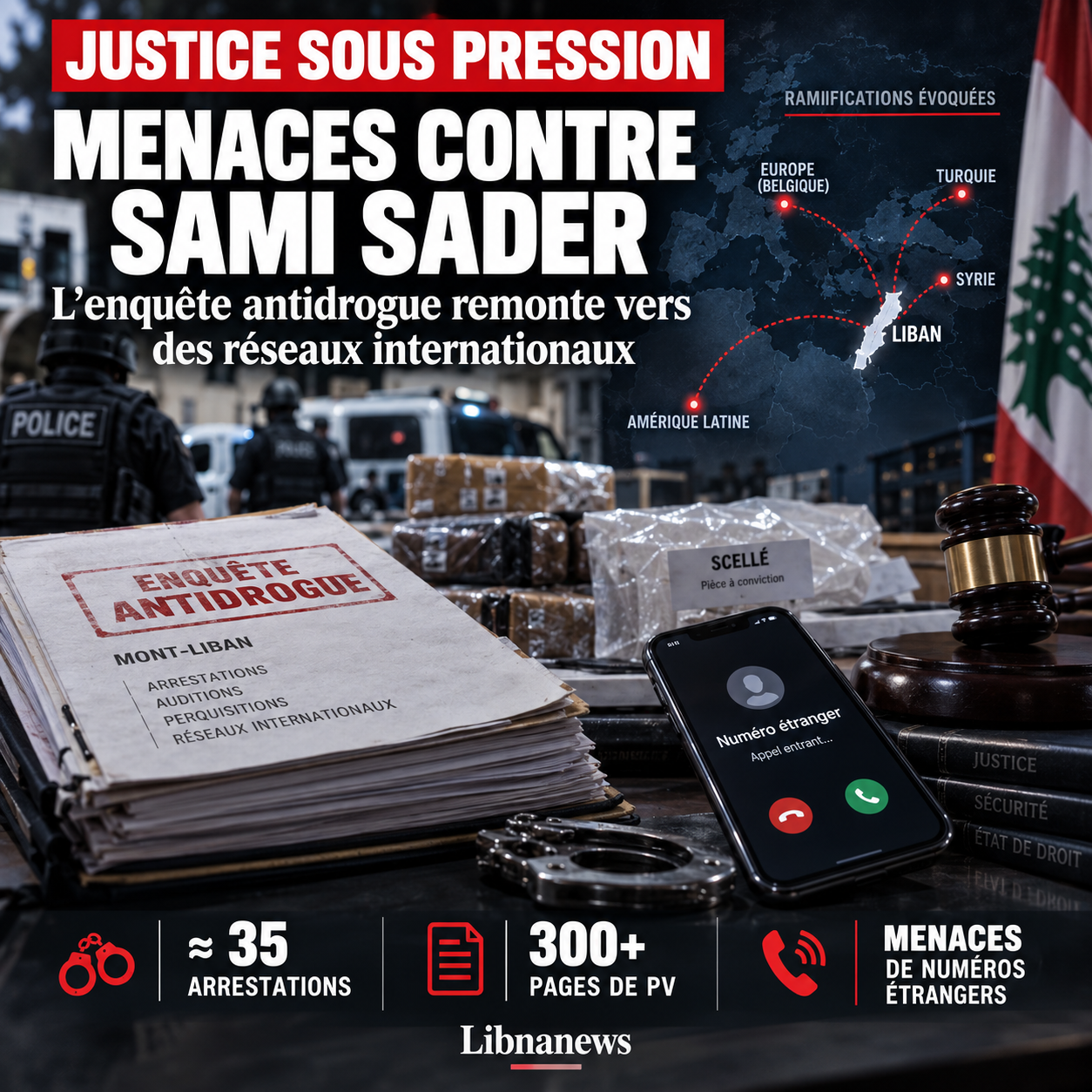
A large-scale investigation into drug trafficking in Mount Lebanon has reportedly already resulted in the arrest of approximately thirty-five people and the issuance of more than 300 pages of reports. As the investigation progresses, the case takes on an international dimension and the pressures are approaching those that lead it. The Attorney General of the Mont-Lebanon Court of Appeal, Judge Sami Sader, reportedly received several threats from foreign numbers. Officers who participated in the operations would also be targeted. Behind the drug case now appears a broader issue: the ability of cross-border criminal networks to exert direct pressure on Lebanese justice.
From a series of arrests to a tentacular investigation
Initially, the dossier is part of the daily work on drug control. Under the supervision of Judge Sami Sader, the competent services multiply operations against persons suspected of belonging to a traffic and distribution network. However, investigations are rapidly becoming unusual. The arrests followed suit and would now reach about 35 people. The minutes would exceed three hundred pages.
The accumulation of hearings, searches and evidence collected has led to a significant increase in the procedure. A second case was said to have been opened on instructions from the magistrate in order to continue the narcotics component in addition to the initial investigation. This decision gives an initial indication of the size of the case. It is no longer just a question of establishing the responsibilities of a few traffickers or resellers, but of understanding an organization whose ramifications appear as investigations progress.
Some operations are said to have exceeded the usual geographical jurisdiction of Mount Lebanon. The investigators were reportedly taken to other territories and, above all, to persons identified as occupying more important positions in the traffic chain. The file would therefore no longer stop those who were responsible for distributing the drug. It would seek to reach those who organize, coordinate or facilitate operations.
It is at this stage that the investigation becomes particularly sensitive. In organised crime cases, the arrest of sellers is rarely the most difficult stage. The real challenge begins when you have to go back to the organizers, identify the supply circuits and understand the links between the different groups. The information gathered in this case would lead the investigators precisely in this direction.
Foreign calls at the pace of the investigation
Pressures would have begun to emerge when investigations approached these larger ramifications. From the beginning of September, there were reports of threatening communications to Judge Sami Sader and to officers of the Mount Lebanon intelligence service involved in the operations.
Those threats would not have remained isolated. They reportedly repeated themselves a second and then a third time after further arrests in the same file. Their chronology draws attention to the fact that every new significant step in the survey would bring a new phase of pressure on those who drive it.
Communications would come from foreign numbers, including some Europeans. Even more worrying, some have reportedly reached the judge on private numbers that would be known only from a small circle of people. This ability to access personal contact information gives another dimension to intimidation. It shows, at a minimum, that those who seek to come into contact with the magistrate have information that is sufficiently accurate to go beyond ordinary professional channels.
The manner in which these numbers were obtained remains unknown. They may have been circulated by several intermediaries, found in the telephones of people involved in the case, or from other sources. But the issue necessarily becomes an integral part of the security file. An organization that is able to identify a magistrate’s private contact information already demonstrates an intelligence capacity that cannot be treated as a mere telephone nuisance.
The officers involved in the searches would also have been the target of communications. Threats thus appear to be directed not only at those who give judicial instructions, but also at those who execute them on the ground. The process, if confirmed to its full extent, is a logic of overall intimidation: gradually increasing the personal cost of continuing the investigation.
From Lebanon to Turkey, Belgium and Latin America
The ramifications attributed to the network partly explain this pressure capacity. The investigations revealed connections between groups based in Lebanon and relays located in Syria, Turkey and Belgium. Other European ramifications would also be examined, with extensions to Latin America.
This geography is important. It shows how contemporary drug trafficking exceeds the traditional representation of an organization operating in a single territory. International networks can operate in successive channels. Some actors provide supply. Others organize transport. Relays support the storage, distribution or movement of funds. Everyone may have only partial knowledge of the rest of the device.
For Lebanese investigators, the challenge is to determine whether the arrested persons belong to the same structure or to several groups working together. We must also understand where the real decision-making centres are. Thirty-five arrests are an important operational outcome, but they do not yet state whether the heart of the organization has been reached.
The file seems to have changed precisely in nature when the investigators began to trace this chain. The « big heads » to which the investigations would lead would be linked to the network inside and outside Lebanon. Their identity is not publicly established, but their appearance in the investigation would explain why operations became more sensitive as they progressed.
Connections with Europe and Latin America also raise the question of international judicial cooperation. A Lebanese investigator may exploit the seized elements within the national territory. But when people, telephones, transactions or movements are in several states, the procedure also depends on exchanges with foreign authorities. The case becomes slower, more technical and more vulnerable to differences in legislation between countries.
Signal and communications discipline
Investigators would also face a rigorous communications organization. In particular, the network would use Signal for certain exchanges and would impose rules on its members to reduce the traces left by their conversations.
Communications should be limited to the needs of operations. Personal discussions would be discouraged. Members would not be expected to call just to take news from each other. The principle would be to communicate only when the work requires it.
Such discipline, where it exists within a criminal network, considerably complicates the work of investigators. A seemingly trivial personal conversation can establish a relationship between two individuals. Repeated calls may reveal a hierarchy. Communication schedules can help to reconstruct the chronology of an operation. Reducing trade therefore reduces the amount of indices that can be exploited.
Of course, the use of Signal is not in itself a criminal clue. Mail is used legally by millions of people who want to protect the confidentiality of their exchanges. What matters here is the combination of several elements: the use of a secure tool, the voluntary limitation of communications and the geographical dispersion of persons suspected of belonging to the network.
This architecture explains why phone seizures and the exploitation of communications can become as important as the arrests themselves. A person arrested may lead to multiple contacts. A contact may reveal an intermediary. It can in turn be used to trace to a supplier or organizer. In a transnational survey, the telephone sometimes becomes a map of the network.
Magistrate warned of danger
However, the most worrying aspect of the case appears outside the minutes. After the threat analysis, a security service reportedly alerted Judge Sami Sader to the need for special vigilance in his movements and movements.
The Council takes on a special significance in relation to the repetition of communications and their foreign origin. He states that the risk would not have been considered trivial enough to be ignored. However, the judge would not have permanent protection at home, a regular escort in his or her travels or an armoured vehicle.
This situation puts the state before a concrete question. From what level should a threat against a magistrate lead to a protective mechanism? Obviously, the answer cannot be automatic. All judges deal with cases that may cause anger, resentment or threats. Heavy protection for everyone would be impossible.
But the present case combines several factors: an investigation into organised trafficking, dozens of arrests, foreign ramifications, repeated threats, communications to private contact information and an alert from a security service. The addition of these elements justifies at least a thorough assessment of the level of risk.
The protection of a magistrate does not necessarily mean that a large convoy is permanently surrounded. It can combine home monitoring, changing travel habits, secure communication, ad hoc support and adaptation of the device according to the most sensitive moments of the survey.
The problem is to avoid that the responsibility for security ultimately rests with the magistrate himself. To advise him to be careful cannot be a response alone when people who seek to intimidate may have international means.
When intimidation becomes a judicial weapon
Criminal networks do not need to carry out their threats in order to achieve part of their goal. Bullying can be enough to change behaviour. An investigator becomes more cautious. A witness hesitates to speak. A staff member prefers not to sign a document. A magistrate may be tempted to reduce his or her travels or to limit the exposure of his or her family.
The danger lies precisely in this grey area. Justice continues to operate officially, but those who operate it must incorporate a personal threat into each of their decisions.
That is why the protection of Judge Sami Sader goes beyond his individual case. It concerns all judges who may work on cases involving organizations with significant resources. A judicial system cannot ask its members to pursue transnational networks while considering their security as a private matter.
The same reasoning applies to officers involved in operations. The arrests expose them directly. They enter places used by suspects, make seizures and sometimes appear in the records. When their identities become known to the accused, they may be subjected to the same mechanisms of intimidation.
The answer must therefore not be only individual. It must address the protection of the entire judicial and security chain involved in the most sensitive cases.
A Threat Investigation in the Drug Investigation
Access to the judge’s private numbers is a lead that deserves special attention. It is not enough to identify the country from which a communication was issued. It must also be understood how the author obtained the information needed to target the judge precisely.
This may lead to several assumptions, but none should be preferred without proof. The coordinates have been in circulation for a long time. They were obtained through an intermediary. They were also found in the directory of a person who had legitimate contact with the judge. In an investigation involving dozens of suspects and many stakeholders, there are many possibilities.
But retracing this traffic would allow to evaluate the capacity of the network. Getting a number is one thing. Knowing several personal details and monitoring the progress of one investigation is another. The more accurate the information held by the threats, the more important the issue of their relays becomes.
The judicial treatment of intimidation should therefore proceed in parallel with the drug case. Identifying the callers would not only protect the magistrate, but perhaps also provide new information on the structure of the network itself.
A threat can become a mistake for whoever formulates it. By seeking to interrupt an investigation, its author creates a new lead.
Beyond drugs, a matter of state authority
The case finally reveals that the fight against drugs is no longer confined to the police or public health. When networks cross borders, use secure communications, have relays in several countries and can put pressure on investigators, they become a sovereign issue.
Traffic generates financial resources. These resources are used to recruit, transport, corrupt or intimidate. The more resources an organization accumulates, the more important it becomes for the state to have the border between crime and organised crime.
The success of the investigation cannot therefore be measured solely by the number of arrests. It will depend on the ability to determine individual responsibilities, to trace funding channels, to identify foreign relays and to present to the courts sufficient solid elements to lead to judicial decisions.
The thirty-five people arrested represent one step. The hundreds of pages of minutes show the extent of the work done. But the real stake is now higher in the chain.
While the investigations have actually reached those responsible for triggering threats from abroad, the protection of those conducting the investigation itself becomes a component of the fight against the network. For from the moment when a magistrate must ask himself who knows his private number, who monitors his movements or who could reach his home, drug trafficking no longer threatens only those who use drugs.
It starts directly testing the state’s ability to protect those who apply its law.