

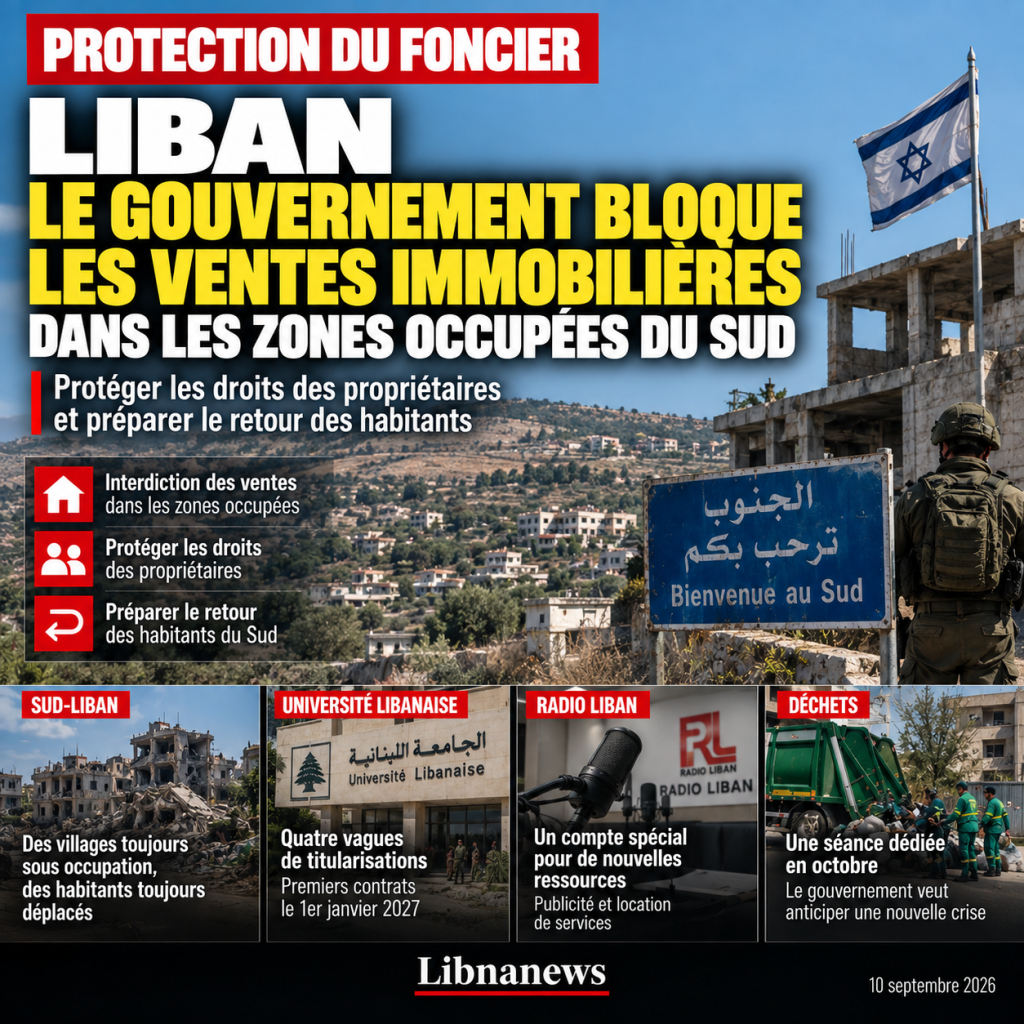
On Thursday, 10 September, the Lebanese Council of Ministers approved a bill to prevent real estate transactions and sales in the sectors of southern Lebanon occupied by the Israeli army. This decision seeks to protect the property rights of the inhabitants while population displacement, destruction and continued occupation make certain transactions particularly sensitive. The Government has also made progress on the return of the inhabitants of the South, the tenure of contract teachers at the Lebanese University, waste and the financing of Radio Lebanon.
Meeting on Thursday at the Baabda Palace, the Council of Ministers approved a request from the Ministry of Finance to prevent the disposal and sale of real estate in areas currently occupied by the Israeli army. Information Minister Paul Morcos announced this decision at the end of the meeting.
The text must take the form of a bill. Its adoption by the government does not yet mean that the ban has its final legislative form. The dossier will have to follow the institutional procedure laid down before its entry into force.
The measure takes place in a particularly sensitive context in southern Lebanon. Residents remain far from their villages, while houses, agricultural land and infrastructure have been destroyed or damaged. In some border areas, the Israeli presence still prevents a normal return of owners.
Real estate sales in the occupied areas concerned
The immediate objective of the project is to prevent properties under occupation from changing their hands when their owners do not necessarily have the material freedom to access, evaluate or negotiate their property normally.
However, Paul Morcos’ statement does not yet specify the exact legal scope of the scheme. In particular, it will be necessary to determine which parcels will be considered to be in a « occupied area », how this qualification will be established and how long the prohibition will remain applicable.
The nature of the acts concerned should also be clarified. The Minister referred to dispositions and real estate sales. The final text should indicate whether other transactions, such as certain donations, assignments of rights, mortgages or proxys, will also be involved.
These clarifications will be important to prevent a sales ban from being circumvented by other legal forms of ownership transfer.
The government wants to reassure the people of the South
Prime Minister Nawaf Salam also stressed the role of the State in the southern regions. According to the statements made at the conclusion of the Council of Ministers, the presence of the Lebanese army and public institutions is a factor of confidence for the inhabitants remaining in their villages.
The Head of Government also mentioned the need for prefabricated housing. They must facilitate, as a first step, the return of the inhabitants to their localities, while many homes have been destroyed or rendered uninhabitable.
This issue therefore exceeds that of military security. To ensure sustainable return, the authorities must restore minimum living conditions: housing, water, electricity, roads, schools, municipal services and administrations.
Paul Morcos said that the coming weeks should better measure the results of efforts in the villages of the South. In particular, he cited the localities selected for pilot experiments and Nabatiyah governorate.
The evolution on the ground will however determine the real possibility of such returns. In several southern areas, military operations and destruction continue to jeopardize rapid normalization.
Lebanese University: four waves of tenure
The Council of Ministers also looked at the long-awaited record of contract teachers at the Lebanese University. The Government has confirmed the criteria previously used to determine beneficiaries of full-time contracts.
These criteria include seniority, the needs of each faculty in terms of specialization, skills and equity considerations. The dossier had generated much discussion because of the number of candidates and the balance to be respected within the public university.
The government has decided that full-time contracts will be implemented infour waves. The lists are still subject to final verification taking into account the comments made by the Ministers.
The matter will be submitted to the Council of Ministers within a maximum of one month in order to complete the process. The first contracts must take effect on1 january 2027.
This deadline now gives a timetable to the teachers concerned, but leaves open the question of the final composition of the lists.
Radio Lebanon will be able to expand its advertising revenues
Another decision concerns Radio Lebanon. The Government approved the Ministry of Information’s request to create a special account for public radio.
This scheme is intended to enable it to collect revenue from advertising, as well as from the rental of broadcasting services and studios. Radio Lebanon will also be able to receive aid and donations according to legal procedures.
The amounts collected shall be recorded in public finances in accordance with the laws and regulations in force. The aim is to provide public radio with more opportunities to generate its own resources without subtracting them from the state budget framework.
This decision comes as Lebanese public institutions continue to face the financial consequences of several years of crisis and the collapse of purchasing power in the public sector.
Waste: a specific government session announced
The waste file also occupied part of the meeting. The Council of Ministers instructed the Council for Development and Reconstruction to assist municipalities in sweeping and collecting.
The government has yet to issue a decision detailing the measures taken. At the same time, Paul Morcos announced that at the beginning of October, a government session on waste issues would be held.
This meeting will need to review the whole file and identify solutions to be implemented. The minister assured that the government was seeking to anticipate a new crisis in this sector.
Lebanon has experienced several major episodes of waste crisis since 2015. The financial difficulties of the municipalities and the deterioration of public services make preventing further accumulation of waste particularly important.
Public service: government removes new taxes
The Council of Ministers also examined the situation of civil servants and the claims of retired military and civil servants. Discussions with the Department of Finance should continue in order to unify estimates of the cost of the proposed measures and their funding opportunities.
Paul Morcos assured that the government did not want to impose new taxes or fees on citizens in order to finance possible increases in salaries and pensions.
However, this position places the executive in front of a difficult fiscal equation. Any sustainable upgrading of public remuneration requires corresponding revenue or reduction of other expenditure.
The government also wants to avoid financing that can fuel inflation. A nominal increase in wages financed without sustainable resources could quickly lose its effect if it caused further price increases or pressure on the currency.
Budget returns Friday to the Council of Ministers
Financial discussions are not over. The government is scheduled to resume consideration of the proposed budget and related files on Friday at 3 p.m.
The Council of Ministers has also adopted a draft enabling, where necessary, the appointment of presidents of offices and clerks among the reservists of the Internal Security Forces. This possibility will no longer be limited to State officials alone.
The Government has also completed the appointment of members of the National Competition Authority.
Of all the decisions taken on Thursday, the decision on theland in occupied areas of southern Lebanonhowever, it has a special scope. It introduces legal protection to prevent property changes during a period when some residents still cannot freely access their land or houses.
Its effectiveness will now depend on the text transmitted, the exact definition of the areas concerned and the mechanisms envisaged to prevent circumvention. At the same time, the government says it wants to prepare for the return of the inhabitants through the presence of the army, the restoration of institutions and the installation of temporary housing.
However, the situation on the ground remains the main factor of uncertainty. The coming weeks, mentioned by Paul Morcos to measure the results in the villages of the South and Nabatiyah, will determine how far the State can transform these administrative decisions into effective returns of the inhabitants.




