

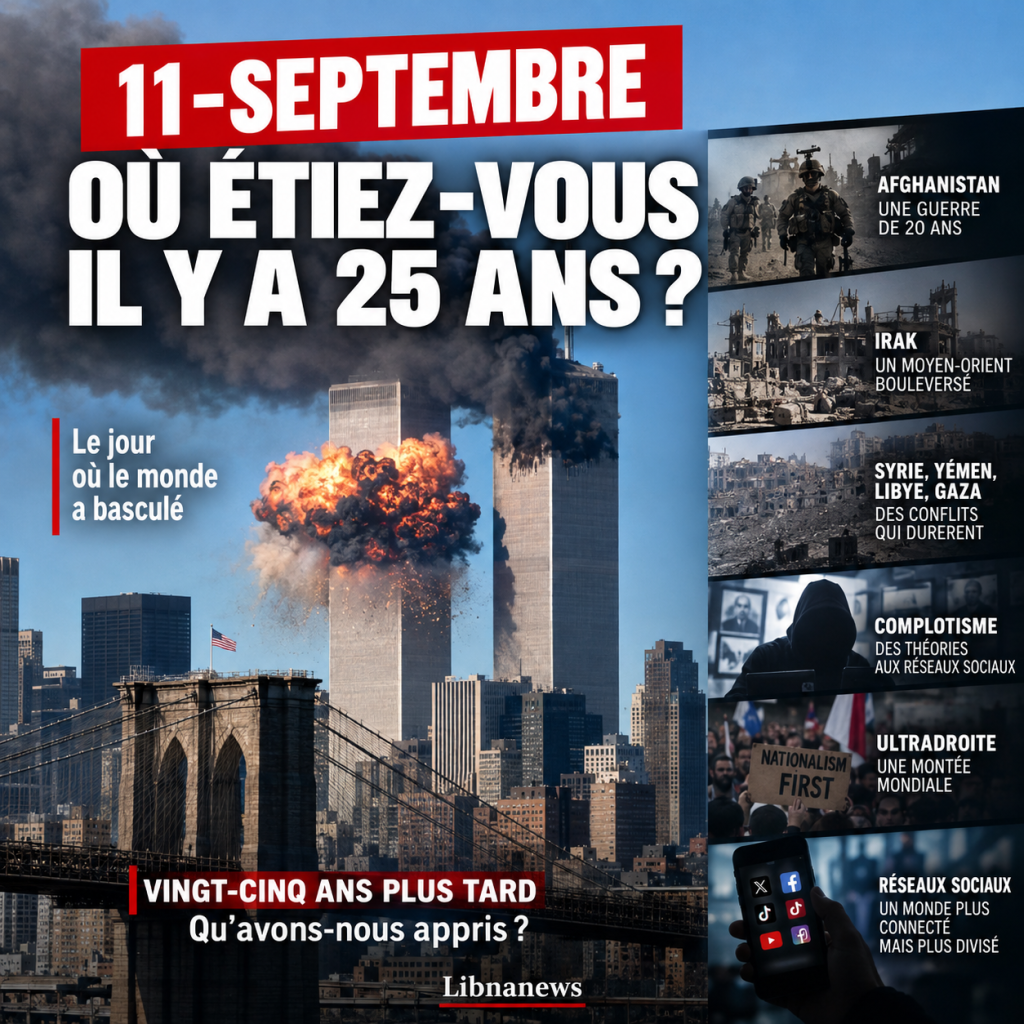
Twenty-five years ago, on September 11, 2001, millions of people interrupted their day to watch, unbelievingly, the towers of the World Trade Center burn and then collapse. A generation still remembers the exact place where it was. A quarter of a century later, this memory also allows us to measure the progress made. War, terrorism, conspiracy, social networks, pandemic, the return of nationalism and the progression of the ultra-right: the world had to become safer. It appears above all more fragmented, suspicious and brutal.
An ordinary day that swings
And what were you doing twenty-five years ago? Some worked, others were in school or university. Some were having lunch, driving or going home. In Lebanon, it was already afternoon when the first images arrived from New York. Then an ordinary day ceased to be.
On 11 September 2001, four airliners were hijacked in the United States. Two struck the towers of the World Trade Center in New York. A third struck the Pentagon near Washington. The fourth, Flight United 93, sank into Pennsylvania after the revolt of passengers and crew members. Nearly 3,000 people were killed.
The images became immediately universal: smoke over Manhattan, the second aircraft appearing behind the buildings, then the towers that collapsed and the streets covered with dust. Those who lived this day of understanding often kept a surprisingly accurate memory of these few hours. Yet they could not know what would follow.
September 11 and the wars that followed
September 11 did not just leave bereaved families and an American trauma. It opened a geopolitical sequence that would profoundly mark the first quarter of the twenty-first century. A few weeks after the attacks, the United States and its allies intervened in Afghanistan to strike Al-Qaida and overthrow the Taliban regime that housed Osama bin Laden.
The Taliban were quickly expelled from Kabul, but the war lasted almost twenty years. By August 2021, the last US forces left Afghanistan while the Taliban had taken over the capital. The images of the chaotic evacuation from Kabul airport offer a striking epilogue to a war that began in the direct wake of the attacks.
Meanwhile, another war had upset the Middle East. In March 2003, the United States and its allies invaded Iraq and overturned Saddam Hussein. The weapons of mass destruction placed at the heart of the American argument were not discovered as announced. Iraq entered a long period of insurgency, attacks and sectarian violence.
Iraqi chaos also encouraged the rise of jihadist organizations. Al-Qaida in Iraq preceded the Islamic State organization, which seized vast territories in Iraq and Syria in 2014. The terrorism that the « war on terrorism » had to fight had changed its face without disappearing. Then the Iranian-Syrian axis to Hezbollah came out reinforced.
From Kabul to Gaza, the war remained
Perhaps the most worrying, twenty-five years later, is the permanence of war. Syria was devastated by a conflict that began in 2011. Libya became fragmented after the fall of Muammar Gaddafi. Yemen has suffered years of war, while Iraq was going through invasions, insurrections and terrorism.
Then the conventional war returned to the heart of Europe. On 24 February 2022, Russia launched its large-scale invasion of Ukraine. Cities were bombed, trenches reappeared and artillery, tanks, drones and missiles became the daily reality of a major conflict on the continent.
In the Middle East, Hamas’ attack on Israel on 7 October 2023 and the subsequent war in Gaza opened a new period of violence with major regional consequences. Lebanon was also directly involved in this instability. Military technology has changed, but under drones and missiles remains an ancient reality: disputed territories, displaced populations, destroyed cities and families burying their dead.
The conspiracy has come out of the margins
September 11 also provided exceptional ground for conspiracy theories. The attacks themselves have given rise to countless alternative narratives: the allegedly organized destruction of towers, the hidden involvement of the American authorities or the deliberate attacks left behind. There was no credible evidence of these scenarios, but their ability to disseminate predicted a much wider phenomenon.
In 2001, social networks as we know them did not yet exist. Theories were circulating on forums, websites, e-mail or in militant videos. Facebook, YouTube, Twitter and then Instagram, Telegram and TikTok then changed the scale of the phenomenon. A dramatic claim can now reach millions even before the facts have been verified.
Conspiracy was not born with September 11. He’s much older. But the first quarter of the twenty-first century offered it an unprecedented global infrastructure. Attacks, wars, elections, migration, vaccines or climate: almost every major crisis now produces its own parallel explanations.
The Covid-19 pandemic gave a spectacular demonstration. False information on the virus, vaccines, governments and laboratories accompanied the health crisis. For part of the population, information from a government, media, university or scientific institution sometimes becomes suspicious precisely because it comes from an institution. The doubt necessary for democratic debate can then turn into a refusal to a common reality.
The rise of extremes and ultra-rights
This mistrust accompanies another major political development: the strengthening of nationalist, populist and, in several countries, extreme right and ultra-right movements. It would be wrong to make this a direct consequence of September 11. The 2008 financial crisis, inequality, de-industrialization, migration, fear of downgrading, cultural upheavals and distrust of elites have fuelled different movements across countries.
However, the Islamist attacks and subsequent wars have affected the public debate. The fear of terrorism has sometimes been mixed with that of immigration. Issues of identity, religion and borders have become increasingly important in electoral campaigns. In Europe, formations previously maintained on the periphery of the political system have settled in parliaments and, in some countries, in power or at its doors.
In the United States, political polarization has also increased considerably. The confrontations now concern confidence in institutions and the legitimacy of elections. Ultra-droit mobilities also use the Internet to recruit, disseminate their propaganda and internationalize their references. Jihadism understood the power of digital communication very early; other extremisms have in turn been understood.
Algorithms have changed our way of seeing the world
In 2001, Facebook, YouTube, Twitter and iPhone did not exist. September 11 was a world event mainly experienced through television. A similar attack today would be filmed from thousands of different angles, broadcast live, instantly commented and accompanied almost immediately by rumours, manipulations and contradictory content.
Artificial intelligence now adds an additional difficulty. A realistic image is no longer necessarily evidence. A voice can be imitated and a video made or modified. We are confronted with a paradox: never did humanity have so many means to document the real, but never did it have so many tools to falsify it.
Yet the Internet has brought individuals closer and democratized access to knowledge. But connecting societies does not necessarily mean uniting them. Platforms often promote content that can cause immediate reaction. Anger, fear and indignation move quickly, while the nuance struggles more to impose.
Two people can now observe the same event without even agreeing on the elementary facts. Political opponents become more easily enemies, compromise can be presented as betrayal and contradiction as aggression. Polarization is not new, but technology gives it unprecedented speed and range.
But the world promised to learn
After 11 September 2001, there were many demonstrations of solidarity. For a few days, violence seemed to have brought to light the fact that the deaths of innocent civilians could not be relativized by borders, religions or political affiliations. A quarter of a century later, this evidence seems sometimes weakened.
Too often victims are looked at according to the camp to which they belong. An atrocity can be denounced when it strikes one another and relativized when it strikes the other. The images of dead civilians become arguments in political and digital battles, while the suffering itself is sometimes forced to choose its flag.
At the same time, the international system appears more fragmented. The rivalry between the United States and China forms an increasing part of the power relationship. The war in Ukraine is in front of Moscow against the Western powers. The Middle East remains through regional conflicts and rivalries. Yet we know what a war is about: destroyed cities, ruined economies, displaced populations and marked generations. Experience was not enough.
What were you doing that day?
This is what gives a special strength to this simple question today. What were you doing on September 11, 2001? For some, the answer is in a few words: I was at work, at school, at home, in front of television. For others, there is no memory because they were too young or not yet born.
An entire generation is now adult without having known the world before September 11. It grew up with counter-terrorism controls, the wars in the Middle East, jihadist attacks, the financial crisis, social networks, smartphones, the Covid-19, the war in Ukraine and the new crises in the Middle East. She grew up in a world where every disaster comes immediately on a screen.
It would be wrong to turn 2001 into a golden age. The world then had its wars, dictatorships, massacres, injustices and extremism. The Balkans had just emerged from a decade of conflict, the Middle East was not at peace and Lebanon still bore the scars of its civil war and long years of confrontation.
However, something has changed in our relationship to time and fear. We are constantly informed, alerted and solicited. We can see almost live a missile hitting a city, a degenerating demonstration or a rumor becoming viral. We gained instantaneity, but lost part of the distance that allows us to understand.
Twenty-five years later, what have we learned?
Since 2001, humanity has made considerable scientific and technological progress. Medicine has advanced, access to knowledge has changed and hundreds of millions of people have seen their material conditions change. So the world didn’t just get worse. But our technical capabilities seem to have progressed faster than our collective ability to prevent old reflexes from returning.
We communicate better, but so does propaganda. We can verify more facts, but lies circulate faster. We have built networks capable of connecting humanity as a whole and extremists also serve to find themselves. We have increasingly sophisticated weapons, but continue to resolve conflicts through destruction.
We know how to recognize the mechanisms of conspiracy, but they continue to seduce. We know the historical consequences of political hatred, racism and dehumanization, but the ultra-righteous and other forms of extremism still find an audience. Perhaps that is what this twenty-fifth anniversary really measures: the distance between what we have learned and what we have been able to do with it.
On September 11, 2001, millions of people stopped what they were doing to watch history appear on their screens. Twenty-five years later, we have history permanently in our pockets. So remember, where were you, what were you doing, how old were you? And when, in twenty-five years, someone looks at our time in turn, he can ask a more uncomfortable question: what have we made of the world we inherited?
Editorial elements and SEO
Number of body words:1902
Keyword:11-September
Keywords Secondary SEO:11 September 2001, New York attacks, conspiracy theories, ultra-right, wars since 2001, World Trade Center, 25th anniversary of 11 September
Description:Twenty-five years after September 11th, wars, conspiracy, ultra-right and social networks tell the deep fractures of a transformed world.
Extract:Where were you on September 11, 2001? Twenty-five years after the attacks on the United States, this intimate question allows us to measure the transformations of an era. Wars in Afghanistan and Iraq, terrorism, conflicts in Ukraine and the Middle East, conspiracy theories, social networks, political polarization and ultra-droit progression accompanied this first quarter of century. The world has made tremendous technological progress, but it still seems unable to get rid of its old reflexes of violence and division.
Five alternative titles
- 11-September: Where were you 25 years ago?
- 25 years ago, the world turned
- 11-September: 25 years later
- Since September 11, a world unrecognizable
- september 11, 2001: the day everything changed
References and links
No link inserted in the body of the article. Detailed references not added, in accordance with the editorial instructions.




