





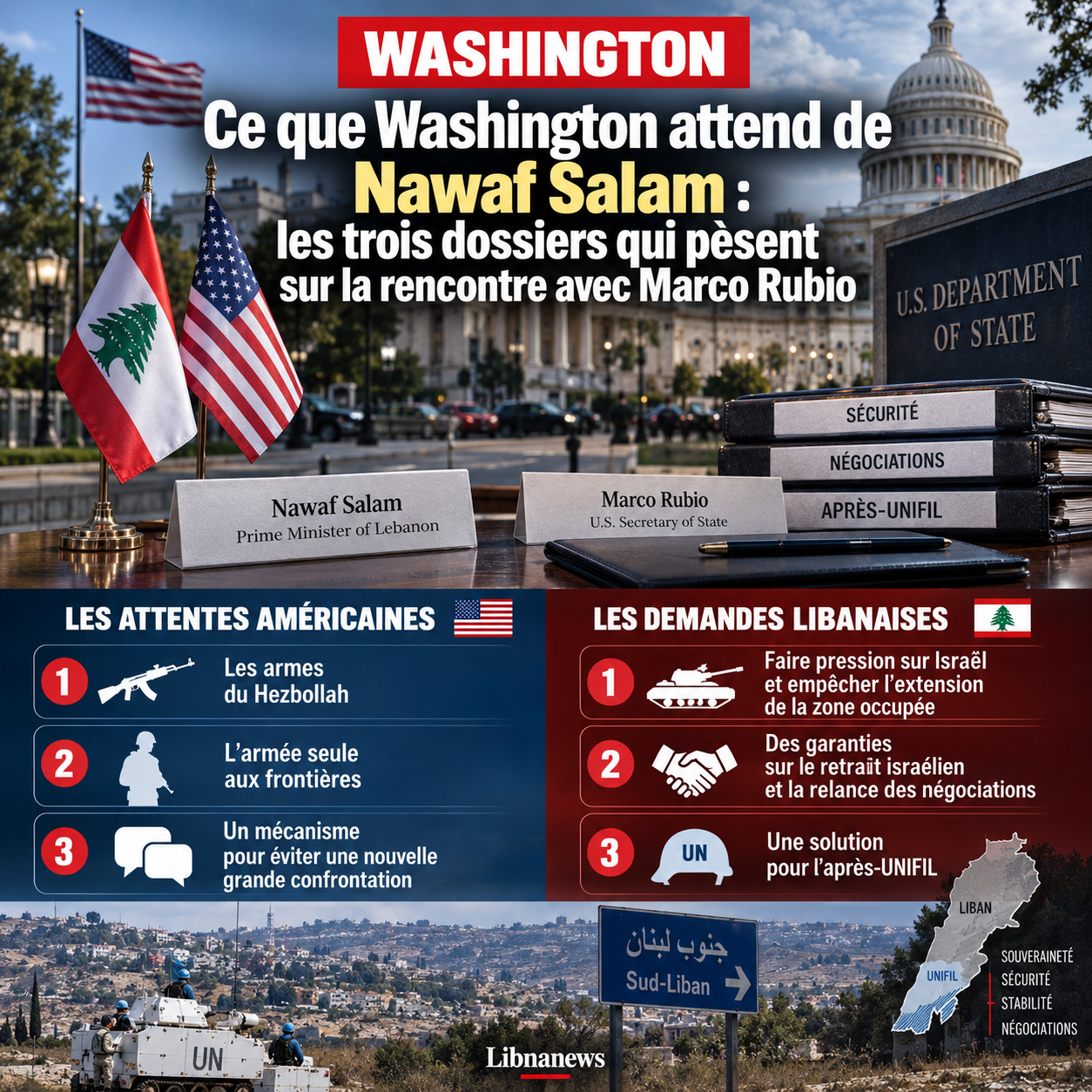
Nawaf Salam arrives in Washington with a more difficult equation than just a request for US support. The Lebanese Prime Minister is seeking pressure on Israel, preventing further expansion of the occupied area in the South, reviving a slowing negotiating process and preparing for the post-UNIFIL period. On the other hand, the US administration should reduce the discussion to three issues much more directly related to the functioning of the Lebanese state: Hezbollah weapons, the exclusive role of the army at the borders and the creation of a mechanism capable of preventing a local incident from triggering a new confrontation.
The planned meeting with Secretary of State Marco Rubio thus comes at the intersection of two agendas that do not completely merge. Beirut wants guarantees of Israeli behaviour before it can make further progress in the South. Washington expects Lebanon to transform the principle of state sovereignty into concrete provisions. Between the two is a territory where the Lebanese army must deploy, where Israel maintains positions and conducts operations, and where Hezbollah refuses to consider its disarmament as an independent precondition for Israeli withdrawal.
From New York to Washington, a change of registry
In New York, Nawaf Salam defended a relatively clear doctrine before the United Nations. The State must regain control of its territory, Lebanon must obtain Israeli withdrawal, and decisions on war and peace must be taken by the institutions. The Washington sequence is more operational. It is no longer just a question of setting out principles, but of determining how they could be applied.
The visit comes at a time when the Lebanese-Israeli negotiation process is showing signs of shortness of breath. The prospect of a new meeting remains uncertain. In particular, Beirut is waiting to know when an eighth negotiating session could be held and whether military discussions involving the parties could take place in the United States. Several scenarios are circulating, but no firm timetable had yet been communicated in Lebanon before Salam’s displacement.
This uncertainty is compounded by the Israeli calendar. The legislative elections scheduled for 27 October bring Israel closer to a time when security decisions can be strongly influenced by domestic politics. In Beirut, therefore, some fear that the window available to relaunch negotiations will soon close.
At the same time, Israeli operations are continuing in the South. The possibility of an extension of the area controlled by the Israeli army is one of the main Lebanese concerns. The problem is no longer just one-off strikes. It concerns the possible transformation of certain military positions into more sustainable territorial arrangements.
It is in this context that Salam must ask Rubio what Washington is prepared to do to prevent such a development.
First file: Time plays against the status quo on weapons
According to information gathered about the preparation of the meeting, the first American message should concern Hezbollah weapons.
For months, the Lebanese authorities have been pointing to the risk of internal confrontation to explain the caution with which they deal with this issue. The argument is not unfounded. The disarmament of an organization with an important political, social and military base cannot be treated as a mere administrative operation. A decision taken without sufficient political agreement could lead to a major crisis.
But Washington would consider that prudence cannot become a permanent principle of government.
The American idea is simple: what can be accepted as a temporary justification risks, over time, undermining the very principle that Beirut claims to want to restore. If the State declares that it must dispose alone of the military decision, while indefinitely maintaining a situation where another force retains its weapons and strategic autonomy, the gap between principle and reality becomes increasingly difficult to defend.
The problem, seen from Washington, would therefore not only be military. It would concern the definition of Lebanese sovereignty. As long as two decision-making centres can coexist on war and security issues, foreign partners will continue to question the State’s ability to enforce its commitments.
This reading comes directly against that of Hezbollah. Naim Kassem once again linked any discussion of weapons to the Israeli withdrawal, the return of the inhabitants and the situation in the South. The party refused to establish disarmament as a precondition while Israel maintained positions on Lebanese territory and continued its operations.
The divergence therefore no longer concerns only the final destination. It deals with the sequence of stages.
Beirut would like to see Israeli progress in making it politically possible for the arms issue to be dealt with gradually. Washington wishes to see Lebanese actions sufficiently tangible to convince Israel to withdraw. Israel, for its part, links its withdrawal to guarantees of control over the territory by the Lebanese army.
Everyone asks each other to start.
Salam dilemma: sovereignty without internal confrontation
For Nawaf Salam, the challenge is to simultaneously defend two ideas that can get into tension. The first is that the state must regain the monopoly of arms and military decision. The second is that this restoration cannot lead to an internal war.
The Prime Minister has already defended the principle of a single State empowered to negotiate on behalf of Lebanon. Minister of Foreign Affairs Youssef Raggi also insisted on the return of the decision to the government. He believes that Hizbullah’s refusal to discuss the concentration of weapons in the hands of the State makes the process particularly difficult.
But doctrine is not enough to create a timetable.
Washington should therefore seek to know not only what the government wants to achieve, but how it intends to do so. What steps can be taken without confrontation? What role should political dialogue play? What can the army accomplish? Which sectors should be given priority? And above all, what commitments can the State make, of which it is certain to be able to enforce?
It is on this ground that the encounter with Rubio can become more difficult than a classical exchange on sovereignty. Both officials can agree on the general principle while at the same time diverge deeply on the speed of its application.
Second case: Washington wants the army alone at the borders
The second expected message is clearer. Washington believes that border security must be the sole responsibility of the Lebanese army and state institutions.
This position goes beyond the mere division of labour on the ground. It corresponds to a Lebanese State concept for the period following the stabilization of the front. The army should not only be an additional force present alongside other actors. It should become the reference military authority.
This distinction is fundamental. Adding soldiers to the South does not regulate anything if several structures simultaneously retain their own chains of command and their own action capabilities. The model sought by Washington is therefore based on an identifiable responsibility: when an incident occurs at the border, only one Lebanese institution must be able to answer for it.
This approach also explains the American reservations that might arise around some post-UNIFIL proposals. Beirut is seeking an international presence capable of accompanying the army, monitoring the situation and documenting violations. But Washington would not want to see a mechanism that would create a new multiplicity of decision-making centres.
The debate, therefore, does not focus solely on the nationality of soldiers who could replace peacekeepers. It concerns their competences.
An international force can observe, verify, facilitate contacts or logistically support the army. It should not, in the American view, replace the state in the exercise of sovereignty.
This is precisely where the post-UNIFIL process becomes an institutional as well as a military one.
After UNIFIL, an emergency approaching
UNIFIL’s mandate is due to end at the end of the year. Lebanon faces an immediate problem with this deadline. It is not enough to decide that another force will take its place. A new international framework requires a legal, political and operational framework.
Beirut wants to avoid a vacuum. The Lebanese army must be able to continue its deployment south of the Litani River, but its resources and sensitivity make it desirable for the authorities to maintain international support.
Youssef Raggi intends to discuss in Washington the possibility of an international force to succeed UNIFIL. Efforts to simply extend the current mission have not been successful. So we have to think about another formula.
However, the replacement of UNIFIL cannot be settled by a simple bilateral agreement. The current arrangements are based on decisions of the Security Council. His disappearance and his replacement necessarily raise the question of a new international mandate.
Then we have to define what that force would do. Would she observe the Blue Line? Would she check the army’s deployment? Would it document the violations? Would it participate in the verification of the absence of non-State weapons in certain areas? Would it have its own means of intervention or would it be limited to a monitoring role?
These questions will determine the reality of the device much more than its name.
Third file: preventing a local incident from becoming a war
The third focus expected in the discussions is coordination between the parties. Recent experience has shown that a limited incident can quickly acquire a much larger dimension when communication channels are insufficient.
The episode of Deir Mimas is cited as an example of this vulnerability. It would have demonstrated the need for an international coordination mechanism enabling the Lebanese and Israeli parties to provide the necessary information promptly when an incident occurs.
The objective is obviously not to create a normal political relationship between Beirut and Israel. It is a mechanism for military prevention. In an area where several forces operate nearby, a few minutes can separate a scorn from a response.
An explosion, a misinterpreted military movement or a presence considered suspicious may trigger a strike. This leads to a response or mobilization. The local incident then becomes a political crisis or even a confrontation.
The proposed scheme should therefore allow rapid verification of what has happened before each party builds its response to its own information.
The United States coordination teams have already played a role in managing certain incidents. But Washington seems to consider that one-off intervention is no longer sufficient. A mechanism should be sufficiently rapid and identifiable to operate systematically.
The difference is important. Emergency mediation depends on the availability and goodwill of actors at the time of the crisis. A permanent mechanism creates procedures: which calls for who, within what time frame, what information is provided and which authority can request field verification.
In southern Lebanon, this architecture can become as important as the military positions themselves.
The node of « verification »
Another key word behind coordination is verification.
Israel does not only want to hear that the Lebanese army is deploying. It wishes to be able to verify that the areas concerned no longer contain Hezbollah fighters or weapons. Lebanon, for its part, does not want a monitoring mechanism to become a means by which Israel can unilaterally decide whether the State has fulfilled its commitments.
Hence the search for a third-party formula.
This question is reflected in the discussions on « experimental areas ». The principle would be to apply the arrangements to a specific sector: Israeli withdrawal, the deployment of the Lebanese army, verification of the security situation and possible extension of the model.
On paper, the method seems pragmatic. It allows a small-scale agreement to be tested before extending. On the ground, it immediately faces the problem of the order of operations.
Israel would demand progress in controlling the territory and the absence of Hezbollah weapons before expanding its withdrawal. Lebanon replied that the army could not fully exercise its sovereignty over an occupied territory.
The mechanism to solve the problem ends up replicating the problem.
Beirut wants Washington to talk to Israel too
Nawaf Salam does not only travel to Washington to receive a list of requests. Lebanon intends to present its own requirements.
The first is to prevent Israel from expanding the area it controls in the South. Concerns are all the greater as some Israeli operations seem to target positions and reliefs deemed strategic.
The second concerns withdrawal. Beirut wants the progress required in Lebanon to be accompanied by an Israeli timetable that is sufficiently clear. In this way, the government seeks to emerge from a logic where Lebanese bonds would be precise while counterparties would remain conditional.
The third concerns guarantees. An area handed over to the Lebanese Armed Forces cannot function as a credible test if Israeli forces can return at any time. Lebanon therefore hopes that Washington will act as guarantor.
Finally, Beirut wants to maintain an international presence after UNIFIL. Not to replace the army, but to have an external witness and a mechanism capable of reducing the risk of confrontation.
It is on these four points that Salam can seek to rebalance the discussion.
A Lebanese case relegated by the war with Iran
The additional difficulty comes from the hierarchy of American priorities. Lebanon no longer occupies the same place on the Washington agenda as in the early stages of negotiations.
Confrontation with Iran, the Strait of Ormuz, oil issues and regional security are now focusing much of American attention. Donald Trump did not mention Lebanon in his address to the UN General Assembly.
This absence doesn’t mean Washington abandoned the file. The process for Lebanon and Israel remains. Military contacts continue. The United States remains essential to any verification or guarantee formula.
But the American method seems to have changed. After a period of strong diplomatic momentum, Washington seems to be more manageable, exerting pressure and waiting for the parties to clarify their positions.
The Salam-Rubio meeting thus becomes a test of investment that the United States is still willing to devote to the issue.
Three US applications, three Lebanese applications
The discussion can finally be summarized by two sets of three requirements.
Washington would expect from Beirut real progress on the issue of arms, the consecration of the army as the only military authority at the borders and the establishment of a coordination mechanism to prevent escalation.
Beirut is awaiting pressure from Washington against the extension of the Israeli occupation, guarantees of withdrawal and an international arrangement capable of accompanying the army in the post-UNIFIL period.
Both agendas are not incompatible. However, they face the same question: who does the first gesture?
Without Israeli withdrawal, the Lebanese government has less political space to move forward on weapons. Without progress on weapons, Israel claims that it does not have the necessary guarantees to withdraw. Without a verification mechanism accepted by both parties, each can challenge the other’s commitments.
Marco Rubio and Nawaf Salam will therefore not only discuss a new diplomatic meeting. They must determine whether there is still a sequence capable of breaking this circulation.
In Washington, Lebanon is seeking less a new statement of support than a mechanical one. An Israeli step, a Lebanese step, a verification and then a new step. If this mechanism is not found, negotiations may remain suspended while, on the ground, the facts continue to precede diplomacy.