






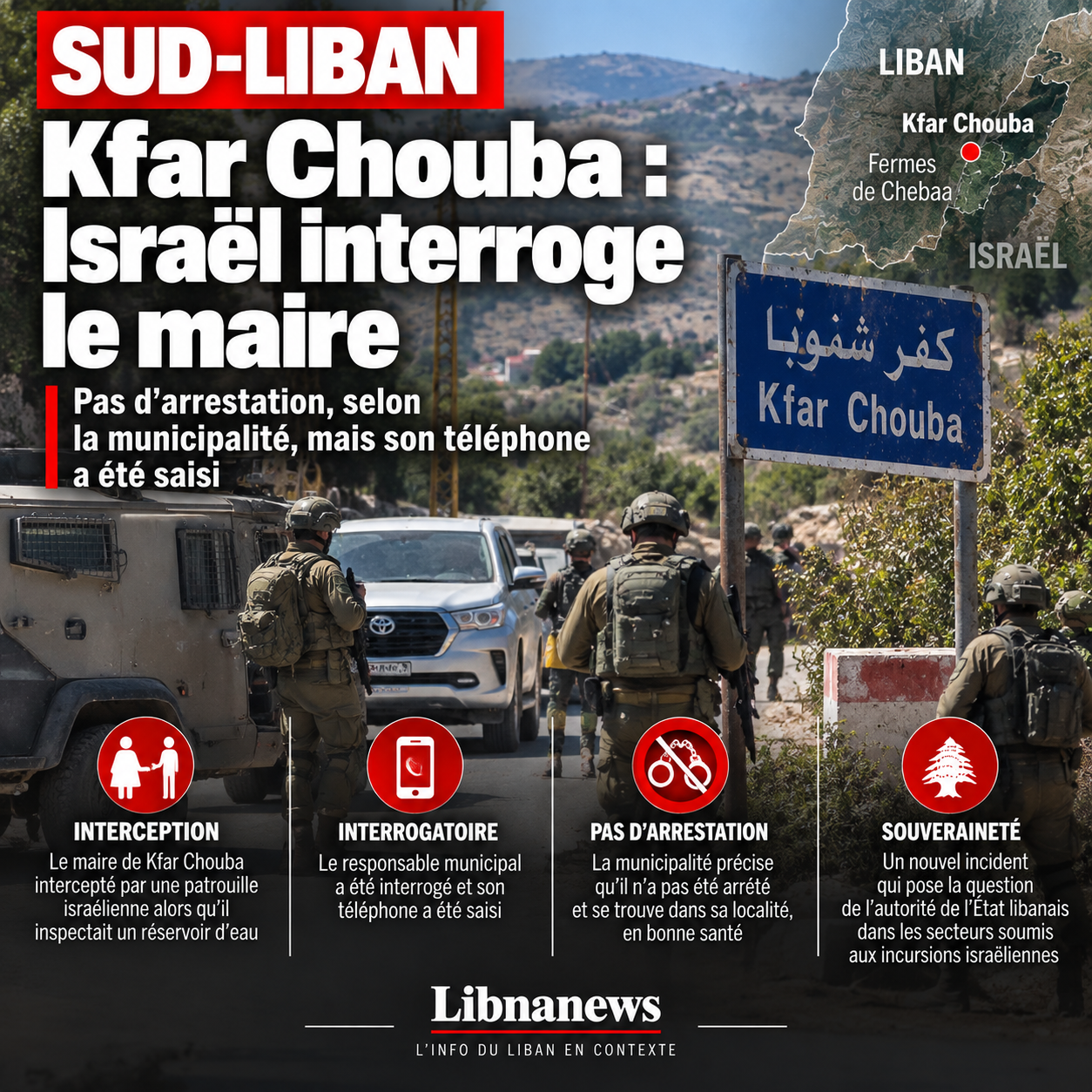
An Israeli patrol entering the area of Kfar Shuba, in southern Lebanon, intercepted on Saturday, 12 September, the president of the municipality, Kassem al-Qadri, while inspecting a reservoir supplying the town with water. The municipal official was interrogated and his phone seized before he could leave. Contrary to the initial reports of his « arrest », the municipality indicated on Sunday that he had not been arrested or taken to another place. The incident, however, once again raises the question of the exercise of Lebanese sovereignty in areas subject to Israeli incursions.
The incident occurred on Saturday in the area of Kfar Shuba, a locality of the Arqub located near the border with Israel and the disputed area of the Shab`a farms.
Kassem al-Qadri, president of the municipality of Kfar Shuba and of the Union of Municipalities of Arqoub, was in the vicinity of the reservoir supplying the locality with water when it was intercepted by an Israeli patrol entering the area.
According to available information, Israeli soldiers interrogated him and seized his cell phone. The municipal official was then left free.
The event was first presented as an arrest. However, this qualification was denied by the municipality of Kfar Shuba.
Kfar Shuba denies the arrest of his mayor
In an update published on Sunday 13 September, the municipality confirmed the incident while providing an essential clarification on its progress.
She stated that Kassem al-Qadri had not been arrested and had not been taken to another location. The president of the municipality is in his locality and is in good health.
This precision leads to a distinction between two elements. The initial announcement of an arrest does not correspond to the later version communicated by the municipality. On the other hand, the mayor’s interception by an Israeli patrol, his interrogation and the seizure of his phone remain reported.
The incident therefore retains an important scope even without arrest in the strict sense.
It concerns a Lebanese elected official who had a function directly related to the management of his municipality and an infrastructure essential to its inhabitants.
The mayor was inspecting the water tank
The location of the incident is one of its most significant elements. Kassem al-Qadri was near the reservoir that supplies water to Kfar Shuba.
The president of a municipality may be required to inspect such equipment in the course of his duties. Water supply is also a particularly important issue in the villages of the South faced with the consequences of military operations, destruction and difficulties of return.
The interception of a municipal official in these circumstances therefore exceeds the only face-to-face between a patrol and a civilian.
It raises the question of the capacity of Lebanese local authorities to access the infrastructure for which they have responsibility when Israeli forces operate in the same area.
The confiscation of the mayor’s phone adds another dimension to the incident. The information available does not establish exactly what the military was looking for or what happened to the contents of the aircraft.
The Israeli forces should therefore not be given an unestablished intention.
A new incursion into South Lebanon
The episode mainly takes place in a context of increasing Israeli operations in southern Lebanon.
In recent days, several localities have experienced strikes, blasting and destruction of buildings. Land operations and military movements have also been reported in various sectors.
In Mansouri, in Tyre District, most of the public school was destroyed on Friday. The facility had been directly threatened two days earlier after explosive material was deposited on its roof.
In the Nabatiyah region, the operation in Ali al-Taher triggered an explosion of exceptional power on Thursday night. Vibration was detected by seismological stations.
Israel claimed to have destroyed in this area an important underground Hezbollah network and assumed operational control of this strategic height.
In this context, the Kfar Shuba incident illustrates another dimension of land operations: the one-time control exercised by Israeli soldiers over the movements of a Lebanese public official.
A question of sovereignty more than vocabulary
The correction to the original account is important. An interrogation followed by release is not equivalent to an arrest and transfer to Israel.
But the denial of arrest does not remove the political question posed by the event.
A Lebanese municipality president was intercepted and interrogated by Israeli soldiers while in the area of his municipality. His phone was seized.
The question then becomes that of authority actually exercised on the ground.
In law and from the point of view of Lebanese institutions, Kfar Shuba is under Lebanese sovereignty. But when a foreign patrol can enter an area, temporarily stop the movement of an elected one and interrogate him, the concrete exercise of this sovereignty is directly affected.
This is precisely one of the problems posed by the persistence of an Israeli presence and incursions in the South.
Kfar Shuba, a particularly sensitive sector
The location of Kfar Shuba also gives the event a special reach.
The town is located in Arqoub, close to the Shabaa Farms area and the Kfar Shuba Hills. This region has long been one of the most sensitive points on the southern border of Lebanon.
Territorial issues are particularly complex because of border delimitation disputes and the status of neighbouring territories.
This geography also explains the military importance of the sector. The heights allow for the monitoring of large areas and the movements taking place there are regularly observed by the various actors present on both sides of the border.
For the inhabitants, these strategic considerations have very concrete consequences. They affect access to agricultural land, roads, housing and municipal infrastructure.
The incident involving Kassem al-Qadri is part of this reality.
The Lebanese State wants to reaffirm its presence in the South
The event occurs when the Lebanese authorities insist precisely on the need to strengthen the State’s presence in the South.
Prime Minister Nawaf Salam said that the presence of the Lebanese army and public institutions is a confidence factor for residents who wish to return to their villages.
The government is also working on the material conditions of return. Prefabricated housing is considered as an interim solution for families whose homes have been destroyed or rendered uninhabitable.
At the same time, the Council of Ministers approved a draft law to prevent sales and other real estate disposal in areas occupied by the Israeli army.
These measures address the same concern: to prevent the present military situation from producing lasting territorial consequences.
The Kfar Shuba incident, however, shows the difficulty of this ambition when local officials themselves can meet an Israeli patrol by visiting an infrastructure in their commune.
After the destruction, the question of territorial control
Recent events in the South are no longer limited to air strikes.
Building blasts, the destruction of infrastructure, the maintenance of military positions and land incursions raise a broader question about the duration of the Israeli presence and its consequences for the population.
The destruction of a house prevents or delays the return of a family. The destruction of a school complicates the destruction of children. Damage to a water system affects an entire community.
The interception of a municipal official affects the very functioning of the local administration.
These different events are not identical and should not be artificially confused. Their accumulation, however, gives rise to the same problem: the difficulty for the Lebanese State and local authorities to exercise their authority in certain parts of the South.
That is why the question of sovereignty is not only measured by a map or the official presence of a border.
It also measures the possibility for a mayor to freely access the water reservoir of his own municipality.