

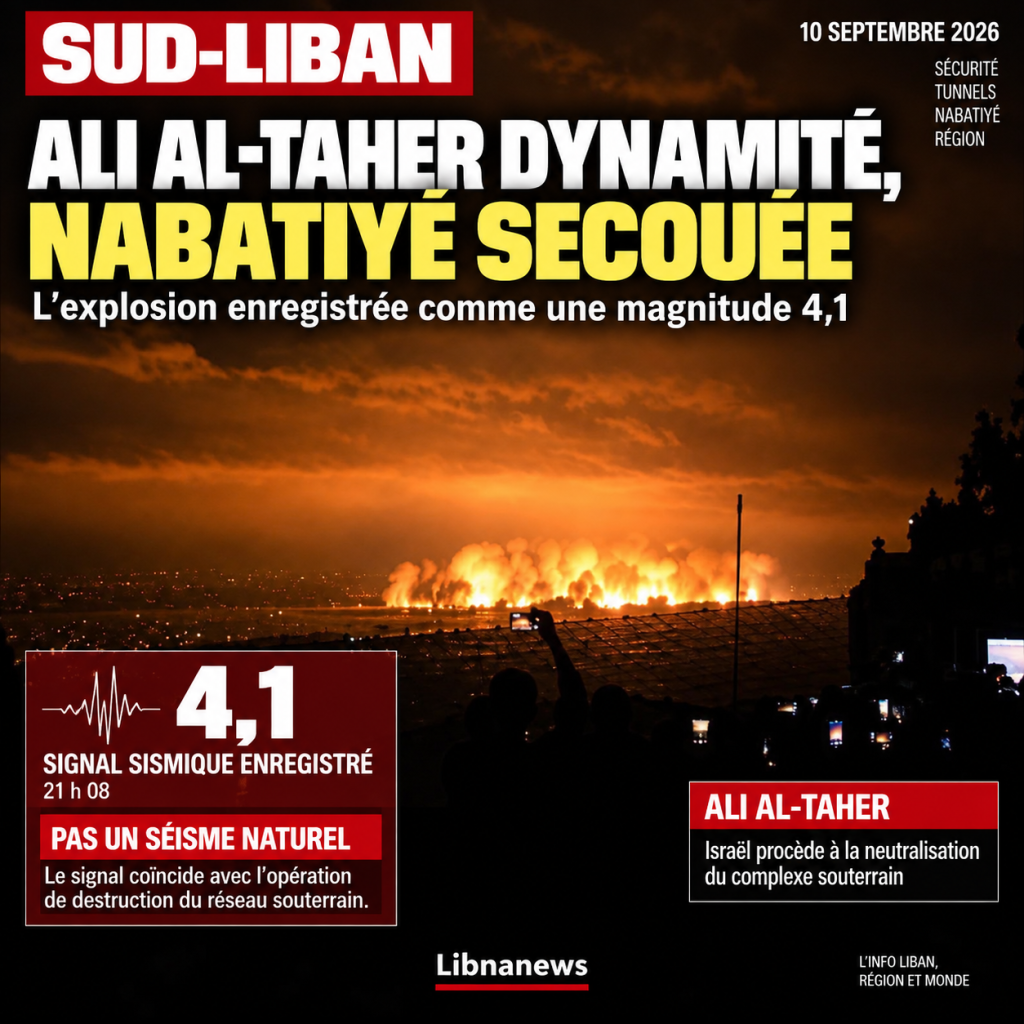
An explosion of exceptional power shook the Nabatiyah area on Thursday evening, 10 September, as Israeli forces destroyed Ali al-Taher’s underground networks. At 2108, the seismological stations recorded a signal corresponding to a magnitude of4.1, located about 13 kilometers west-southwest of Nabatiyah. The event, felt in a large part of southern Lebanon, corresponds to the operation of destruction of tunnels carried out on the heights of Ali al-Taher, which Israel had announced in recent days the next neutralization. The power of deflagration gives a new dimension to a military operation that is no longer limited to the control of the underground complex: it physically alters a dominant Nabatiyah area and several surrounding localities.
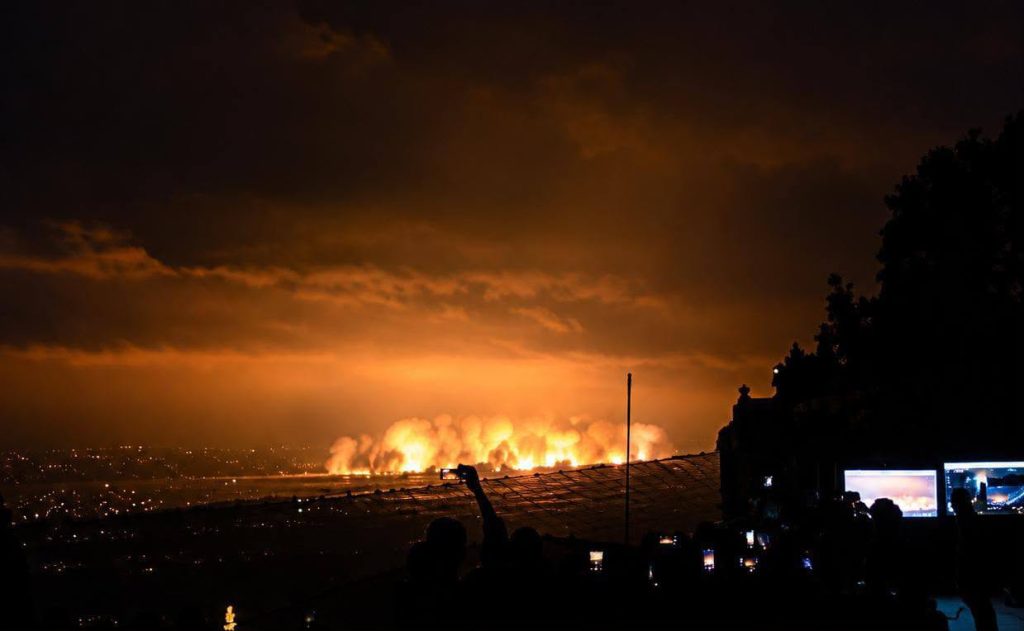
The recording displayed by seismological networks therefore does not mean that a natural earthquake struck Nabatiyah. Automatic or semi-automatic systems can detect a significant underground explosion as a seismic event and attribute magnitude to it. The capture recorded on Thursday evening also indicates a manual assessment and a depth of 10 kilometers, which should not be interpreted as the actual depth of the explosion. In the immediate context of Ali al-Taher, where a tunnel destruction operation was in preparation, the signal corresponds to the deflagration that has just shaken the region.
An explosion recorded as a magnitude 4.1
Deflagration occurred at21 h 08 min 48 s, according to seismological data displayed Thursday night. The signal reached a magnitude of4.1 mb, with an indicated margin of ±0.2.
The location is located in the Nabatiyah area, about 13 kilometres west-southwest of the city. This instrumental location should be considered approximate when an explosion is involved, not a tectonic earthquake.
For the inhabitants, however, scientific distinction is less important than the power felt. An explosion capable of producing a signal of this magnitude releases enough energy into the ground to be recorded remotely by instruments normally intended to monitor earthquakes.
It also explains why the explosion could have been felt far beyond the point of destruction.
The event took place after several days when Israeli forces prepared the neutralization of Ali al-Taher’s underground network. Israel had announced on 4 September that it had taken operational control of the heights and access to tunnels after several weeks of fighting. The Israeli army then indicated that the process of destroying underground installations was not complete.
Thursday evening’s deflagration seems to materialize this new phase.
Ali al-Taher, weeks of fighting before the destruction
The destruction came after a battle that gradually concentrated around this strategic height between Nabatiyah al-Fawqa and Kfar Tebnit, north of Litani.
Ali al-Taher dominates a large part of the Nabatiyah region. The height, which peaks around 600 meters, makes it possible to observe several axes linking Nabatiyah, the Litani and the heights of Iqlim al-Tuffah. This position explains the military importance of the sector in recent months.
Israel claims to have discovered a vast underground system used by Hezbollah. According to the Israeli army, the complex included facilities for combatants to remain underground for extended periods of time: living spaces, generators, weapons depots and operating rooms.
Not all of these claims were independently verified by the Israeli army.
However, the existence of a large tunnel network in the sector is now established by several concordant sources. An international news agency reported on 4 September that Israel had announced that it had evacuated Hezbollah fighters from the network and took operational control of the ridge. A Lebanese military official indicated that Israeli forces controlled, inter alia, southern access and monitored other entrances.
The destruction of these infrastructures was still in preparation.
More than 15 tunnels had already been energized
Thursday night’s explosion is not the first episode of this operation.
The6 septembermore than 15 tunnels had already been energized simultaneously in the Nabatiyah area, between the Beaufort Castle area and Ali al-Taher, according to information reported from the field.
These destructions had caused high detonations throughout the region.
The difference on Thursday night is the importance of the recorded signal. A seismic magnitude of 4.1 gives an indication of the energy transmitted to the basement, even if it does not allow to calculate directly and simply the amount of explosives used.
In particular, it would be incorrect to mechanically convert a magnitude 4.1 into a tonnage of explosives. Energy detected depends on many parameters: load depth, geology, tunnel geometry, rock fragmentation and proportion of energy actually transmitted as seismic waves.
However, the figure allows a qualitative comparison: it is a considerable deflagration.
A day already marked by the strikes on Ali al-Taher
The explosion comes after another day of military pressure on the region.
On the night of Wednesday to Thursday, Israeli forces had already increased the number of strikes around Ali al-Taher. At least four raids were reported on the ridge, accompanied by artillery fire. Other strikes targeted Qantara, Mansouri and Beit al-Sayyad.
On Thursday, operations continued around Nabatiyah al-Fawqa and the foot of the ridge.
The series of bombardments and the massive deflagration of 2108 indicated that the operation had entered a different phase. After seeking access control and inspection of the galleries, Israeli forces are now working to render the network unusable.
This destruction could continue.
The exact size of the complex and the number of galleries still intact are not publicly known. It is therefore not possible to state on Thursday night that the explosion marks the end of the operation.
The destruction of tunnels can also upset the surface
The issue goes beyond the disappearance of an underground military infrastructure.
Destroying a large network of galleries requires large loads. Depending on their depth and configuration, explosions can cause collapses, cracking and surface changes.
This is precisely one of the concerns around Ali al-Taher.
The ridge is not isolated in the middle of an uninhabited area. Nabatiyah al-Fawqa, Kfar Tebnit and other localities are nearby. Housing, roads, agricultural land and civil infrastructure surround the sector.
The bombings of the last few weeks have already caused significant damage in nearby localities.
Mass destruction of the underground network can add indirect damage, even when loads are placed away from homes. Their extent can only be determined after a field inspection.
At 2142 hours, no complete assessment of the damage caused by the 2108 deflagration was yet available.
A spectacular demonstration of land transformation
Operation Ali al-Taher also raises a broader question for southern Lebanon: the physical transformation of the territory by Israeli military operations.
Over the past several weeks, blasting has increased in different regions. Houses were destroyed in Mansouri, Bani Hayyan, Khiam and several border villages. Again on Wednesday, dozens of blastings had been recorded in the Mansouri area alone.
In Ali al-Taher, the scale is different because the destruction targets an underground network.
But the territorial consequence is comparable: Israel is no longer just hitting a target on time. It destroys infrastructure and changes the premises to prevent their reuse.
From the Israeli point of view, this policy aims to permanently suppress Hezbollah’s military capabilities.
On the Lebanese side, it directly raises the question of the sovereignty and integrity of the territory. The Lebanese army again denounced on Wednesday the continuation of Israeli destruction and considered that it was hampering its own deployment.
The Lebanese army warned of an escalation
On the eve of the explosion, the Lebanese Army command had adopted a particularly harsh tone.
He accused Israel of intensifying its attacks on residential areas and institutions and of continuing its demolition operations in the South. According to the military report, about7,700 israeli violationshave been registered since the framework agreement of 26 june.
Above all, the command believed that continued operations prevented the army from normally carrying out the tasks entrusted to it to restore stability.
The destruction of the tunnels of Ali al-Taher illustrates this contradiction.
The Lebanese Government affirms its desire to extend the state’s arms monopoly and to entrust territorial security only to regular institutions. At the same time, Israel is directly pursuing large-scale military operations on Lebanese territory against the infrastructure it attributes to Hezbollah.
The Lebanese army is thus called upon to regain control of a space whose land itself continues to be transformed by Israeli operations.
Ali al-Taher also becomes an argument in the debate on weapons
A few hours before the explosion, Kataëb President Sami Gemayel quoted Ali al-Taher at a press conference on disarmament.
He asked the government whether there were any « Ali al-Taher 2, 3 or 4 » in Lebanon, including in Bekaa, Beirut, Metn or Kesrouan.
His argument was that the possible existence of underground military infrastructure in inhabited areas could transform the surrounding localities into Israeli objectives.
Thursday evening’s deflagration brutally gives substance to this concern.
It obviously does not resolve the political debate on Hezbollah. The party and its supporters consider that its military capabilities remain necessary in the face of Israel, while its opponents believe that they now expose the territory more than they protect it.
But the explosion shows very concretely what the presence of an underground military complex means when it becomes the objective of a destruction operation.
A magnitude 4.1 that should not be presented as an earthquake
In the next few hours, the way in which the event appears in seismological applications may itself cause confusion.
The capture recorded on Thursday night presents the event in a familiar form to users of earthquake applications: magnitude, depth, coordinates and time.
This is not enough to make it a natural earthquake.
Quarry explosions, nuclear tests and large military explosions also produce seismic waves. The monitoring networks detect them because their sensors measure the vibrations of the ground, whatever their origin.
The displayed depth of10 kilometresabove all, it should not be used to assert that the tunnels of Ali al-Taher descend to this depth. That would be a misinterpretation. The deep location of an explosive event may be poorly constrained and some treatments use conventional depths when they do not have enough data.
What is relevant Thursday evening is the sign of magnitude 4.1 and its temporal and geographical concordance with the destruction of the complex.
What the explosion can announce for the next few hours
The question now is whether this deflagration is the main destruction operation or only a step.
Israel had announced that it had taken operational control of the network and wanted to neutralize it. Previous operations show that destructions can be carried out in several sequences to treat different galleries and accesses.
New explosions are still possible.
The second point to be monitored will be the state of the ground. Reconnaissance will be required to determine whether the deflagration caused further collapse or damage around Nabatiyah al-Fawqa, Kfar Tebnit and areas close to the ridge.
Finally, the reaction of the Lebanese State will be decisive. A powerful enough explosion to produce a 4.1-magnitude seismic signal in the heart of Lebanese territory is another spectacular episode of a campaign that the army already denounces as incompatible with the stabilization of the South.
TO21:42 thursday, 10 september, the deflagration of Ali al-Taher is the last major development of this sequence. The ground has recorded what the inhabitants of Nabatiyah have just heard and felt: the destruction of the underground network has entered a phase of exceptional power.




