

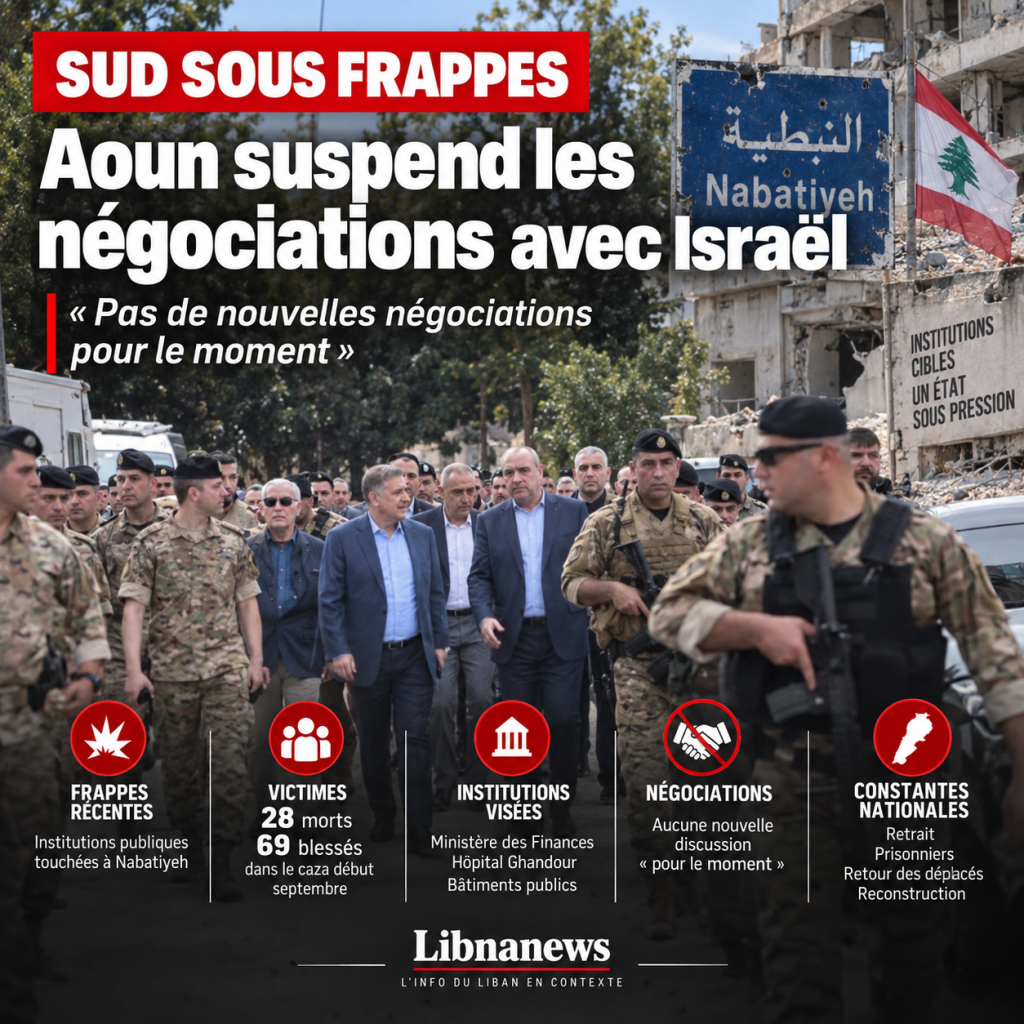
On a trip Saturday, September 12, 2026 to Nabatiyah, a few days after a series of Israeli strikes against the city, President Joseph Aoun said that there would be « no new negotiations with Israel at the moment ». Accompanied by chiefs of the main security apparatus, he went to the government seral in a context where public institutions, a Ministry of Finance building and Ghandour Hospital were targeted. The visit also took place at a time when the Head of State was facing an increasing challenge to his negotiating strategy, as his critics felt that the commitments made by Beirut had not obtained sufficient Israeli counterparts.
Joseph Aoun in Nabatiyeh after a week of strikes
Joseph Aoun chose Nabatiyeh to address one of his strongest messages since the opening of the negotiation process with Israel. Arriving on Saturday at the city’s government serail, with the heads of the security apparatus, the president said that no new negotiations with Israel were planned « for the moment ». At the same time, he presented the Israeli withdrawal, the return of prisoners, the return of displaced persons and the reconstruction as « national constants » which the State undertakes to implement.
The place and timing of the declaration shall be of particular relevance. On 6 September, Israeli strikes struck Nabatiyah and its environs. The Ministry of Finance building in the city was severely damaged and Ghandur Hospital in Nabatiyah al-Fauqa was destroyed. The Lebanese Ministry of Health also reported deaths and injuries in several attacks in the caza during the first days of September.
The Presidency then denounced an escalation of State institutions and civilian infrastructure. Joseph Aoun quoted the Ministry of Finance building, but also a previous targeting of a state security centre that had caused death. His presence in Nabatiyeh, surrounded by security officials, thus intervenes in a city that has become one of the symbols of military pressure on Lebanese institutions in the South.
Seral, symbol of a state directly exposed
The arrival of the government seral is not only a matter of protocol. In the Nabatiyeh area, administrative, security, municipal, school and health buildings were affected during Israeli operations. In August, the Lebanese army announced, inter alia, the destruction by Israeli forces of the municipal building, the public school, the clinic and a day-care centre in Zawtar al-Sharqiyah, Nabatiyah district.
This series of attacks feeds a question that has become central to the presidency: how can we reaffirm the authority of the state in the South when its own structures and forces are exposed themselves? The army publicly stated on 9 September that Israeli attacks hindered its deployment efforts and threatened stability. She then referred to the strikes on residential areas and institutions and the destruction in the South.
It was in this context that Joseph Aoun presented himself in Nabatiyah with the security apparatus officials. Three days earlier, he had chaired a meeting in Baabda on the South in general and Nabatiyah in particular. Military Commander Rodolphe Haykal, the directors of the Internal Security Forces, General Security, State Security and Civil Defence, as well as key intelligence officials, had participated.
No new negotiations with Israel « for now »
Nabatiyeh’s statement is above all a change of tone. For several months, Joseph Aoun has been defending negotiation as a means of avoiding a new war and achieving the restoration of Lebanese sovereignty. In early September, he had again stressed the need for full implementation of the commitments reached, by refusing to implement in a single sense.
On Saturday, the President did not announce the definitive abandonment of the diplomatic route. The words « for now » are essential. They indicate a suspension or, at least, the absence of a new immediate sequence. This clarification is all the more important as discussions planned in Rome have been postponed, while diplomatic contacts on the Lebanese-Israeli issue continue.
Joseph Aoun, on the other hand, set very legible political conditions. The withdrawal of Israeli forces, the prisoner record, the return of displaced populations and reconstruction must produce concrete results. By calling them national constants, he seeks to put these dossiers above the debate on the method of negotiation itself.
A presidential strategy under the fire of critics
This inflection comes as Joseph Aoun’s strategy is increasingly challenged in Lebanon. Since the framework agreement concluded in June, his political opponents and some of the critical voices in the South have accused him of having accepted important commitments without obtaining, so far, the expected Israeli withdrawal or the lasting cessation of the strikes. This criticism has been reinforced as the attacks continue and the destruction has affected communities where the State claims to want to restore its authority.
The complaint is about a perceived imbalance: Lebanon is called upon to strengthen State control, deploy the army and advance on the issue of Hezbollah’s weapons, while Israel maintains forces in the South and conditions its withdrawal to the disarmament of the Shiite movement. In August, Israel’s Defense Minister, Israel Katz, explicitly linked the withdrawal to complete disarmament of Hezbollah. Washington had also reiterated its opposition to a permanent Israeli presence and called for the implementation of the agreed framework.
Critics don’t come from one side. Hezbollah rejects part of the process and refuses to separate the issue of its weapons from an Israeli withdrawal. Nabih Berri also expressed reservations about the conduct of the discussions. In the areas directly affected, the challenge takes a more immediate form: internally displaced inhabitants and local officials ask what the agreements have changed in practice while strikes, demolitions and displacement continue.
However, it would be incorrect to present this criticism as a national consensus. Joseph Aoun maintained support for his diplomatic strategy and argued that a military confrontation would not allow Lebanon to obtain better guarantees. The debate therefore focuses less on the objectives — withdrawal, sovereignty, return and reconstruction — than on the price paid, the timing and the compensation actually obtained.
The contrast between Lebanese commitments and reality on the ground
Nabatiyeh’s visit makes this debate particularly visible. The Lebanese State affirms its commitments and strengthens its security arrangements, while the army says that Israeli operations make it difficult to carry out its missions. On 9 September, his command denounced a new wave of attacks on residential areas and institutions, believing that they hindered his efforts to establish stability.
Figures from the first days of September illustrate the extent of pressure on the Nabatiyah caza. The Ministry of Health reported 28 deaths and 69 injuries in three days of attacks in several localities in the district. In Kfar Rummane, 7 September strikes killed children, women and a rescuer. Other attacks affected Nabatiyah al-Tahta, Nabatiyah al-Faukah, Arab Salim and the surrounding area.
Israel claims to target Hezbollah, its fighters and its military infrastructure, and presents several of its operations as responses to attacks by the movement against its forces. The Lebanese authorities contest the proportionality of these operations and denounce attacks on civilians, public services and State institutions.
This shift feeds the pressure on Baabda. The presidential promise was that the diplomatic path could produce more security and promote the return of the State. In part of the South, however, the population still sees destroyed villages, displaced inhabitants and affected administrations. It is this contradiction that Joseph Aoun must now manage politically.
Nabatiyah, demonstration of presence and message to Israel
Saturday’s trip partly responds to this challenge. By coming himself to Nabatiyah, with the military and security command, Joseph Aoun seeks to show that the state does not withdraw from the ground at the time its institutions are targeted. The message is addressed to the people of the South, but also to Israel and international mediators.
The presence of security leaders gives the visit an operational and institutional character. It extended the Baabda meeting on 9 September, during which the Presidency discussed ways to strengthen the presence of the legal forces. It also aims to prevent a security vacuum from being invoked to justify an extension of Israeli operations or the maintenance of forces in Lebanon.
The declaration on negotiations now adds a diplomatic dimension to this demonstration. Joseph Aoun does not permanently close the door, but it means that the continuation of dialogue cannot be presented as an end in itself. The President is thus forced to show that the negotiations must produce visible counterparts if they are to maintain political legitimacy in Lebanon.
The continuation of the visit to Nabatiyeh will therefore be observed through two concrete questions: the measures that the State will announce for the affected inhabitants and institutions, and the conditions that Baabda will pose before any resumption of discussions with Israel. After the strikes against Nabatiyeh and the growing challenge to the strategy followed since June, these responses will weigh directly on the credibility of the presidential line.




