Iran’s Wanted Meeting Despite Lebanese Reservations
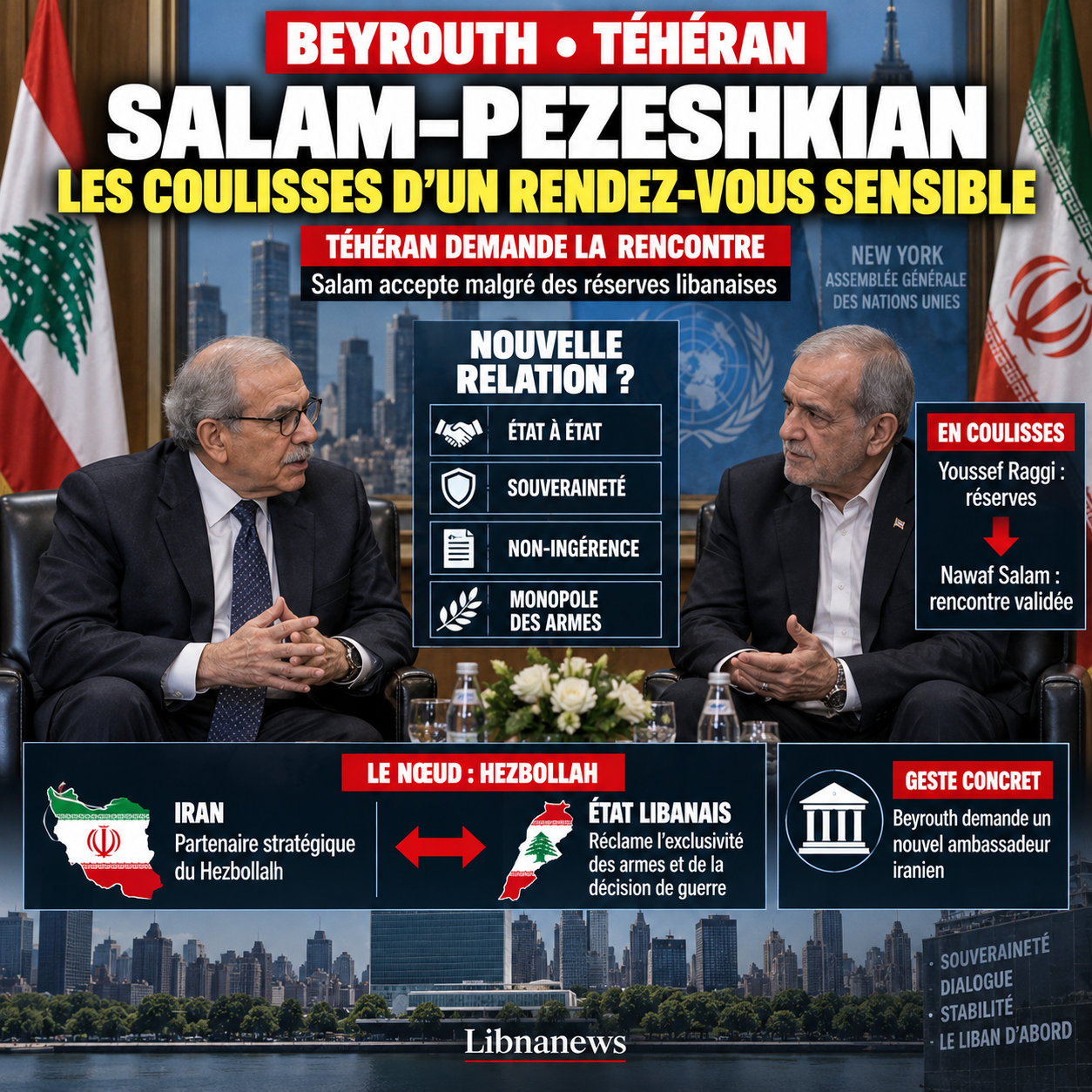
The meeting between Nawaf Salam and Masoud Pezeshkian in New York was not a simple protocol meeting organized mechanically on the margins of the UN General Assembly. Behind the official photograph of the Prime Minister of Lebanon and the Iranian President appears a more delicate sequence. Tehran reportedly requested the interview. Within the Lebanese delegation, that request would not have attracted immediate support. Foreign Minister Youssef Raggi is said to have expressed reservations. Nawaf Salam finally decided in favour of the meeting.
This arbitration is revealing. The Prime Minister did not choose to avoid Iran while relations between the two countries are being crossed by the Hezbollah issue, the issue of arms and the consequences of regional war. On the contrary, it accepted a direct dialogue, but gave it particular political content. The line defended in New York is to maintain relations with Tehran while seeking to put them in an institutional framework: two sovereign states, common interests, non-interference and respect for the decisions of the Lebanese State.
The context makes this approach more sensitive than an ordinary diplomatic meeting. Lebanon is emerging from a new phase of war that has profoundly affected the south, displaced people and aggravated an already very heavy economic crisis. At the same time, the State has embarked on a process aimed at extending the authority of the army, obtaining Israeli withdrawal and dedicating the monopoly of arms, as well as the decision on war and peace. Iran has had a strategic relationship with Hezbollah for decades. Any discussion between Beirut and Tehran therefore directly affects one of the most sensitive issues of Lebanese policy.
The presence of Youssef Raggi and Iranian Foreign Minister Abbas Araghchi during the interview also gives an institutional dimension to the meeting. Despite the reservations reported earlier, the Lebanese Minister participated in the meeting once the decision was taken. The episode thus shows a tactical disagreement within the executive, but not a public rupture of the institutional chain.
Lebanon paid a high price: Salam’s central message
Nawaf Salam has used a formula that summarizes the new doctrine he seeks to establish in the relationship with Tehran: Lebanon has paid a high price in terms of security, stability and economy and no longer wants to be a arena for regional conflicts or the exchange of messages between powers.
This sentence directly refers to the experience of recent years. The military decisions taken in the context of the regional clashes have had considerable consequences for Lebanese territory. The destruction in the south, the displacement of people, the paralysis of economic activities and the burden of reconstruction have increased the pressure on a country that has not yet absorbed the effects of the financial collapse that began in 2019.
However, Salam does not formulate his message as a break with Iran. On the contrary, it recalls that relations between the two countries and their populations are old. But he immediately added that Lebanon wished to open a « new page ». The content of this new page is defined: a healthy relationship between state and state, based on respect for the sovereignty and independence of everyone, the absence of interference in internal affairs and the search for common interests.
The choice of words is important. « State to State » means that Beirut wants to move the center of gravity of the relationship. Iran’s interlocutor must be the Lebanese State and not a political or military organization acting independently of it. It is not a question of demanding the disappearance of Iranian political relations in Lebanon. The stated objective is to make official institutions the framework for the bilateral relationship.
This doctrine joins the government’s general discourse on sovereignty. The same Prime Minister, who called on Israel to leave Lebanese territory completely, said that the State should exercise its authority over the whole country alone. In this construction, external sovereignty and internal sovereignty are presented as inseparable. Lebanon cannot call for an end to the Israeli occupation while accepting that certain strategic decisions escape its institutions.
The return of an Iranian ambassador becomes a political gesture
One of the most concrete elements of the interview was Iran’s request to appoint a new ambassador to Beirut. At first glance, the approach could be seen as a simple diplomatic issue. In the current context, however, it carries a broader message.
Calling for a new ambassador amounts to favouring ordinary diplomatic channels at a time when Beirut is talking about a state-to-state relationship. The embassy thus becomes the institutional instrument by which disagreements, demands and common interests must be addressed.
This request also shows that the government is not trying to break up with Tehran. Despite the war and political tensions, Salam wishes to maintain an active Iranian diplomatic representation in Lebanon. The change sought thus concerns the nature of the relationship and not its existence.
This distinction is important in the face of the two opposite readings that often dominate the Lebanese debate. The first considers any normalization with Iran as an acceptance of its influence through Hezbollah. The second interprets any claim of sovereignty against Tehran as an attempt to break or disalign Washington. Salam’s approach attempts to build a third path: to maintain a full diplomatic relationship with Iran while setting stricter political limits to intervention in Lebanese affairs.
However, the success of this approach will depend on practice. The appointment of an ambassador alone does not alter the balance of power. It becomes significant if the most sensitive cases go through the official institutions and Tehran accepts that decisions concerning Lebanese territory are taken in Beirut.
Hezbollah at the centre of the conversation even when it is not named
The question of Hezbollah necessarily structures this relationship. It appears behind the three principles defended by the government: the extension of State authority, the monopoly of arms and the exclusivity of the decision of war and peace.
Hezbollah’s position remains very different. His parliamentary representation reaffirmed the legitimacy of the resistance and considered that its military role remained necessary in the face of Israeli occupation and attacks. On the occasion of the second anniversary of the death of Hassan Nasrallah and Hashem Safieddine, the Hezbollah parliamentary bloc renewed its commitment to the current leadership of the party, led by Naim Kassem, and defended the continuity of the choice of resistance.
This divergence is therefore not theoretical. The Government states that weapons must be controlled exclusively by the State. Hezbollah considers that the continued Israeli occupation and attacks justify the maintenance of its military capacity. Iran, the main regional support of the movement, is directly concerned with how this contradiction will be addressed.
The message from Salam to Pezeshkian can therefore be read as an attempt to move the discussion. Rather than starting with a direct confrontation with Hezbollah, Beirut reminds Tehran of the principles that should govern Lebanon’s international relations. While Iran does recognize Lebanese State sovereignty and non-interference, the logical consequence is that the strategic decisions taken on Lebanese territory must be the responsibility of Lebanese institutions.
But there is no information available to suggest that this interpretation has been accepted by Iran in all its implications. The meeting opens a dialogue. It does not resolve the fundamental disagreement.
Iranian relationship becomes more expensive for Lebanon
The war has profoundly changed the context in which the debate on Iran is taking place. The cost of confrontation is no longer just political or security. It is economic and social.
The south must face significant destruction. Several villages suffered major damage. Families remain displaced or live in uncertainty. Agriculture, commerce and local infrastructure have been affected. Reconstruction will require considerable resources while the Lebanese State is still facing a deep financial crisis.
At the same time, the cost of living is reaching extremely high levels. A family of four people renting accommodation in Beirut or its suburbs may require between $1,400 and $1,500 per month to cover only housing, minimum food, electricity, water and transportation. However, this estimate excludes medical care, medicines, education, telecommunications and several essential expenses.
Regional war also puts pressure on energy prices. The increase in oil is affecting transport, private generators and freight costs. Inflation in the first eight months of 2026 reached about 17%, much more than forecast at the beginning of the year.
In this context, the formula used by Salam on the « high price » paid by Lebanon has a very concrete meaning. A new involvement of the territory in a regional confrontation would have consequences that the Lebanese economy is less and less able to absorb.
Tehran also negotiates its own exit from crisis
The meeting comes in parallel with much broader negotiations around Iran. The United States and Tehran are exploring an exit from the war. Indirect channels operate in New York, with Qatar playing a role in particular. China is also pushing for a resumption of discussions on the Islamabad reference.
The negotiations concern the Strait of Ormuz, the sanctions and blockade regime, the frozen Iranian assets and the nuclear issue. They also affect the different regional fronts. Lebanon therefore potentially appears in a much broader negotiation between Washington and Tehran.
This dimension worries Beirut as much as it offers it a possibility. American-Iranian de-escalation can reduce pressure on Lebanon. But the Government wants to prevent decisions concerning its territory being negotiated between foreign powers without Lebanese participation.
That is precisely why direct dialogue with Pezeshkian is important. Salam seeks to establish that Lebanon must no longer be merely a matter within the relationship between Iran and the United States. He must have his own voice and interests.
This position is all the more important as there are reports of regional discussions that may include the cessation of wars on several fronts, including Lebanon, Gaza and Yemen. If such negotiations progress, Beirut wants to avoid its security future being defined as a mere counterpart in a broader agreement.
The reserves of Youssef Raggi reveal a divergence of method
The reservations given to the Minister of Foreign Affairs prior to the meeting provide a better understanding of internal debates. They should not be turned into institutional conflicts whose sources do not provide evidence. However, they show that the way in which the Iranian relationship is managed is not fully uniformly read.
One line may consider that a high-level meeting with the Iranian President might give Tehran political normalization without sufficient compensation. Another believes that it is precisely necessary to speak directly to Iran to explain the new rules that the government wants to establish.
Nawaf Salam chose the second method. He accepted the meeting, but he used it to talk about sovereignty, non-interference, Israeli withdrawal and state monopoly. The diplomatic opening thus becomes the means of conveying a demanding message rather than a sign of alignment.
This choice is also consistent with the Prime Minister’s diplomatic style in New York. It meets simultaneously with Arab, European, Russian, Syrian and Iranian leaders. The objective is to prevent Lebanon from being locked into a single axis when its future depends on a very broad set of partners.
However, the divergence of methodology within the delegation revealed a question that would probably come back: how far should the relationship with Iran be normalized before any concrete changes were made to the issue of arms and sovereignty?
Salam speaks to Pezeshkian but also to Hezbollah
The message sent to the Iranian President also has an inner destination. By saying that Lebanon no longer wants to serve as a ground for regional conflicts, Salam implicitly speaks to Lebanese political forces that maintain external alliances.
The formula does not deny the existence of these alliances. It sets a limit: no regional relationship should allow a Lebanese party to decide alone on a confrontation involving the whole country.
This issue became particularly sensitive after the wars of 2023 and 2026. Criticism of Hezbollah’s engagement has increased as destruction increases. Walid Jumblatt, in particular, recalled his opposition to Iran’s and Hezbollah’s involvement in regional conflicts, but felt that dialogue with the party was still needed.
This combination of criticism and dialogue, on another register, resembles Salam’s approach to Tehran. The government is not trying to build an immediate break-up policy. It seeks to gradually change the rules of the game by strengthening institutions.
The difficulty lies in the fact that Hizbullah still considers its weapons necessary in the face of Israel. As long as the occupation persists and the attacks continue, the party has a powerful argument to refuse a quick challenge to its arsenal.
The success of the government strategy therefore also depends on the Israeli withdrawal process. The more territory the army recovers and the more security the state can provide, the more the argument in favour of arms monopoly becomes stronger. Conversely, the continuation of occupation feeds the discourse of resistance.
Iran facing the new language of the Lebanese state
The real challenge of the meeting is finally how Tehran will respond to this new Lebanese formulation. The government is not asking Iran to disappear from the diplomatic landscape. He asked him to accept a relationship structured by the institutions.
This may seem semantic, but it directly affects the nature of Iranian influence in Lebanon. For years, the strategic relationship between Tehran and Hezbollah has often been more important on security issues than the institutional relationship between the two states. The new doctrine seeks to reverse this hierarchy.
The request for the appointment of a new ambassador is exactly in line with this logic. It means: Lebanon wants to speak with Iran, but it wants to do so through the state channels. The message on non-interference complements this approach. The one on the arms monopoly gives it its security dimension.
However, the Iranian response cannot be assessed solely through diplomatic declarations. It will have to be observed in behaviour: attitude to the Lebanese government’s decisions, position on the arms monopoly process, relationship with Hezbollah and possible integration of the Lebanese issue in negotiations with Washington.
The real test will come after New York
The meeting in New York restored a direct political channel at a time when relations could have evolved into verbal confrontation. It also gave Nawaf Salam the opportunity to set out the principles of the policy he intends to pursue.
But the most difficult cases remain entirely open. Israel still occupies Lebanese territories. Hezbollah keeps its weapons. The American-Iranian negotiations are continuing. The regional war is not finally over. The south must be rebuilt and the army must extend its control.
The relationship with Tehran will therefore be judged on its ability to accompany these transformations without seeking to block them. If Iran accepts that Lebanese decisions are taken by the State and supports a de-escalation allowing Israeli withdrawal, the formula of a « new page » can take concrete content.
If, on the contrary, the State-to-State relationship remains confined to diplomatic language while strategic decisions continue to go through parallel channels, the New York meeting will have changed only form.
This is precisely what gives so much importance to the reserves that preceded the interview. The debate within the executive was not just about the opportunity to meet a foreign president. It concerned the very effectiveness of the dialogue with Iran. Nawaf Salam chose to test this path. He opened the door, but by placing on the table conditions that affect the heart of the relationship between the two countries: sovereignty, non-interference, monopoly of arms and refusal to return Lebanon to the ground of a war decided elsewhere.