

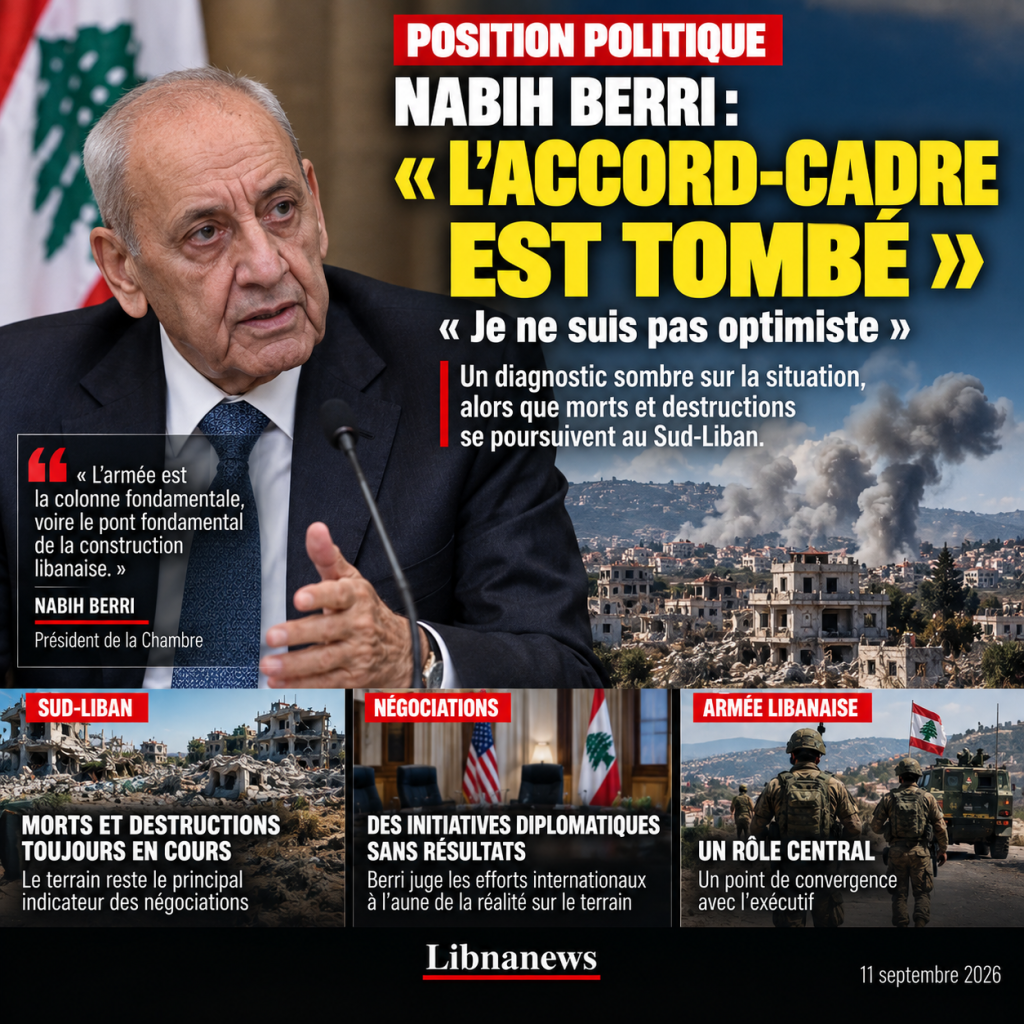
The Speaker of the Chamber, Nabih Berri, delivers Friday, September 11, one of his most pessimistic diagnoses on the Lebanese situation. « I’m not optimistic, » he says, adding that « the framework agreement has fallen. » Behind these formulae is a conviction: diplomatic initiatives are of value only if they change the situation in South Lebanon in concrete terms. Deaths, destruction and the continuation of operations on the ground now feed his appreciation, while the executive continues to rely on diplomatic mechanisms.
An unusually dark diagnosis
The choice of words is unusually dark for an official who has occupied a central place in Lebanese negotiations for decades. In an interview published on September 11, 2026, Nabih Berri does not seek to maintain the idea of an upcoming breakthrough. It describes a general dangerous situation and considers that solutions remain remote. His « I’m not optimistic » should therefore be read as a political assessment of the current state of discussion.
His diagnosis is based first on what is happening in the South. The death, destruction and continuation of Israeli operations are the main elements invoked. The last few hours have been marked by explosions, strikes and destruction in several southern areas. For Berri, the land thus becomes the main instrument for measuring diplomatic efficiency.
Nabih Berri says « framework agreement has fallen »
The formula has an even stronger political scope. By saying that « the framework agreement has fallen », Nabih Berri is not content to regret the slowness of the discussions. It considers that the framework intended to allow for a change in the situation no longer produces the expected results. Berri does not, however, formally announce the end of any negotiations and does not present a complete alternative architecture in the comments.
This is important because the Speaker of the Chamber remains one of the most experienced Lebanese interlocutors on South-related issues. His views are observed as those of the Head of Parliament and the Amal movement, but also as an indicator of the state of the political channels surrounding the southern front. His message therefore targets Lebanese officials as well as mediators and external actors.
Land rather than diplomatic movements
Berri sets a concrete criterion for judging international efforts. Meetings, diplomatic movements and messages transmitted between capitals are not a step forward in themselves. They must result in a decline in violence, a decline in destruction and a visible development in the situation in the South. Otherwise, diplomatic activity can be intense while remaining without real effect.
Recent events reinforce this pessimistic reading. In Mansouri, in Tyre District, most of the public school was destroyed on Friday morning after being directly threatened two days earlier. Housing and infrastructure destruction have also been reported. On Thursday evening, a particularly powerful explosion in the area of Ali al-Taher near Nabatiyah caused vibrations detected by seismological stations.
A difference of tone with the executive
The language of the Speaker of the House contrasts with that of the Executive, which continues to work through available diplomatic and institutional mechanisms. Prime Minister Nawaf Salam insists on the presence of the army and state institutions in the South as well as the conditions necessary for the return of the inhabitants. The Council of Ministers also approved a draft law to prevent sales and disposal of property in areas occupied by the Israeli army.
However, this difference in appreciation should not be transformed into an institutional breakdown. Berri does not question the role of the state or the role of the army. The difference is mainly about the assessment of the diplomatic sequence: the executive continues to rely on the available mechanisms, while the Speaker of the Chamber considers their results to be in the hands of a land always marked by destruction.
Army, point of convergence
On the Lebanese army, Berri’s speech is particularly supported. « The army is the fundamental column or even the fundamental bridge of the Lebanese construction, » he says in the interview reported on Friday. His pessimism about diplomacy is therefore not accompanied by a questioning of the role of the military institution. On the contrary, it places it at the centre of stability and reconstruction of the State.
This position is consistent with that of the government. Nawaf Salam also described the presence of the army and public institutions in the South as a confidence-building factor for residents wishing to return to their villages. Despite different assessments of the effectiveness of the negotiations, institutional leaders continue to place the deployment of the State and its army at the centre of any lasting stabilization.
South weighs on all negotiations
The problem raised by Berri is the gap between diplomacy and daily reality in South Lebanon. The political objectives are known: to stabilize the border, to strengthen the deployment of the army, to allow the return of the population, to resolve the issue of the occupied sectors and to prevent further escalation. On the ground, these objectives continue to face military operations and destruction, which make any return more difficult.
The destruction of buildings alters the nature of the problem. A family can obtain the theoretical possibility of returning to their village and no longer have a habitable dwelling. The destruction of a school such as Mansouri adds another dimension: return involves housing, but also schools, roads, water, electricity and utilities. The Government now refers to prefabricated housing as a temporary solution in some villages.
What does the fall of the framework agreement mean?
Berri’s statement opens a political question: if the « framework agreement has fallen », what mechanism can replace it? The Speaker of the Chamber does not provide any new detailed arrangements in the statements reported on Friday. It is more like a failure of the current framework than the announcement of an alternative. This is precisely what gives weight to his pessimism.
Berri is usually associated with political practice based on negotiations, arrangements and long-term compromises. Its lack of optimism therefore does not simply mean that one official considers the situation bad. It states that an actor directly involved in the political mechanisms surrounding the Southern issue does not see, at this stage, the conditions for announcing a near outcome.
A warning to mediators
The declaration can also be understood as a warning to international actors involved in the discussions. Mediation of political value only when it produces an observable change: reduction of deaths, cessation of destruction, return of inhabitants, effective deployment of the army and restoration of state authority. The number of visits and meetings is not sufficient to demonstrate its effectiveness.
This requirement explains the strength of Berri’s expression. It moves the debate of the diplomatic procedure towards its results. A mechanism can continue to exist administratively while losing its political credibility if the events that it was to prevent continue. This is, in essence, the pessimistic statement made by the Speaker of the House.
Next days as a test
The government does not give up diplomatic instruments. He works simultaneously on the presence of the State in the South, the return of the inhabitants and the legal protection of their property. The two readings are therefore not entirely incompatible: the executive is still trying to build an exit, while Berri warns that this exit does not yet materialize on the ground.
The contrast is mainly due to the degree of confidence in the current process. On Friday 11 September, Nabih Berri chose not to leave any ambiguity: he was not optimistic and considered that the framework agreement had fallen. Future developments will therefore be judged less on the number of meetings announced than on the deaths, destructions, the return of the inhabitants and the ability of the Lebanese State to effectively recover in the sectors concerned.




