

Michel EdmondGhanem
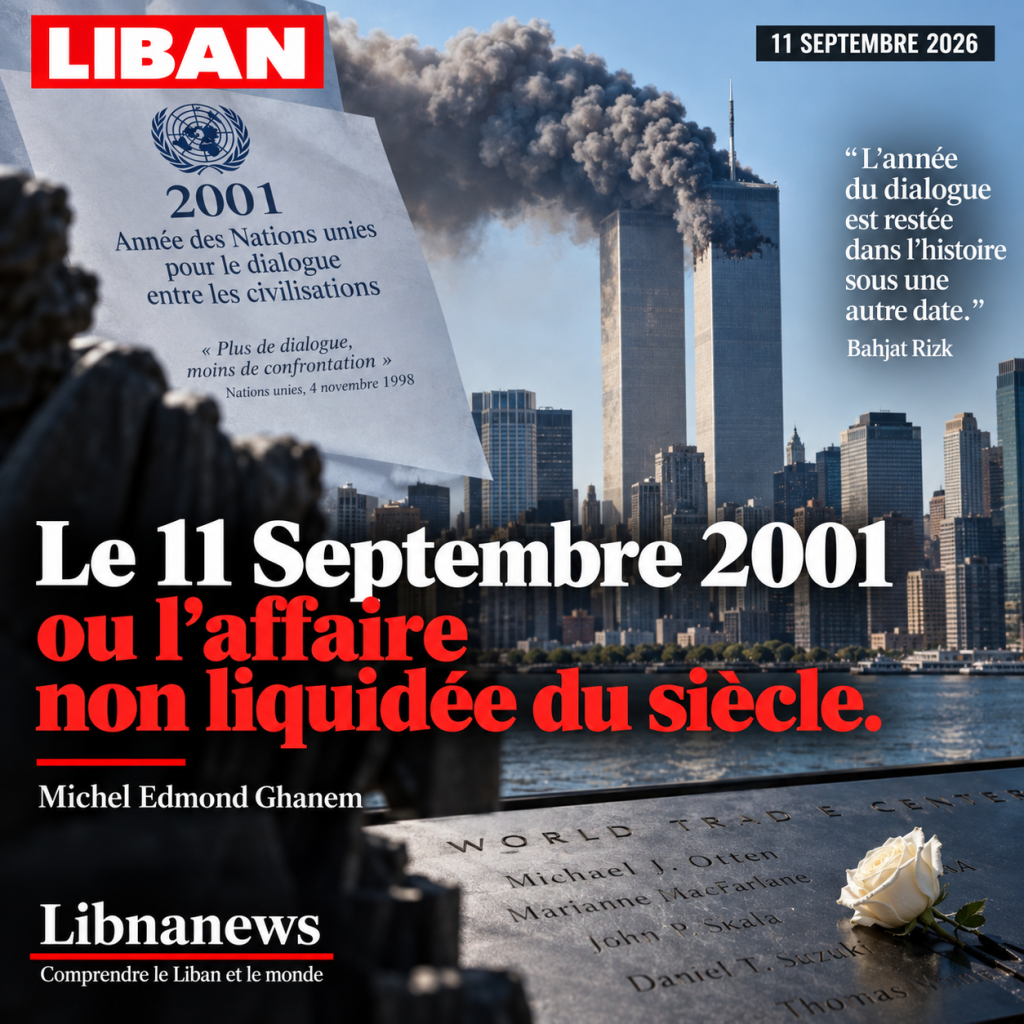
On 4 November 1998, the UN General Assembly adopted without a vote a resolution proclaiming the year 2001 as the United Nations Year of Dialogue among Civilizations. The text had been proposed a few weeks earlier by Iranian President Mohammad Khatami, in explicit response to Samuel Huntington, whoseThe Shock of Civilizationshad just imposed itself as the world’s grammar after the cold war. In the year 2000, Unesco published a global cultural report on cultural diversity, pluralism and conflict, noting that most conflicts within nation states now have a cultural component. IXndfrancophonie Summit was scheduled to be held in Beirut in October 2001, on the theme of cultural dialogue: the first Francophone summit in an Arab country, chosen for what it was supposed to demonstrate.
We know the rest. The summit was postponed for a year and was held in Beirut from 18 to 20 October 2002, with the same theme and a declaration which, meanwhile, became a self-defence play. On 2 November 2001, seven weeks after the attacks, the Unesco General Conference adopted in Paris the Universal Declaration on Cultural Diversity. Bahjat Rizk, who was a member of the Lebanese delegation in this forum for 35 years, notes irony in his last book: « the summit on the dialogue of cultures was postponed by the clash of cultures. The year of the dialogue has remained in history under another date.»
It is this date that we commemorate for the twenty-fifth time. I think it’s worth asking what it commemorates exactly – and asking for it against a reading that has been imposed in the meantime, that which holds the cultural as a second variable, invoked by the powers when their interests need a dressing. It’s the most reassuring reading, because it clears us of customs. She is also, I believe, the one who disarmed us.
What 1919 had already decided
The habit was taken to treat September 11 as a beginning: beginning of the century, beginning of a new war, entering an age of terror. He’d be more right to see a return. What turned out that day had been put into shape eighty years earlier, between 1914 and 1923, during the first globalization of the identity issue.
The great empires – Ottoman, Habsburg, Russian, etc. of which Amin Maalouf is nostalgic – had not solved the plurality: they had administered it, by hierarchy, differentiated tax, personal status, and establishment of themillets for the Ottomans. Coexistence without equality, but coexistence. Their collapse left a void that the Wilsonian principle of nationalities undertook to fill in with a unique form, the nation-state, generalized to spaces that were not prepared there. Applying the right of peoples to self-determination in a mixed space implies first defining the people. The criterion must therefore be chosen: language, blood, religion, morals. We need to identify, classify, sort. And when the criterion does not coincide with geography, geography remains to coincide with the criterion.
It is precisely this logic that led in 1915 to the deportation and extermination of Armenians from the Ottoman Empire. And it is the same logic, pushed to its educational consequence, which is practiced in Antoura, in the Lebanese mountain, where an orphanage was set up for the surviving children: they were given Turkish names, they were taught Turkish, they were converted (see M.E. Ghanem, Les Voix d’Antoura). Four parameters rewritten administratively, on children, one by one, in a register. What the border could not align, the school could. This example is not isolated. Let us look at the world around us; the examples are legion.
The sequel is known and reads as a series of dates: Sykes-Picot agreement in May 1916, Balfour declaration in November 1917, treatise of Sèvres in August 1920, proclamation of Greater Lebanon on the 1standseptember 1920, Treaty of Lausanne in July 1923 -assembled a convention of compulsory exchange of populations which moved more than one million Orthodox Christians and a few hundred thousand Muslims, and which made the disentanglement of peoples a clause of international law. Borders were drawn by men who did not live within, according to selected parameters from outside: religion in Lebanon, dynasty elsewhere, language in Central Europe. One hundred and ten years after Sykes-Picot, the Gaza Strip was again cut off by a temporary route: the « yellow line » of the ceasefire of October 2025, a mobile, poorly defined deployment line, which decided every day who could circulate and who was shot. The line is direct: Balfour in 1917, the mandate, the division of 1947. They’re not analogies, they’re the same file. Century waited 1944 for Raphaël Lemkin to forge the wordgenocideand 1948 for a convention to define it. He named the thing after doing it twice.
We still live in this architecture. Today’s conflicts – Ukraine, Palestine, Lebanon, Nagorno-Karabagh, New Caledonia – take place, with few exceptions, on lines drawn between 1919 and 1923, or on those inherited by decolonization from a similar gesture. In Ukraine, Russian justification is still based on language and narrative: the assertion that the Ukrainian nation does not exist as such, on a border inherited from the dissolution of an empire. The parameter invoked in 2022 was 1919.
The 1946 Denial
Bahjat Rizk’s own contribution lies in a rapprochement of texts, and this rapprochement is more effective than a theory.
Book VIIIInvestigationHerodotus reports the Athenian response to Sparta emissaries: « what unites the greek world is the common tongue, blood, shrines and sacrifices, the same manners » Four elements, set out around 450 B.C.E., not to be defended but because they were observed. Herodotus does not take sides between the Greeks and the Persians; He knows.
Twenty-five centuries later, the Constituent Act of Unesco, adopted on 16 November 1946, urged the Organisation to promote understanding among nations « without distinction as to race, sex, language or religion ». The same grid, term for term or almost, with the inverted sign. Where Herodotus lists what unites, the charter lists what must be overcome.
Rizk draws an unpleasant consequence: post-war universalism was based on a negation, not a definition. He proscribed identity parameters without describing them, which amounts to banning one vocabulary without proposing another. The identities thus struck by illegitimacy do not disappear; they only cease to be negotiable, and return by way of deed. The institutional symptom of this denial is recognizable: we gladly republishRace and history(1952), where Levi-Strauss philosophically founded the universalism of the house, and he buriedRace and culture(1971), where he casts doubts on the prolonged cohabitation of cultures in the same space. The first text became a heritage; the second, an incident.
Hence the proposal, modest in its statement and considerable in its effects: to recognize the parameters -religion, language, race, morals – as a framework of prior description, to be able to negotiate before the conflict rather than arbitrate afterwards. Not to consecrate them, but to stop being surprised every time they come back.
2001: a conflict without borderss
What distinguishes September 11 from the wars of the previous century is neither its record – 2,977 dead, less than an ordinary day of the war of 14-18 – nor its cruelty. It’s her lack of territory. For the first time, a world-wide confrontation opposed a state to something that was not a state, without a front, without a capital, without a population to defend, and whose organization itself reproduced the form of its economic opponent: a nebula, transnational financing, diasporic recruitment, and instant communication. The target had been chosen for its symbolic function, at the financial centre of the world known as « free ». The cultural conflict had acquired property that defined globalization: deterritorialization.
The answer was immediately territorial. We fought Afghanistan, then Iraq, as if the enemy had had a capital; By force the only grammar available, that of the state against the state, is restored. Rizk observes that the United States continues to act in the world as a super-nation state, while its internal space is composed of languages, races and different denominations – and that one day or another they will have to ask themselves inside the question they deal with outside.
Huntington had laid himself, and this is the most instructive point. InWho are we?(2004), the theoretician of the clash of civilizations turns to American identity and concludes that its survival requires the reaffirmation of the founding values: white, Anglo-Saxon, Protestant, those of the Founding Fathers. A racial criterion, an ethno-linguistic criterion, a religious criterion, a moral criterion. The parameters of Herodote, identically, two thousand five hundred years later, under the pen of the one who claimed to describe not a nation but the world. The clash of civilizations was less a prophecy on the planet than the mirror of a national concern projected upon it. September 11th did not check it: it made it irrefutable, which is not the same thing.
Anticulturalist objection, and why I’m not
This reading comes up against a school which must be said from the outset that it is the most rigorous in the French field, and that it is right about almost everything that is verifiable.
Ghassan Salamé, inThe temptation of Mars(Fayard, 2024), treats culturalism as an solicitation of culture out of its own domain, recurring with every acceleration of history, and mobilized to fracture where one hoped for convergence. The real object of the book is elsewhere: the deregulation of the use of force, the stench of multilateralism, the capping and then the reflux of the democratic wave, a missed historical opportunity to build a balanced order. Cultural is a symptom, not a cause. Karim Émile Bitar, a prominent political scientist, develops a more tightened version of the same position: what followed September 11 is explained by decisions taken in Washington, namely the neoconservative ascendant, the Iraq war, the outsourcing of torture – and not by a loophole between civilizations; and in Lebanon, the exit from crisis requires citizenship, institutional reform, deconfession, not the consecration of communities.
On the causes of the 2001-2003 wars, they are right and Huntington is wrong. No need for culture to explain Iraq’s invasion: archives are enough. My disagreement is not about what triggered these wars, but about what made them dictable, transmissible, and what came back after them.
So three remarks.
The first one is logical. To say that the crop has been sought out of its field assumes that this field is delimited. So far no one has defined it. We do not have a shared definition of culture – Unesco itself has forsaken it, and this is the fact that Rizk left after thirty-five years spent inside the house. One cannot blame a concept of crossing a border that has never been traced. What the anticulturalist thesis describes as abuse is in reality a vacancy: if culture is summoned everywhere, it is because it is legitimately assigned nowhere. Instrumentalisation is not the effect of an excess of culture in politics, but of a lack of definition.
The second is probationary. The reproach to Huntington is not to be rebuttable. Is the reverse thesis more? If any identity conflict comes back at last to interests, then the stability of the grid throughout the centuries becomes a coincidence: Herodotus lists the language, blood, shrines and morals around 450 B.C.E.; Fichte, in 1807, in Berlin, under the Napoleonic occupation, states language, religion, race, culture; Renan, in 1882 at the Sorbonne, after the loss of Alsace-Lorraine, denied point by point the same criteria; Unesco banned them in 1946; Huntington reaffirmed them in 2004 to define America. Five texts, two thousand five hundred years, four terms. When the affirmation and denial of an identity borrow the same lexicon, this lexicon is not an epiphenomenon of politics: it is the language of politics. A variable that never varies is something other than a dependent variable.
The third is strictly political, and that’s where the backfoot is. Salamé’s multilateralism and Bitar’s citizen reform are both heirs of 1946: they answer the identity question by declaring it illegitimate. But the Lebanese century is the counter-test in both directions. The denominational quota poisons – men cannot simultaneously be divided into categories and reunited, nor can they be forcibly reunited. But the proclamation that confession is not a political fact never, not once, disarmed a militiaman. She only moved the question out of the available language, where she continued to operate without a contradictor. Between the quota and the denial, there is only one place left: to name the parameters to negotiate them, before the move to the act rather than after.
Finally, there is a biographical detail that I do not want to use as an argument, because it is not one, but one that illuminates a collective trajectory. Ghassan Salamé was Minister of Culture of Lebanon from 2000 to 2003, and he chaired the organizing committees of the Arab Summit of March 2002 and the Francophonie Summit of October 2002 – this summit of the dialogue of cultures displaced by September 11. He was institutionally the man of the cultural moment. Twenty-two years later, he wrote the withdrawal. One year after this withdrawal ofThe temptation of Mars« , he becomes again Minister of Culture. I see no inconsistency: the decade of dialogue was not refuted, it was simply abandoned, because it proved to be inoperative. But abandoning a spade for lack of handle did not amount to demonstrating that it was the wrong tool; And an agronomist says so.
However, Rizk’s grid says which criteria are at stake and not which one should prevail: it opens negotiations, it does not conclude. That’s his limit, and his honesty. No method will exempt arbitration, and arbitration is political. But negotiating on recognized terms is still something more than fighting on prohibited terms.
What we commemoratetoday
Twenty-five years later, the asymmetry of memory is itself a political fact. The dead in New York, and Washington have a name, a memorial, a date, an annual public reading. The deaths of the following two decades have no stable date or count: according to the methods, Iraqi estimates vary by a factor of five. A society commemorates what it can name. Memory is a parameter among others, and the most discreet: it decides what happened.
I wrote these lines in September 2026, while an open war between Iran and Israel and the United States since February, with a goal of changing the regime. The country of Mohammad Khatami, which had proposed to the General Assembly to make 2001 the year of dialogue, is now bombarded according to the 2003 grammar – and Iran is precisely one of the few states in the region that 1919 did not invented, which shows that the parameter operates there without the need for a mandate boundary: since 1979 it has been religious and is projecting outside.
11 September 2001 is not the date of a clash between civilizations, entities that no one has ever been able to delimit: on this point, anticulturalists have won, and they must be granted it without reservation. This is the date when the unliquidated case of the previous century – a plurality that the empires had administered and that the nation-state did not manage to contain – appeared again in a world without internal borders, where neither territory nor citizenship is enough to situate an opponent. Having refuted Huntington didn’t make us able to deal with the problem. We may have won a controversy and lost twenty-five years.
So what we should commemorate is not the attack. This is our continuing inability to define what we claim to be defending, and the price others pay regularly for this lack of definition.
The century has shown that a name can be changed in a register. He did not show that a parameter could be erased by decree.
To go furthersome references:
Bahjat E. Rizk,Ambivalence of politics and culture. 35 years at Unesco, Erick Bonnier Editions, 2026. From the same author:Parameters of Herodote or collective cultural identities,EditionsEast Day, 2009.Michel Edmond Ghanem,Voices of Antoura,PublishingCalima Artliban, 2026. From the same author:For a policy of recognition of cultures, RevueStudies 2026/5 N° 4337 , pages 19 to 30. Ghassan Salamé,Mars’ temptation. War and peace in the XXIecentury, Fayard, 2024. From the same author:When America Remakes the WorldFayard, 2005. Samuel Huntington,Who are we? National identity and cultural shock, Odile Jacob, 2004.




