





Saudi Arabia returns to the Lebanese case with a method that is significantly different from that which has long characterized its influence in Beirut. It is no longer just a question of supporting political allies, financing institutions on an ad hoc basis or announcing spectacular aid. The approach that is emerging focuses on several levels: restoring economic relations, strengthening institutions, accompanying the army and maintaining a prudent distance with the international military arrangements that will emerge in the South.
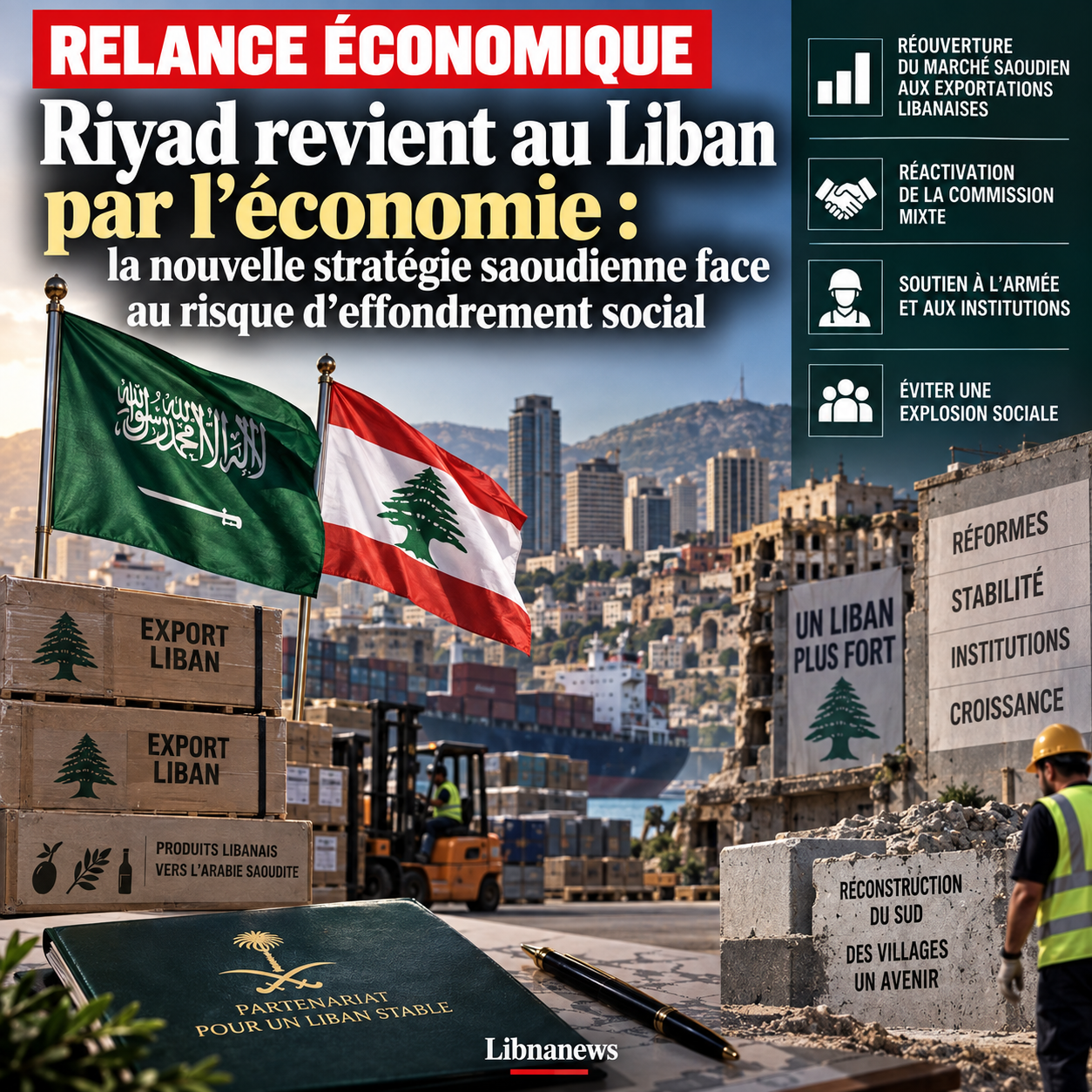
The meeting in New York between Prime Minister Nawaf Salam and Saudi Foreign Minister Faisal bin Farhan gave a first official translation to this orientation. The two officials discussed the reactivation of the Lebanese-Saudi Joint Commission after the lifting of the blockade on Lebanese exports to the Kingdom. The prospect is for a resumption of trade and gradual economic normalisation, at a time when Beirut is at the same time trying to convince its international partners that the reform cycle has really begun.
Behind this approach is also a quieter battle. Lebanon remains exposed to profound social fragility. Revenues are low, bank deposits are not settled, public services are still weak, and the destruction caused by the war is particularly affecting the South. A new social explosion could change the political balance. Above all, it could strengthen organisations already able to provide direct assistance, accommodation, services or compensation to their environment. Hezbollah’s announcement of its own housing, repair and reconstruction assistance programme gives this issue an immediate reality.
In this context, bringing the Lebanese economy back into motion is no longer just a growth objective. For Riyadh, as for other Beirut partners, strengthening the state can also become a means of reducing the economic and social vacuum in which the partisan apparatus has a structural advantage.
Trade before the billions
The first feature of the new Saudi approach is that it does not start with the announcement of an amount.
Riyadh reaffirms its interest in supporting the Lebanese army and institutions. However, no final figures were announced for a new military or financial envelope. This is in contrast to the times when the relationship between the two countries was regularly measured against the billions pledged or committed.
The immediate priority seems to be more structural: to restart the normal channels between two states.
The reactivation of the Lebanese-Saudian Joint Commission responds to this logic. Such a structure may seem technical. However, it directly affects trade, investment and mechanisms to address administrative barriers between the two countries. Its reactivation is gaining more weight with the reopening of the Saudi market to Lebanese exports.
For Lebanon, the stake is considerable. The Gulf market has long been a natural outlet for part of its agricultural, agri-food and industrial production. The restrictions imposed in recent years have therefore not only reflected a diplomatic crisis. They have affected producers, businesses, carriers and entire regions.
The reopening can offer oxygen without going through the classic logic of public aid. A Lebanese product sold in Saudi Arabia generates an activity that spreads throughout the economy: production, packaging, transport, insurance, financing and employment. This mechanism is less spectacular than a donation, but potentially more sustainable.
This is one of the most interesting changes. The relationship with Riyadh could gradually shift from assistance to exchange, and from political support to a logic of mutual economic interests.
Support now conditional on the state
However, this return is not unconditional. Saudi signals are part of an environment where Lebanon’s partners demand results on three issues: State sovereignty, reforms and the functioning of institutions.
The government of Nawaf Salam promises to concentrate weapons in the hands of the state. At the same time, it defends the Israeli withdrawal from all occupied Lebanese territories and seeks to relaunch the reforms necessary to restore financial confidence.
These three files are linked.
A State that does not control its security struggles to attract investment. A financial system unable to address the issue of deposits and losses discourages the return of capital. An administration whose services remain deficient reduces the effectiveness of any foreign aid. And an unstable military situation in the South makes any long-term economic project particularly risky.
Saudi support for the army thus takes on a different dimension. It is not just about strengthening an institution appreciated by Arab and Western partners. The army is expected to become one of the essential instruments for the restoration of state authority, especially in the South.
This approach is in line with the Beirut discourse on the need for a single State capable of assuming responsibility for security and military decision-making. But it immediately encounters the most sensitive problem of the Lebanese landscape: Hezbollah’s weapons.
The social battle behind the battle of arms
Reducing the balance of power between the State and Hezbollah to the issue of missiles and fighters alone would be insufficient. The power of a party is never based exclusively on its military apparatus. It also depends on its social location, its institutions, its ability to mobilize and the services it can provide to its environment.
It is here that the Lebanese economic crisis becomes a major political problem.
The war has displaced families and destroyed or damaged housing. People still cannot find their villages in normal conditions. The needs for accommodation, repair and reconstruction are significant. At the same time, Lebanese public finances do not allow the State to respond quickly to all requests.
Naim Kassem precisely chose this ground to announce that Hezbollah would participate directly in the effort. The party intends to mobilize its own resources, donations and available aid to contribute to housing, repairs and reconstruction. At the same time, it calls on the State to fulfil its responsibilities.
The political significance of this announcement is obvious, even if its actual effectiveness will have to be measured on the ground. When a family loses its housing, the first institution capable of providing a solution becomes more important than the financial value of the aid.
In the affected regions, reconstruction is therefore also a competition for institutional presence.
If the State is absent and a partisan organisation provides accommodation, finances repairs and accompanies families, it mechanically strengthens its social role. Conversely, when public institutions respond to needs, the relationship between the citizen and the State is strengthened.
That is why economic recovery and reconstruction can have as many political consequences as arms negotiations.
The risk of a social explosion
This question goes beyond the South.
Lebanon remains plagued by a number of discontents. Wages have lost much of their value in the years of crisis. Purchasing power remains fragile. Depositors are still waiting for a lasting solution to the money held in banks. Public services are insufficient, and electricity, administration and infrastructure issues remain at the heart of criticism.
Social discontent now appears in political discourse. Naim Kassem explicitly stated that citizens have the right to protest and protest against their living conditions. He challenged the government on the economic situation, utilities, electricity and bank deposits.
This position deserves to be looked beyond its rhetorical dimension. It shows that the social crisis can become a new ground for political confrontation.
A social explosion would not automatically benefit Hezbollah. The party itself faces the consequences of the war, the considerable needs of its base and a difficult regional environment. But a deep crisis does not strike all actors in the same way.
Parties with a structured local network, associations, community relays, financial resources and the ability to distribute aid directly have an advantage over those whose action depends almost entirely on a paralyzed state.
The paradox is therefore important: the impoverishment of Lebanon does not necessarily mean the proportional weakening of all political forces. On the contrary, it can increase people’s dependence on organizations that can replace public institutions on an ad hoc basis.
It is in this sense that Saudi economic return takes on a strategic dimension. Support for a productive economy and institutions capable of providing services also means reducing the abandoned space to parallel aircraft.
However, it would be excessive to say that Riyadh is acting explicitly for fear of a social explosion that would benefit Hezbollah. The available evidence does not allow such motivation to be established as an official Saudi position. But the risk exists in the Lebanese equation and allows us to understand why economic stabilization is inseparable from the restoration of the state.
Yazid bin Farhan expected in Beirut
The expected visit of the Saudi Lebanese adviser, Yazid bin Farhan, is expected to clarify this direction.
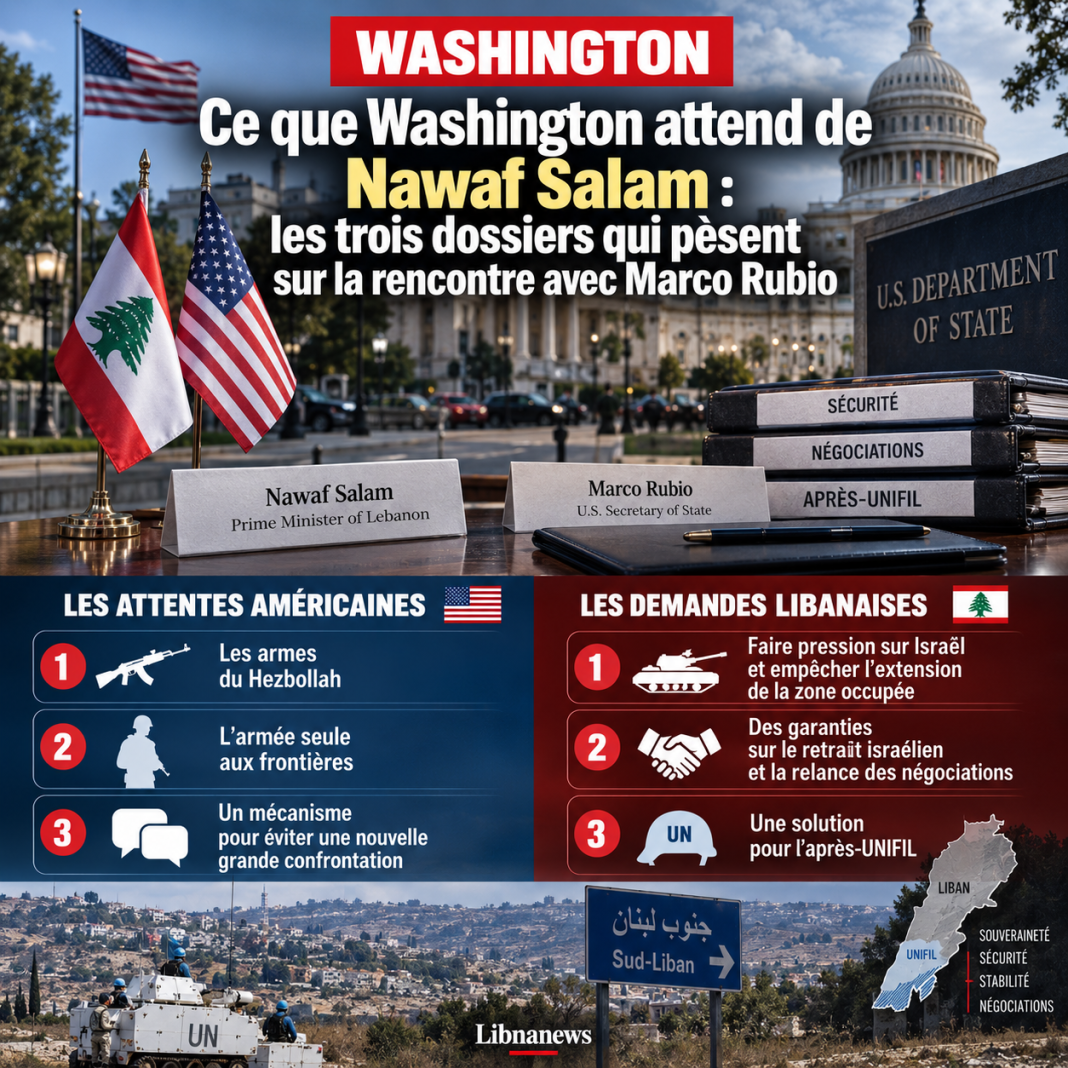
Its displacement occurs in a particularly dense period. It must coincide with discussions on the security future of the South and with the search for a formula to avoid a vacuum after the end of the UNIFIL mission.
The calendar is not trivial. He puts Riyadh in contact with a case where security, diplomacy and reconstruction meet. But Saudi Arabia seems to want to carefully define the limits of its involvement.
The kingdom supports the Lebanese state and the army. He can participate in the economic effort. He can use his diplomatic weight with his Western and Arab partners. On the other hand, it does not appear to seek to move directly to the centre of an international military device in the South.
This distinction allows us to understand the general logic: to help Lebanon strengthen its own institutions rather than create a Saudi substitute mechanism.
For Riyadh, direct military involvement in an environment in which Israel, Hezbollah, Iran, the United States and the United Nations are associated would pose significant risks. Support for the Lebanese army offers a less exposed and politically more coherent path with the defence of State sovereignty.
After UNIFIL, red line of Saudi prudence
The planned end of the UNIFIL mission adds a special urgency.
Lebanon wants to avoid a security vacuum in the South. Several avenues are being explored to maintain an international presence in a different form. But the definition of a new device remains complex. Its mandate, personnel, relationship to the Lebanese army and role in border surveillance must be determined.
Riyadh would not, in the above-mentioned configuration, be intended to directly provide forces to such a mechanism.
This reservation does not mean disengagement. Rather, it reveals a division of roles. Territorial security should return to the Lebanese army. The international mechanism should be used as a back-up or monitoring mechanism. Arab partners could help finance, equip and consolidate the State.
This pattern also responds to an ancient Saudi concern: to avoid Lebanon becoming the direct ground for a confrontation between regional powers.
The kingdom has politically paid the price of its past Lebanese commitments. A new institutional-based strategy would maintain its influence without reconnecting with a confrontational logic by interposed actors.
Rebuilding the South without rebuilding a parallel state
Reconstruction will probably be the most concrete test of this policy.
Destruction is significant and needs exceed the immediate capacity of the Lebanese Treasury. Families need housing even before political discussions on reconstruction financing are completed. This emergency gives a clear advantage to structures that can quickly mobilize money.
Hezbollah understood. In announcing its future housing programme, it seeks to respond immediately to its base while stressing the inadequacy of government action.
The state therefore faces a double challenge. It must physically rebuild villages and politically rebuild its presence.
A dwelling financed by a public institution does not only have a real estate value. It shows that the State assumes responsibility. A repaired road, a re-serviced school or a paid allowance has the same effect. Conversely, every essential need that only partisan structures respond to reinforces the idea that the state is secondary.
Saudi aid could find a particularly sensitive land here. But its shape will be decisive.
Financing public institutions directly does not have the same consequences as distributing aid through political networks. Supporting productive infrastructure does not have the same effect as a one-time relief programme. Helping businesses export creates economic autonomy that does not create an exceptional allocation.
It is probably in this distinction between assistance and economic capacity that the new Saudi strategy can be the most significant.
Exports, first concrete test
The lifting of restrictions on Lebanese exports to Saudi Arabia is an immediate test.
The result will not only be measured by the number of tonnes exported. It will be necessary to observe whether Lebanese companies actually succeed in regaining the market, whether agricultural producers benefit from the reopening and whether logistical and regulatory obstacles are removed.
The Lebanese agricultural sector is already suffering from high costs and significant competition from imported products. The possibility of finding solvent markets in the Gulf can improve the situation in some sectors.
The same reasoning applies to agri-food and several small industries. Lebanon will not return to sustainable growth only through domestic consumption. Its market is too small and its purchasing power is too weakened. It must find external outlets.
Saudi Arabia can help without necessarily transferring billions to the government.
It is a less visible form of support but, if it works, reduces dependence on aid.
Army as second pillar
After the economy comes the military question.
Riyadh affirms its support for the Lebanese army, but the precise contours of new assistance remain to be defined. Yet the needs are important. If the army is to expand its deployment, control more territory and become the reference security authority in the South, it will need additional resources.
It’s not just heavy weapons. Needs include mobility, communications, monitoring, infrastructure, salaries and the ability to sustain units in the field.
International support for the army must therefore be seen as an investment in the capacity of the State.
The issue is also political. A weak army leaves the debate on sovereignty in the area of principles. An army capable of fulfilling the tasks entrusted to it allows the government to gradually transform these principles into reality.
But military aid will not solve the problem of Hezbollah’s weapons alone. It remains political before being technical. A better equipped military institution does not remove the need for a national agreement on the role of resistance, security guarantees and defence strategy.
Riyadh seems precisely to want to avoid confusing these two dimensions: strengthening the state without replacing the Lebanese dialogue.
A State-to-State relationship
The formula that is emerging is ultimately a more general transformation of Lebanese foreign policy.
Nawaf Salam insists on institutional-led relations. The same principle is upheld in relations with Iran: Lebanon wants to maintain relations with States, but refuses to allow them to go through armed organizations or parallel channels.
The relationship with Saudi Arabia offers the positive side of this doctrine. Joint commission, government, army, trade and investment: the instruments mobilized belong to the normal functioning of relations between two States.
This standardisation may be more important than the announcement of a new aid programme.
For years, Lebanese policy has been structured by the question of which local actor was supported by what regional power. The logic sought today is, at least officially, to place the state at the centre of these relations.
The success of this approach will, however, depend on its ability to produce results that are perceptible to the population.
Real competition takes place in the social field
This is where the main challenge lies.
The citizen does not measure the restoration of the state only through discourses on sovereignty. It measures it to the operation of a school, to the electricity available, to the possibility of recovering its money, to the state of a road or to the aid received when its house was destroyed.
If the institutions fail on these grounds, the restoration of political authority will remain abstract.
Hezbollah has a very long experience in building social networks parallel to or complementary to those of the state. Its announced project to support housing and reconstruction shows that this function remains at the heart of its relationship with its base.
For Lebanon’s partners, therefore, the answer cannot only be security.
A State capable of controlling a border but unable to support its citizens will remain fragile. Conversely, an economic improvement without restoring public authority would leave the problem of sovereignty intact.
Preventing the social crisis from reshaping the balance of power
It is in this articulation that the risk of a social explosion makes sense. A new wave of poverty, unemployment or anger against institutions would not necessarily produce a single political beneficiary. On the contrary, it could fuel the challenge of all traditional forces. But it would encourage organizations on the ground that already have the means to meet immediate needs when the State cannot.
Hezbollah belongs to this category. Its ability to intervene in accommodation, repairs and help its environment allows it to transform a social function into a factor of political resilience. This does not mean that the crisis would automatically strengthen the party. It must itself meet the considerable expectations of a population affected by war and displacement. But the weakness of the state leaves it a space that more effective public institutions could reduce.
The issue therefore far exceeds the traditional rivalry between Riyadh and Tehran. The real challenge is to know which model will meet the needs of Lebanese: a state that is financed, reformed and able to perform its functions, or a country where each community depends more on its own political and social structures.
The reopening of the Saudi market, the revival of the Joint Commission, the announced support for the institutions and the prospect of assistance to the army take on another significance when they are placed in this perspective. The goal is no longer just to help Lebanon through a bad pass. The aim is to restore to the State a capacity for action whose gradual disappearance has enabled parallel structures to become indispensable in certain territories.
A less spectacular but potentially more sustainable strategy
However, this method is weak: it takes time.
Direct help immediately produces a political image. A financial envelope can be announced in minutes. An economic commission, banking reform or rebuilding an export capacity takes months, sometimes years.
Lebanon does not necessarily have that time.
Displaced families need solutions now. Producers need opportunities at the next harvest. Companies must pay their employees. Depositors have been waiting for years. The army must maintain its units while the situation in the South remains unstable.
The difficulty of the new sequence therefore lies in the combination of urgency and reform. If international partners demand that all reforms be completed before supporting, the country may continue to deteriorate during the transition period. But if the aid is paid without condition or control mechanism, the mistakes of the past can be repeated.
Riyadh seems to be looking for a third path: gradually reopening economic channels while reserving the most important financial commitments at a stage when Lebanese institutions have demonstrated their ability to function.
This caution also allows Saudi Arabia to measure results before increasing its commitment.
The reconstruction test
The South is likely to be the first area where this strategy can be judged.
If the State manages to organize the return of the inhabitants, rebuild the infrastructure and mobilize transparent international financing, it will demonstrate that it can take over a function long held in part by local political structures.
If he fails, the vacuum will be quickly occupied.
Hezbollah has already announced that he will not remain a spectator. His commitment to housing and reparations responds to a real emergency, but he simultaneously reaffirms his position as an autonomous social actor. This situation sums up the Lebanese dilemma: the services provided to the population are indispensable, but each function performed permanently outside the State also helps to institutionalize its weakness.
For Riyadh, supporting reconstruction by public institutions could therefore be of dual interest. The aim would be to help the affected populations without rebuilding, alongside the villages, a political system based on dependence on partisan structures.
But this requires a Lebanese administration capable of managing funds, setting priorities and providing sufficient transparency to donors. Reconstruction cannot be sustained by diplomatic goodwill alone.
It therefore brings Lebanon back to its other construction site: reform.
The economy as an instrument of sovereignty
Perhaps this is the main lesson of Saudi return. In Lebanon, sovereignty is not just a matter of borders and weapons.
A State unable to pay properly for its agents, operate its services, protect bank deposits or rebuild a destroyed village necessarily sees its authority eroded. Other actors then take over the functions that he abandons.
The economy thus becomes a component of sovereignty.
The reopening of Saudi markets can support businesses. Cooperation with international financial institutions can help rebuild the banking system. Assistance to the army can strengthen the state’s presence in the South. Reconstruction can restore its link with war-affected populations.
None of these measures will suffice in isolation. Together, however, they draw a very different strategy from the logic of injecting money into a system that remains unchanged.
Saudi Arabia seems to return to Lebanon without wanting to take over exactly the place it once occupied. Less proxy policy, more institutional relations. Less spectacular promises, more trade and conditionality. Support for the army, but caution towards direct military involvement in the South.
The success of this approach will depend as much on Riyadh as on Beirut. The kingdom can reopen its market, encourage investment and support the army. It cannot reform Lebanese institutions in their place.
And that is precisely where the limit of any strategy external to Lebanon lies: partners can strengthen the state, but they cannot replace it without, in turn, contributing to its weakening.
In a country where social anger could become the next political front, the decisive competition may not take place around a diplomatic table. It will be played in the villages of the South, with depositors, in companies, schools and public services. It will oppose less two regional axes than two capacities: that of the State to become useful again and that of the parties to continue to be in its place.