



In Lebanon, drone noise is using nerves
In Lebanon, the sound of drones became a war without immediate explosion. Permanent buzzing sets up a state of alert, disturbs sleep, weakens children, exhausts parents, workers and rescue workers. This sound monitoring transforms the daily into a possible hit. Even in the event of a ceasefire, the cessation of bombings will not be enough if overflights continue to keep civilians in fear.

Palestine: international law without effect
In Palestine, international law is pervasive in speeches, resolutions and judicial decisions. It condemns occupation, settlements, forced transfers and arbitrary detention. Yet its concrete effect remains limited. Palestinian prisoners remained numerous, settlements were progressing and sanctions remained targeted. The gap between legal norms and political constraints feeds into a lasting crisis of credibility of international institutions.

Can Lebanese diplomacy speak with one voice?
Lebanese diplomacy must find a common line while the Iran-USA agreement places the country at the centre of a regional game that it does not control. The Presidency, the Government, Parliament and Hezbollah share some demands, such as the Israeli withdrawal and the cessation of strikes. But the divides remain deep on weapons, Iran and negotiations with Israel. The withdrawal of the Iranian ambassador's accreditation also deprived Beirut of a useful official channel with Tehran.
Lebanese Army: return under caution
The Lebanese army calls on the displaced inhabitants of the South not to return too quickly to the border villages, despite information about a regional ceasefire. The communiqué issued by the leadership emphasizes the risks of Israeli violations, aggression and unexploded ordnance. This puts civil security at the heart of the transition from diplomatic announcement to reality on the ground.

Nabih Berri, forced passage of Lebanese stability
Nabih Berri again becomes a central player in the post-regional agreement. President of Parliament since 1992, Head of Amal and interlocutor of the Shiite tandem, he occupies a place that neither Joseph Aoun, Nawaf Salam, nor foreign mediators can ignore. Its role can facilitate the ceasefire, the return of the South and the dialogue on arms. But its proximity to Hezbollah, internal criticism and international expectations set clear limits.
Stop fire in Lebanon: the five necessary guarantees
The ceasefire in Lebanon can only be achieved if it is based on concrete guarantees. The five minimum conditions are the complete cessation of strikes, the verifiable Israeli withdrawal, the safe return of the inhabitants, the clear role of the Lebanese army and the Finul, and a mechanism for resolving violations. Without these safeguards, the regional agreement announced between Washington and Tehran risks remaining a diplomatic formula with no lasting effect on the ground.

USA-Iran agreement: international community’s cautious reactions
International reactions to the US-Iran agreement combine relief and caution. France, the United Kingdom, the European Union, the United Nations and several Arab countries welcome an opportunity for regional de-escalation. But all insist on implementation, freedom of navigation in the Strait of Ormuz, Iran's nuclear issue and Lebanon's sovereignty. The Lebanese front remains the main test of credibility of the announced protocol.
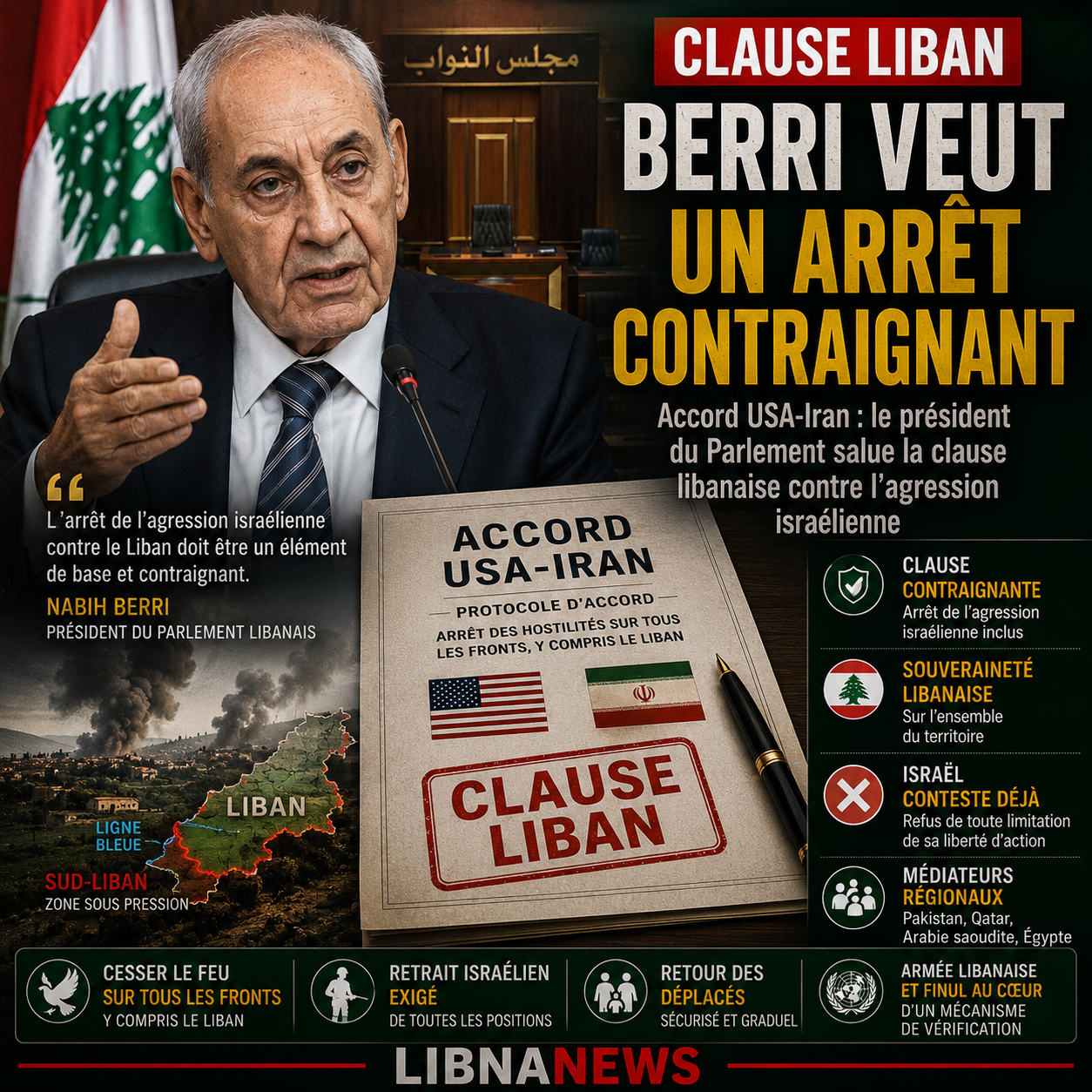
USA-Iran agreement: Berri welcomes Lebanon clause
Nabih Berri welcomed the Memorandum of Understanding between the United States and Iran, stressing the Lebanon clause. For the President of Parliament, the Israeli aggression must be a central and binding part of the text. This position places Beirut at the heart of a diplomatic arm where Israel already challenges any limitation of its military action against Hezbollah.

Southern Lebanon: villages under alert before agreement
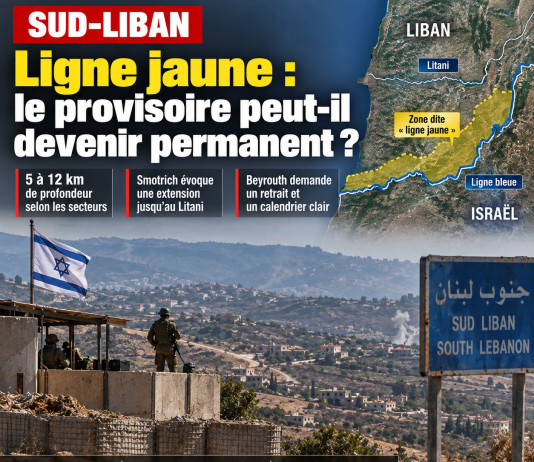
In southern Lebanon, the regional agreement expected on 19 June will be judged on the ground. The evacuation orders, the yellow line imposed by Israel, the roads cut off, the agricultural losses and the uncertain return of the internally displaced persons show that the ceasefire is only valid if it produces concrete guarantees. For Beirut, Israeli withdrawal, reconstruction and the role of the Lebanese army remain the minimum conditions for a return to stability.
Israel refuses the Lebanese side of the deal Iran
Israel hardened its position against the US-Iran agreement and refused to allow the Lebanese side to limit its military action against Hezbollah. Benjamin Netanyahu, Israel Katz, Benny Gantz and Itamar Ben-Gvir each defend, in their own register, the maintenance of freedom of action in Lebanon. This line places the Lebanese front at the heart of the arm between Washington, Tehran and Tel Aviv, while the implementation of the regional compromise remains fragile.
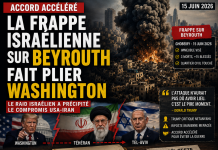
The Israeli strike on Beirut that made the United States fold
The Israeli strike on Beirut had an immediate political effect. By threatening to defeat the Washington-Theran deal, it pushed Donald Trump to speed up the conclusion of a reduced-to-essential compromise: stopping operations, reopening of Ormuz and subsequent negotiations on Iran's nuclear. The episode reveals a growing divergence between Benjamin Netanyahu's electoral calculations and those of the US president, under pressure before the midterms.

‘ALL THE PLACES WE BELONG
In Beirut, a city shaped by migration and diversity, the idea of belonging reflects the complex relationship between identity, uprooting and seeking its place in the world. Art lovers are invited to discover the exhibition ‘ALL THE PLACES WE BELONG

Press review: Lebanon at the centre of the arm between Washington, Tehran and Tel...
The Lebanese press review of 15 June 2026 shows a Lebanon placed in the centre of the arm between Washington, Tehran and Tel Aviv. Hits on Beirut, USA-Iran agreement, Israeli pressure in the South and ceasefire now condition regional balance and Lebanese sovereignty in the face of the risks of major escalation this week.
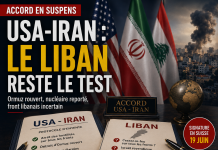
USA-Iran agreement: Lebanon between antagonistic readings
The US-Iran agreement announced in the night opens a major diplomatic phase, but its application to Lebanon remains uncertain. Washington highlights the reopening of the Strait of Ormuz and the end of the naval blockade against Iran. Tehran affirms that hostilities must cease on all fronts, including in Lebanon. Israel still claims its freedom of action against Hezbollah, at the risk of turning Beirut and South Lebanon into an immediate test of compromise.



