





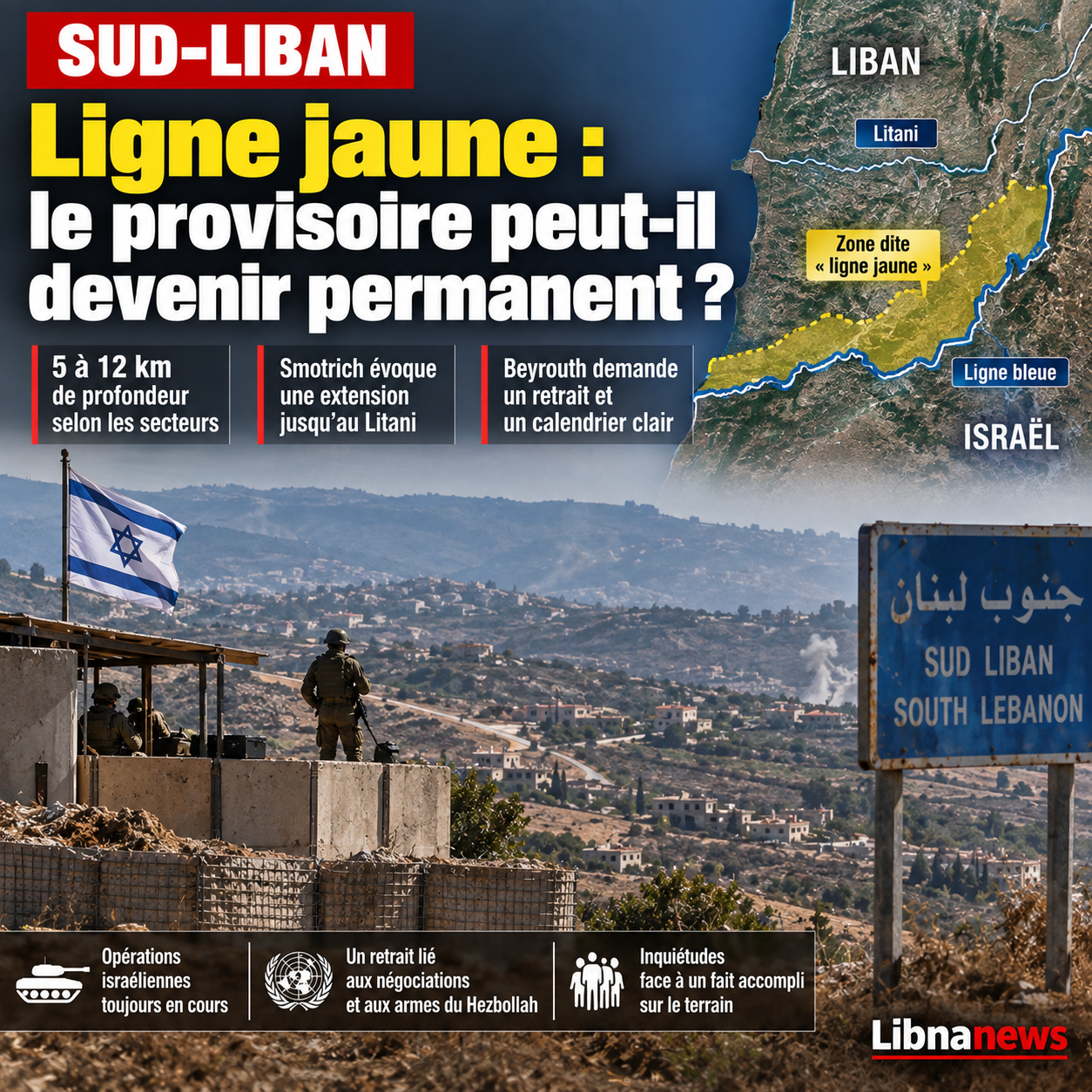
The concept of a « yellow line » gradually settles in the vocabulary of confrontation in South Lebanon. However, it does not correspond to the international border or the Blue Line drawn by the United Nations. In its 29 September 2026 edition, Al Akhbar describes it as an Israeli military device established inside Lebanese territory. The newspaper refers to an occupied area whose depth varies, depending on the sector, between five and twelve kilometres. Israel would present it as an « advanced line of defence », designed first to remove immediate threats from its border communities.
This description takes on a different dimension when it is reconciled with the information published on the same day by Al Araby Al Jadid. According to the newspaper’s sources, Prime Minister Nawaf Salam had received, during his meetings on the margins of the UN General Assembly, American messages indicating that Israel intended to continue its operations and remain in the security zone that it had designed in the South. This information is not an official announcement from Washington or Israel. They reveal, however, the Lebanese fear that a military device presented as temporary will settle over time.
The debate becomes even more sensitive following statements by Israeli Finance Minister Bezalel Smotrich. Asharq Al-Awsat reports on 29 September 2026 that he publicly referred to the annexation of Lebanese territories to the Litani. Al Jumhouria also goes back to these remarks and underlines their contradiction with the Israeli commitment, contained in the negotiations, not to nurture territorial ambitions in Lebanon. Three concepts overlap without being equivalent: the « yellow line », the currently occupied security zone and the Litani. Their confusion could mask very different objectives.
A depth of five to twelve kilometres
Al Akhbar devotes detailed development to the military logic of this « yellow line ». The newspaper claims that Israeli forces are present in villages and localities integrated into what Israel calls a buffer zone. Its depth would vary between five and twelve kilometres.
According to the newspaper, the difficulties encountered at the seventh session of the Rome negotiations were not limited to technical details. Israel has already established a military concept based on this advanced line, while maintaining some freedom of action beyond.
The shade is important. An occupied area would not necessarily be intended, in this reading, to constitute a new political frontier. It would be used to create a military depth between the border and Israeli localities.
Al Akhbar cites the statements of Israeli Chief of Staff Eyal Zamir. It was reported that the mission entrusted to the army was a positioning on a line preventing direct fire against Israeli communities. At the same time, he reportedly mentioned the continuation of operations against threats beyond that line and even north of the Litani River.
This distinction allows us to understand the device described by the journal. The « yellow line » could prevent or complicate some proximity attacks. It would not, however, neutralize weapons capable of acting from a greater depth.
The Israeli ground presence would therefore serve a limited function. It would create a surveillance and intervention zone. It alone would not address the issue of rockets or drones that could be launched from more remote areas.
It is precisely this limitation that could explain the Israeli will to maintain freedom of action beyond the occupied area.
The previous heights of Ali al-Taher
Al Akhbar uses the heights of Ali al-Taher to illustrate this doctrine. After an operation of destruction in this area, the Israeli army began to withdraw from the relief to redeploy to the « yellow line ».
According to the newspaper, Israel was then able to control the area by observation and fire. This approach is important. It means that a permanent occupation of each height would not be considered necessary when the army can retain the ability to monitor and strike at a distance.
The « yellow line » would therefore function less as a conventional border than as a control base.
This approach also gives more flexibility to negotiations. A military line can theoretically be moved. It may decline as arrangements are implemented. It can also be maintained or strengthened if negotiations fail.
Al Akhbar also considers that this mechanism remains linked to a political solution that has not yet matured. The newspaper presents it as a provisional front management formula.
The Lebanese problem is precisely contained in this word: provisional. A temporary military presence can become sustainable when the conditions for its withdrawal are not met.
Messages received by Nawaf Salam
Al Araby Al Jadid’s information reinforces this question.
In its September 29, 2026 edition, the newspaper states that Nawaf Salam received several messages during his stay in New York. The most important would have come from the American side. According to the sources cited, Israel would remain determined to continue its operations and to maintain its security zone in the South until the Lebanese State takes sufficiently serious measures regarding Hezbollah weapons from the point of view reported by those interlocutors.
According to Al Araby Al Jadid, United States officials have reportedly found the steps already taken by the Lebanese Government insufficient. They reportedly called for an acceleration of the process of placing weapons under State authority, warning that the situation might otherwise deteriorate further.
The exact nature of this information must be maintained. They are attributed to the newspaper’s sources and do not correspond to an official US statement. Their importance lies precisely in the gap they suggest between public statements and messages conveyed in diplomatic meetings.
Nawaf Salam continues to defend the negotiating process. Al Araby Al Jadid reports that Lebanese official sources consider this choice difficult but without any real alternative. The Prime Minister was to ask the US officials to urge Israel to implement the framework agreement signed on 26 June and to maintain the negotiations.
Two logics therefore appear face to face. Beirut wishes to use the negotiated framework to obtain a withdrawal. According to reports, Israel links its presence and operations to the evolution of the Hezbollah case.
The « yellow line » thus becomes a pressure instrument as well as a military device.
From military arrangements to political claims
Bezalel Smotrich’s statements introduce an additional dimension.
Asharq Al-Awsat of 29 September 2026 reports that the Israeli Minister of Finance declared that he wished to annex Lebanese territories to the Litani. The newspaper directly asks the question: is it a political auction or the expression of a deeper territorial project?
Retired General Hicham Jaber, interviewed by Asharq Al-Awsat, believes that Israeli ideas about the Litani or annexation of parts of the South are not new. It considers, however, that their reappearance in the current context is more aimed at raising the ceiling on claims than at announcing an immediately applicable transaction.
This distinction is essential. A ministerial declaration is not a decision of the Israeli Government. Nor can it be said that the « yellow line » would be the first stage of an official annexation plan to the Litani.
But the declaration changes the political context in which the military apparatus is interpreted.
Al Joumhouria of 29 September 2026 highlights this problem. The newspaper believes that Smotrich’s comments contradict the part of the negotiated framework in which Israel does not claim Lebanese territory. The Israeli minister is therefore not content to discuss a depth of security. It places the territorial issue in public debate.
This is enough to feed Lebanese concerns.
The Litani is not the « yellow line »
However, the two concepts should not be confused.
The Litani has a special place in resolution 1701. Asharq Al-Awsat recalls that it serves as a geographical reference point for security arrangements within Lebanese territory. This reference does not transform the river into an international border.
The « yellow line » described by Al Akhbar responds to another logic. It lies further south and its depth varies by sector. His position is military. It aims to create a distance between Israeli positions and close threats.
Finally, the security zone referred to by the sources of Al Araby Al Jadid refers to the territory in which Israel, according to the information, wishes to maintain its presence during the current phase.
The three notions can overlap in political discourse. They should not be presented as identical.
This distinction is all the more necessary since the idea of keeping to the Litani would constitute a considerable change of scale. It would no longer correspond to a depth of five to twelve kilometres. It would affect a much larger part of southern Lebanon.
The source files do not make it possible to state that an official Israeli decision has been taken in this direction.
On the other hand, they show that this assumption is now made publicly by an Israeli minister and discussed in the Lebanese and regional press.
A land that continues to move
The territorial debate takes place as military operations continue.
Al Binaa of 29 September 2026 reports Israeli strikes on several parts of the South. The newspaper mentions Zawtar al-Sharqiya, Qantara, Tallousa, Zibqin, Yater, Mays al-Jabal, Haris and Hadatha. It also reports a major explosion by Israeli forces in Mansuri.
Al Sharq also describes a succession of bombings and military movements. The newspaper reports, inter alia, Israeli tank movements in the Arnun area, accompanied by fire and shelling towards Zawtar al-Sharqiyah. It also states that a Lebanese Army engineer unit dismantled an Israeli spy camera equipped with a solar device near Wadi Zibqin.
These events give the « yellow line » a concrete dimension. The debate is not about a theoretical map developed for future negotiations. It concerns a territory where operations are still being carried out and people remain confronted with the direct consequences of the conflict.
This reality complicates any distinction between temporary occupation and sustainable installation.
The longer the scheme remains in place, the more the withdrawal depends on a political agreement. And the longer this agreement takes, the more the military situation gains its own inertia.
The tripartite framework as an instrument of exit
In this context, Nawaf Salam met US Secretary of State Marco Rubio in Washington.
Asharq Al-Awsat of 29 September 2026 reports that the Prime Minister requested the activation of the tripartite framework. It wishes to translate the principles of reciprocity and progressivity into concrete measures. The stated objective is twofold: to achieve full Israeli withdrawal and move towards the state monopoly of weapons.
Salam also called for a clear timetable for commitments. He hoped that a verification mechanism would accompany their implementation in order to avoid the failure to fulfil an obligation as a justification for blocking the whole process.
This demand reveals the central problem.
Lebanon seeks to prevent the Israeli withdrawal from being postponed indefinitely pending the completion of all arms measures. He wants a parallel progression.
On the Israeli side, the information published by Al Araby Al Jadid suggests, on the contrary, that the continued military presence remains linked to the assessment of Beirut’s actions against the Hezbollah arsenal.
The sequence of the steps becomes as important as their content.
If each party requires the other to act first, the « yellow line » may remain in place even if it is officially presented as temporary.
A militaryly useful but insufficient line
The analysis published by Al Akhbar brings here an important element. Even from the Israeli military point of view described by the newspaper, the « yellow line » does not solve the whole problem.
It removes the immediate Earth threat. It creates a depth of surveillance. It makes it more difficult to return military infrastructure directly to the border.
But it does not neutralize longer-range weapons.
This limitation explains why maintaining an occupied area would not necessarily be sufficient to meet Israel’s stated security objectives. A logic of remote control and operations beyond the line could therefore continue.
In other words, the debate is not just about where Israeli soldiers are. It also concerns the area in which Israel intends to maintain freedom of action.
A line can retreat while allowing for a much deeper response capacity.
This makes the future arrangement particularly complex for Lebanon.
The risk of a provisional situation without maturity
None of the source files of 29 September 2026 show that the Israeli government has decided to turn the « yellow line » into a permanent border. There is no further evidence that an official plan to annex to the Litani is being implemented.
The sources, on the other hand, make it possible to establish several distinct elements.
Al Akhbar describes an Israeli military depth that ranges from five to twelve kilometres. The newspaper presents this line as an advanced device to protect Israeli communities from threats.
Al Araby Al Jadid reports, based on its sources, that Israel intends to remain in the security zone during the current phase and that Washington is exerting pressure on Beirut on Hezbollah’s weapons.
Asharq Al-Awsat and Al Jumhouria report Smotrich’s statements in favour of an extension to the Litani, while placing them in the context of Israeli domestic policy and negotiations.
Finally, several newspapers describe the continuation of military operations in the South.
Together, these elements do not demonstrate the existence of a single territorial project. However, they show why the question of duration becomes central.
A military presence may be announced as provisional but may remain for several months or years. A safety line can become a fait accompli if no mechanism sets the conditions and timetable for its dismantling.
This is precisely what Beirut is trying to avoid by asking for a timetable to apply the tripartite framework.
Between military pressure and negotiation
The « yellow line » finally appears as a hybrid instrument.
It has an immediate military function. It protects Israeli positions and removes certain threats. It also provides a means of pressure in the negotiations. Its withdrawal may be linked to measures requested in Lebanon.
But it is evolving in a political environment where some Israeli officials defend much broader territorial objectives. This naturally feeds Lebanese distrust.
The challenge therefore is not to confuse the most maximalist statements with the officially adopted policy, but not to ignore them.
The files of 29 September 2026 show above all a battle around the transformation of the provisional into a lasting arrangement. For Lebanon, the tripartite framework must lead to Israel’s complete withdrawal and the restoration of State authority. For Israel, according to reports from several newspapers, security conditions and the weapons record remain critical.
Between these two positions, the « yellow line » remains on the ground.
As long as a withdrawal schedule is not implemented, its true nature will therefore remain ambiguous: a military line intended to disappear with an agreement, a security zone that will last, or a point of departure for broader territorial requirements imposed by a part of the Israeli political class.
The available sources allow for these three scenarios. They do not yet make it possible to decide between them.