






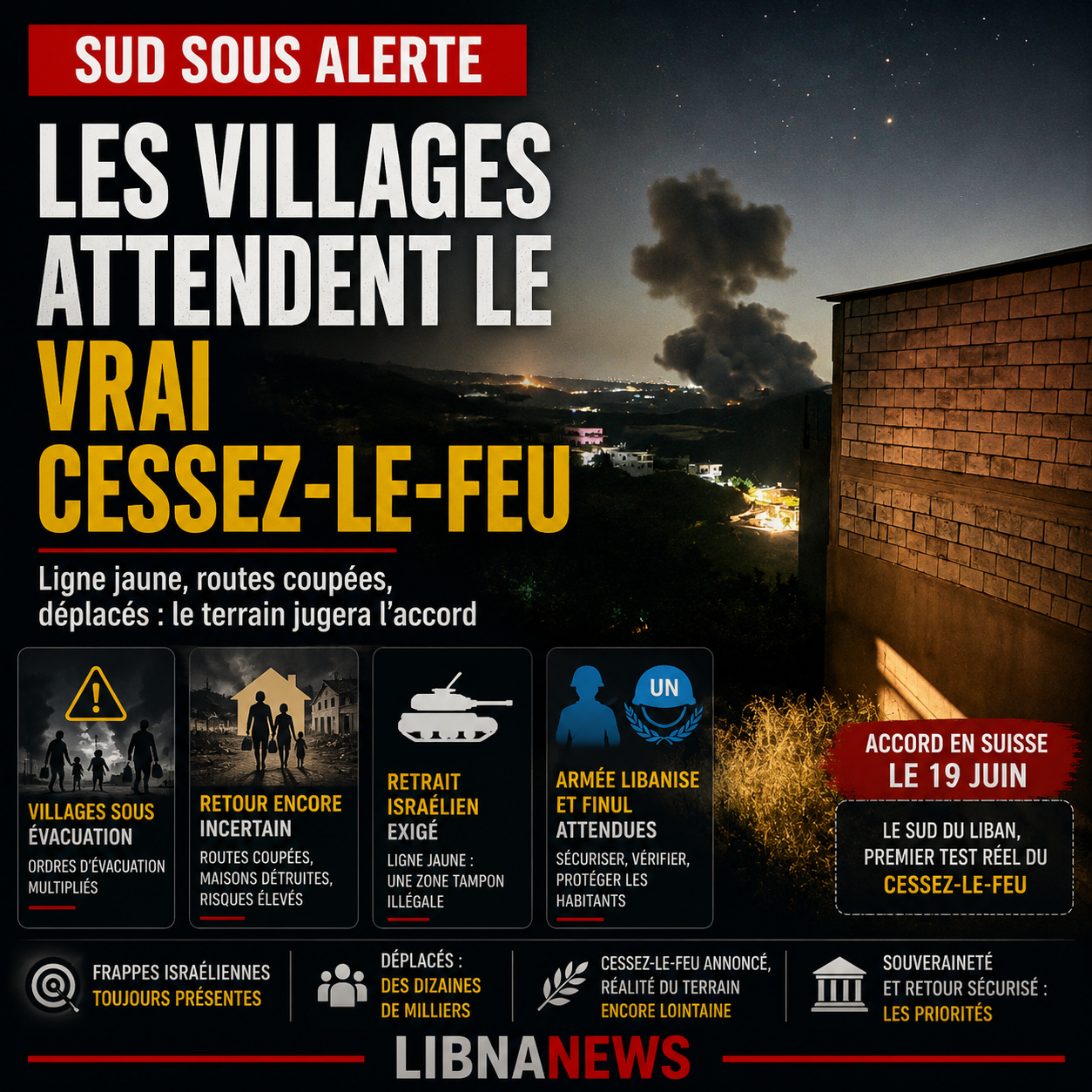
In southern Lebanon, the villages under alert before the agreement between the United States and Iran are the first real test of the ceasefire announced on the night of 14-15 June. Diplomacy talks about regional de-escalation, reopening of Ormuz and signing scheduled for 19 June in Switzerland. The land remains marked by evacuation orders, strikes, road cuts, abandoned fields and destroyed houses. Between international press releases and the lives of the inhabitants, the gap remains immense. Southern Lebanon does not measure the value of an agreement to its general formulas, but to a simple question: will families be able to return without fear of a drone, shell, mine or new order of departure?
Evacuation orders that maintain the alert
On Sunday, 14 June, the Israeli army issued new warnings against dozens of southern localities. Residents were ordered to leave their homes before announced strikes. The areas concerned are in addition to a series of evacuations already imposed for several weeks, notably in Nabatiyah, Tyre and Jezzine. Communities that still served as relative shelters have seen their status change. The city of Tyre, long regarded as an anchor for the coastal displaced, was also affected by evacuation orders and deadly strikes. For many families, the south is no longer divided between dangerous villages and safe villages. It has become a moving space, where the map of fear is redrawed every morning.
The Lebanese authorities therefore called on the displaced not to rush to their villages after the announcement of the American-Iranian deal. This message reflects deep mistrust. A regional ceasefire can be proclaimed without local risks disappearing. Housing can remain trapped by unexploded ordnance. Axes can be impassable. Neighbourhoods may be close to military positions. Villages can still be considered by Israel as prohibited areas. Beirut’s prudence also aims to avoid a massive return that exposes civilians to incidents in areas where neither the Lebanese army nor international forces nor relief forces have yet full access.
This caution is explained by the sequence of the last days. Israeli strikes continued in the south, including after the partial truce announcements of April. Lebanese officials claimed that Israel had conducted several thousand strikes since then, with controlled destruction and shaving operations in border villages. Israel claims to be targeting Hezbollah infrastructure and reserves the right to act against any threat. Lebanon responded that these operations affected inhabited areas, extended displacement and established a de facto military presence. So the ceasefire is not just a matter of weapons silence. He must say who controls the territory, who can move there and who decides to return.
The yellow line, new territorial test
The concept of a yellow line concentrates this battle. Since April, Israel has presented this line as an operational demarcation in the south, distinct from the Blue Line recognized by the United Nations as a withdrawal line. In the Israeli reading, this is an advanced defence zone to protect northern Israel from Hezbollah fire. In Lebanese reading, this line creates a unilateral buffer zone within the national territory. It turns villages into forbidden or semi-prohibited areas. It is not the result of a bilateral agreement, a decision of the Security Council or an arrangement accepted by Beirut.
The difference between Blue Line and Yellow Line is essential to understand the issue. Since 2000, the Blue Line has served as an international benchmark for the Israeli withdrawal from Lebanon. It does not resolve all disputes, but it provides a well-known framework for the Finul, the Lebanese army and the diplomatic authorities. The yellow line is the result of an Israeli military decision. It’s moving the control area north. It installs a fait accompli in varying depth. In some readings, it covers several kilometres and concerns dozens of localities. For the inhabitants, this legal difference does not remain abstract. She decides on the right to return, cultivate, rebuild or even visit a family cemetery.
Media sources reported that Israel did not intend to withdraw from this security zone despite the agreement in preparation with Iran. Israeli officials also indicated that a reduction in the pace of operations could be envisaged without abandoning the military presence. This position creates a direct contradiction with the Iranian reading of the deal, which states that the cessation of operations concerns all fronts, including Lebanon. She also puts Washington in front of a credibility test. If the United States guarantees regional de-escalation, but cannot prevent the continuation of an Israeli line in southern Lebanon, the inhabitants will agree to this limit.
Return prevented from the people of the South
The villages concerned are not mere points on a map. They form a dense social fabric, made up of displaced families in Nabatiyah, Tyre, Saida, Beirut or in the mountains, but also farmers, traders, teachers, artisans and pensioners attached to their land. Several localities close to the border have already experienced massive destruction. Others have lost access, water, power lines, schools, clinics or secondary roads. In some areas, residents do not know if their homes still exist. In others, they know that it exists, but they cannot enter.
Displacement has transformed the social geography of Lebanon. Families in the South have lived for weeks or months with relatives, in expensive accommodation, schools, reception centres or improvised apartments. Return is not just a matter of security. It involves a roof, a road, water, electricity, medical access, an open school and a means of income. When these conditions are lacking, the announcement of an agreement can create as much anxiety as hope. Some want to leave immediately to check their homes. Others fear to find a empty village, guarded by drones and lined with ruins.
Fear also circulates through the roads. The axes to Nabatiyah, Marjayoun, Bint Jbeil, Tyre or the coastal plain were affected by strikes, leak jams, dams and infrastructure destruction. A journey that used to be used to reach a field, hospital or market may become impossible. Ambulances and rescue teams must assess the risks before each trip. Families often arbitrate without complete information. Should we wait for an official statement? Should we enjoy a lull? Should we go home by night or avoid secondary roads? This uncertainty uses the nerves and prolongs the war in everyday life.
Southern agriculture in the risk zone
Agriculture pays a central price. Losses are not limited to burned fields or destroyed greenhouses. They affect production cycles. Unmaintained olive trees, inaccessible tobacco, orchards of citrus fruits without irrigation or scattered herds cause losses that extend beyond the ceasefire. The Lebanese Ministry of Agriculture reported damage and losses in excess of several hundred million dollars. Tens of thousands of hectares have been allocated nationally, with a significant share in the southern conflict zones. For rural families, this crisis threatens the income of the year, but also the social anchor of the village.
The civilian effects are not limited to the figures. In the villages of the South, the economy is often based on a fragile combination: a public wage, a small farm, diaspora transfers, an agricultural season, sometimes a commercial activity linked to the road or the local market. War breaks these balances. Traders lose their customers. Farmers lose access to plots. Daily workers lose their jobs. Schools lose their students. Municipalities lose their revenues and must manage aid applications without sufficient resources. The return of the inhabitants will therefore also depend on the ability to revive an ordinary life, not just the cessation of explosions.
Lebanese requirements: withdrawal, return, reconstruction
Faced with this situation, Lebanese demands are structured around four priorities. The first is the complete withdrawal of Israeli forces from all areas occupied or controlled in the south. Without verifiable withdrawal, the ceasefire will remain incomplete. The second is the safe return of the inhabitants, with traffic corridors, risk mapping, demining operations and safeguards against strikes. The third is the reconstruction of housing and basic infrastructure. The fourth is the restoration of State authority, through the effective deployment of the Lebanese army and clear coordination with international forces.
These demands seem simple. Their implementation will be difficult. Israel wants to prevent Hezbollah from reconstituting its positions near the border. Hezbollah refuses that the ceasefire should be used to legalize an Israeli presence or a prohibited area. The Lebanese state claims sovereignty, but it has to deal with fragmented military terrain and with power relations that go beyond it. The mediators are looking for a broad enough formula to avoid a regional resumption of war, but precise enough to be applied in concrete villages. The risk is that of a text that calms capitals without protecting the inhabitants.
Final and Lebanese Armed Forces, arbitrators expected from the ground
The role of the Finul is therefore at the forefront. The international force has experience, positions, connecting channels and fine knowledge of the Blue Line. It can observe, report, accompany certain movements and support the Lebanese army. But it cannot alone impose an Israeli withdrawal, disarm Hezbollah or guarantee the safety of every road. His mandate has already been weakened by attacks, loss of life, restrictions of movement and debates on his future. In the post-agreement, it will have to be strengthened politically if asked to verify a more ambitious truce.
The Lebanese army will be the other actor expected. It represents, in the eyes of many Lebanese and foreign partners, the only national framework capable of restoring a state presence to the south. Its role should cover the control of roads, support for the return of inhabitants, coordination with the Finul, the security of public buildings and the identification of dangerous areas. But its resources remain limited. It must manage the economic crisis, lack of equipment, internal political pressure and the difficulty of acting in areas where Hezbollah retains military and social influence. A deployment without resources or guarantees could place it on the front line without providing it with the necessary tools.
The ceasefire will therefore require a specific verification mechanism. It is not enough to announce the cessation of hostilities. Violations will need to be identified, documented, attributed and responded to. A drone strike, artillery fire, infiltration, house destruction or prolonged overflight must be treated by a clear chain. People need to know who to report an incident to. Municipalities must have an interlocutor. The Lebanese authorities must be able to present evidence. Mediators must be able to intervene before the incident becomes a response.
The return of civilians also requires an organized humanitarian phase. The first days after signature should not be presented as a general return. They should include inspections, building assessments, relief operations, agricultural surveys and family censuses. Schools, clinics, water stations, electrical transformers and main roads must be prioritized. Villages near the yellow line will require special protocols. The return will be slower, more monitored, and more political. Each family returning will become an indicator of confidence or confidence in the agreement.
Reconstruction will finally be the test of duration. South Lebanon has already experienced cycles of war, return and reparation. This time, destruction affects a financially exhausted country whose banks remain in crisis and whose public finances cannot absorb the bill alone. Donors will ask for transparency guarantees. Arab countries will call for a State capable of controlling its borders. Residents will be asking for quick help. Hezbollah will seek to show that it can support its social environment. The state must avoid allowing reconstruction to become a new field of political competition.
In the villages under alert, the agreement of 19 June will therefore be assessed primarily by visible gestures. An evacuation order cancelled. A road reopened. A drone that disappears from the sky. A Lebanese Army patrol entering without incident. A team from the Finul who found a withdrawal. A family that can come back, sleep and go back to the field the next day. Until these signs come together, the South will remain the place where the announcement of a ceasefire comes up against the reality of a war that has not yet left homes, roads and land.