






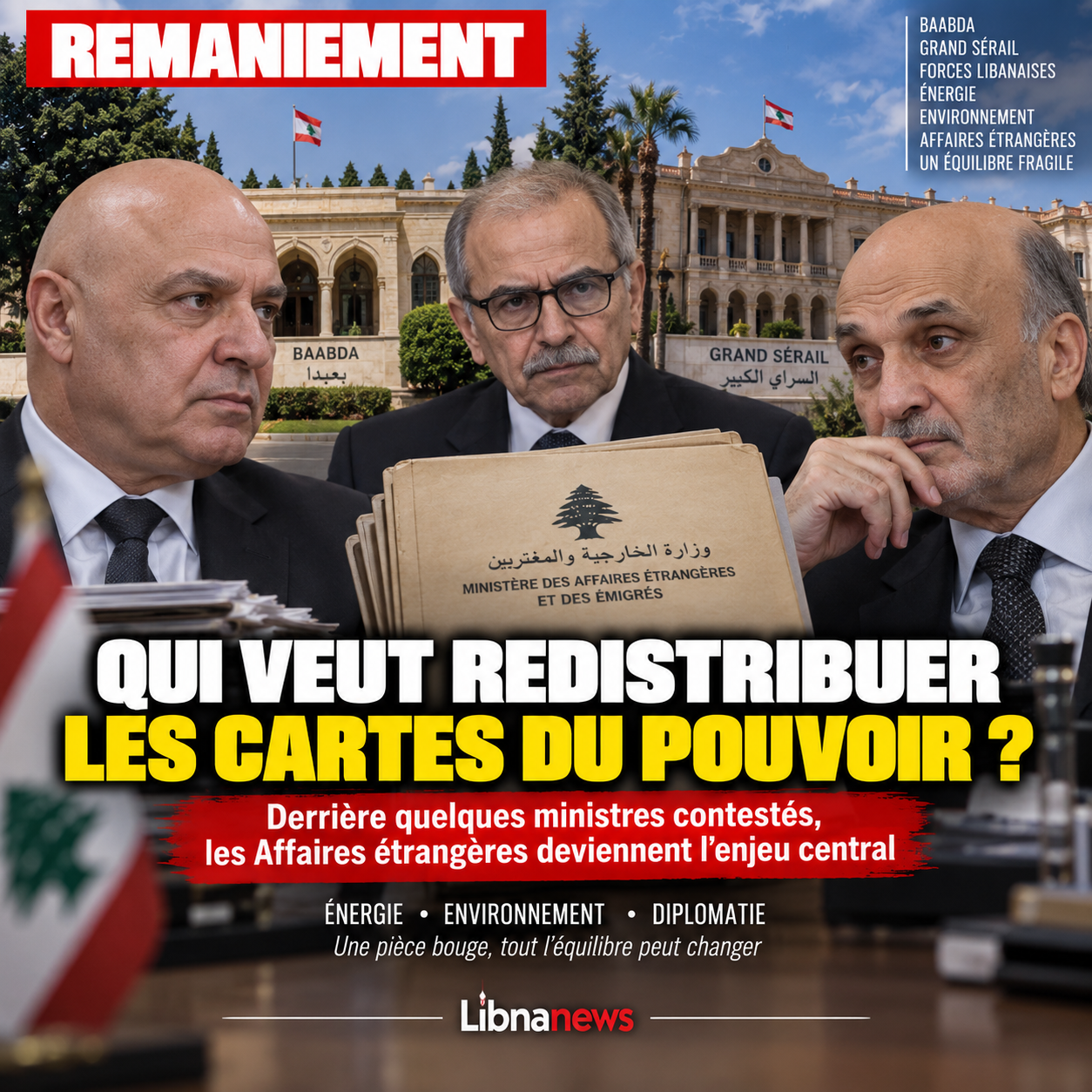
The problem is no longer to replace a minister
The debate on a possible reshuffle of the Nawaf Salam government could give the impression of a limited operation. Joe Saddi encounters difficulties in the Ministry of Energy. Tamara El Zein leads a politically costly confrontation with quarries. Other ministers are being criticized. It would then be sufficient to replace a few members of the cabinet to relaunch the government’s action.
The information available on 23 September 2026 describes a much more complex situation. Changing a single piece of the team may reopen the political agreement that made it possible to form the government. Behind the names of Joe Saddi and Tamara El Zein appears a much more sensitive battle around the Foreign Ministry, occupied by Youssef Raggi.
Information is circulating on this subject in the political circles: President Joseph Aoun would like to entrust Foreign Affairs to his political adviser Jean Aziz in place of Youssef Raggi, appointed in the framework of the government share attributed to the Lebanese Forces. This information has not been formalized by Baabda and must remain presented as a backstage data. However, it is of particular importance when it is brought closer to the already public tensions between the Presidency and the Lebanese Forces in the Minister’s place in the conduct of diplomacy.
Samir Geagea himself has publicly asked the question of the absence of the Minister of Foreign Affairs during certain international trips of the President of the Republic or the Prime Minister. His criticism was explicit: how to talk about a state operating through its institutions if the minister responsible for external relations does not systematically accompany the leaders in their main diplomatic missions?
The potential reshaping therefore affects a much more important issue than the individual performance of a few ministers. He could determinewhich controls Lebanese diplomacy at the time of the negotiation of the Israeli withdrawal, the future of South Lebanon, relations with Washington and the succession of UNIFIL.
The Department of Foreign Affairs became much more strategic than at the time of government formation
When the government was formed, the portfolios were divided according to a classic combination of criteria: political representation, religious balance, technical profiles and the willingness of Nawaf Salam to maintain some autonomy in the selection of his team.
Since then, the nature of the political moment has changed.
Lebanon has entered into direct negotiations with Israel under American mediation. The issue of state monopoly of arms has become one of the main subjects of government. The mandate of UNIFIL is nearing completion. Washington has a decisive influence on the negotiating schedule. Paris tries to preserve its role. Riyadh, Doha, Ankara and Cairo are all seeking to influence the new regional architecture.
In this context, the Ministry of Foreign Affairs is no longer solely responsible for managing embassies and ordinary diplomatic relations. He is in direct contact with the main sovereignty issues.
Youssef Raggi also participates in meetings in New York alongside Nawaf Salam. He met with Vatican Secretary of State Pietro Parolin and participated in interviews with several foreign officials. In particular, it defends the choice of negotiation as a means of achieving Israeli security and withdrawal.
But Lebanese diplomacy does not go exclusively through his ministry. Joseph Aoun has his own advisers and direct contacts. Nawaf Salam himself conducted active diplomacy. The President of Parliament also retains his channels. In addition, political parties, many of which have direct relations with foreign capitals, are also involved.
The conflict around foreign affairs therefore also concerns the centralization of this fragmented diplomacy.
Jean Aziz appears in the discussions around Baabda
The name Jean Aziz is precisely interesting for this reason. Joseph Aoun’s political adviser, he belongs to the circle directly associated with the presidency.
According to information circulating around the reorganization, Baabda would like to entrust him with the Ministry of Foreign Affairs in case of a change of government.
Such an appointment would have a very different scope than simply replacing one minister with another.
It would bring the Ministry directly closer to the Presidency of the Republic. The diplomacy led by Baabda and the Quai Bustros would then be much more closely aligned.
For the Lebanese Forces, however, this would mean the loss of a strategic portfolio.
This is where the issue becomes a conflict. The party may request the replacement of certain ministers or criticize the functioning of the government. But to accept the principle of reshaping is to allow other actors to also request a change in the portfolios allocated to the Lebanese Forces.
The party thus finds itself faced with a dilemma: to demand changes without being able to guarantee that it will retain exactly the same positions in the new configuration.
The absence of Youssef Raggi on certain trips is not a protocol detail
The controversy raised by Samir Geagea makes it possible to understand why the foreign affairs issue already precedes the reshuffle.
The leader of the Lebanese Forces asked publicly about the international movements of the President of the Republic or Prime Minister in which Youssef Raggi had not been associated. He saw it as an institutional problem.
The issue actually goes beyond the protocol.
A foreign minister who is excluded from certain diplomatic sequences necessarily has less direct information on commitments made, requests made and responses received. The department may then be responsible for implementing a policy in which it was only partially involved.
On the other hand, Baabda may consider that the President of the Republic has a constitutional role in external relations and that he is not obliged to transform each displacement into an expanded ministerial delegation.
Behind the dispute is therefore an old question of the Lebanese system: who really leads foreign policy when the President, Prime Minister and Minister belong to different political sensitivities?
The possibility of replacing Raggi with a Joseph Aoun adviser would provide a very clear answer in favour of greater coherence around Baabda.
It would simultaneously change the balance with the Lebanese Forces.
Joe Saddi puts the Lebanese Forces in an uncomfortable situation
The Minister of Energy’s file further complicates this equation.
Joe Saddi would have started considering resignation because of the obstacles encountered in his attempt to reform the electricity sector. Among the difficulties mentioned are the unpaid invoices by some public administrations and the refusal of the proposal to further change the electricity tariff according to the cost of oil.
According to information from circles close to the Lebanese Forces, all options are politically costly for the party.
If Joe Saddi leaves Energy and the Lebanese Forces get another portfolio, the change can be interpreted by their opponents as recognition of the failure of their experience in a ministry they have long used to criticize the Free Patriotic Movement.
If Saddi stays and the power supply does not improve, the party will continue to bear the political cost of the situation.
The case is all the more sensitive as the Free Patriotic Current is particularly familiar with the ministry after having controlled it for many years. Each decision of Joe Saddi can therefore be compared to the policies of his predecessors.
The battle is no longer just energy. It has become a battle of narrative: can the Lebanese Forces demonstrate that they are doing better in a ministry whose management they have denounced for almost a decade?
The Lebanese Forces would consider a collective response, not the isolated departure of a minister
Another information significantly alters the redesign scenario.
According to sources close to Maarab, if the Lebanese Forces were to decide to leave the government, the movement would not be limited to Joe Saddi or a single minister. All ministers considered to belong to their representation could be involved.
The party would then like to present its departure not as a consequence of a dispute over a portfolio, but as a global position on the method of government and the decisions taken in the main files.
This distinction is important.
An individual resignation of Joe Saddi can be quickly replaced. A collective resignation of ministers associated with the Lebanese Forces would create a much greater political crisis.
It would force Nawaf Salam and Joseph Aoun to decide whether they simply want to replace the resigned ministers or rebuild part of the government coalition.
It would also raise the question of the Christian representation of the cabinet and the political weight of the new appointments.
The reorganization could then turn into a government crisis.
Tamara El Zein opens a second front
The Minister of the Environment is in a different situation, but her name also feeds the discussions.
Tamara El Zein is currently leading the careers and crushers file. His department forwarded 1,509 recovery orders in excess of $1.3 billion to the Department of Finance. The overall rights claimed by the State exceed three billion.
She claims to be under pressure and refuses to return to the process.
At the same time, his name appears in the replacement scenarios.
There is no strong enough evidence to suggest that the career record explains a possible desire to remove it. Establishing this link without evidence would turn a political coincidence into a charge.
But his case shows why a redesign quickly becomes difficult to read.
If replaced, will it be for reasons related to its ministerial action, a political balance, a request from its camp or the desire to modify several portfolios simultaneously?
And above all, will his successor pursue exactly the same recovery procedures?
The real test would therefore not be his departure, but what would happen to the 1,509 files after it.
Limited overhaul is almost impossible in the Lebanese system
The fundamental difficulty lies in the structure of government.
A minister never holds only an administrative office. Its portfolio fits into several simultaneous balances.
He has a religious affiliation. It may be associated with a political party or force. His department has a different weight depending on his skills. Finally, his appointment results from negotiations between the President of the Republic, the Prime Minister and the groups represented in the government.
Therefore, replacing a minister requires several questions to be answered.
Should his successor belong to the same community? Should he be chosen by the same political force? Does this one keep the same wallet? Can the Prime Minister take advantage of the change to appoint an independent? Can the presidency ask for compensation in another ministry?
Therefore, an operation announced as a technique can quickly become a renegotiation of the entire firm.
The problem becomes even more acute when the portfolios concerned are Energy, Environment or Foreign Affairs.
Nawaf Salam would have much to lose in a long government negotiation
The Prime Minister did not choose a particularly favourable time to rebuild his cabinet.
Lebanon is negotiating with Israel. The government must move forward on arms monopoly. The post-FINUL file is not settled. The reconstruction of the South still lacks sufficient funding. Banking reform and the treatment of financial losses remain under way. The social crisis is getting worse as fuel increases.
A government crisis would immediately shift the focus of attention.
The parties would resume negotiating names and portfolios as Nawaf Salam instead sought to convince foreign partners that the Lebanese State was capable of fulfilling its commitments.
There is also an economic risk. Financial reforms are monitored by international institutions. A lengthy government paralysis could delay several texts necessary for bank restructuring and discussions with the International Monetary Fund.
The Prime Minister therefore has an interest in avoiding a reshuffle simply to satisfy a series of partisan demands.
It could, however, accept whether it solves major blockages or strengthens its government.
The whole question is whether it could still control its perimeter once the process has begun.
Baabda could be the main beneficiary of redistribution
If the information on Jean Aziz is confirmed, the Presidency has a particular interest in a targeted change.
Getting Foreign Affairs would bring a strategic ministry closer to President Joseph Aoun at a time when diplomacy is one of the main instruments of Lebanese policy.
Baabda is currently seeking Israeli withdrawal, support for the army, a solution for the South Lebanon and international guarantees. The Presidency maintains its own relations with Washington, Paris, Riyadh and other capitals.
A minister directly aligned with the president would reduce friction between presidential diplomacy and that of the government.
But this coherence would have a political price.
The Lebanese Forces could consider the loss of ministry as a reduction in their weight. They could request an equivalent portfolio or threaten to review their participation in government.
The question would then become: what compensation can be offered without creating a new conflict with another force?
The overhaul could finally change the political majority of the cabinet
This is the heaviest scenario.
If a few ministers are replaced individually, the government retains its structure.
If a political force withdraws all its representatives, the balance changes.
The government can legally continue under the applicable constitutional conditions, but its political legitimacy can be challenged by the withdrawing camp.
A collective resignation of Ministers associated with the Lebanese Forces would therefore be used politically well beyond the Council of Ministers.
The party could accuse the government of being away from its initial commitments. His opponents could reply that he chose to leave the executive because he could not impose his choices.
This battle would then take place near other political and electoral deadlines.
That is precisely why sources close to the Lebanese Forces insist that a possible exit would not be presented as a dispute between people. The party would seek to give it a general political justification.
Three files will determine whether the redrafting is actually in preparation
The first indicator will be Joe Saddi. If he obtains decisions to unblock financing for electricity in Lebanon and remains in the ministry, one of the main immediate reasons for a change will disappear. A formal resignation would indicate, on the contrary, that the problem has gone beyond internal pressure.
The second will be Youssef Raggi. If its role in international travel and negotiations is further reduced, the assumption of a replacement will gain credibility. If Joseph Aoun and Nawaf Salam continue to associate him with the main deadlines, the tension can remain contained.
The third will be Tamara El Zein. Its continuation or replacement will, among other things, verify whether the government intends to maintain the continuity of the career file beyond the person of the Minister.
These three cases do not have the same origin. Bringing them together artificially in one explanation would be a mistake.
But their convergence creates a political opportunity for reshaping.
The real battle is not about names
Current discussions can easily be reduced to a list: who leaves, who stays and who replaces who. That would be missing the essential.
Joe Saddi represents the Lebanese Forces in a ministry where they had promised a break with previous practices. Tamara El Zein has a financial and environmental record of considerable economic interest. Youssef Raggi is at the centre of a more institutional conflict over the conduct of foreign policy. Finally, Jean Aziz embodies the possibility for Baabda to bring the Ministry of Foreign Affairs directly closer to the Presidency.
Changing these posts would therefore not only produce new faces around the Council of Ministers table.
This could move three power centres at the same time: energy management, control of a multi-billion dollar environmental issue and the conduct of diplomacy at the most sensitive time of negotiations with Israel.
This explains why reshaping remains easier to evoke than to achieve. Once the first room is moved, there is no guarantee that other actors will accept that the rest of the government will remain intact.