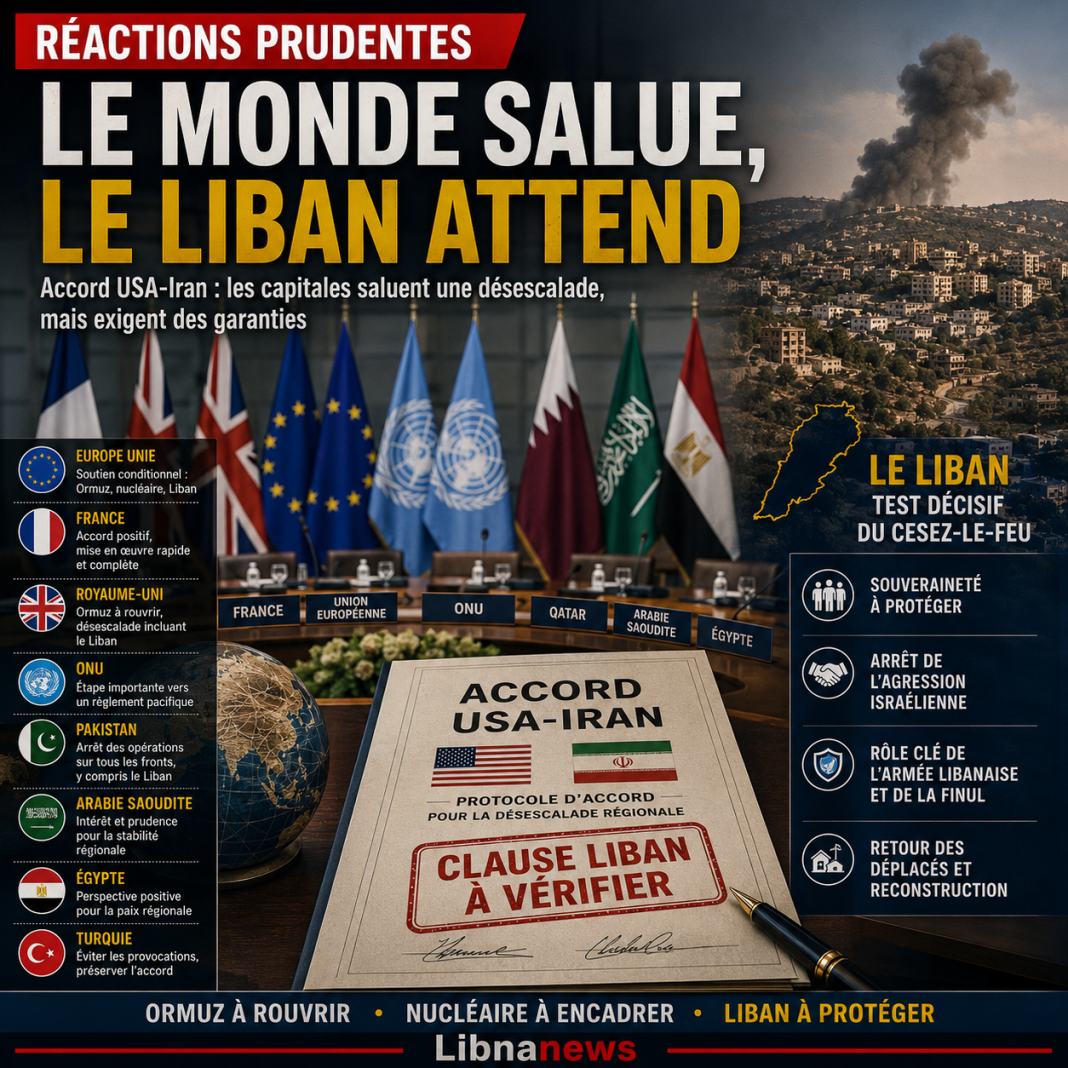
In southern Lebanon, a cease-fire is only worth the guarantees that accompany it. The regional agreement announced between the United States and Iran promises to stop operations on several fronts, including the Lebanese front according to Tehran’s reading and mediators. But this general formula is not enough. Villages in the South remain marked by evacuations, strikes, road cuts, abandoned fields and disputed Israeli positions. The experience of previous truces has shown that partial silence of weapons can mask a war that continues with drones, incursions, destruction and pressure on civilians. For a ceasefire in Lebanon to become something other than a fragile pause, it must be based on five minimum, verifiable and applicable guarantees from the first days.
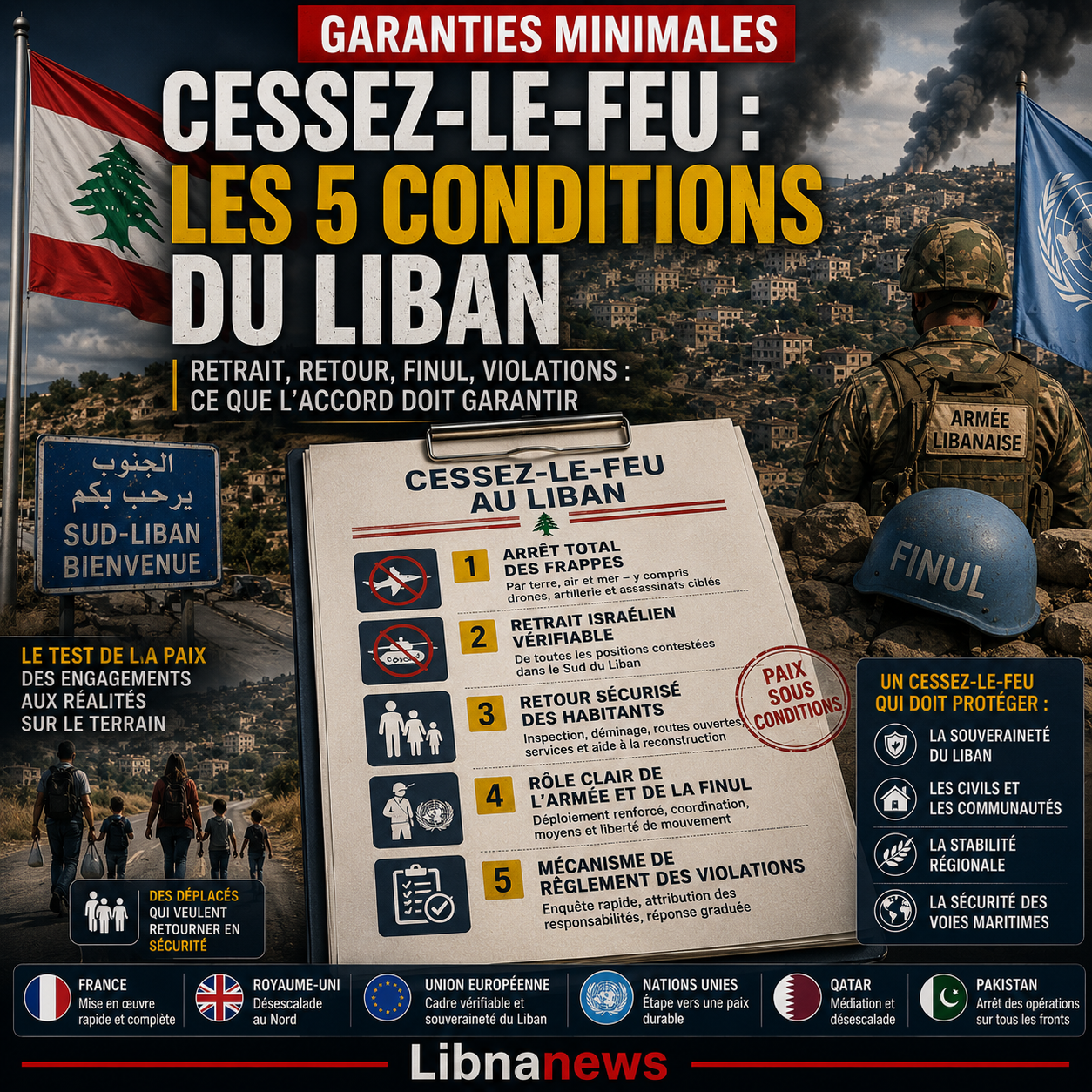
1. A complete stop to strikes on land, air and sea
The first guarantee concerns the complete cessation of strikes by ground, air and sea. The ceasefire must cover aerial bombardments, artillery fire, drone strikes, ground incursions, house destruction, naval operations and targeted assassinations. It must also provide guidance for overflights that maintain permanent psychological pressure on the inhabitants. Without this broad definition, each camp will be able to retain its own exception. Israel will take action against an imminent threat. Hezbollah will respond to a violation. The Lebanese State will denounce an infringement of its sovereignty without being able to prevent it. The ceasefire will then become a political formula rather than a rule on the ground.
The risk of failure is known. A pre-emptive strike may be sufficient to revive the escalation. A house destroyed in a border village can be described by Israel as a military site and by the inhabitants as civilian property. An isolated rocket fire can result in a disproportionate response. An armed drone can strike without notice and create a chain of reactions. The guarantee must therefore specify the prohibited acts, the areas covered and the alert procedures. It must prevent parallel reading. An agreement that allows each actor to define the threat alone carries with it its violation.
The application of this first guarantee implies a permanent monitoring chain. The Lebanese army must record incidents and secure accessible areas. The Finul must observe, verify and quickly transmit its findings. The American and European mediators must intervene from the very first signal of rupture. Iran, if it claims that Lebanon is included in the agreement, must also weigh on its allies to avoid an automatic response. Israel must accept that its freedom of action cannot remain unlimited in a regional ceasefire framework. The decisive point is not only the cessation of the shots. It is the recognition of a common rule.
2. A verifiable Israeli withdrawal
The second guarantee is verifiable Israeli withdrawal. It is the political heart of the Lebanese case. As long as Israeli forces remain present in disputed areas of the South, the ceasefire remains incomplete. Lebanon cannot demand the sustainable return of its inhabitants if communities remain in or near an imposed military zone. Israel defends this presence in the name of the security of its north and the need to prevent Hezbollah from returning to the border. Beirut sees it as an occupation. Hezbollah sees it as a motive for maintaining its weapons. The mediators see it as the most explosive point in the phase following the signature.
This guarantee must be measurable. A withdrawal cannot depend on a declaration. It must be mapped, dated and recorded. The positions concerned must be appointed. Villages and roads must be identified. Areas mined or destroyed shall be reported. The Blue Line must remain the international benchmark. Any unilateral military line, including the yellow line mentioned by Israel, must be clarified or lifted. The danger would be to allow a de facto buffer zone to settle inside Lebanon. Such a situation would reduce strikes, but maintain the challenge. It would turn the truce into a territorial freeze.
The actor responsible for ascertaining the withdrawal must be accepted by all parties. The Finul has the experience of the Blue Line and the necessary connecting channels. The Lebanese army embodies national sovereignty. Both must work together, with political support from the Security Council and the guarantors of the regional agreement. The United States has a special responsibility here. If they cannot obtain from Israel at least a verifiable withdrawal of the disputed points, their guarantees will quickly lose their value. The test will not be diplomatic. It will be visible in villages, on the hills, around roads and old military positions.
3. A secure return of the inhabitants
The third guarantee is the safe return of the inhabitants. She seems humanitarian. She’s also strategic. No ceasefire can be considered solid if displaced families cannot return. Southern Lebanon has emptied settlements, destroyed neighbourhoods, abandoned land, uninhabitable houses and cut-off infrastructure. The return cannot be improvised by families who want to verify their property. It must be prepared. The buildings must be inspected. Unexploded ordnance must be identified. Roads must be reopened. Water, electricity and telecommunications networks must be restored, even temporarily.
The risk of failure is double. Too fast a return can expose civilians to direct dangers. Too slow a return can turn displacement into a lasting break. Families who remain for months away from their villages lose their jobs, their landmarks, their schools and sometimes their de facto rights to their property. Farmers miss entire seasons. Small shops close. Municipalities are emptying. Hezbollah, parties, associations and self-help networks then take on a role that the state cannot occupy. Secure return is therefore also a condition for avoiding social reconstruction from public institutions.
This guarantee requires a practical mechanism. The Lebanese authorities must establish lists of accessible, partially accessible or temporarily prohibited villages. Municipalities must have public and verified information. The army must secure the axes. Civil defence must be able to intervene. Humanitarian agencies must accompany the first waves of return. Donors must finance temporary shelters, emergency repairs and family support. Finul can support assessments in areas close to the border. Return must not become an act of individual bravery. It must become a framed public policy.
4. A clear role for the Lebanese Army and the Final
The fourth guarantee concerns the clear role of the Lebanese army and international forces. Lebanon cannot stabilize the South by declarations of sovereignty alone. It needs an effective, continuous and sustained presence. The Lebanese army must be able to deploy on the main roads, near the evacuated villages, around the infrastructure, in the return areas and near the friction points. It must act as a national force, not as an observer. It must also coordinate with municipalities, relief and Finul. Its mission cannot be limited to holding symbolic posts.
The limits are important. The army lacks resources. The economic crisis has weakened its logistical capabilities. Soldiers face destroyed land, explosive risks and internal political tensions. It must also evolve in an environment where Hezbollah retains military power and a social base. A deployment that ignores this reality could cause friction. Too weak a deployment would not change anything. The guarantee must therefore provide for concrete means: fuel, vehicles, demining equipment, communications, medical support, intelligence and sustainable financing of the units engaged.
The Finul, for its part, must obtain a clear mission. Its natural role is observation, liaison, support for the return of the Lebanese army and verification of incidents. But it cannot replace the Lebanese state. Nor can it impose a military decision on Israel or Hezbollah alone. If the powers that support the agreement want to give it greater responsibility, they must protect it politically and materially. Movement restrictions, attacks on patrols and denials of access reduce its effectiveness. An international force without freedom of movement becomes a witness, not a guarantee.
5. A mechanism for resolving violations
The fifth guarantee is the mechanism for resolving violations. This is often the most neglected point. However, it decides on the duration of a ceasefire. Violations are likely to exist. Unattributed fire, drone, explosion, blocked patrol or targeted strike may occur. The question is whether these incidents automatically trigger a response, or whether they are absorbed by an investigation and de-escalation mechanism. Without procedure, the fastest actor imposes his story. With a procedure, the facts can be established before the crisis becomes uncontrollable.
This mechanism must be rapid, credible and public in its broad outlines. It should provide for a liaison centre involving the Lebanese Army, Finul and international guarantors. It should allow short-term inspections. It should classify incidents according to their severity. It should provide for direct channels with Israel, even without political normalization. It should also incorporate pressure on Hezbollah through Lebanese and regional channels. The United States will have to prove that it can act on Israel. Iran will have to prove that it can act on its allies. The Lebanese government must prove that it can speak on behalf of the State.
The risk of failure comes from the asymmetry of narratives. Israel often considers its operations defensive. Hezbollah regards its armed presence as a response to occupation and violations. The Lebanese State considers the two logics as limits to its sovereignty, but depends on power relations that it does not control entirely. A mechanism of violations will not resolve this debate. However, it can prevent each incident from becoming a new war. It can document, isolate provocations, reduce immediate responses and provide mediators with opposable facts. In such a fragmented space, evidence becomes a tool for stability.
Military but also civilian guarantees
The civil dimension must therefore be integrated as soon as the system is drafted. A truce that does not provide for rapid repair of networks, access to care, school recovery and minimum compensation for agricultural losses creates immediate frustration. Villages don’t live again just because cannons are silent. They relive when a bakery reopens, when a school can accommodate its students, when a clinic receives medication, and when families know what service they need. This concrete dimension must be entrusted to a single Lebanese cell, capable of coordinating ministries, municipalities, army, relief, international agencies and donors. Otherwise, emergency reconstruction will be dispersed, slow and politicized.
The issue of prisoners, missing persons and detained bodies can also disrupt stabilization. It does not concern all villages in the same way, but it affects families and war stories. A ceasefire that ignores these files leaves an anger open. Ombudsmen should therefore provide for a separate humanitarian channel, with the International Committee of the Red Cross or another accepted forum. This channel will not replace military safeguards. However, it can reduce tensions, avoid the instrumentalization of families and give the agreement visible human content from the first weeks.
These five guarantees form a whole. Stopping strikes loses its value without withdrawal. The withdrawal remains fragile without secure return of the inhabitants. The return fails without a Lebanese army and without international forces capable of accompanying the ground. Military deployment is not without a mechanism of violations. Each guarantee supports the others. A single weakness can open a breach. This makes the Lebanese ceasefire more difficult than just a regional agreement. It does not apply to a sea, diplomatic channel or negotiating table. It applies to inhabited villages, roads, fields, schools and disputed borders.
The agreement expected in Switzerland can offer a window. It can stop the dynamics of war, give negotiators time and place Lebanon in an international framework. But it won’t be enough alone. The South will not judge the text on its regional scope. They will judge him on the possibility of returning, sleeping, repairing, cultivating and circulating without fear of a strike. The Lebanese authorities will not be satisfied with a reference to Lebanon in an agreement between Washington and Tehran. They will have to transform this statement into written warranties, maps, patrols, aids and procedures. It is at this concrete level that the real value of the ceasefire will be decided.