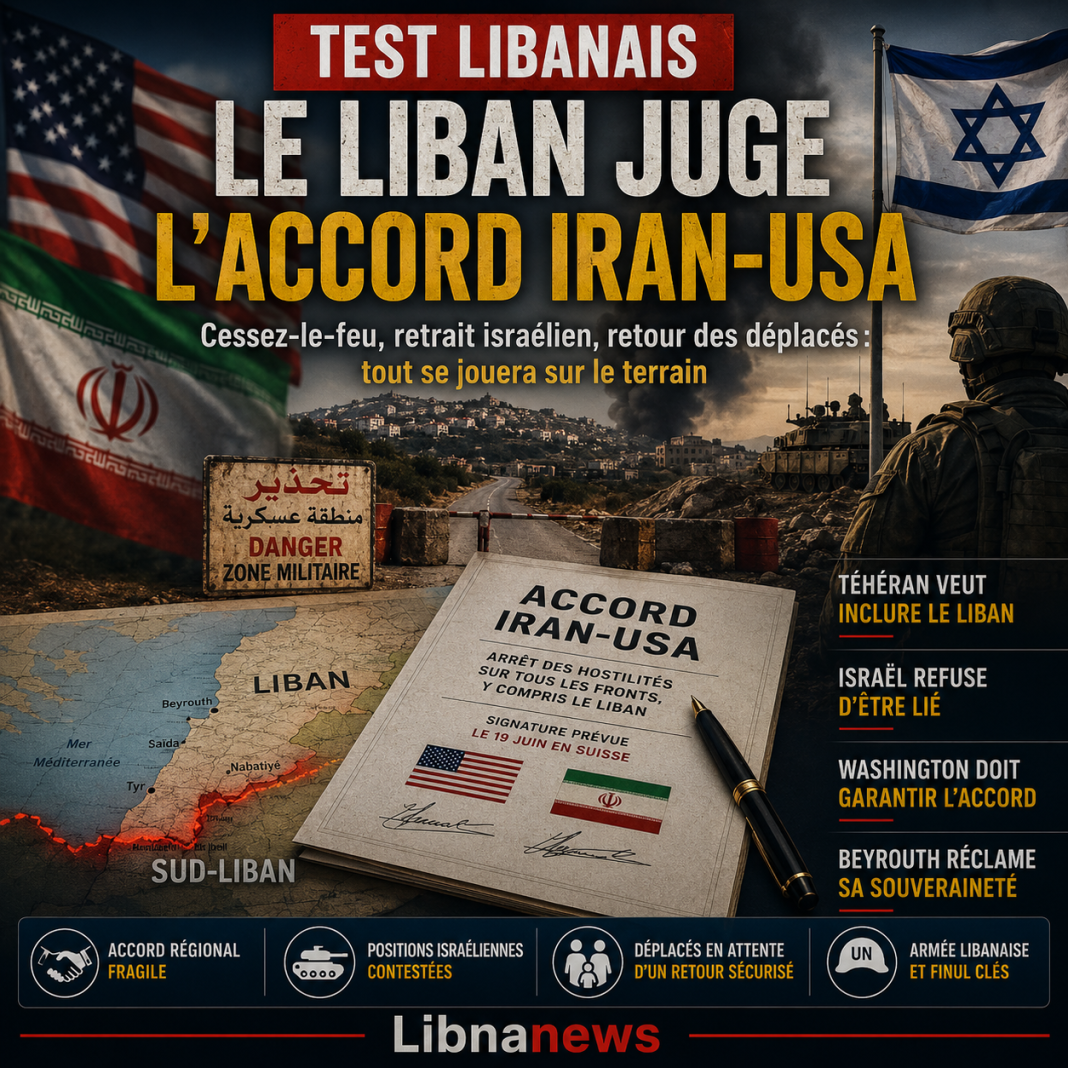






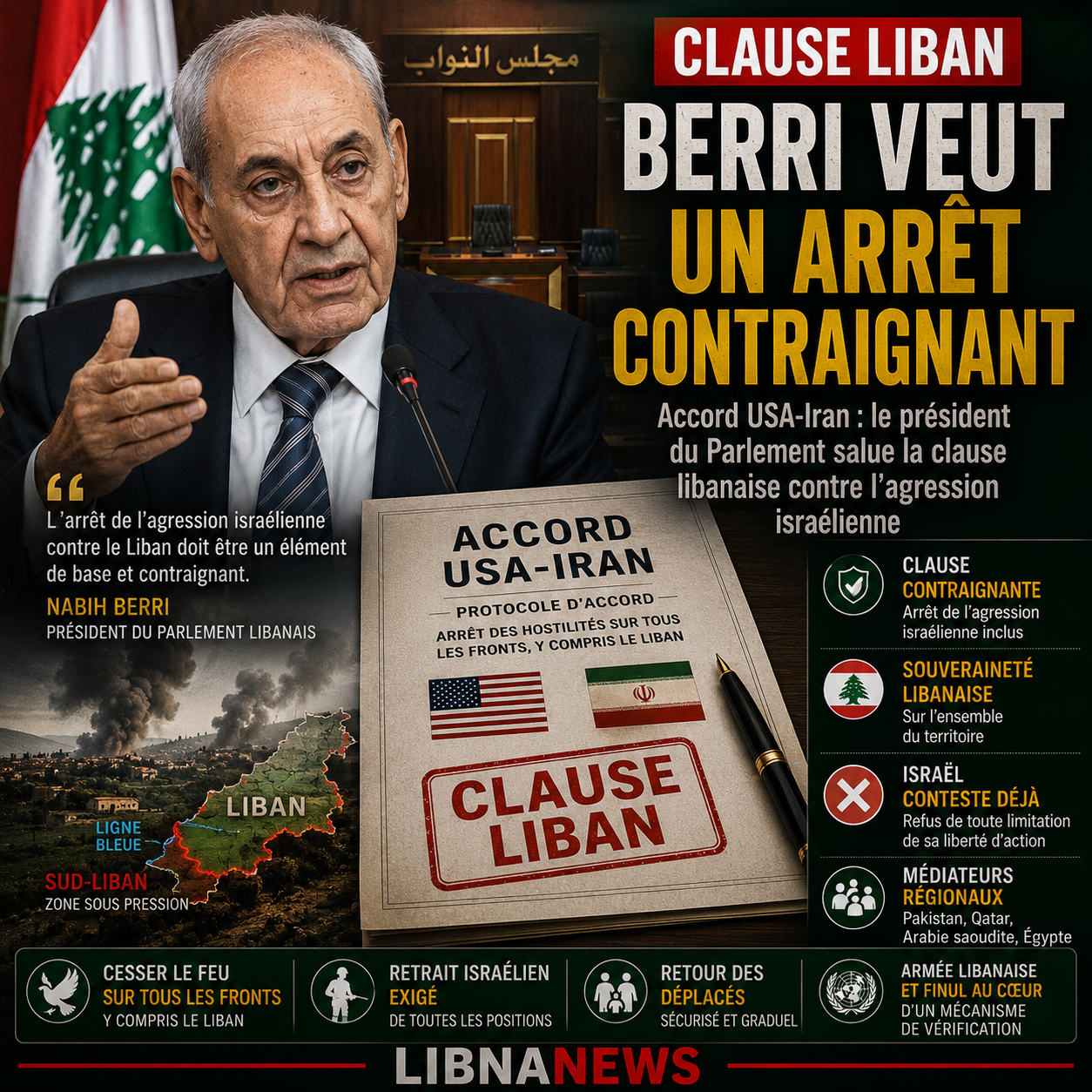
The President of the Lebanese Parliament, Nabih Berri, sees the US-Iran agreement as an essential clause for Lebanon: the binding stop of Israeli aggression. His statement turned the protocol between Washington and Tehran into a test of sovereignty for Beirut, while Israel already refused to limit its military action in Lebanon.
The President of the Lebanese Parliament, Nabih Berri, welcomed the Iran-American Memorandum of Understanding, focusing on a specific clause: the cessation of Israeli aggression against Lebanon. Its position gives a clear Lebanese reading of a still fragile text. It transforms the agreement between Washington and Tehran into a direct issue of national sovereignty, when Israel already refuses to consider itself bound by the Lebanese side.
Berri places Lebanon at the centre of the agreement
Nabih Berri’s message comes in a dense diplomatic sequence. The Memorandum of Understanding between the United States and Iran was presented as a step towards stopping the regional war, reopening the Strait of Ormuz and opening a period of technical negotiations. But for Beirut, the most important thing is played elsewhere. Lebanon wished to know whether the text could produce a real halt to Israeli operations on its territory. Berri states that this requirement is at the heart of the document.
This statement is not just a gesture of gratitude to Tehran and Washington. It is also a political response to Benjamin Netanyahu. The Speaker of the Chamber insists that the Lebanese clause must preserve the country’s sovereignty over its entire territory. He added that it should not contradict the independence of the national decision. This clarification is intended to prevent the cessation of hostilities from being used to impose an externally dictated security framework.
In his statement, Nabih Berri thanked Iran and the United States for their « commitment » and « insistence » to include the cessation of aggression against Lebanon as a basic and binding element. It also welcomes the efforts of Pakistan, Qatar, Saudi Arabia and Egypt. This list is not insignificant. It shows that Beirut reads the agreement as the product of an expanded regional mediation, not as a mere bilateral transaction between Washington and Tehran.
A binding clause, not a symbolic mention
The most important term is coercion. Speaking of a « core and binding » element, Berri seeks to prevent a flexible interpretation of the text. It does not want Lebanon to be mentioned in the agreement without an effective mechanism. He wants the cessation of Israeli operations to be treated as a central political obligation. This formulation responds to the Lebanese fear of a regional agreement that would calm the Iranian front, while leaving South Lebanon under sustained military pressure.
This reading directly opposes the Israeli discourse of the last hours. Israeli Defense Minister Israel Katz said Israel would not withdraw its army from the areas it occupies in Lebanon, Syria and Gaza. He presented this presence as a security necessity. He also stated that the army would remain in these areas despite current or future pressures. This line contradicts the idea of a global halt to military operations on all fronts.
Katz’s reaction confirms that the battle is already about the interpretation of the protocol. For the mediators, the agreement must stop the regional war. For Iran, it must include Lebanon, because Hezbollah is part of the security equation opened up by confrontation with Israel. For Berri, it must preserve the integrity of Lebanese territory. For Netanyahu, it must not limit Israel’s freedom of action against Hezbollah. The same text therefore gives rise to four competing readings.
Berri defends an institutional reading
The Speaker of the House knows the weight of this ambiguity. Since the beginning of the war, he has played an institutional role in the discussions on the southern front. His speech engages a central part of the Lebanese political system, but it is also part of a delicate internal balance. In welcoming the agreement, he sought to show that Lebanon could derive a diplomatic benefit from the Iranian-American military arm, without accepting a guardianship of its national decision.
The reference to « all Lebanon » is an important one. It means Berri refuses to reduce the file to a border band or a few military points. He talks about sovereignty over the entire territory. It therefore enshrines the stoppage of aggression in a national logic, not community or partisan. This formulation also targets Lebanese actors who fear that the country will be drawn into a negotiation whose parameters it does not control.
Lebanon has already paid a very heavy human and material price. The fighting between Israel and Hezbollah has led to massive displacement, destruction in the South, civilian casualties and further economic paralysis. Local authorities in the South have called on displaced people not to return too quickly, despite the announcement of the agreement. This caution shows that the gap between a diplomatic formula and the real security of villages remains great.
USA-Iran agreement: execution as a real test
In this context, Berri’s praise remains measured. He does not proclaim the end of the crisis. It highlights a potential acquired, then implicitly recalls that everything will depend on execution. Caution is understood. Israel affirms its desire to maintain safe areas. Iran says the cessation of hostilities must be permanent. The United States wants to move towards nuclear and economic negotiations. Lebanon, for its part, seeks first a halt to the strikes and a military withdrawal.
The Iran-US agreement opens a 60-day period to deal with the most difficult issues, including Iran’s nuclear power and sanctions. This schedule can help stabilize the region, but it can also create an area of uncertainty. During this period, each incident in Lebanon may become a test. An Israeli strike, a Hezbollah response or a border clash could weaken the entire system.
Berri’s reference to the « traps » attributed to the Israeli political level led by Netanyahu gives his statement a more offensive dimension. The Speaker of the House accused the Israeli government of trying to turn the Lebanese clause into a tool of pressure. He feared a scenario in which Israel would verbally accept de-escalation, while maintaining its security forces and strikes. This fear corresponds to Israeli statements on freedom of action.
Netanyahu and Katz are already challenging the scope of the text
Netanyahu has been defending the idea for several months that Israel cannot delegate to any international agreement the protection of its northern inhabitants. This doctrine is summed up in one sentence: the Israeli army must be able to act where it believes that a threat is being created. Implemented in Lebanon, it means that Tel Aviv refuses to renounce the attacks on the infrastructure attributed to Hezbollah. It also means that a ceasefire applies to Israel only if it does not block its future operations.
This position places Washington in an uncomfortable situation. Donald Trump presents the protocol as a diplomatic and economic success. He wants to reopen the Strait of Ormuz, reduce market tensions and start discussions with Tehran. But his Israeli ally already refuses part of the Iranian and Lebanese reading of the text. If the US administration fails to contain Israeli operations in Lebanon, the credibility of the agreement will be quickly challenged.
Berri’s statement therefore also refers to Washington. By thanking the United States for its commitment, it puts the US administration before its responsibilities. The message is diplomatic, but it is clear. If the United States had accepted a binding Lebanese clause, it would have to weigh for its implementation. The formula allows Beirut to ask for a guarantee without breaking the positive tone of the announcement. It links American success to the effective cessation of Israeli operations.
Regional ombudsmen in the balance
Pakistan’s role also deserves attention. Islamabad announced the agreement and affirmed that the cessation of operations should cover all fronts, including Lebanon. This mediation gives the text a non-Western and regional dimension. It offers Iran an acceptable exit door, while allowing Washington not to appear alone in the face of Tehran. For Lebanon, this Pakistani involvement reinforces the idea that the Lebanese front has been treated as a central issue.
Qatar, Saudi Arabia and Egypt also appear in Berri’s thanks. Each of these actors has its own channels. Doha dialogue with several regional parties. Riyadh seeks to avoid an extension of the war and to protect its economic priorities. Cairo follows the fronts of Gaza and the Levant with direct attention. Their presence around the agreement shows that Lebanon is no longer a secondary theatre, but a regional equilibrium point.
This centrality entails a risk. The more Lebanon becomes an element of negotiation between major powers, the more fragile its sovereignty can be. Berri tries to prevent this danger by insisting on the independence of the national decision. He wanted to avoid the Lebanese clause being read as an arrangement between Iran, the United States and Israel over the head of Beirut. Its communiqué therefore defends two simultaneous objectives: to use the agreement to stop the aggression and to preserve the Lebanese capacity to decide.
An attentive and divided Lebanese scene
This double requirement reflects the internal fractures of Lebanon. Part of the political scene fears that Iran will speak on behalf of the country through the Hezbollah file. Another believes that only Iranian pressure can force Israel to stop its operations. Between these two readings, Berri seeks an institutional formula. He salutes Iranian insistence, thanks Washington, appoints Arab mediators and affirms Lebanese sovereignty. The purpose of this construction is to reduce dispute angles.
On the ground, the situation remains harder than diplomatic words. Border areas do not automatically regain security because a protocol is announced. The displaced people want concrete guarantees. Southern municipalities monitor military movements. The families are waiting to know whether the roads are workable, whether the houses are still standing and whether the bombings have actually stopped. It is on this scale that the agreement will be judged.
The humanitarian issue cannot be separated from the political battle. If Israel maintains its positions and continues to destroy infrastructure that it attributes to Hezbollah, returns will remain limited. If Hezbollah considers that the Israeli presence continues, it may refuse to respect a lasting lull. If the Lebanese State does not obtain a verification mechanism, it will have to manage the anger of the people without the necessary military levers. The agreement may then remain suspended between expectations and violations.
A guarantee to be transformed into a mechanism
Berri seeks to make the Lebanese clause an effective guarantee. This ambition requires concrete steps. A withdrawal schedule, a definition of the areas concerned, a monitoring mechanism and a chain of responsibility for violations are needed. Without these instruments, the notion of stopping aggression will remain vulnerable to interpretation. The Israeli government will say that it acts against threats. Hezbollah will say he’s responding to an occupation. Beirut will say that its sovereignty remains violated.
The Speaker of the House cannot impose this architecture alone. But his statement set a useful Lebanese position before the protocol was announced. It claims that Lebanon should not be an annex to the Iranian case. It recalls that the end of the regional war must have a precise territorial translation in southern Lebanon. It also places a verifiable requirement on mediators: the cessation of aggression must concern Lebanese territory as a whole.
This statement comes as Netanyahu and his ministers seek to impose their own reading. Israel Katz speaks of military maintenance. Other Israeli officials defend freedom of action. The Israeli nationalist right refuses any agreement that would limit the strikes against Hezbollah. This internal coherence gives Israel an ability to block. It requires mediators to clarify quickly whether the Lebanese clause is binding or only declarative.
For Lebanese institutions, the challenge now is to transform this window into an official approach. The government will have to speak to chancelleries, the United Nations and regional actors with a unique vocabulary. It will also have to prevent internal debates from weakening the main demand. Berri gave a political formulation. It should be taken up, clarified and documented by the executive authorities, including on violations, occupied areas and protection needs of civilians.
Lebanon is thus entering a verification phase. Berri’s statement turns the diplomatic announcement into a political test. If the strikes stop, if the Israeli forces retreat and if the displaced can return, the protocol will become a first stabilization framework. If Israel maintains its positions, the clause welcomed by Berri will become the starting point for a new diplomatic confrontation. The next few hours will depend on the orders given on the ground, the messages sent to Tel-Aviv and the final writing expected before signing.