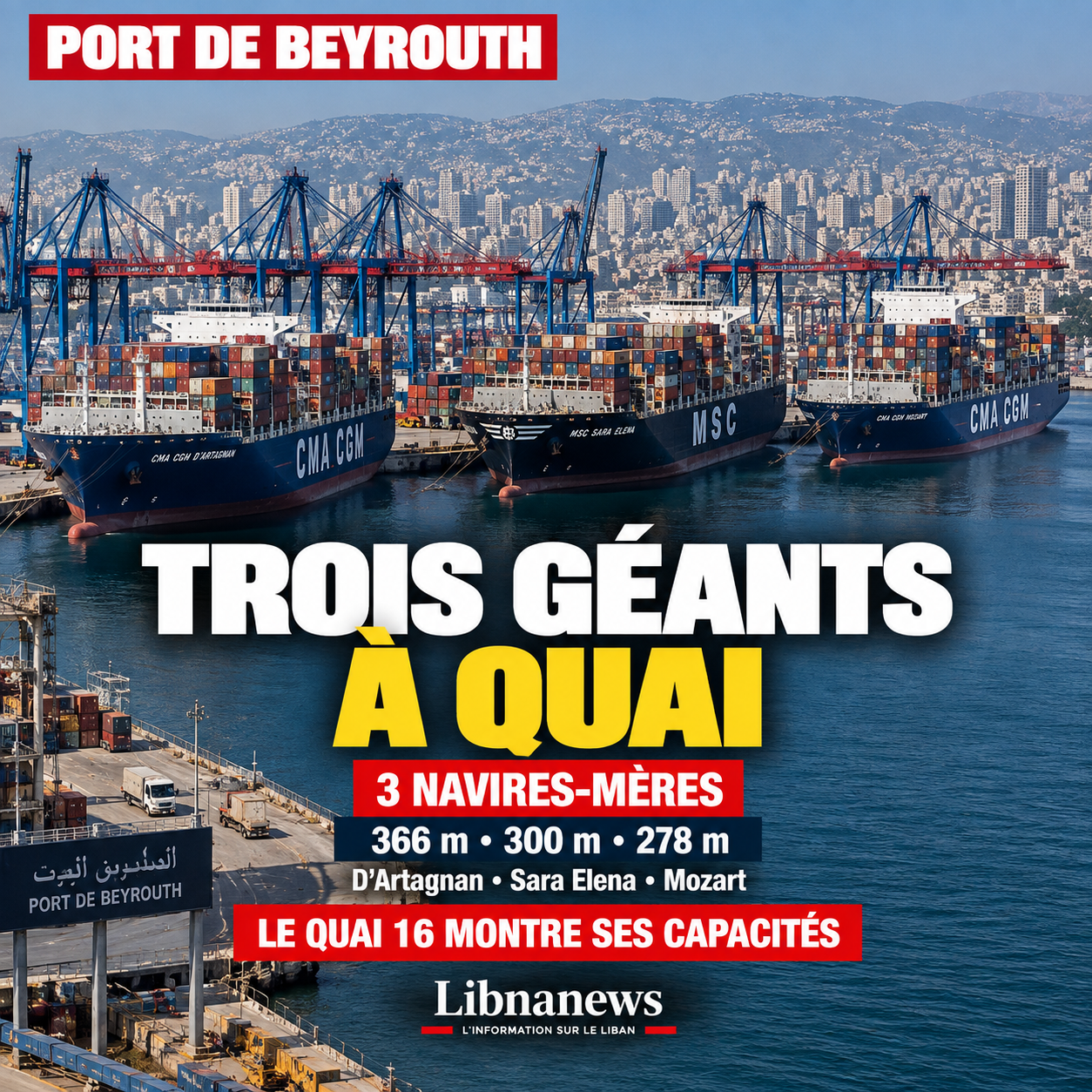
At the same time, the port of Beirut hosted three large container carriers on Wednesday 23 September 2026, an operation presented by its management as exceptional in the current regional context. TheCMA CGM D, 366 meters long, onMSC Sara Elena300 metres, and theCMA CGM Mozart, 278 meters, docked the same day at Pier 16. For the port authority, this triple port of call of mother ships illustrates the terminal’s ability to handle large container carriers and accompanies the modernization work undertaken to strengthen the logistic role of the port of Beirut.
Three mother ships in the port of Beirut
The scene is unusual in its magnitude. Three large ocean containers were received during the same day at the Beirut container terminal.
The three vessels landed on Wednesday, September 23, at Pier 16, an infrastructure essential for the treatment of large container carriers.
The most imposing is theCMA CGM D, which is 366 meters long. It is operated by the French group CMA CGM, one of the world’s leading shipowners of container shipping.
The second, theMSC Sara Elena, reaches 300 meters. It belongs to the fleet of Mediterranean Shipping Company, MSC, another major player in global shipping.
TheCMA CGM Mozart, 278 meters long, completes this triple stopover.
The simultaneous presence of these three buildings is mainly a life-size test of the terminal’s operational capabilities. The reception of ships of this dimension requires suitable docks, sufficient depth, handling equipment capable of intervening on large units and an organisation to manage container movements without blocking other operations.
Pier 16 at the Operations Centre
The three vessels were directed to Pier 16, at the heart of the port’s container terminal.
This infrastructure plays a central role in Beirut’s ability to remain connected to major international shipping lines.
The stake is not limited to allowing the berthing of a ship of several hundred meters. A container port of call involves a succession of coordinated operations: piloting and towing, mooring, positioning of cranes, unloading and loading of containers, transfer to storage areas and then organization of exits by land.
The presence of three large ships in the same day mechanically increases the constraints on the teams, equipment and spaces available.
The port administration therefore considers the operation of 23 September as an indicator of its ability to maintain a high level of activity despite regional circumstances.
It also stresses the role ofCMA Beirut Terminal, which operates the container terminal and provides handling operations.
What is a « mother ship »?
The English term « Mother Vessel », used by the Port Authority, refers to a main vessel assigned to international shipping.
These vessels carry containers between the main ports of a maritime network. The goods can then be transferred to smaller vessels, called « feeders », to serve secondary ports.
The reception of mother ships is therefore important for a port which seeks to maintain or develop direct links with the major maritime routes.
It reduces dependence on transhipments carried out in other ports and can enhance the attractiveness of a platform for shipping companies.
However, the presence of a parent ship does not automatically mean that all its cargo is destined for the Lebanese market. A stopover may combine import, export and, depending on the lines concerned, transhipment operations.
The economic importance of the triple port of call of 23 September must therefore be seen above all as an indicator of the physical and operational capacities of the terminal, rather than as proof alone of a strong increase in foreign trade.
Two CMA CGM vessels on the same day
The presence of two CMA CGM buildings also underlines the weight of the French group in the current activity of the port of Beirut.
CMA CGM maintains close historical ties with Lebanon. Its founder, Jacques Saade, was of Lebanese origin, and the group maintained an important presence in the country.
This relationship took on a new dimension after the explosion of 4 August 2020.
The port container terminal has been operated since 2022 by a consortium led by CMA CGM. This was an important step in the re-operation and modernization of port facilities after the disaster.
CMA Terminals, a subsidiary of the group, had obtained the management, operation and maintenance of the container terminal for a period of ten years.
The group then announced an investment programme to modernize infrastructure, replace or upgrade certain equipment and improve terminal performance.
The simultaneous presence of the D-Artagnan and the Mozart thus takes place in a port where CMA CGM is not only a maritime customer but also an important player in the operation of the terminal.
Modernisation initiated for several years
The triple stopover occurs as the port continues a programme of upgrading its facilities.
The management of the port refers to a development process which has been under way for several months, along with plans for extension and modernisation.
The container terminal is one of the main axes of this strategy.
After the 2020 explosion, the restoration of port capacity became a national economic issue. A significant part of the facilities had been destroyed or severely damaged, although the container terminal located further east had been less directly affected than the areas near the explosion site.
The work undertaken since then aims to increase the reliability of the equipment and the processing capacity of the terminal.
For shipowners, the quality of a port depends on several parameters: depth of basins, length of docks, availability of portals, productivity of operations, waiting times and fluidity of the passage of goods to their final destination.
The possibility of hosting several large vessels simultaneously is therefore a concrete element of this competitiveness.
Port remains vital for Lebanese imports
Beyond the technical performance, the activity of the port is of particular importance to the Lebanese economy.
Lebanon relies heavily on imports to meet its needs for goods and raw materials. A significant part of these flows arrive by sea.
The port of Beirut is one of the country’s main commercial gateways to Tripoli.
Containers transiting there carry a wide variety of products, from consumer goods to the raw materials and equipment needed by businesses.
The ability to maintain regular connections with large shipping companies therefore has consequences that far exceed the port sector.
A reduction in shipping or an increase in logistics costs can be passed on to importers, then to businesses and consumers. Conversely, faster port operations and sufficient competition between routes can help to limit certain additional costs.
Regional competitiveness
The management of the port also has the ambition to strengthen Beirut’s role as a regional logistics platform.
This ambition places the port in the face of significant competition in the eastern Mediterranean.
To attract more direct lines and develop trans-shipment, a port must offer more than a docking capacity. Shipping companies assess the speed of operations, costs, reliability of services, the quality of infrastructure and the possibility of organising connections to other markets.
Political and security stability is also part of their decisions.
In this context, the arrival of three large container carriers on the same day provides the port of Beirut with a favourable operational indicator, but it alone is not sufficient to establish its repositioning as a large regional transhipment centre.
This will depend on the frequency of such stops, the volumes actually handled and the evolution of the lines proposed by the large shipowners.
An activity maintained despite regional tensions
The Harbour Authority particularly insists on the context in which the operation of 23 September took place.
Tensions and conflicts in the region have disrupted several supply chains and forced transport companies to adapt their operations.
Maritime transport is particularly sensitive to geopolitical risks. Shipowners may change their routes, suspend certain ports of call or reorganize their services when conditions of navigation or insurance become more difficult.
For Lebanon, maintaining access to major trade routes remains essential.
The simultaneous arrival of CMA CGM D-Artagnan, MSC Sara Elena and CMA CGM Mozart shows that the terminal remains capable of hosting large ocean units despite this context.
It also constitutes a signal for Lebanese importers and exporters, whose activity depends on the continuity of maritime links.
Performance will have to be confirmed in volumes
The event of 23 September highlights the operational capabilities of Pier 16 and the container terminal.
To measure its real economic effect, however, the volumes of containers handled over a longer period will have to be observed.
The number of ports of call, the capacity of ships, the traffic in 20 feet equivalent — the unit used internationally to measure containers — and the share of transhipment will determine whether this exceptional day corresponds to a sustainable trend.
The development of the port will also depend on continued investment in equipment and infrastructure.
For the Port Authority, the stated objective remains to consolidate Beirut as Lebanon’s main maritime gateway while strengthening its function as a regional logistics platform. After the simultaneous reception of the three large container carriers on Wednesday, the next ports of call and the evolution of the volumes will allow to measure whether this operational performance is translated into the activity of the port.