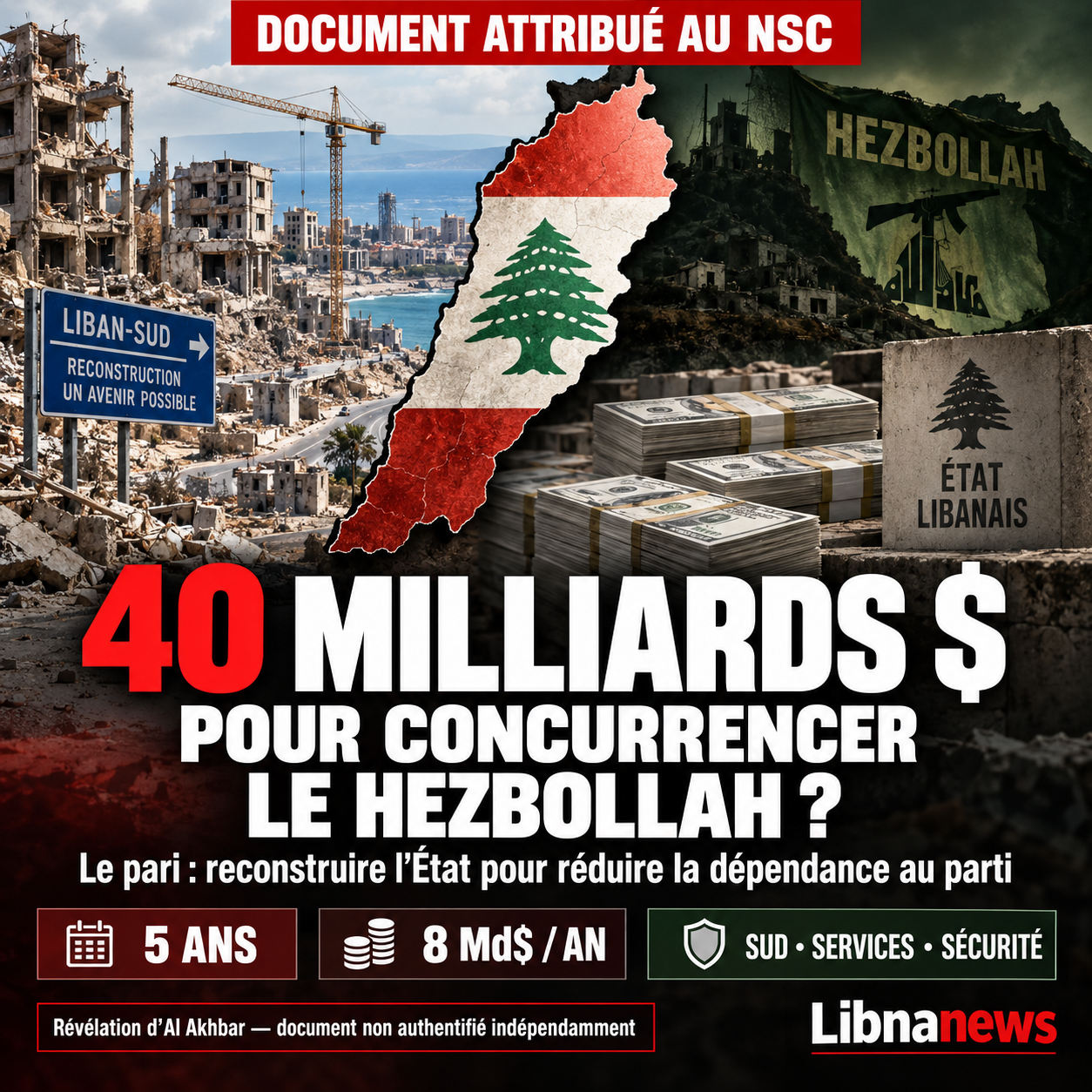
The figure first hit by its magnitude: $40 billion. But the sum is only the most visible part of a much larger project. In its September 29, 2026 edition,Al Akhbarclaims to have obtained a classified document prepared within the US National Security Council and intended for President Donald Trump. The paper presents the text as a proposal that would no longer seek only to disarm Hezbollah. It would aim to gradually reduce the dependence of a part of the Shia population on the party by building a state offer capable of competing with its networks.
Al AKhbar-29 09 2026.pdf
Caution remains essential.Al Akhbarit states that it obtained a copy of the document and that it would have been prohibited from circulating it among political and diplomatic officials. The newspaper also provides an unofficial translation. No other corpus file of September 29, 2026 can independently authenticate this piece. Its content must therefore be presented for what it is:Al Akhbarclaims to obtain it and the newspaper attributes it to the American National Security Council. This reservation does not detract from the interest of the text. It simply sets the boundary between a journalistic revelation and an officially confirmed American policy.
A document that would change the American method
According toAl AkhbarOn 29 September 2026, the document would be the result of several months of discussions within the US administration. Several officials working on Lebanon were reportedly examined. It would also be based on data that would not be publicly used by American officials. The reflection would be based on one observation: the methods used so far would not have produced the desired strategic outcome against Hezbollah. The document would then consider four different ways.
Al AKhbar-29 09 2026.pdf
The first is a major transformation in Iran. A brutal weakening or a fall in Iranian power would theoretically deprive Hezbollah of some of its financing, supplies and strategic depth. But the document, as published byAl Akhbarconsiders that such an assumption cannot constitute a Lebanese strategy. Hezbollah is described as sufficiently implanted in politics, social services, municipalities and community networks not to disappear automatically with a upheaval in Tehran.
The second route would be classical negotiation. It would involve progressive disarmament, reintegration of combatants, guarantees and institution-building. However, the document considers this fragile solution without Iranian participation or profound change in the calculation of Hezbollah leadership. It starts from the idea that weapons are not just a military instrument. In this reading, they also participate in a political identity, a deterrent function and a regional relationship with Iran.
The third option would be military. It would be based on an intensification of Israeli operations against Hezbollah. The text published byAl Akhbarconsiders this path the worst. It could weaken the party without guaranteeing its disappearance. The main risk is further destruction in Lebanon while leaving an armed, decentralized and politically difficult organization to eliminate.
It is therefore a fourth path that occupies the heart of the document: a programme of state reconstruction. Its principle is to conduct two processes simultaneously. The first would enhance the credibility and capacity of the Lebanese State. The latter would gradually reduce the position of the Hezbollah armed project. According to this logic, calling for immediate disarmament for the benefit of a State considered to be failing would be politically difficult. But waiting for an ideal state to appear before approaching weapons would also lead to an impasse. The two trajectories should therefore move forward together.
Al AKhbar-29 09 2026.pdf
Not to start with Hezbollah, but with its environment
This is where the document becomes singular. Its main target would not initially be the Hezbollah leadership. She would be her environment.
The text published byAl Akhbarconsiders that more than 40 years have produced a system combining protection, social benefits, jobs, identity, sense of dignity, memory of sacrifices and distrust towards the state. It attributes to this construction a central idea: the Lebanese state would be absent, corrupt and unable to protect the Shiite community. According to this reading grid, sanctions, speeches on sovereignty and international donor conferences would not suffice to undo such a system.
Al AKhbar-29 09 2026.pdf
The programme would therefore seek to build a competitor rather than immediately remove what exists. The State should provide sufficient security, services and economic opportunities to gradually change behaviour. The document imagines this process over several years, not as an ad hoc intervention or an additional donor conference. It refers to an execution structure and an intensive phase lasting between two and five years.
Al AKhbar-29 09 2026.pdf
The reconstruction of the South occupies a central place. Families whose homes have been destroyed or displaced constitute the first target population. In the logic of the text, their relationship to Hezbollah would have an important functional dimension. If the state becomes able to provide reconstruction, return, security and compensation, part of this dependency could decrease.
The second category consists of the Shiite middle class described as pragmatic: professionals, entrepreneurs, teachers and people who are not ideologically linked to the party. For this population, the project focuses on economic recovery, addressing the issue of bank deposits and more effective administration.
Local actors and municipalities form another stratum. The reasoning is still functional. Those who cooperate with the structure capable of providing services could reorient their relations if the State were to demonstrate a higher capacity.
Then come schools, clinics, civil society associations and networks. The document does not propose their destruction. On the contrary, it recommends their integration, regulation and construction of a public service capable of competing effectively with them.
Al AKhbar-29 09 2026.pdf
The fifth layer is political. The document considers that local officials adapt to structures that provide resources, influence and electoral capacity. The aim would therefore be to change the incentives for this relationship.
The sixth category is very different. It corresponds to the ideological, military and security core. The text does not purport to convince him. Rather, it envisages gradually neutralizing it by reducing the dependence of its environment. The distinction is fundamental: it would not be to persuade Hezbollah leaders that their project is wrong, but to reduce the social and political functions that make this project indispensable in the eyes of part of its environment.
Al AKhbar-29 09 2026.pdf
Why exactly $40 billion?
The amount would not have been chosen solely from a classical estimate of reconstruction needs.
According to the document published byAl AkhbarThe programme must be massive enough to go beyond what it presents as several decades of Iranian investment in Hezbollah. It would therefore not only be a matter of repairing roads, housing and public networks. The amount would have a political function: to show that another system of protection and services can have more resources.
Al AKhbar-29 09 2026.pdf
The table reproduced byAl Akhbargives a low estimate and a high estimate of Iranian financing over different periods. For the 1990-2005 phase, the cumulative amounts reported range from $2.4 billion to $4 billion. For the 2006 reconstruction, they would range from 1.2 billion to 2 billion. Between 2006 and 2009, the document advanced between $800 million and $1.2 billion. For 2010-2017, the range ranges from 2.4 billion to 4.4 billion. Between 2018 and 2020, it is between 600 million and 1.2 billion. For 2021-2023, between 1.5 and 2.4 billion. For 2024-2025, between 1.6 and 2.4 billion. Finally, for 2026, the table provides an estimate of between $500 million and $800 million.
Al AKhbar-29 09 2026.pdf
These figures should be treated with the same caution as the document itself. The corpus provided does not allow to verify their method of calculation. They represent the estimates reproduced in the text published byAl Akhbar, not an independent audit of iranian financial flows.
However, the project’s financial reasoning is clear. The paper aims to compare two long-term political investments. He believes that Iran has spent decades building a system. A credible response should therefore have a financial mass capable of producing visible effects on a comparable scale.
Eight billion dollars a year: the deceptive simplicity of the figure
Over five years, $40 billion represents an arithmetic average of $8 billion per year. But this division masks the main problem: money does not automatically produce a state.
The document also seems to recognize this difficulty. It stresses the visibility, traceability and control capacity of expenditure. The sums should reach directly the populations concerned. Digital governance is presented as a means of bypassing corruption mechanisms and making each expenditure verifiable.
This is where the analytical test really begins.
The project assumes that a massive financial contribution can create a virtuous circle. Reconstruction, compensation and public services would restore confidence. This confidence would strengthen the state. A more credible State would then make the transfer of Hizbullah functions politically less costly. Reducing social dependency would in turn diminish the party’s ability to present its weapons as a need for protection.
This chain is consistent on paper. But each link depends on the previous one.
Forty billion distributed by an ineffective administration could produce the opposite effect. Delays, favouritism or suspicions of corruption would feed precisely the discourse that the programme seeks to weaken. So the question is not just whether donors could raise $40 billion. It is a question of whether the State could transform this sum into quick, visible and equitable services.
The text published byAl Akhbarit seems aware of this risk as it makes digital governance and the traceability of spending central elements. However, the source files do not provide operational details on how tenders, controls, selection of beneficiaries or distribution between central and local authorities would be organised.
This absence prevents the administrative feasibility of the programme from being concluded.
Can we compete with a political organization with public services?
The most important bet of the document is ultimately not financial. He’s sociological.
It consists in considering that a substantial part of the relationship between Hezbollah and its environment is based on concrete functions. If a family obtains reconstruction, security, care, employment and compensation from the State, it would need less parallel structures. If a municipality receives the means to provide its services directly, it would need less political intermediary. If a middle class regains access to its deposits and a functional economy, its priorities may change.
This logic explains the division into layers. It avoids considering the Shiite community as a politically homogeneous whole. The document published byAl Akhbaron the contrary, it distinguishes internally displaced persons, middle classes, local actors, social networks, political leaders and the military core.
This distinction is one of the most structured parts of the project. It means that the program is not based on collective ideological conversion. It involves different reactions according to social interests and positions.
But reasoning meets a major limit contained in the document itself. Hezbollah is not only presented as a service provider. The text recognizes the role of identity, dignity, protection and memory. These dimensions cannot be replaced mechanically by an administrative service.
A reconstructed road can change the ratio of a resident to the state. It is not necessarily enough to change a political identity built over several decades. Compensation can reduce material dependency. It does not automatically erase a security design or collective memory.
The programme must therefore succeed on two different grounds: materially improve life and convince that this improvement will be sustainable.
Safety as an indispensable part of the device
The document published byAl Akhbardoes not reduce the question to social benefits. It provides a security framework with Israel, the return of the State to the South and the deployment of the Lebanese army with real capabilities.
This dimension is decisive. A state can rebuild a house. If it cannot prevent its destruction a few months later, reconstruction does not produce the confidence sought.
The project thus links Hezbollah with border security. It envisages safeguards to deal with the Israeli threat and withdrawal. Economic reconstruction is therefore not intended as a complete substitute for security. It depends on this one.
This also makes the project much more complex than its 40 billion envelope. Success would not only depend on Washington or donors. It would involve Lebanese commitments, security architecture, developments on the ground and a framework for the army to carry out the functions assigned to it by the programme.
In other words, billions can only produce their political effect if military conditions allow them to produce a lasting material effect.
An American strategy also oriented towards Iran
The document assigned byAl Akhbarthe National Security Council does not present the programme as a policy concerning Lebanon only. It is part of a broader strategy towards Iran.
The reasoning is explicit: Hezbollah is one of Tehran’s largest regional investments. Reducing its influence through the strengthening of the Lebanese state would therefore, according to this approach, enable the Iranian regional structure to be reached without resorting only to war.
The document even compares costs. A prolonged confrontation between the United States and Iran could, according to his argument, cost hundreds of billions, if not more, without guaranteed results. In comparison, the Lebanese programme would cost $40 billion over five years, distributed among several donors.
Al AKhbar-29 09 2026.pdf
The text also presents this policy as a result that could be achieved during an American presidency. Reconstruction, security framework and weakening of a regional ally of Iran would thus be grouped into one project.
Al AKhbar-29 09 2026.pdf
This formulation reveals significant ambiguity. The programme is presented as a reconstruction of the Lebanese State. But its strategic justification is also American and regional. Both objectives can be joined, but they are not identical.
Rebuilding a State requires that its institutions define their priorities according to national needs. Using reconstruction as an instrument to modify a regional power ratio introduces another logic. The success of the programme would therefore also depend on the ability to avoid aid being perceived solely as a political operation directed against a community or party.
The document seems to anticipate this risk when it insists on direct benefits for the Shia population. However, this orientation can itself feed into a question: can a programme presented as a national focus a community without generating new tensions in a country organized around sensitive community balances?
The sources provided do not answer this question.
The problem of timing
The programme envisages an intensive period of between two and five years. However, the system it seeks to compete with is described by the document as the result of more than forty years.
This asymmetry is probably his most important difficulty.
Building a building can take a few months. Building a credible institution takes more time. Building a relationship of trust between a population and this institution can take even longer.
The document acknowledges this in part. He states that four decades of building a dependency system cannot be cancelled overnight. Rather, its ambition would be to gradually create a competing reality, community after community and service after service.
Al AKhbar-29 09 2026.pdf
This profoundly changes the meaning of the 40 billion. The sum would not be the price of disarmament. It would fund an institutional competition.
In this competition, the decisive criterion would not be the amount announced, but the daily experience. A functioning administration, an actual allowance paid, an accessible school, a municipality capable of acting and a reconstructed house would have more political value than a promise of several billions.
Conversely, a spectacular announcement with no visible results could reinforce those that the program seeks to compete with.
The state as a real bet
The revelation published by Al Akhbar on 29 September 2026 places the debate far beyond disarmament alone. The document it assigns to the American National Security Council raises a deeper question: can the problem of Hezbollah be dealt with without simultaneously dealing with the problem of the Lebanese state?
The answer proposed by the text is clearly negative. It considers that a disarmament called for in favour of a weak State unable to provide security, services and reconstruction would be unlikely to succeed. But it also avoids the idea of waiting for the State to become fully functional before addressing the issue of weapons. Both processes should proceed in parallel. The reconstruction of the State would create the political conditions for gradually reducing the position of the armed project. At the same time, this reduction would strengthen the authority of public institutions.
This logic is the core of the programme described by Al Akhbar. It is based on a simple idea: Hezbollah’s strength is not solely military. It would also come from a system of protection, services, jobs, social assistance and political representation built over several decades. Therefore, an arms-only strategy would lack an essential part of the problem.
The document states that Iran and Hezbollah have built for more than forty years a combination of protection, social assistance, identity, employment, services and a sense of security. This architecture would have flourished in parallel with a widespread belief in the regions concerned: the Lebanese State would be too weak to protect the population sustainably or meet its needs.
The programme described by Al Akhbar therefore intends to act on this relationship between the population and institutions. The aim would not be to convince the military leadership of Hezbollah first. The aim would be to progressively increase the presence of the State in areas where the party has a social, economic or security function.
This distinction is essential. The bet is less about ideological conversion than about changing dependency relationships.
Six circles around Hezbollah
The document published by Al Akhbar goes a long way in this direction. It breaks down the Hezbollah environment into six distinct layers. Each should receive a different response.
The first consists of war-exhausted communities and displaced families. For them, the immediate need is concrete: to find housing, return to villages, receive compensation and receive a minimum of security. The programme believes that dependence on Hezbollah could decrease if the State itself assumed these functions.
The second layer concerns a Shiite middle class described as pragmatic. It would include professionals, entrepreneurs and teachers who would not necessarily be linked to Hezbollah through ideological adherence. Some of these categories have suffered from the banking crisis, the loss of deposits, the contraction of economic activity and the loss of professional opportunities.
For this population, the proposed response is not safe. It would be economical. The paper focuses on addressing the issue of deposits, rebooting the economy and digital modernization of administration.
A third category includes local actors and municipalities. The reasoning is still different. According to the text published by Al Akhbar, these actors tend to work with the structure capable of providing the necessary services to their territory. If the state becomes able to finance reconstruction and provide visible services again, their relationship with the various power centres could evolve.
The fourth layer concerns schools, clinics, charitable organizations and social service networks. Here, the document does not recommend their destruction. On the contrary, it envisages their integration, their regulation and the creation of a public offer likely to compete with their performance.
The fifth layer is political. The reasoning is based on the mechanisms of clientele, financing and electoral influence. If the structure that distributes resources changes, some political behaviours may also change.
Finally, the sixth layer consists of the ideological, military and security core. The document does not seem to believe that it is possible to convince this category by the same instruments. Rather, he speaks of the gradual neutralisation of his influence by reducing the dependence of the surrounding environment.
This division reveals the nature of the project. It is not simply a reconstruction programme. Reconstruction becomes a tool for transforming the inner power ratio.
Forty billion dollars compared to 40 years of investment
This is where the $40 billion figure makes sense. It is not only an estimate of the destruction or material needs of Lebanon. In the document published by Al Akhbar on 29 September 2026, this amount is presented as a response to the scale of Iranian investment accumulated since the 1980s.
Al Akhbar thus reproduces a table attributed to the authors of the document. The report presents low and high estimates of Iran’s funding to Hezbollah at different times.
For the construction phase from 1990 to 2005, the estimate ranges from $2.4 billion to $4 billion. For the reconstruction of 2006, it would be between 1.2 billion and 2 billion. Between 2006 and 2009, the range was 800 million to 1.2 billion. For the period 2010-2017, it reached between 2.4 and 4.4 billion.
The table then looks at between $600 million and $1.2 billion for 2018-2020, between $1.5 and $2.4 billion for 2021-2023, and between $1.6 and $2.4 billion for 2024-2025. For 2026, the document estimates funding in progress between $500 million and $800 million.
However, these figures should be handled with caution. They belong to the document published by Al Akhbar and are not independently compiled by the other source files. They are therefore the financial assumptions on which the programme authors construct their reasoning.
The text adds that these estimates would not necessarily include the value of weapons, infrastructure, training centres, intelligence assistance or some sources of income specific to Hezbollah.
That is precisely why the authors put forward the figure of $40 billion. Their reasoning is both psychological and accounting. To produce a visible change, the program should be large enough to be perceived as a rupture.
The money would therefore not be intended solely to rebuild buildings. It should show that the State can accomplish what its citizens previously considered impossible.
The Battle of Public Services
This dimension allows us to understand why the document places so much emphasis on the visibility of investments. A reconstructed road, a compensated house, a functional school or an efficient administrative service have a political function here.
The programme seeks to create institutional competition.
This idea, however, has a major difficulty. Spending $40 billion is not enough to create a credible state. However, the funds must reach their recipients and their use must be considered fair.
The document seems aware of this weakness. It therefore stresses digital governance, the traceability of expenditure and the reduction of the number of intermediaries.
The stated objective would be that every dollar spent on reconstruction could be monitored. This requirement directly addresses the problem of trust in the Lebanese administration. A programme presented as an alternative to Hezbollah networks would lose much of its scope if it were to feed new customer networks.
The bet then becomes much more demanding than simply raising funds.
Villages should be rebuilt while reforming State mechanisms. Timely compensation should be provided while controlling expenditures. The army should be strengthened while the public services should be restored. Finally, war-torn populations should be convinced that the new structures will work on a sustainable basis.
This is a considerable task.
The South at the centre of the system
South Lebanon naturally occupies a central place in this architecture. Destruction and displacement create an immediate emergency. But they also create a competition between several reconstruction models.
In the reasoning of Al Akhbar’s paper, reconstruction must begin with the populations most directly affected. The State should allow return, rebuild housing, provide security and pay compensation.
The choice is not neutral. The document specifically considers that the affected communities are the first layer likely to alter its relationship with Hezbollah if a credible public alternative appears.
However, this approach has a potential contradiction. To rebuild sustainably, we need security stabilization. This stabilization itself depends on the settlement of the issue of arms, Israeli withdrawal and border guarantees.
The programme therefore links problems which cannot be easily dealt with separately.
The return of the inhabitants depends on security. Security depends on military arrangements. Military arrangements are linked to Hezbollah. The issue of Hezbollah is itself linked to Iran. Finally, international financing for reconstruction depends on political decisions taken outside Lebanon.
The circle is hard to break.
Security as a condition for reconstruction
The document does not reduce the protection of people to a social issue. He believes that an alternative to the security role claimed by Hezbollah requires a credible deployment of the Lebanese army.
According to the text, this presence should be accompanied by a security framework and American safeguards. The document also considers that the Israeli threat must be addressed through an applicable border mechanism and withdrawal guarantees.
This is essential to understand the internal coherence of the project. It implicitly acknowledges that a policy of simply asking the people of the South to abandon the existing model of protection would not work if no other protection were to replace it.
In other words, the programme is not based solely on schools, compensation or employment. It also implies a transformation of the safe environment.
It’s probably his hardest part.
Services can be funded. Infrastructure can be rebuilt. Administrative procedures can be digitized. On the other hand, lasting security in the South requires much more complex political and military commitments.
Time factor
The document issued by Al Akhbar does not describe its programme as a rapid operation. It evokes an architecture spread over several years, with an intensive work phase between two and five years.
The amount of $40 billion would also be distributed over several years and among several donors.
This represents, over five years, a theoretical average of $8 billion per year. But this average does not say anything about the actual distribution of expenditure. Massive reconstruction would probably require significant disbursements at the beginning of the programme. Other investments, including institutional investments, could spread further.
The difficulty lies mainly in the gap between political time and the time of reconstruction.
A family whose house was destroyed does not reason for five years. A company that has lost its business cannot necessarily wait for the full restoration of institutions. A municipality must provide its services immediately.
Conversely, rebuilding a credible administration takes time.
The success of the project would therefore depend on its ability to deliver visible results quickly without sacrificing long-term reforms.
Hezbollah faces different competition
The logic of the alleged US program is precisely to move the terrain of confrontation.
Instead of directly opposing one military force to another, it seeks to oppose a system of public services to a system of social and political dependencies.
The document thus raises a question, according to its authors, intended to gradually impose itself in the Hezbollah environment: is armed resistance still protecting the community, or is it now an obstacle to reconstruction, security and the return of the State?
This formulation shows that the project is not politically neutral. Reconstruction would be used to provoke questioning within the party’s social base.
But there is nothing in the source files to say that this strategy would actually produce the desired result.
A political relationship built over several decades is not simply an exchange between services and loyalty. Identity, family, territorial, religious and security factors are themselves present in the diagnosis of the document. The fact that the latter recognises them also shows the limits of a purely financial reading.
Forty billion dollars can finance infrastructure. They do not automatically change a political identity.
The economic equation remains immense
The number itself asks another question: who would pay?
According to the document submitted by Al Akhbar, funding would be distributed among several donors over five years. The United States would therefore not bear the $40 billion alone.
The text also attempts to present this amount as relatively limited when compared to the potential cost of a prolonged war between the United States and Iran. In its reasoning, investing in Lebanon would be cheaper than a military confrontation, the outcome of which would remain uncertain.
This comparison again reveals the strategic nature of the program. The $40 billion is not seen as conventional humanitarian aid. They are presented as a geopolitical investment designed to weaken what the authors consider one of Iran’s major regional investments.
Success would therefore be assessed according to two different criteria.
For Lebanon, it would depend on the reconstruction and functioning of the State.
For Washington, according to the logic attributed to the document, it would also depend on the weakening of Iranian influence.
These objectives can be met. However, they are not necessarily identical.
Credibility before the billions
Perhaps here is the main weakness of the device described by Al Akhbar.
The programme assumes that the state can become an alternative. But to become this alternative, he must first convince that he will be able to deliver on his commitments.
However, the document itself bases much of its diagnosis on the historical weakness of Lebanese institutions.
So the question is not just whether $40 billion is enough. She asked which institution would be able to administer them without replicating the mechanisms the programme claimed to combat.
An opaque reconstruction would strengthen intermediaries. A distribution perceived to be discriminatory could increase divisions. Projects interrupted due to lack of funding could exacerbate mistrust. Finally, unfulfilled international commitments would further weaken the credibility of the State.
In order to function, the programme would therefore need very fast results and an exceptionally strong institutional architecture.
It should also avoid giving the impression that aid to the people of the South is conditional on a prior change in their political behaviour. The document itself stresses the need to present the inhabitants of the South not as a defeated community, but as a founding component of the Lebanese State to be restored.
This nuance is fundamental.
A bet Al Akhbar has not yet confirmed
Finally, a distinction remains indispensable. Al Akhbar claims, in its September 29, 2026 edition, that he obtained the document and states that it was prepared for submission to Donald Trump.
This does not mean, solely on the basis of the available files, that the entire $40 billion program has been formally adopted, funded or committed.
This difference between strategic and policy projects must remain at the centre of reading.
However, the document is important because it reveals the reasoning that Al Akhbar attributes to his authors. He is no longer seeking only a military response to Hezbollah. It envisages a much longer competition on the state, services, reconstruction, protection and trust.
With this in mind, the real bet does not ultimately cover the $40 billion or even disarmament alone.
It focuses on the ability of the Lebanese State to return to its presence so that its citizens no longer need to look elsewhere for the functions it is supposed to perform.