





A formula circulates in New York without being an agreement
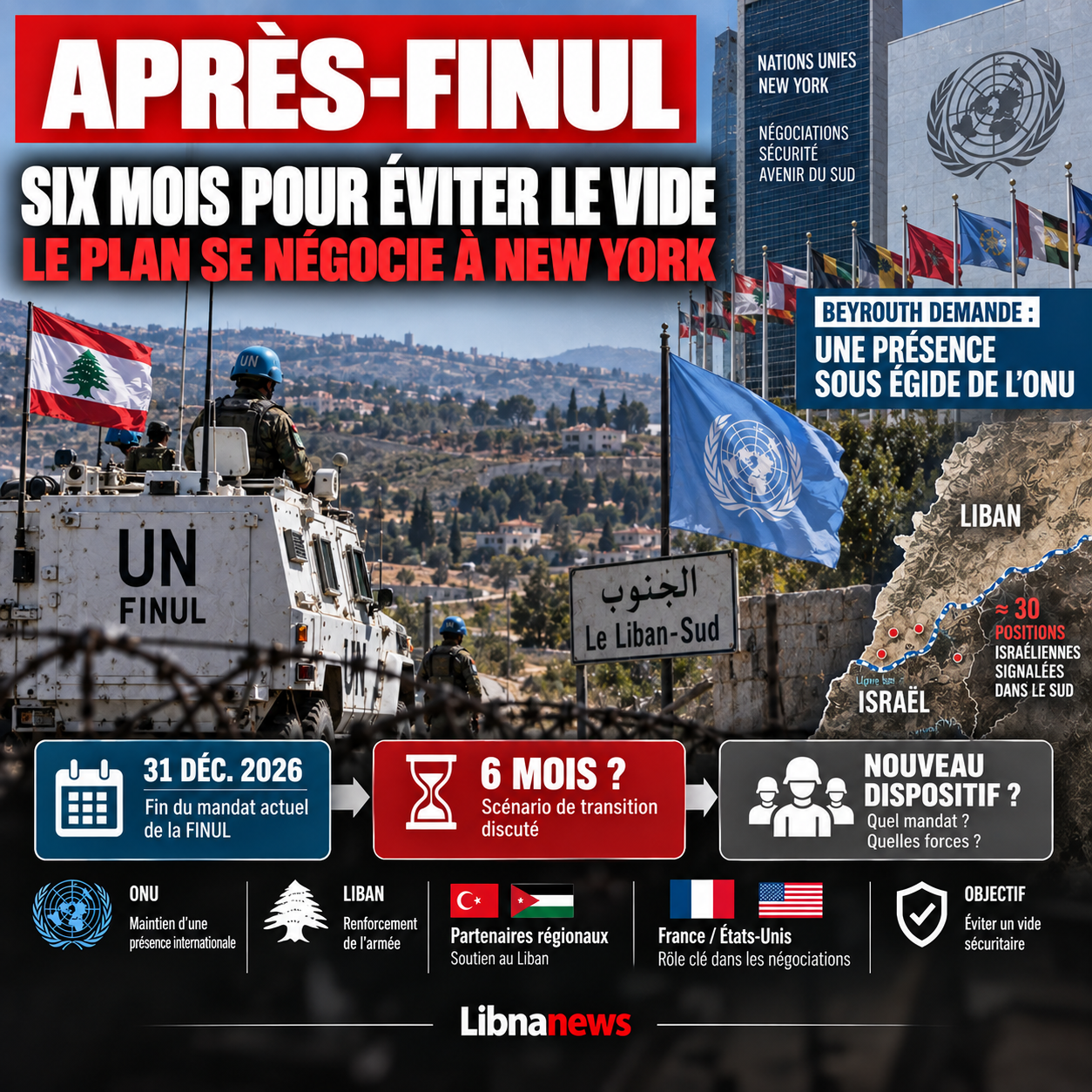
A compromise proposal circulates in the diplomatic exchanges devoted to the future of South Lebanon: extending the mission of the United Nations Interim Force in Lebanon by six months in order to avoid a security vacuum, while giving the various parties time to define the mechanism to succeed it. Several diplomatic sources refer to this formula as of 23 September 2026. But Prime Minister Nawaf Salam’s entourage brings an essential nuance: at this stage there would be no comprehensive and agreed-upon plan for an extension of six months. What is confirmed is the Lebanese will to maintain an international presence under the aegis of the United Nations in the South.
This difference is central. It suggests that the six months constitute for the moment a formula discussed or even tested with the various actors, rather than a definitively negotiated compromise.
Consultations in New York seek to resolve an equation that has become urgent. The current mandate of UNIFIL comes to an end at the end of 2026. However, Lebanon considers that the security conditions do not permit an international withdrawal followed by a period without a monitoring mechanism. At the same time, the States concerned are already discussing the nature of a mechanism to take over.
The position of Nawaf Salam is therefore to dissociate two issues. The first is immediate: prevent a vacuum on January 1, 2027. The second is more complex: to determine which international structure can then function, with which mandate, which forces, which participating countries, and what relationship with the Lebanese army.
The six months would allow precisely to separate these two calendars.
An official Lebanese letter to the United Nations
Beirut was not content with informal discussions. According to available information, the United Nations received an official Lebanese letter requesting the continuation or extension of the international mission. This confirms that the principle of international continuity has become an official position.
The exact wording of the solution, however, remains under discussion. A first option would be the renewal of the mission. If this is not possible, a limited six-month extension could be the transition solution. A third option would be the creation of a new international mechanism.
This architecture explains why the available information may seem contradictory without necessarily being. Diplomatic sources refer to an extension of six months. At the same time, the Prime Minister’s entourage indicates that no such comprehensive proposals have yet been agreed.
It can therefore be a work scenario submitted to the various capitals before being transformed, possibly, into an official proposal.
The international calendar also plays a role. According to official sources, Lebanon envisages a final decision on the future of the mechanism after the elections in the United States and Israel and after a clarification of the conflict between Washington and Tehran. An additional period of six months would allow the structural decision to be deferred to a potentially different regional environment.
However, this expectation poses a risk: while diplomacy negotiates future architecture, military realities continue to evolve on the ground.
Thirty Israeli positions complicate the withdrawal scenario
The military situation is precisely the main obstacle to a simple transition.
According to data provided by UNIFIL, Israeli forces are reported to be present in approximately 30 military positions in various areas of the South Lebanon. Among these would be eight fortified positions.
Prior to the new confrontation, five Israeli fortified positions were identified near and north of the Blue Line. Three new fortified positions were reportedly observed during the year 2026.
These facilities would add about twenty temporary military positions installed in what is described as a safe area. According to available information, this area can reach up to ten kilometres deep inside Lebanese territory in certain areas.
These data profoundly change the nature of the UNIFIL discussion. The debate is not simply about the replacement of an international force upon completion of its mandate. The issue of occupation, Israeli military positions and the freedom of movement of the Lebanese army remains open.
For Beirut, the maintenance of an international presence therefore serves several purposes: monitoring, communication between the parties, documentation of incidents and support for the deployment of the army.
Nawaf Salam made these demands in New York, at the same time stressing the full Israeli withdrawal, the strengthening of the army’s capabilities and the return of the inhabitants to the southern localities.
Nawaf Salam seeks continuity under the UN flag
During his meeting with UN Secretary-General Antonio Guterres, Nawaf Salam stressed the need to maintain an international presence in the South after UNIFIL.
The wording used is important. The Prime Minister is not only asking for the retention of foreign observers. He hoped that this presence would remain under United Nations cover. It should provide monitoring, reporting and communication missions while contributing to the stability and deployment of the Lebanese State authority.
This position shows that Beirut does not automatically regard any multinational force as an acceptable substitute.
United Nations coverage offers a political and legal framework different from that of a coalition of countries formed outside the organisation. It also allows Lebanon to present the international presence as support for the authority of the State and not as a substitute for it.
This distinction becomes all the more important as Nawaf Salam simultaneously reaffirms the government’s willingness to place arms and the decision on war and peace under the exclusive authority of the State.
The Lebanese strategy is based on two parallel movements: strengthening the army as the main security actor and maintaining international coverage during the period of its expansion.
Turkey opens new track
Turkey entered directly into the post-FINAL discussion.
During his meeting with Nawaf Salam in New York, President Recep Tayyip Erdogan said an international initiative would be needed to replace the current force. He also confirmed his country’s willingness to continue its support for Lebanon.
The Turkish formulation, however, remains general. There are no full offers from Ankara to deploy a Turkish force to replace UNIFIL.
It is therefore necessary to distinguish Turkish support for the idea of an international mechanism for possible Turkish military participation, which is not established.
However, Turkey is involved on several levels in the Southern dossier. Discussions focused on prefabricated homes for residents, return to villages, reconstruction and infrastructure. Cooperation projects in energy, transport and regional links are also mentioned.
This presence could give Ankara a role in the stabilization phase without prejudging the exact form of its security commitment.
Jordan also supports the idea of a replacement force
King Abdullah II of Jordan also discussed with Nawaf Salam the question of the international arrangements to succeed UNIFIL.
Discussions focused on the need to avoid any vacuum after the end of the mission. Jordan also supports the Lebanese army and participates in efforts to mobilize international support for security institutions.
The convergence between Beirut, Ankara and Amman on the need for international continuity is politically important. However, it is not enough to create a force.
In order for a new arrangement to emerge, it will be necessary to determine its mandate, rules of engagement, staffing, funding and troop-contributing States.
It will also be necessary to know whether Israel will accept its presence and under what conditions.
This is where the six-month formula makes sense. It would give time to negotiate these parameters without causing an immediate break in the international presence.
Paris wants to retain a role in South Lebanon
France remains particularly active on this issue. According to available information, Emmanuel Macron was to preside over a meeting of the Security Council devoted to the Middle East, with Lebanon among the topics discussed. The question of UNIFIL and the question of the replacement force should occupy an important place.
Paris seeks to maintain European involvement in the security architecture of the South. This approach is of particular importance as the French role in the monitoring mechanisms of the Lebanese case has evolved in recent months.
France had participated in the ceasefire monitoring mechanism alongside the United States, Lebanon, Israel and UNIFIL. Subsequent developments and direct negotiations, however, reinforced Washington’s place.
The future international mechanism is therefore also becoming an issue of division of roles between Western partners.
A force with a strong European component would offer Paris the opportunity to maintain an operational presence. A formula controlled primarily by Washington would produce a very different balance.
Washington is the main unknown
The American position remains decisive.
The information gathered in the Lebanese case shows that Washington has gradually strengthened its control over the negotiating and monitoring mechanisms for the South. The United States is sponsoring direct negotiations between Lebanon and Israel. They are therefore central to any discussion of the future security arrangements.
The eighth round of Lebanese-Israeli negotiations is expected in October 2026. However, by 23 September Beirut had not yet received a specific date or formal invitation from the American Ombudsman.
This absence adds additional uncertainty.
The United States might consider that the direct mechanisms it sponsors are sufficient to provide part of the political functions formerly exercised by a broader international presence. Such an approach would not necessarily correspond to the Lebanese preference for UN coverage.
The debate therefore focuses less on the abstract need for oversight than on its architecture.
Who’s watching? Under what mandate? Who arbitrates the incidents? What remains of the United Nations? What role does Washington have? And what autonomy does Lebanon retain in this mechanism?
Israel also imposes its realities on the ground
During these discussions, Israel continues its operations in the South.
Artillery bombing, building destruction, house fires and movement of military vehicles have been reported in several areas. The Khiam area is one of the areas where the Israeli military presence remains visible.
Israeli Defense Minister Israel Katz also claimed that the Israeli army was deployed in safe areas in Lebanon, Syria and Gaza.
This situation creates an asymmetry between diplomatic and military time.
Negotiators discuss a future security mechanism. In the field, new positions can gradually become permanent. The longer this situation continues, the more likely the future international arrangement may have to manage a fait accompli rather than supervise a withdrawal.
This is one of the main Lebanese concerns.
An international presence after UNIFIL would be limited in scope if it intervened without a settlement of the issue of Israeli positions and without sufficient freedom of deployment for the Lebanese army.
The role of the Lebanese Armed Forces at the centre of all forms
None of the scenarios discussed officially provides for an international force to replace the Lebanese army on a lasting basis.
On the contrary, Beirut’s position is to strengthen the deployment of the army and to make the State the central security authority in the South.
The government thus presents the international presence as an accompaniment.
This distinction also responds to criticism that an extension of UNIFIL would delay the moment when the State alone assumed responsibility for border security. For Beirut, the two objectives are not contradictory: the strengthening of the army must continue while an international mechanism reduces the risk of confrontation and ensures the necessary communications.
UNIFIL itself asserts that its role cannot replace the political decisions of the parties. His command considers that the full implementation of resolution 1701 remains the basis for lasting stability.
The international mission can therefore observe, report and facilitate communications. It alone cannot impose a regulation.
The six-month buffer period scenario
In this context, the six months appear less as a new strategy than as a buffer period.
They would avoid three simultaneous breaks: the departure of UNIFIL, the absence of a replacement force and a Lebanese army still facing an unstable military situation.
This period could also make it possible to negotiate the composition of a new arrangement.
A European force? A lighter United Nations observation mission? A multinational structure involving several countries? A strengthened monitoring mechanism around the Lebanese army? The sources of 23 September do not yet give priority to a formula.
They show above all that several proposals are circulating.
The six-month extension would therefore save time. But saving time is useful only if this delay actually allows for a new architecture.
An apparent disagreement that reveals the real state of the negotiations
The most revealing point finally remains the divergence between diplomatic information and the position conveyed by Nawaf Salam’s entourage.
On the one hand, several sources clearly speak of a six-month compromise. They present this duration as a solution designed to avoid the vacuum and allow the negotiation of a successor.
On the other hand, the Prime Minister’s entourage states that there is no complete and finalized proposal for a six-month extension. The Lebanese demand focuses on maintaining an international presence.
Both versions can be reconciled if the six-month formula is still at the diplomatic consultation stage.
It would then be sufficiently advanced to circulate between the actors, but not sufficiently negotiated to be formally assumed by Beirut as an agreement.
This is precisely what makes the file sensitive. A premature announcement could provoke opposition even before the terms of the compromise were agreed.
The next steps will measure its maturity: discussions in the Security Council, Nawaf Salam meetings in Washington, US position, Israeli reaction and preparations for the eighth round of direct negotiations.
On September 23, 2026, one thing was established:Beirut refuses an international vacuum in South Lebanon after UNIFIL. The six-month extension is an option seriously mentioned by diplomatic sources, but it is not yet presented by the government as a final negotiated formula. Between these two elements is now one of the most important negotiations for the security future of the South.