





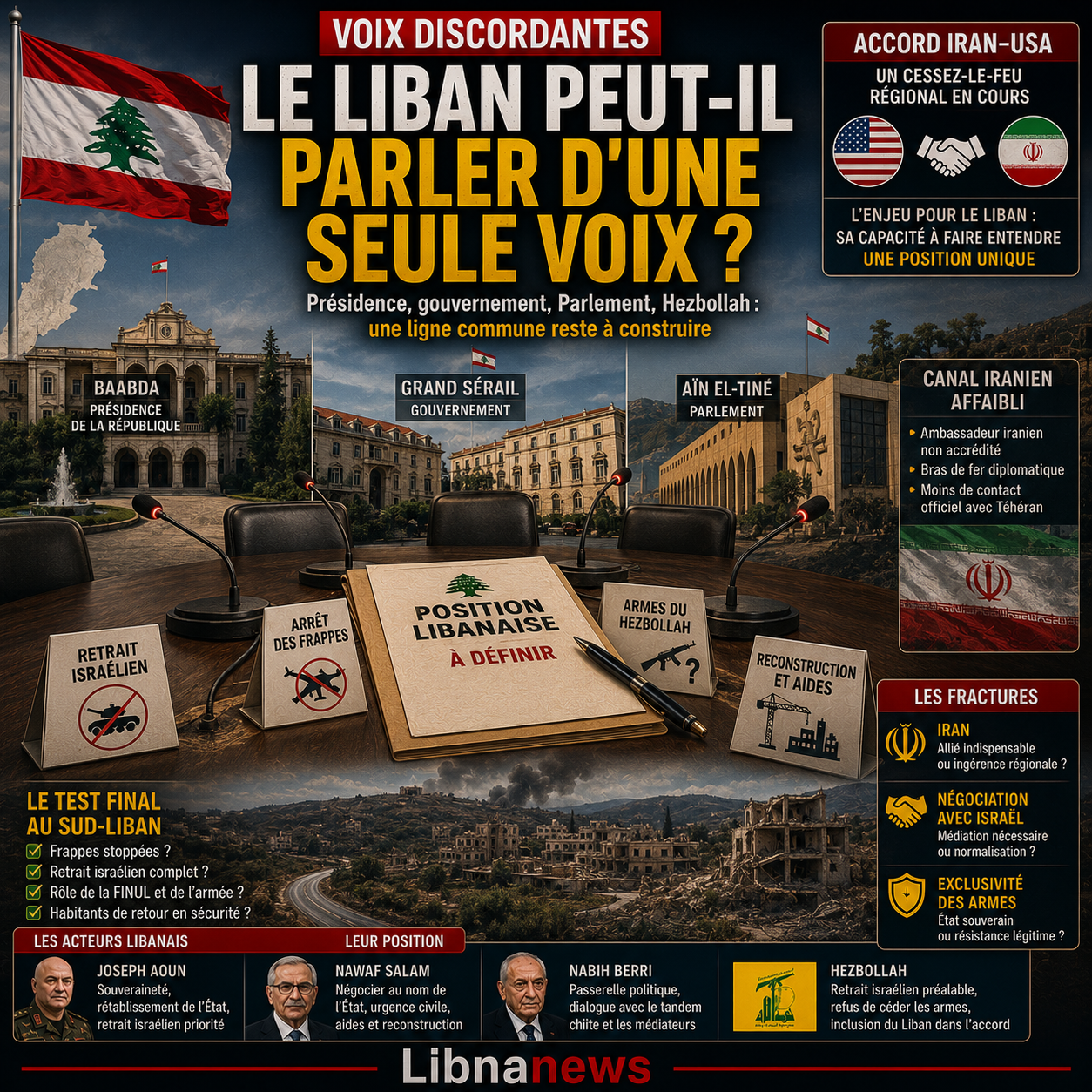
Lebanon enters the phase opened by the Iran-USA agreement with a question that goes beyond diplomatic technique: can its diplomacy speak with one voice? The country is directly affected by the regional ceasefire announced on the night of 14-15 June, but does not control the parameters of its implementation alone. Washington wants to save a de-escalation that reopens Ormuz and pushes back the nuclear talks. Tehran claims that Lebanon is included in the cessation of hostilities. Israel refuses to lose its freedom of action against Hezbollah. Beirut called for Israeli withdrawal, the return of displaced persons and respect for its sovereignty. These requests appear to be consensual. Yet they hide deep fractures on weapons, Iran, negotiations with Israel and the real role of the state.
The Lebanese difficulty is not only due to the diversity of positions. It is because each institution has partial legitimacy and a different channel. The Presidency speaks on behalf of the State, the army and sovereignty. The government manages negotiations, economic emergencies, donors and reconstruction. Parliament, by Nabih Berri, maintains a bridge to the Shiite tandem and to several mediators. Hezbollah, a political and military actor, has de facto power over the decision to war. This plurality can produce a national line if it is coordinated. It can also give external powers the opportunity to choose their interlocutors and impose their timetable.
The Presidency seeks to restore the state
Joseph Aoun built his position around one principle: Lebanon should not be a map in the negotiations of others. This line is aimed first at Iran, accused by some Lebanese officials of using the southern front as a lever in its arm with Washington. It also targets Israel, which often treats Lebanese territory as a space of operations against Hezbollah. Finally, it addresses Western partners, to whom Beirut wishes to remind that Lebanese sovereignty cannot be invoked only when it comes to limiting Hezbollah’s weapons, and then forgotten when it comes to Israeli strikes.
The President therefore seeks to impose a clear hierarchy. First the cessation of the strikes and the Israeli withdrawal. Then the return of the inhabitants. Then the strengthening of the army and the opening of an internal debate on arms exclusivity. This sequence allows him to speak to several audiences. To the people of the South, he said that the State did not normalize the occupation or imposed security zones. To the sovereignists, he said that military decision must go back to institutions. To donors, he said that Lebanon wanted a public authority capable of managing borders, aid and reconstruction.
This position remains fragile. The Presidency cannot impose an Israeli withdrawal alone. It cannot disarm Hezbollah by decree. It cannot guarantee that Washington will contain Benjamin Netanyahu. It depends on the army, the government, the Parliament, the Finul and the mediators. It must also prevent the discourse of sovereignty from being perceived as a Community confrontation. Joseph Aoun must therefore maintain a balance: firm on the principle of the state, cautious on the method, insisting on Israeli withdrawal, but open to a gradual transition.
The government and the weakened Iranian channel
Nawaf Salam has a different constraint. The government must manage the civil emergency and the international agenda at the same time. It must organize the return of internally displaced persons, prepare for reconstruction, reassure donors, revive exports to Saudi Arabia, process financial records and maintain contact with mediators. This accumulation gives the Prime Minister a central but also exposed position. He must speak as head of a sovereign government, while knowing that several key issues are decided outside the Council of Ministers.
His line is to say that no one negotiates on behalf of Lebanon outside the state. This formula is important. It responds to the risk of de facto delegation to Iran, Hezbollah or mediators who would deal directly with influential forces on the ground. It also meets a demand from Arab and Western partners: a state capable of verifiable commitments. The Government therefore wants to transform the regional ceasefire into a Lebanese road map. It must include the national priorities: cessation of fire, withdrawal, return, reconstruction, prisoners, border control and support for the army.
But the government is advancing with a handicap that it has itself helped to create. The withdrawal of the accreditation of the Iranian ambassador, decided by the Ministry of Foreign Affairs led by Youssef Raggi, was a sovereignist logic. Beirut accused the Iranian representative of interventions that were considered to be contrary to diplomatic practice and interference in internal affairs. In principle, the decision could therefore be defended. A State does not have to tolerate an ambassador’s comment on its security choices or the impression of treating Lebanon as an extension of Iran’s regional strategy.
In retrospect, however, this decision appears to be a tactical error. It deprived the Lebanese State of a direct official channel with Tehran as Iran became one of the decisive actors in the ceasefire in Lebanon. The crisis became even more problematic when Iran suggested that its ambassador would remain in office despite Lebanese order. Beirut wanted to assert its authority. He found himself in front of an arm of fire which revealed above all the limits of this authority when Hezbollah and its allies refused to follow the same line.
This diplomatic vacuum has a concrete consequence. When Lebanon is to send a message to Tehran on the ceasefire, Israeli withdrawal, Israeli freedom of action or the role of Hezbollah, it can no longer count fully on a normal bilateral circuit. It must go through indirect channels: Nabih Berri, Hezbollah, Qatar, Pakistan, France or other third-party capitals. This weakens Beirut’s claim to speak with one voice. It gives more weight to actors who still have a functional relationship with Iran, particularly Ain al-Tiné and Hezbollah.
The lesson is severe for Lebanese diplomacy. A sovereign policy is not just about sanctioning interference. It also consists of keeping channels open with the powers that influence the national terrain. Closing a channel can satisfy some of the opinion and send a signal of firmness. But if no alternative channel is controlled by the state, the decision can strengthen informal mediators. In the Iranian case, it paradoxically increased Beirut’s dependence on Berri and the actors who were at the very heart of the sovereignty problem.
Nabih Berri, parliamentary and political channel
Nabih Berri therefore remains the third pillar of this fragmented diplomacy. President of Parliament, Head of Amal and historical interlocutor of the Southern dossier, he can speak with Hezbollah, mediators and institutions. Its favourable reaction to Lebanon’s inclusion in the regional ceasefire shows its willingness to present the agreement as a gain for stability. It can help transform this reading into a national position, especially if Parliament has to vote on texts related to reconstruction, aid, budget, army or donor reforms.
Its role is useful because it avoids a break between the state and the Shiite tandem. In a country where the application of a truce in the South also depends on the behaviour of Hezbollah, no government can be content with an abstract institutional line. We need channels. Ain al-Tinah offers one. Berri can translate some of Hezbollah’s demands into Lebanese political language. It can also transmit to Hezbollah allies the constraints of the state, donors and Arab countries. This bridge function can reduce the risk of rupture.
However, it has a cost. Hezbollah’s opponents blame Berri for protecting permanent ambiguity over weapons and slowing down decisions that would strengthen the state. International partners know that it is essential, but they fear that parliamentary stability will serve to postpone reforms. Lebanese diplomacy will only be able to speak with one voice if Berri uses his power of timing to accompany a road map, not to neutralize the most difficult debates. Its role will be judged on laws, sittings, votes and the ability to support a common position.
Hezbollah, an actor without whom nothing applies
Hezbollah remains the most sensitive point. It is not only a party represented in Parliament. He is an armed force, a social actor, an ally of Iran and an indirect interlocutor of regional balances. It can support Lebanon’s inclusion in the Iran-USA agreement because this inclusion protects its front from a strictly American or Israeli reading of the truce. It may also refuse any formula that would make the ceasefire conditional on its unilateral withdrawal or immediate disarmament. For him, Israeli withdrawal is the prerequisite, not the consequence.
The movement shares with the Lebanese institutions two demands: the cessation of strikes and the complete Israeli withdrawal. These commonalities are real. They can establish a minimum diplomatic position. But fractures begin as soon as the question of post-retirement is asked. The state wants arms exclusivity. Hezbollah wants to maintain a deterrent capacity as long as it considers the present Israeli threat. The sovereigns want a calendar. Hezbollah wants a dialogue without external constraint. Donors want guarantees. The movement denounces American and Israeli pressure.
This divergence cannot be masked indefinitely. However, it can be managed if Lebanese diplomacy distinguishes the stages. A common position may first require the cessation of strikes, withdrawal, return of inhabitants and reconstruction. It can then open a national debate on arms, linked to the strengthening of the army and international guarantees. If the stages are confused, each camp will use the other as a pretext. Israel will say that Hezbollah justifies its strikes. Hezbollah will say that the strikes justify its weapons. The state will remain in between.
Points of agreement exist, but they are narrow
Lebanese diplomacy can speak with one voice if it is first limited to a specific base. This base exists. It includes the Israeli withdrawal from all disputed positions, the cessation of strikes on land, air and sea, the safe return of the displaced, the increased role of the Lebanese army, coordination with the Final and the reconstruction of the affected areas. On these points, the Presidency, the Government, Parliament and Hezbollah can find a common formulation, even if their motivations differ. This convergence must be exploited.
It must also be written. Lebanon cannot be content with parallel statements. It needs a national roadmap, with hierarchical demands and unique language. This sheet must be forwarded to the United States, France, the United Nations, the Arab countries, Qatar, Pakistan and other mediators. It must specify the five immediate priorities: withdrawal, cessation of violations, return, reconstruction, guarantees. It must also state that any discussion of weapons is a Lebanese process, not an Israeli injunction.
Fractures remain deep
Three fractures threaten this unit. The first concerns Iran. Some Lebanese officials regard Tehran as an actor who helped to impose Lebanon’s inclusion in the agreement. Another sees it as a power that uses the country as a regional lever. Hezbollah defends the first reading. The sovereignists insist on the second. The presidency and the government are trying to avoid the two excesses: to thank Iran to the point of removing the state, or to challenge it to the point of causing an internal crisis.
The second fracture concerns negotiations with Israel. Some officials believe that indirect discussions, under United States or international mediation, are necessary to secure withdrawal, deal with violations and organize the return of internally displaced persons. Others fear that any negotiating formula will be used to impose concessions on Lebanon or to normalize an Israeli presence. Hezbollah rejects any approach that appears to it to circumvent the resistance. The government must deal with practical issues. This tension requires great precision in terms of technical negotiation, indirect mediation, lack of standardization, limited objectives.
The third fracture concerns weapons. She’s the heaviest. Arms exclusivity is a central principle for the State and its partners. Hezbollah sees it as an issue related to the power relationship with Israel. The sovereigns want a calendar. The Shiite tandem favours dialogue and Israeli withdrawal. Donors want guarantees before reconstruction. This fracture will not disappear with the cease-fire. It can even intensify if the strikes cease and the issue becomes less military than institutional.
The risk of a de facto delegation
If Lebanese diplomacy does not speak with one voice, the risk is known: the country will be represented in fact by others. Iran will talk about the Lebanese front in its negotiations with Washington. Israel will impose its security lines. The United States will define safeguards according to its own priorities. Arab countries will condition their assistance without always waiting for internal arbitration. The United Nations and the Final will manage field procedures. The Lebanese government will be consulted, but not central. This is the scenario Beirut says it wants to avoid.
To reduce this risk, Lebanon must move from reaction diplomacy to proposal diplomacy. It must produce maps, schedules, needs lists, violation mechanisms, reconstruction priorities and funding requests. It must link these elements to a single institutional position. The Presidency, the Government and Parliament must appear as the bearers of this sheet. Hezbollah must at least not sabotage it, even if it retains its reservations on certain points. This is a high requirement, but it is the price to prevent the regional agreement from turning Lebanon into a simple enforcement clause.
So the question is not whether all Lebanese actors think the same thing. They don’t. The question is whether they can identify what they want together in the decisive days: end of strikes, Israeli withdrawal, return of displaced persons, reconstruction, respect for sovereignty, useful diplomatic channels and strengthening of the army. If this list becomes Lebanon’s official position, the country will regain a margin. If each camp speaks separately to its regional ally, the decisions will continue to be taken elsewhere, while the villages of the South will wait to know what voice, in essence, actually engages the state.