





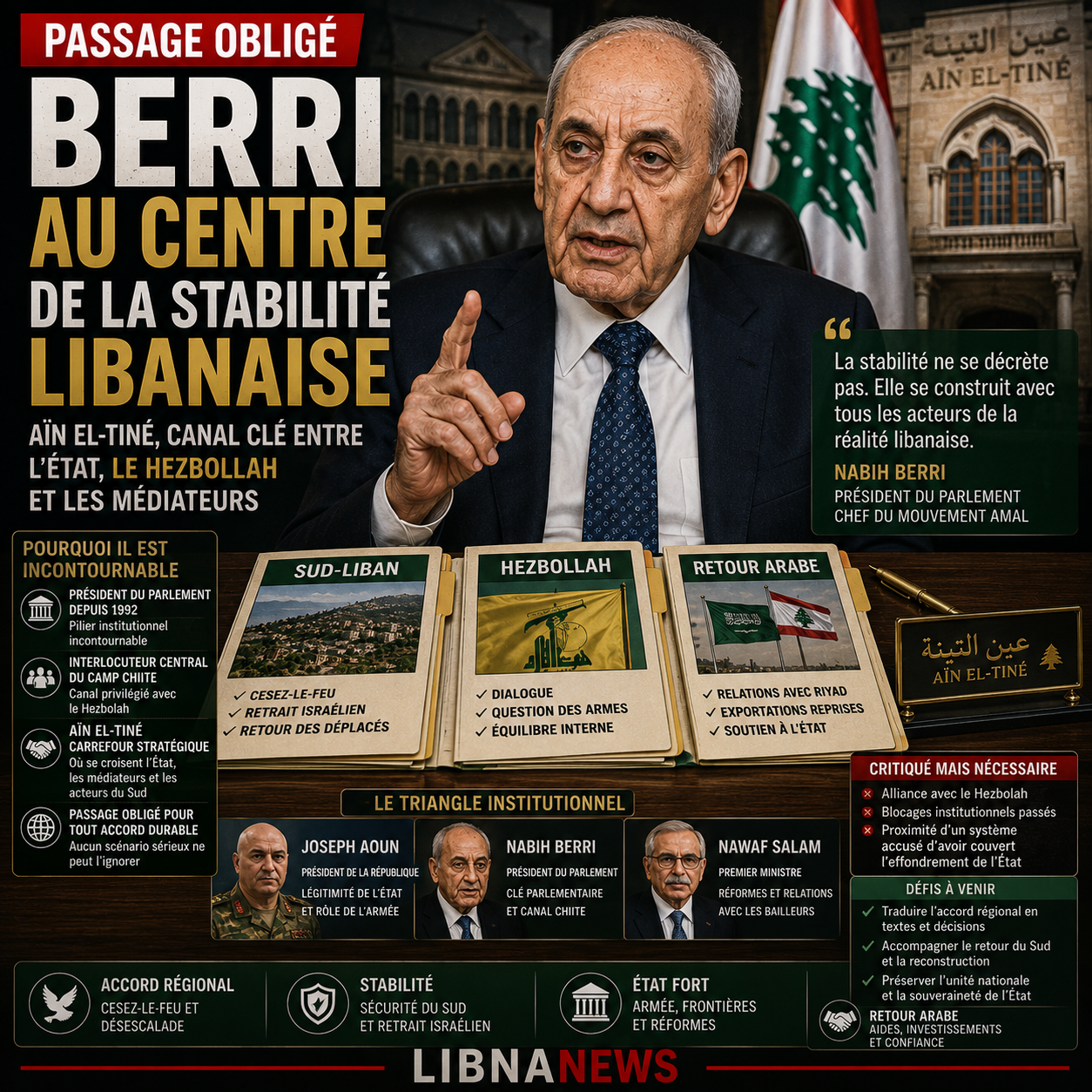
Lebanon addresses the post-regional agreement with a clear indication that its partners cannot circumvent: Nabih Berri remains a necessary part of Lebanese stability. President of Parliament since 1992, leader of the Amal movement and central interlocutor of the Shiite camp, he occupies a rare institutional and political position. Ain al-Tinah, his political residence, is not only a place of consultation. It is one of the few areas where the state, Hezbollah, foreign mediators, Arab leaders and local actors in the South cross. In a phase marked by the expected cease-fire, the question of Israeli withdrawal, Hezbollah’s weapons and the Arab return from Lebanon, its role becomes decisive again.
This centrality is not valid for general approval. Berri also has strong critics. His opponents blame him for his alliance with Hezbollah, his long-term control of Parliament, his role in past institutional blockages and his proximity to a political system accused of covering the collapse of the state. But Lebanese stability is built not only with those who are judged to be the most consensual. It is also built with those who have real relays in communities, institutions and areas of tension. It is this paradox which explains why, despite the criticisms, no serious scenario of exit from crisis can ignore Ain al-Tiné.
A President of Parliament with a strategic role
The constitutional role of Nabih Berri first gives institutional weight to its influence. The President of Parliament is not merely an arbitrator of sittings. In the Lebanese system, it controls part of the legislative rhythm, convenes sessions, organizes the parliamentary order and participates, through its position, in the balance between the Presidency of the Republic and the Government. This function is becoming more important at a time when every decision on ceasefire, reconstruction, international aid or banking reform will have to be made through laws, budgets, credits, commissions and votes. Diplomacy can produce an agreement. Parliament will then have to turn part of this agreement into legal instruments.
Retrouvez les dernieres depeches et mises a jour en direct sur Libnanews Live.
This fact obliges Joseph Aoun and Nawaf Salam to deal with it all the more as Lebanon has deprived itself of an official interlocutor with Iran following the decision and political error of Foreign Minister Youssef Rajji to expel the Iranian ambassador. The President of the Republic carries the legitimacy of the State and the army. The Prime Minister defends the government line, reforms and relationship with donors. Berri holds the parliamentary key and the Shiite channel. Without him, the promise of sovereignty can remain locked in the discourse. With him she can find a way through the institutions, provided that a compromise is possible. The Aoun-Berri-Salam triangle does not clear the differences. It sets the minimum framework for institutional stability in a country where a break between the three poles would immediately open a wider crisis.
Ain al-Tinah, an indispensable channel with Hezbollah
Ain al-Tinah is primarily responsible for liaison with Hezbollah. Berri does not lead the armed Shiite movement. He doesn’t speak for him on all the files. But he remains the most credible civil interlocutor in the Shiite tandem. Since the last rounds of negotiations, he has often been presented as the one who could transmit, test or frame some of Hezbollah’s positions, including on ceasefires, Israeli withdrawal and southern security. This capacity does not mean that it can impose a decision alone. It means that no durable device can completely bypass the channel it represents.
This role explains why mediators return to him. Americans, French, Qataris, Egyptians and other actors know that official Lebanon cannot apply a truce to the South if the Shiite tandem rejects it. They also know that Hezbollah will not want to appear as receiving direct American instructions. Berri then offers a political translation area. It can formulate Lebanese demands, resume guarantees requested by Hezbollah, send messages to chanceries and preserve the appearance of a national decision. This filter function is essential in a country where words engage as much as weapons.
The sequence opened by the agreement between Washington and Tehran further reinforces this role. Iran claims that Lebanon is included in regional de-escalation. Israel refuses to lose its freedom of action against Hezbollah. The United States wants to protect a compromise that reopens Ormuz and pushes nuclear negotiations to a later stage. In this context, Berri can become one of the Lebanese interpreters of the truce. He can argue that the ceasefire only makes sense if it includes the South, the Israeli withdrawal and the return of the inhabitants. It can also prevent this reading from turning into a frontal confrontation between the government and Hezbollah.
But its usefulness also lies in its limits. Berri cannot disarm Hezbollah. It cannot guarantee, alone, the cessation of all operations. He cannot force Israel to withdraw. It cannot replace the Lebanese army, the Finul or international mechanisms. Its role is political, not operational. It can facilitate a formula, not make it automatically applicable. The confusion between mediation and control would be dangerous. It would give Ain al-Tiné a responsibility that he cannot assume, and then serve as a pretext to accuse Berri of failure if the truce broke on the ground.
The Aoun-Berri-Salam triangle seen by Riyadh
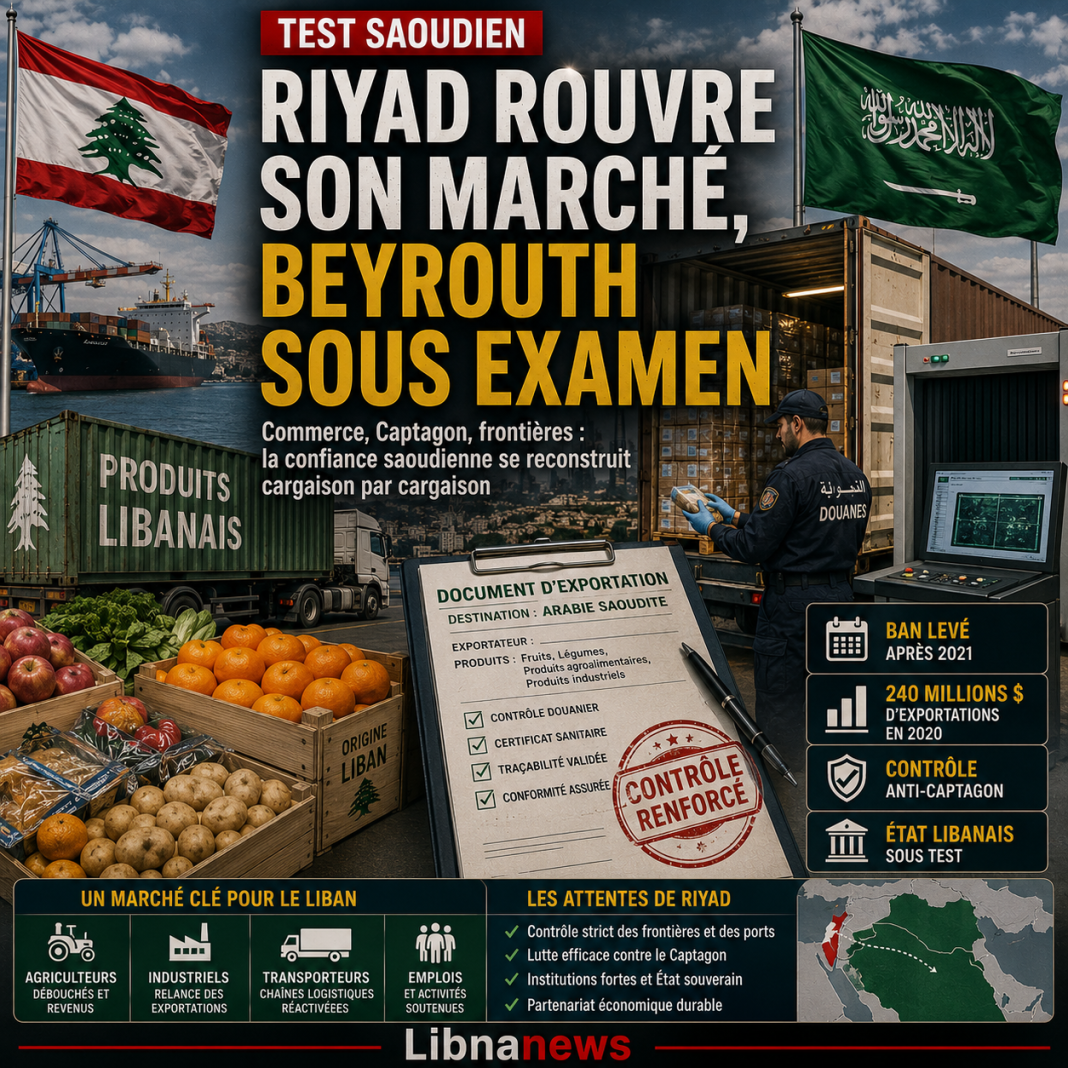
The Saudi dimension adds another layer. The announced resumption of Lebanese exports to Saudi Arabia exceeds trade. It states that Riyadh wants to test the new Lebanese power, support a return from the state and measure Beirut’s ability to control its borders, fight the Captagon and reduce the grip of non-State actors. Joseph Aoun and Nawaf Salam embody this institutional expectation. But Riyadh also knows that no lasting stabilization can ignore the main Shiite political representation. A stable Aoun-Berri-Salam triangle can therefore serve as a minimum guarantee: the state speaks, the government acts, the parliament accompanies, and the Shiite channel does not turn into a breaking opposition.
This reading does not mean that Saudi Arabia unconditionally rehabilitates Berri or the Shiite tandem. Saudi reserves of Hezbollah remain deep. Riyadh wants a state capable of controlling ports, borders, cargo and financial channels. He’s waiting for evidence, not just commitments. But Saudi diplomacy knows how to distinguish between hostility to Hezbollah’s military weight and the need to speak with the forces that still structure Lebanon. Berri occupies precisely this space. He is not the man of the Arab return alone. It is one of the passages that can prevent this return from stopping on an internal denominational rupture.
For Joseph Aoun, the equation is sensitive. The president wants to restore the role of the army and put the military decision under the authority of the state. It cannot appear dependent on Ain al-Tin. Nor can he treat Berri as an absolute obstacle. An open confrontation between Baabda and the President of Parliament would weaken the Lebanese position at a time when the country was calling for Israeli withdrawal, American guarantees and Arab aid. Aoun must therefore obtain from Berri a contribution to stability without abandoning the principle of State exclusivity. This line requires time, reciprocal gestures and public discipline.
For Nawaf Salam, the challenge is different. The Prime Minister embodies an expectation of reform, transparency and institutional standardization. He speaks to Western donors, financial institutions and capitals. He knew that reconstruction, the removal of the financial grey list, banking reform and the resumption of exports required legislative decisions. He therefore needs Parliament. But it must avoid that reforms are absorbed by traditional compromises. The relationship with Berri will be judged on this point: can it produce useful texts without replicating the mechanisms that paralyzed the state?
Hezbollah weapons, central limit
Hezbollah’s weapons record remains the heaviest limit. Berri can support a national dialogue, defend a gradual approach and refuse internal confrontation. This position can help to avoid a civil crisis. It can also be denounced as a way to save time. The sovereignist forces demand that arms exclusivity be clearly applied. Hezbollah responds that any serious debate requires first an Israeli withdrawal, a halt to strikes and security guarantees. Between these two lines, Berri traditionally seeks a formula that postpones the explosion. In the current period, this postponement may be useful. But it cannot become a permanent strategy.
The pressure of the Shiite street also plays. The destruction in the South, displaced persons, agricultural losses and bereaved families create a demand for protection and reparation. Amal and Hezbollah will be judged by their ability to obtain return, compensation and visible reconstruction. Berri cannot accept an agreement perceived as a capitulation of the South. It must therefore defend a complete Israeli withdrawal and prompt assistance, while avoiding a resumption of war that would worsen civilian casualties. This tension explains his cautious language. He must speak to the state, to mediators and to a proven social base.
The pressure also comes from the non-Shiite street. A significant part of Lebanese opinion refuses to allow the country to be led into wars decided by others. It calls for a State capable of protecting without dependent on an armed organization. She observes Berri with distrust, as she sees him as the political guarantor of Hezbollah. In this view, stability cannot be limited to the absence of fighting. It must include arms monopoly, border control, financial transparency and the end of blockages. If Berri wants to remain an acceptable compulsory passage, he will have to show that he facilitates the state instead of neutralizing it.
A useful but disputed actor
International expectations are similar. Donors and Arab countries can accept a gradual transition. They do not want to finance a reconstruction that would prepare a new war. They will demand guarantees on the army, borders, financing channels and distribution of aid. Parliament will have a major role in these matters. Berri can speed up or slow down texts. It may encourage compromises or allow projects to simmer. Its timing power thus becomes an economic power. In a ruined Lebanon, stability is also measured by the ability to pass the laws necessary for post-war financing.
This power arouses an old criticism: that of a system where the same officials remain indispensable because they have helped to lock institutions. Berri embodies this ambivalence. It is both a factor of continuity and a symbol of blocking. He knows the files, the actors, the red lines and the balance of power. But its long retention at the top of the Parliament is fuelling the idea of a closed policy, little renewed and little responsible to the citizens. This criticism will not disappear after the agreement. It will weigh on every compromise negotiated at Ain al-Tinah.
Lebanese stability will therefore depend on how that role will be used. If Berri is used to cover a permanent ambiguity about weapons, borders and reforms, it will become an obstacle. If it is used to bring the Shiite tandem to a verifiable agreement, to accompany the deployment of the army, to vote on the reconstruction texts and to preserve a minimum agreement between Baabda, the Great Serail and Parliament, it will remain a pillar. The difference will be less in statements than in decisions: convening meetings, adopting laws, supporting the return of displaced persons, coordinating on the South, engaging in a real national dialogue.
Another issue concerns the political succession within the Shiite community. Berri remains one of the last major actors in the generation emerging from the civil war. His personal authority has long managed balances that institutions alone did not regulate. But this authority also raises the question of post-Berri. The more the system depends on a single mediator, the more fragile it becomes when the mediator weakens or withdraws. For this reason, stability cannot be based solely on its experience. It must transform its channels into procedures, its compromises into texts and its arrangements into institutions capable of surviving people.
The next few days will give a first indication. After the expected signature in Switzerland, Lebanon will have to clarify its demands: stop strikes, Israeli withdrawal, return of inhabitants, reconstruction, prisoners, role of the army and international guarantees. Berri can help transform this list into a national position, or let each side reformulate it according to its interests. Ain al-Tiné will then remain what she has been for years: a place where one comes to seek an exit, but also a place where one measures the Lebanese difficulty in producing a fully state decision.