





A strike on Beirut at the most sensitive moment
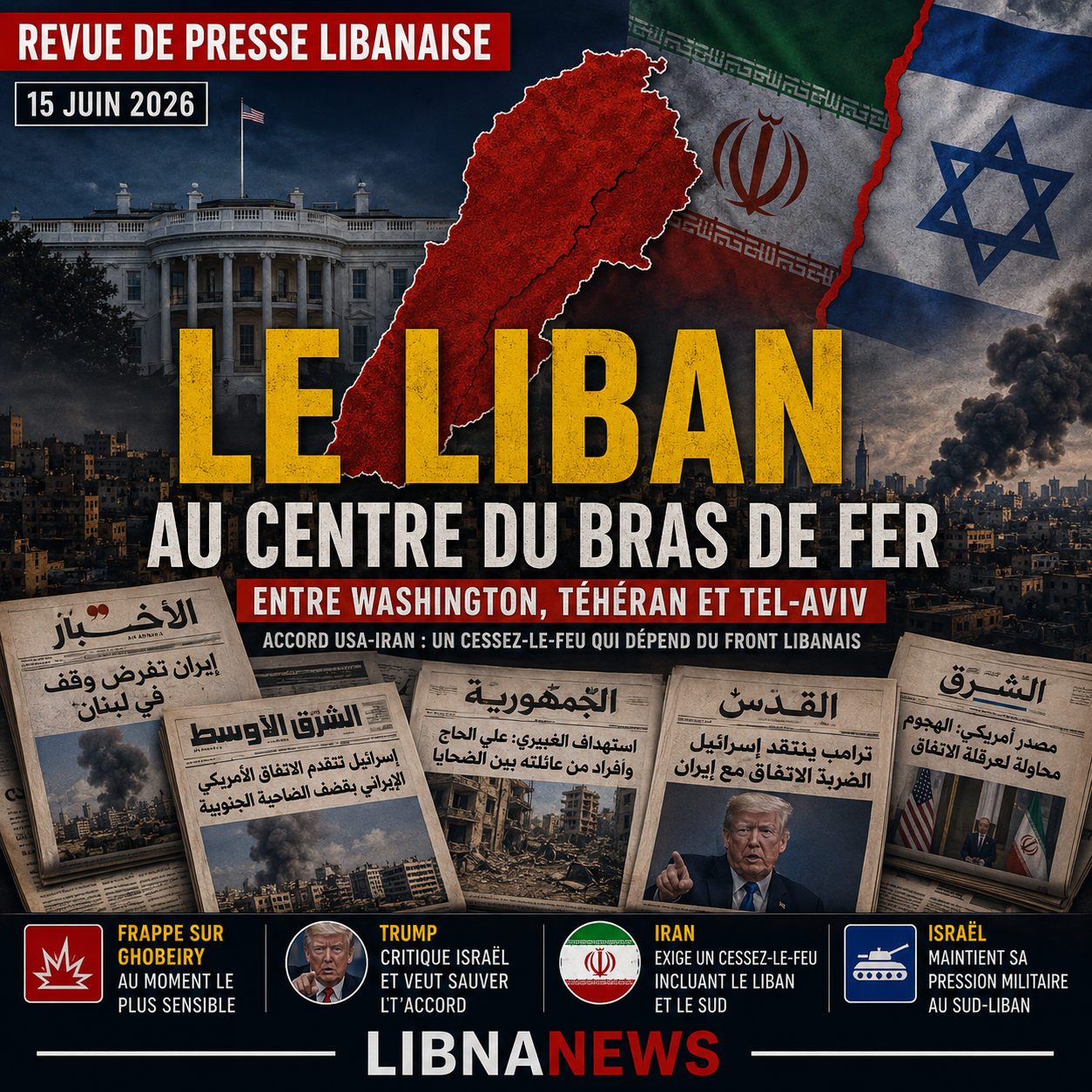
The Lebanese issue has become the heart of the regional sequence. On 15 June 2026, several newspapers placed the same sequence: an advanced negotiation between the United States and Iran, an Israeli strike on the southern suburbs of Beirut, and a series of warnings about the risk of derailment of the agreement. According to Al Akhbar, the central title is that Iran imposes an end to the war in Lebanon. The newspaper presents the Israeli withdrawal from the south as a point at the heart of the negotiations, in a context where the strike on the southern suburbs revived the ceasefire issue throughout the Lebanese front.
Al Sharq Al Awsat, 15 June 2026, writes that Israel has preceded the expected American-Iranian agreement, which should include a ceasefire in Lebanon, targeting the southern suburbs of Beirut and extending outside the so-called yellow line to the south. The newspaper adds that evacuation alerts targeted nearly 30 localities and villages. This reading places the strike not as an isolated episode, but as an attempt to impose military facts before possible political stabilization.
The immediate target is in the Ghobeiry area. Al Sharq Al Awsat reports that the strike hit a residential apartment, while the Israeli army claimed to have targeted a Hezbollah command centre in Beirut. The same newspaper also highlights contradictory information about the target person, with Israeli media referring to an official of the Hezbollah Liaison Unit.
Al Joumhouria, 15 June 2026, gives a human and political dimension to this strike. The newspaper reports that Israeli channel 12 introduced the targeted official as Ali Al Hajj, while the attack also reportedly killed his wife Salam Choucair and his sister Salma. More than fifteen injured are mentioned, with significant damage to neighbouring buildings and shops. This data feeds the idea of a broad-impact strike, in a dense civilian neighbourhood, at a time when regional deals were entering their decisive phase.
Trump criticizes Israel, but seeks to save the deal
Donald Trump’s reaction occupies a major place in the newspapers. Al Jumhouria, on 15 June 2026, reports that the US President wrote that the attack on Beirut should not have happened, especially in a day when the parties were close to a peace agreement with Iran. He recognized Israel’s right to defend itself, but held that the attack to which Israel was responding was limited, without a victim, and should not disrupt the ongoing process. He called on all actors to step back and demanded that there should be no more Israeli attacks on Lebanon or Hezbollah attacks on Israel.
Al Quds, June 15, 2026, echoes this criticism by insisting that Trump saw the strike as a dangerous act for the agreement. The newspaper also notes that Hezbollah did not claim to attack northern Israel on Sunday, but issued several press releases targeting Israeli positions in southern Lebanon. This nuance is important because it weakens the Israeli justification based on a direct attack on the Israeli north.
Al Akhbar, 15 June 2026, goes further in the story of American pressure. The newspaper writes that Trump would have asked Benjamin Netanyahu to stop the strikes, directly accusing him of his action in Lebanon. According to that reading, Washington was not just trying to contain a military crisis, but to prevent an Iranian response that could have brought down the compromise negotiated with Tehran.
Al Sharq, on 15 June 2026, reports that an American official quoted by an American channel described the Israeli attack on the southern suburbs as a clear attempt to sabotage the ongoing agreement between Washington and Tehran. The same article notes that the strike could complicate negotiations with Iran. This formulation transforms the reading of the event: the strike is no longer merely an Israeli security operation, but a gesture likely to affect the regional diplomatic calendar.
Iran links the ceasefire to the Lebanese case
Iran’s role is central to the narratives. Al Quds, June 15, 2026, writes that the American-Iranian agreement remains fragile, as Tehran continued to transmit its proposals to the Americans through Qatari mediators. The newspaper also highlights the difficulty of building an internal consensus in Iran, especially after demonstrations of currents hostile to the agreement. This internal opposition gives more weight to the Israeli strike, as it provides the opponents of the compromise an argument to denounce the American ability to contain Israel.
Al Arabi Al Jadid, on 15 June 2026, reports that Mohammad Bagher Ghalibaf accused the United States of failing to honour their commitments after the bombing of the southern suburbs. He claims that this attack is either a lack of American will or a failure to meet the commitments made. The newspaper states that Iran demands that any agreement with Washington include a ceasefire in Lebanon.
Al Sharq Al Awsat, 15 June 2026, describes diplomatic activity around Qatar. Qatari negotiators visited Tehran to help finalize the agreement. According to sources cited by the newspaper, Iran wanted to transmit through them the points it wished to include in the text, with details deemed necessary. The same passage indicates that no definitive conclusion was yet reached, even if discussions progressed.
In this sense, Lebanon becomes an element of the political price of the agreement. Al Akhbar, on 15 June 2026, writes that Iran called for a halt to the bombing all over the south, not only on the southern suburbs. The newspaper adds that, according to this reading, the immediate beginning of the implementation of the ceasefire should concern Lebanon as a priority.
Israel tries to keep military cards
The press insists that Tel Aviv seeks to preserve its military margins. Al Joumhouria, on 15 June 2026, cites diplomatic sources according to which Israel fears that an American-Iranian agreement will limit its deep operations in Lebanon or force it to stop its ground advance before obtaining all the guarantees it seeks on the ground. The newspaper believes that the resumption of the equation between the Israeli settlements in the north and the southern suburbs could become a factor in political and military deadlock.
Al Sharq Al Awsat, 15 June 2026, speaks of an Israeli will to strengthen its negotiating cards before any agreement is reached. The newspaper reports that the southern suburbs were targeted for the second time in a week, while southern Lebanon experienced an escalation of air strikes and evacuation orders. In this approach, Israel acts on two fronts: direct pressure on Beirut and territorial pressure on the south.
Al Quds, 15 June 2026, also describes an escalation on the ground. The newspaper reports that the Israeli army has intensified its airstrikes and artillery on several areas, while ordering evacuations to a number of southern localities. It mentions areas such as Zrariyeh, Kfar Badda, Kharayeb, Ansar, Arzi and Breiqa, as well as several farms and localities in Nabatieh. The official Israeli message accuses Hezbollah of violating the ceasefire, which serves as a justification for wider action.
At the same time, Hizbullah announced that it had targeted gatherings of Israeli soldiers and vehicles in Majdel Zun and a position in Hula. Al Quds, on 15 June 2026, also reported near Hezbollah reports of Israeli tanks being attacked or burned at Kfartebnit and Majdel Zun. This sequence confirms that the battle was not limited to the Beirut strike. It combined aerial pressure, drones, missiles, artillery and ground movements to the south.
Lebanon between formal sovereignty and regional reality
The Lebanese Government is trying to maintain a line of separation between its own negotiation and the regional compromise. Al Quds, on 15 June 2026, reports that Nawaf Salam reaffirmed that Lebanon is negotiating for itself as an independent State, and that no one is negotiating on its behalf. But the Prime Minister also acknowledged that the country is affected by the Islamabad talks and regional détente, especially if this process leads to a ceasefire.
Nahar, 15 June 2026, presents the Lebanese official position as attached to the separation of the Lebanese road to the end. The newspaper, however, refers to a Lebanon that awaits the effects of the compromise while undergoing a wide escalation. This contradiction sums up the crisis: Beirut wants to defend diplomatic sovereignty, but the military terrain remains exposed to decisions taken elsewhere.
Al Sharq, on 15 June 2026, formulated this tension by writing that Lebanon had become a land for regional interests, while Joseph Aoun and Nawaf Salam were working to resume national decision-making and sovereignty. The newspaper links the Hezbollah drones, Netanyahu’s reaction and the schedule of the American-Iranian agreement, considering that it is difficult to separate the strike from the southern suburbs from the moment chosen to sign the compromise.
One of the day, therefore, is about a finding: Lebanon is placed at the centre of a negotiation that goes beyond it, while trying to draw a ceasefire. Newspapers differ on responsibilities and intentions, but converge on the main fact. The Israeli strike on the southern suburbs was carried out at the most delicate moment of the discussions between Washington and Tehran. It revived the threat of an Iranian response, gave opponents to the agreement a new argument, and transformed southern Lebanon into the main test of regional compromise.
Local politics: the Lebanese state between public sovereignty, military pressure and Hezbollah crisis
Joseph Aoun poses the choice between state and armed logics
The Lebanese political life of 15 June 2026 is dominated by a central question: who decides war, peace and negotiation on behalf of Lebanon. In today’s sources, this issue goes through the statements of President Joseph Aoun, the statements of Prime Minister Nawaf Salam, the reactions of Hezbollah and the warnings of several politicians. Al Sharq, June 15, 2026, reports that Joseph Aoun put the debate back in a clear alternative. Lebanon, according to him, is faced with a choice between a « sovereign State » and a country retained by a logic of militia. The same newspaper associates this position with the memory of the civil war, the commemoration of the massacre of Ehden and the idea that national memory should not select its wounds. The Head of State thus affirms a line based on citizenship, the rule of law and equality among Lebanese, instead of belonging based on community force, fear or balance.
This formulation is political, but it is also institutional. It aims to put the national decision back to the centre, while the Israeli strike on Ghobeiry and the tensions in southern Lebanon reinforce the feeling that the country remains caught in a war whose state does not control all levers. Al Quds, on 15 June 2026, also reports that Joseph Aoun recalled that Lebanon must be a State that holds arms alone, upholds the law and protects the citizen regardless of his membership. This statement is therefore not limited to the debate on Hezbollah. It refers to a broader view of the state, where security can no longer depend on several force centres.
In this context, the Presidency seeks to avoid two pitfalls. The first would be to suggest that Lebanon agrees to negotiate its fate elsewhere. The second would be to turn the arms debate into a direct internal confrontation. Al Sharq Al Awsat, 15 June 2026, stresses that the restoration of the role of the State cannot be achieved by a shock with a basic Lebanese component, but by the construction of a political and institutional framework that brings citizens back to the State as the only reference for protection, representation and services. This reading gives a more gradual dimension to Joseph Aoun’s line. It insists on the need to rebuild public authority, not just to proclaim sovereignty.
Nawaf Salam defends Lebanese negotiation, but recognizes regional effect
Prime Minister Nawaf Salam appears as the other pole of this official line. Al Sharq, on 15 June 2026, reported that he had received the army commander, General Rodolphe Haykal, to examine the results of his visit to Pakistan, the situation in the south and the military aspect of the negotiations expected in Washington. This detail is important. It shows that the government wants to place the southern issue within a diplomatic, military and institutional framework. Negotiations are not presented as a simple regional arrangement. It must go through the Lebanese State, its army and the government.
Al Sharq, on 15 June 2026, also states that Nawaf Salam is asking Hezbollah to save the country and make Lebanon’s interest prevail over that of Iran. He called on the party to take the same path as the government to secure Israeli withdrawal from the south. He states that Hezbollah should support the negotiations in Washington, D.C., or move forward at the same pace as the state. At the same time, it recognizes that Lebanon is affected by the regional process, because a war is taking place on its territory and its consequences are felt there. But he insists on one principle: no one negotiates on behalf of Lebanon.
This position allows the government to reconcile two realities. On the one hand, Lebanon cannot ignore the discussions between the United States and Iran. They influence the ceasefire, the south, the fate of the Israeli strikes and the Hezbollah margin. On the other hand, Beirut wants to prevent this regional framework from erasing its own decision-making capacity. That is why Salam refuses to regard Hezbollah disarmament as a mere Israeli condition. Rather, it presents it as a Lebanese sovereign need. This nuance is essential because it aims to remove the debate from Israel’s hands and bring it back to the state.
On the same day, Salam also brings together ministers and representatives of the industrial and agricultural sectors to accompany the recovery of exports to Saudi Arabia. Al Sharq reported that the meeting focused on preventive measures. The government therefore links security, diplomacy and the economy. The restoration of trust with Riyadh requires the fight against trafficking, the credibility of institutions and the ability to protect legal trade.
Hezbollah under pressure between the regional agreement and the internal scene
Hezbollah is at the centre of local criticism. Al Sharq, on 15 June 2026, headline on the issue of the link between the party and Iran, and affirms that Hezbollah wants to link Lebanon to the Islamic Republic project. The newspaper also writes that the state negotiates for itself and that there is no alternative to the way to Washington. This line reflects part of the Lebanese debate. It considers that the priority is not only to stop the war, but also to get the national decision out of the regional axis.
Al Sharq, on 15 June 2026, further reports that Lebanese officials criticise the fact that Hezbollah is pushing for Lebanon’s attachment to the Islamabad process, while the official position favours direct and independent negotiation. In this reading, the agreement between Washington and Tehran could include Lebanon, but it should not replace the Lebanese decision. The newspaper believes that the official government wants to sit at the table with Israel, with American mediation, to settle the fate of its territory and population.
Hezbollah’s response requires another reasoning. Al Quds, on 15 June 2026, quotes MP Ali Fayyad, member of the Hezbollah parliamentary bloc, according to which the possible agreement between the United States and Iran on the end of the war, with a Lebanese component, should push the power to reconsider its negotiating position. He accuses the official approach of sank into the trap of Israeli blackmail, aggravated the internal problem and weakened Lebanon in the face of Israeli aggression. This statement shows that the party is not just defending its weapons. He also challenged the way the government conducted the case.
Thus, the local debate is not just about the ceasefire. It deals with the political narrative of the war. For the government and its supporters, the priority is to bring the state back into the decision. For Hezbollah, the priority is not to give in to what it presents as Israeli pressure masked by international negotiations. Between these two stories, public opinion suffers the strikes, uncertainty and risks of a new shift to the south.
Other political actors seek balance
Walid Jumblatt appears in the sources as a warning voice. Al Sharq, on 15 June 2026, reported that he asked whether the announced agreement covered all Lebanon, whether it provided for Israeli withdrawal from all the south, whether it confirmed the truce and whether it guaranteed the maintenance of international forces. He also criticizes the expression « safe villages », which he presents as an invention intended to avoid talking about occupation. His position therefore combines two themes: distrust of Israel and the need not to erase the question of the occupation of the south behind an administrative or security vocabulary.
Joumblatt also extends the debate to the region. According to Al Sharq, on 15 June 2026, he believes that Benjamin Netanyahu wants war for war and that he sees no future peace in the region. It evokes an Israeli logic nourished by a harsh ideological vision, whose effects go beyond Lebanon alone. This reading gives the local debate a regional depth. It echoed concerns about the risk that southern Lebanon might become a test ground for the power relations between Israel, Iran and the United States.
In the sovereignist camp, other voices support the idea of exclusive arms in the hands of the state. Al Sharq, on 15 June 2026, quotes former Minister Youssef Salameh, who presents the state’s arms monopoly as a sovereign requirement. He hoped that the agreement between Iran and the United States would complete the direct process between Lebanon and Israel, but recalled that the Lebanese issue remained the end of the dispersal of arms and the country’s return to stability.
MP Walid Baerini takes a close position, but with a more institutional and socio-economic angle. Al Sharq, on 15 June 2026, writes that he hopes that the ongoing contacts and mediations will lead to the cessation of the war in Lebanon and the region, an Israeli withdrawal from Lebanese land and the application of the principle of arms exclusivity in the hands of the State. It also links this perspective with the reopening of Lebanese exports to Saudi Arabia, ground transport, the passage of trucks through Syria and support for farmers and industrialists.
Ain al-Tinah, Riyadh and the stability of government
On June 15, 2026, Al Liwa According to the newspaper, Saudi reading is pragmatic: the Speaker of Parliament remains a central part of any internal agreement, because of his constitutional role and his ability to speak with several forces, including Hezbollah. The newspaper adds that Riyadh seems attentive to the strengthening of cooperation between Joseph Aoun, Nabih Berri and Nawaf Salam, and sees the Salam government as a sort of safety valve, necessary to preserve official stability and to prepare for possible international aid.
This reading gives an important place to the institutional triangle. It shows that local politics cannot be reduced to verbal confrontation around weapons. It also plays a role in the capacity of the Presidency, Parliament and Government to avoid the collapse of public decision-making. Berri, in this equation, is presented as an indispensable relay with a part of the Shiite system and with Hezbollah. Salam is seen as the government face of the negotiations. Aoun embodies the restoration of state authority.
The resumption of exports to Saudi Arabia adds another level to this debate. Al Sharq, on 15 June 2026, reports that Interior Minister Ahmad Hajjar highlights cooperation with Saudi authorities in the fight against trafficking in Captagon. He points out that an operation carried out after information provided by the Saudi Ministry of the Interior has seized a large amount of tablets prepared for smuggling and arrested suspects, including the suspected brain. The Minister believes that this success builds confidence between the two countries and paves the way for the resumption of Lebanese exports to the kingdom.
Local politics is therefore caught between military sovereignty, security credibility and economic recovery. The government must prove that it can negotiate, control, protect and deliver results. The challenge is heavy because each file refers to another. The south refers to weapons. The weapons refer to Iran. Exports refer to traffic. Traffic refers to Saudi confidence. Trust refers to the state’s ability to act.
Sovereignty as an internal file before being a diplomatic file
Al Sharq Al Awsat, 15 June 2026, structurally formulates the problem. Negotiations can deal with the urgency of war, reduce risks and provide diplomatic coverage to the State, but they cannot resolve alone the profound flaw that has allowed Lebanon to enter into a war without a state decision and to seek a way out without being able to impose peace. As long as the state does not recover the effective monopoly of sovereignty, arms and decision-making, negotiations may remain a mere crisis management.
This idea summarizes the local of the day. Lebanese officials talk about Israeli withdrawal, ceasefire and American mediation. But the real debate is about the state’s ability to become the only place to decide. Joseph Aoun places the question in the terms of the sovereign state. Nawaf Salam wants to keep the negotiation in the hands of official Lebanon. Hezbollah challenges part of this approach and accuses the government of weakening the country. Berri remains a must for any internal balance. Jumblatt warns about the Israeli danger and the words that mask the occupation. Baerini and other officials link the end of the war to the arms monopoly and economic recovery. On 15 June 2026, Lebanese local politics thus appeared to be a battle of method as much as a battle of substance: leaving the war, but above all deciding who had the right to declare peace.
Quote and speech by political figures: words of crisis, language of sovereignty and war of narratives
Donald Trump sets US limit to Israel
The most commented word of June 15, 2026 comes from Donald Trump. In Al Quds, on 15 June 2026, the US President clearly criticized the Israeli bombing of Beirut. He claims that the attack should not have taken place. He added that the time was very sensitive, as the United States was close to a peace agreement with Iran. This sentence installs a change of tone. Washington isn’t just calling for calm anymore. The U.S. President identified the raid on the southern suburbs as a dangerous act for the diplomatic process.
Al 3arabi Al Jadid, 15 June 2026, repeats the same statement in more detail. Trump recognizes Israel’s right to defend itself against threats. However, he felt that the attack to which Israel was responding was very limited. He also claims that she had not made a victim and that she should not disturb an agreement which he presents as close. The message is double. He wants to prevent a response from Iran or Hezbollah. But he also wants to remind Benjamin Netanyahu that the American priority of the moment remains the signature with Tehran.
In this speech, Trump includes Lebanon in the promise of regional peace. According to Al 3arabi Al Jadid, on 15 June 2026, he claims that the expected agreement must bring peace to the region, including Lebanon. He then asks all actors to step back. He states that there must no longer be Israeli attacks in Lebanon or Hezbollah attacks on Israel. The American president therefore places both fronts in the same framework. He talks about an agreement with Iran, but he already describes its expected effects on Lebanon.
This speech contrasts with the usual tone of American support for Israel. It does not break the covenant. It does not condemn Israel in substance. But it says Netanyahu can become an obstacle to the American calendar. Al Quds, June 15, 2026, notes that Trump refers to an attack attributed to Hezbollah, while the party did not claim fire against Israel that day. This clarification weakens the Israeli justification. It also shows that the battle of words accompanies the military battle.
Israeli officials speak in language of force
The Israeli response is part of a hard deterrence logic. Al Sharq, on 15 June 2026, quoted a joint statement by Benjamin Netanyahu and Defence Minister Yisrael Katz. Both officials claim that the Israeli army hit Hezbollah targets in the southern suburbs of Beirut. They describe this operation as a response to Hezbollah firings into Israeli territory. The press release adds that Israel will not tolerate firing at its territory. This formula places Israeli action in an automatic response doctrine.
The same article by Al Sharq on 15 June 2026 states that the Israeli army claimed to have targeted a headquarters used by Hezbollah to prepare operations against Israeli civilians and forces in southern Lebanon. This statement provides military justification for the raid. But it does not respond to the main American reproach. This is less about the target than about the timing. The tension therefore comes from the difference between two logics. Israel speaks of immediate security. Washington talks about diplomatic sequence.
The toughest Israeli ministers go further. Al Sharq, on 15 June 2026, reports that Bezalel Smotrich sees the firing from Lebanon as a test of the equation of the southern suburbs. He states that this equation must be applied firmly. Itamar Ben Gvir states, for his part, that the southern suburbs of Beirut must tremble after every shot from Lebanon. These words give the raid a symbolic reach. The southern suburbs are no longer just a target area. It becomes a political message to Hezbollah, Iran and the United States.
Al 3arabi Al Jadid, on 15 June 2026, also reports that Smotrich called for ten buildings to fall in the southern suburbs for every shot north of Israel. This word radicalizes the formula of deterrence. It reflects a desire for collective punishment in a dense urban space. It also feeds the Iranian discourse that Israel seeks to sabotage the agreement.
Tehran responds with threat and negotiation
Iranian officials hold a more complex line. They don’t close the door when they agree. But they see the Israeli strike as a test of American credibility. Al Quds, 15 June 2026, quotes Mohammad Bagher Ghalibaf, President of the Iranian Parliament. He warned that negotiations with the United States could stop if Israeli attacks on Lebanon continued. He adds that these attacks show Washington’s inability to meet its commitments.
Al Sharq, on 15 June 2026, clarified this charge. According to the newspaper, Ghalibaf writes that the attacks on Lebanon once again show that the United States lacks either will or capacity to deliver on its commitments. This sentence is aimed at the heart of American mediation. It is not just addressed to Israel. She told Washington that the deal was worthless if the Israeli ally could clear it from the first day.
The tone gets tougher with Ebrahim Rezaei. Al Quds, on 15 June 2026, reports that the spokesman for the Committee on National Security and Foreign Policy in the Iranian Parliament calls not to be mistaken in the calculations. He claims that, even if Iran wants an agreement or arrangement, the way is to correct Israel. He added that any agreement would harm Iran after its signature if Israel was not contained. This word does not reject compromise. It makes it conditional on real coercion against Israel.
Al Sharq, on 15 June 2026, also cites Mohammad Jafar Assadi, Iranian military leader. He claims that the crimes committed in the southern suburbs of Beirut will not remain unanswered. This threat responds to Iran’s need not to appear weak when negotiating. It also serves to contain internal criticism of the agreement. Tehran wants to show that he’s negotiating, but not under Israeli pressure.
On 15 June 2026, Al Bina According to the newspaper, Iran’s position is not limited to negotiating or responding. Rather, it is based on negotiation from a position of strength. The newspaper adds that Iran presents the Israeli strikes as proof of the central problem: the American inability to compel Israel to abide by the terms of an agreement.
Nawaf Salam wants to remove Lebanon from the regional market
The Lebanese word tries to preserve a national margin. Al Quds, 15 June 2026, reports that Nawaf Salam acknowledges that Lebanon is affected by the ongoing negotiations in Islamabad and their impact on the Lebanese ground. This sentence is realistic. She acknowledged that the country was not isolated from the regional compromise. But it does not mean that Beirut agrees to be represented by others.
On 15 June 2026, Al Bina also quoted a direct Salam formula addressed to Hezbollah. The Prime Minister tells the party that if he is really concerned about his environment and suffering, he must respect his commitments. It links this requirement to cooperation in the application of the principle of arms exclusivity. This is the heart of the internal debate. Salam is not just discussing the ceasefire. He talks about the State’s ability to regain the monopoly of decision-making and force.
Salam’s tone tries to avoid two traps. He does not want to give the image of a government that covers Israeli demands. But neither does he want to let Hezbollah turn the state into a mere spectator. His sentence on commitments moved the issue. It says that disarmament, or at least the restoration of the security decision, is a Lebanese duty before being an external condition. It is a language of sovereignty, but it remains prudent.
This caution is related to the risk of internal fracture. The state wants to assert its authority, but it cannot do so through an open shock. That is why government discourse is based on words such as commitment, cooperation, sovereignty and national interest. Words are chosen to avoid humiliation. But they remain clear enough to mark a break with the logic of permanent war.
Walid Jumblatt and fear of trapped formulas
Walid Jumblatt intervenes with his alert style. Al Bina, on 15 June 2026, reported that he asked whether the agreement included all of Lebanon, where Israel’s complete withdrawal was and how the truce line would be fixed. He also contests the formula of safe villages, which he presents as an invention designed to avoid talking about occupation in Lebanon. This speech focuses on vocabulary. For Jumblatt, the words used in an agreement can hide a military reality.
His question about all of Lebanon is essential. She refuses partial peace. It also refuses stabilization that would leave areas under Israeli pressure. His criticism of safe villages shows mistrust of technical terms. He feared that a humanitarian or security vocabulary would replace political words. However, the word occupation retains a legal and national burden. By withdrawing it, the agreement could, according to this reading, weaken the Lebanese position.
In this sequence, Jumblatt does not speak as a block actor only. He speaks as a guardian of the Lebanese political lexicon. He recalled that agreements often started with words. Then these words create facts. It therefore calls for withdrawal, occupation, truce and the whole territory. This vigilance, otherwise, joins the line of sovereignty defended by the State.
Joseph Aoun, Youssef Raji and Farid Haykal El Khazen place sovereignty at the centre
On 15 June 2026, Al Liwasa quotes Farid Haykal El Khazen, who states that Lebanon cannot be administered by ambiguous formulas or by incomplete arrangements. He added that the country needed complete sovereignty and clarity that left no room for interpretation. This sentence condenses part of the sovereignist discourse. It expresses the fear of vague compromises, which would stop the war without solving the fundamental problem.
In the same passage, Al Liwa He added that this required appropriate decisions and international support. It also recognizes that the Lebanese Government is moving slowly to avoid internal friction. This speech has a clear objective, but it highlights the gradual method.
Joseph Aoun’s line, already present in the day’s institutional speeches, is part of the same register. It is based on the idea that the State alone should protect citizens, enforce the law and decide on war and peace. The head of state speaks to a society exhausted by the fronts, crises and cross-trust. His speech seeks to re-establish a fragile evidence: Lebanon cannot survive if several armed powers speak and act on its behalf.
These local speeches share the same concern. Lebanese officials know that a regional agreement can stop the strikes. But they also know that he can freeze a bank situation. That is why their words relate to Israeli withdrawal, the exclusivity of weapons, the clarity of the texts, the role of the army and the ability of the government to negotiate itself. The day of 15 June 2026 thus shows a war of quotations as much as a missile war. Each camp tries to impose its narrative before a possible agreement is signed.
Diplomacy: Lebanon in negotiating between regional ceasefires, Arab mediations and American safeguards
The Lebanese file enters into the text of the agreement
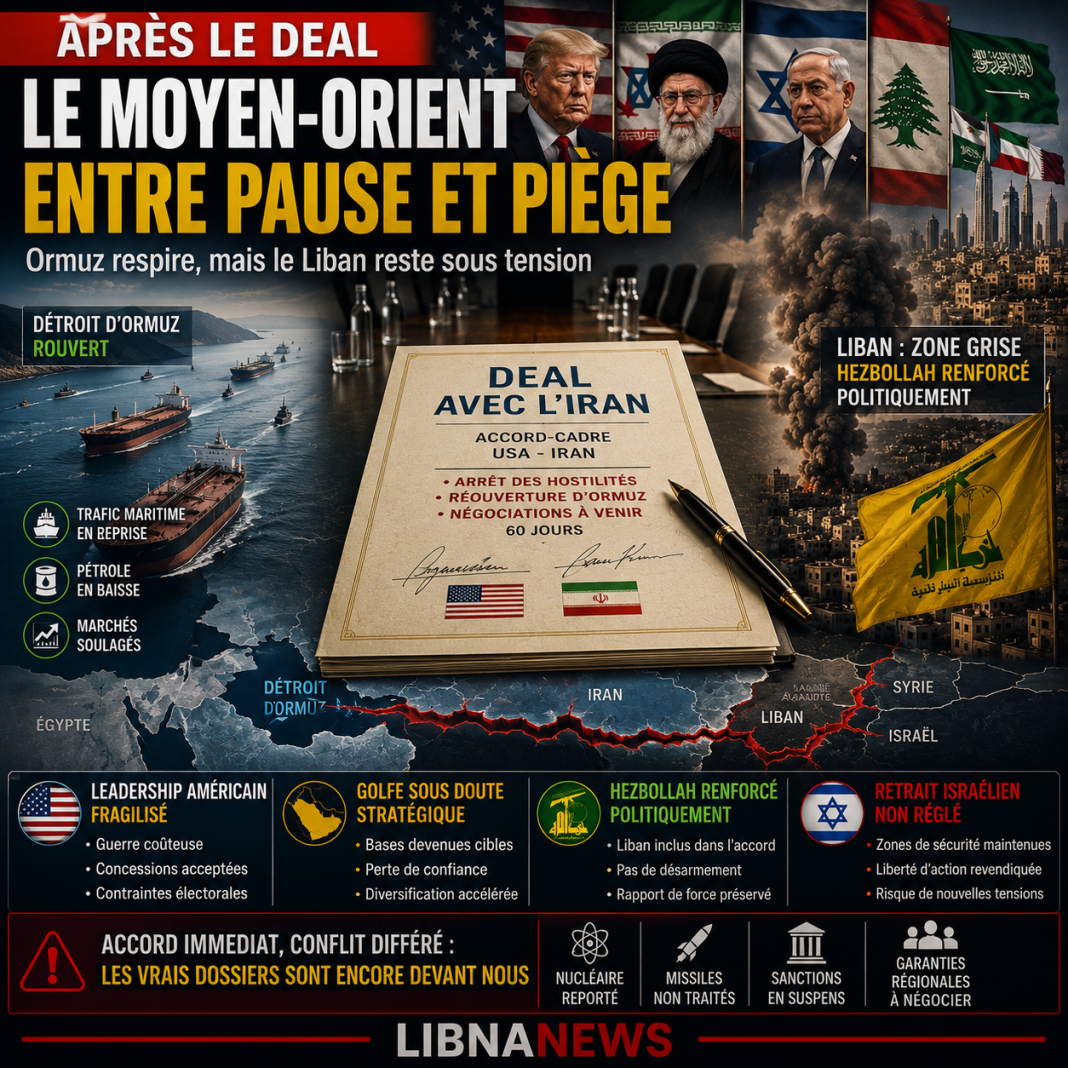
The diplomacy of 15 June 2026 is dominated by a major fact: Lebanon is no longer merely a secondary theatre of the regional crisis. It becomes an explicit element of the negotiations between Washington and Tehran. Al Quds, on 15 June 2026, reports that a senior American official acknowledges that the expected memorandum between the United States and Iran also includes Lebanon, in accordance with an Iranian request, while Washington and Israel initially wanted to separate the Lebanese file from the rest of the process. This precision is central. It shows that Tehran managed to impose the Lebanese front in the general discussion, while the United States seeks to save the agreement without appearing as guarantors of an extension of Iranian influence.
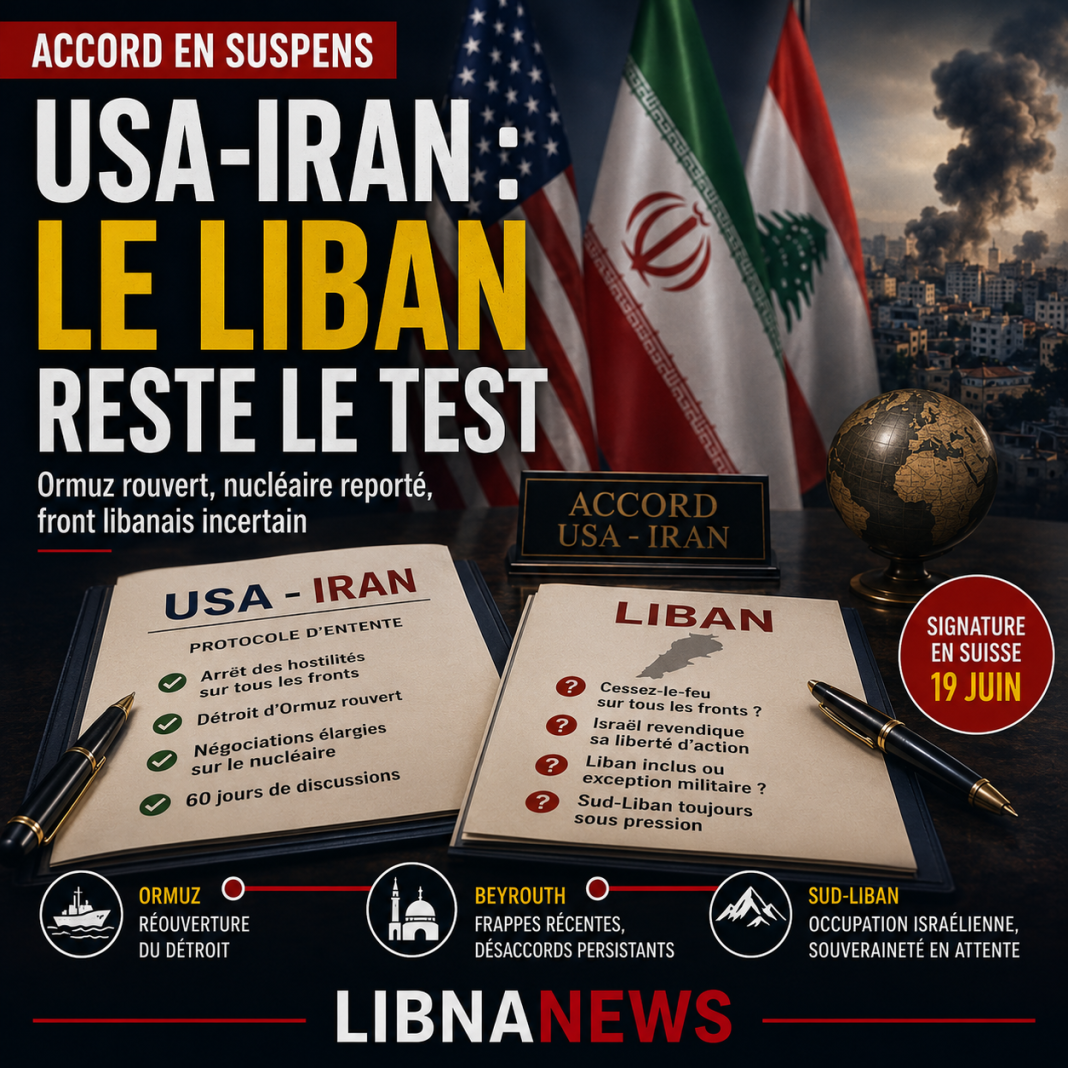
Al Akhbar, 15 June 2026, presents the same dynamic from a more assertive angle. The newspaper writes that Pakistan’s Prime Minister Shehbaz Sharif announced an American-Iranian peace agreement for the immediate and permanent cessation of military operations on all front lines, including in Lebanon. According to this source, the official signing ceremony was to take place on 19 June in Switzerland. This formulation gives Lebanon a direct place in the text. It does not treat it as an indirect consequence of the agreement, but as a field of application of the regional ceasefire.
However, this inclusion does not mean that all details are settled. Al Sharq, 15 June 2026, insists on the uncertainty of the content. The newspaper writes that the memorandum could provide for a comprehensive ceasefire in the region, including Lebanon, and could also mention the need for an Israeli withdrawal from the south. But he adds that nothing will become concrete without separate negotiations between the Lebanese State and Israel, under American sponsorship, to set out the details and mechanisms for implementation. This reading thus distinguishes the general diplomatic framework from its field execution.
This shade weighs heavily. It means that the American-Iranian agreement can open a door, but it does not solve the most sensitive Lebanese issues by itself. The Israeli withdrawal, the role of the Lebanese army, the presence of international forces, the fate of the border areas and the issue of Hezbollah’s weapons remain full dossiers. Regional diplomacy produces a framework. Lebanese diplomacy must then convert it into specific commitments.
Qatar and Pakistan at the heart of mediation
Qatari mediation appears to be one of the most active channels. Al Sharq Al Awsat, on 15 June 2026, reports that a group of Qatari negotiators visited Tehran on Sunday morning in an attempt to conclude the agreement. The newspaper also cites a source close to the Iranian negotiating team, according to which Iran transmits through the Qatari channel the clauses it wants to include in the text, with the details it deems necessary. This information shows that Doha is not just a messenger. Qatar becomes an instrument of indirect drafting between two capitals that do not speak full and direct.
Al Quds, 15 June 2026, confirms this role. The newspaper reports that a Qatari delegation arrived in Tehran to discuss the latest developments in the diplomatic process. He adds that Iranian agency Fars reported that Tehran had transmitted to the Americans, through Qatari mediators, its proposals, the ceiling of its expectations and the details of its requests. Mediation thus becomes a sorting procedure. It is not just about bringing positions together. It is also used to clarify what is acceptable, what should be written, and what cannot remain oral.
Pakistan occupies another place. According to Al Akhbar, on 15 June 2026, Prime Minister Shehbaz Sharif’s announcement comes after a phase of tension linked to the Israeli strike on the southern suburbs of Beirut and the Iranian threat of a response. This announcement places Islamabad in a position of political relay. It gives a public form to a still fragile compromise. The Pakistani role is therefore different from the Qatari role. Doha acts in the details of the negotiations. Islamabad gives an announcement scene, political validation and a signature calendar.
This multi-channel diplomacy corresponds to a new regional reality. Al Akhbar, on 15 June 2026, also devoted an analysis to changing the world of mediation. The newspaper notes that wars no longer always end with major final agreements, but with arrangements to contain conflicts, while regional and middle states, such as Qatar, Pakistan, Saudi Arabia, Egypt, Turkey, Oman and Switzerland, are becoming increasingly involved in mediation efforts. This idea enlightens the Lebanese case. Lebanon does not expect a comprehensive peace treaty. He is waiting for a stabilization mechanism.
The strike of the southern suburbs as a diplomatic test
The Israeli strike on the southern suburbs of Beirut acts as a credibility test for the entire process. Al 3arabi Al Jadid, 15 June 2026, writes that Israel attempted to sabotage settlement efforts by once again targeting the southern suburbs. The newspaper believes that Tel Aviv is seeking to push Iran towards a response, in order to prevent Donald Trump from signing an agreement deemed to be unfavourable to Israeli interests. This reading gives the strike a diplomatic as well as a military function. It would aim at disrupting the calendar, awakening internal opposition in Iran and placing Israel at the centre of American decision-making.
Al Sharq Al Awsat, 15 June 2026, highlights the fragility of the process. The newspaper writes that Washington and Tehran seem close to a memorandum, but that the last few hours have revealed the vulnerability of the diplomatic path. The Israeli attack on Beirut, the Iranian threat of response, the reservations in Tehran and the differences between the American and Iranian accounts of nuclear power, the funds and the Strait of Ormuz make the agreement ready to be signed, but exposed to any incidents of internal terrain or politics. This formula summarizes the moment. Diplomacy is advancing, but it does not yet control the armed actors.
Al Quds, on 15 June 2026, reports that the President of the Iranian Parliament Mohammad Bagher Ghalibaf accuses the United States of failing to honour its commitments after the Israeli bombing of the southern suburbs. He claims that the attack threatens the discussions between Tehran and Washington. The newspaper also recalls that Iran makes any agreement with the United States conditional on the inclusion of a ceasefire in Lebanon. This declaration transforms Lebanon into a criterion of confidence. If Washington cannot prevent Israel from hitting Beirut, Tehran can challenge the value of its signature.
Al Quds, on 15 June 2026, adds that Iranian officials are referring to a possible response to the attacks on the southern suburbs, while Israeli media reports a preparation for a possible salve of Iranian missiles. This climate underlines the difficulty of diplomacy: the agreement is discussed as the armies adjust, threats circulate and alert systems are identified. Negotiations are not taking place in a military pause. It takes place under maximum pressure.
Official Lebanon wants to separate its path without ignoring the real
The Lebanese position is based on a delicate balance. Al Quds, on 15 June 2026, reports that official Lebanon claims to want to separate the Lebanese road from the Iranian road. But the newspaper adds that this separation could be overtaken by the facts, especially after the statement by Iranian Foreign Minister Abbas Araghchi that the agreement includes Lebanon. According to the same source, Prime Minister Nawaf Salam acknowledges that Lebanon is affected by the ongoing negotiations in Islamabad and that their results are reflected in Lebanese territory.
This sentence of Salam translates a line of realism. The government does not want to delegate its sovereignty. He doesn’t want Tehran to speak for him. But he knows that stopping the strikes, the pace of Israeli withdrawal and the stabilization of the south also depend on a broader agreement. Lebanese diplomacy is therefore trying to hold two positions at the same time. It defends the independence of its negotiations and observes the possible effects of a regional compromise.
Al Sharq, 15 June 2026, shows that this line is translated into institutional work. Nawaf Salam received the army commander, General Rodolphe Haykal, to examine the results of his visit to Pakistan, the situation in the south and the military aspect of the negotiations expected in Washington. The meeting indicated that the government was seeking to prepare for the transition from diplomacy to the field. Principles are not enough. Maps, units, guarantees, deployment zones and coordination with mediators are needed.
Al Sharq, on 15 June 2026, also reports that Joseph Aoun sets five principles for the negotiating team: complete cessation of fire by land, sea and air, complete Israeli withdrawal from all Lebanese territories occupied since the beginning of operations, return of displaced persons, start of reconstruction and return of prisoners. The newspaper adds that these conditions are not open to bargaining. This list provides a diplomatic basis for the Lebanese position. It prevents the ceasefire from being reduced to a mere drop in military tension.
Riyadh returns through economy and reconstruction
Lebanese diplomacy is not limited to military matters. It also seeks to reopen Arab channels, particularly with Saudi Arabia. Al Sharq, June 15, 2026, writes that Joseph Aoun considers that there is no peace or regional settlement possible without the stabilization of Lebanon, without independent and sovereign power in Beirut, and without the positive intervention of Donald Trump to prevent both Israeli destruction and Iranian escalation against Lebanese sovereignty. The same article states that Joseph Aoun is also preparing an international approach towards a major reconstruction conference in Lebanon, focusing on destruction in the south and southern suburbs of Beirut.
In this context, the link with Riyadh takes on political value. Al Sharq, 15 June 2026, reports that Joseph Aoun, during his meeting with Saudi emissary Yazid bin Farhan, stressed the positive effects of the Saudi Crown Prince’s decision to respond to his request and that of Nawaf Salam for the return of Lebanese exports to Saudi markets. The newspaper also highlights the expected effects on Lebanese farmers, many of whom are in areas affected by the tensions in the south.
This economic openness has a clear diplomatic dimension. The return of exports is not only a trade opportunity. It points to a resumption of confidence, recognition of the efforts of the State and the possibility of re-enlisting Lebanon in its Arab space. Al Sharq, on 15 June 2026, also reports that Nawaf Salam gathered ministers and representatives of the industrial and agricultural sectors to monitor the resumption of exports to Saudi Arabia and the preventive measures to be taken. The message sent to Riyadh is direct: the state wants to control, secure and guarantee.
Economic diplomacy complements security diplomacy. Lebanon is seeking Israeli withdrawal, but also reconstruction funds. It seeks a ceasefire, but also the resumption of exports. He is seeking an American role, but also Arab protection. In this architecture, the relationship with Saudi Arabia can become a lever of internal normalization, provided that the State proves its ability to deliver on its commitments.
Israeli withdrawal as a node of any guarantee
The Israeli withdrawal from the south remains the most sensitive point. Al Quds, on 15 June 2026, quotes a reading that Iran insists that there should be no signature with the Americans before the end of the war against Lebanon, nor a final agreement without a full Israeli withdrawal schedule from Lebanese territory. This demand places southern Lebanon at the centre of the compromise. It reduces the margin of an agreement which would be content with a simple provisional calm.
Al Sharq Al Awsat, 15 June 2026, recalls, however, that Israeli targets go beyond the immediate response to the shots. Analyses cited by the newspaper refer to the possible creation of a new security band, the transformation of Lebanese border villages into almost empty areas, the control of heights and strategic axes such as Khiam, Wadi Saluki, Maroun Al Ras and Bint Jbeil, as well as the accumulation of pressure cards for any future negotiations on Lebanon or the post-war regional order.
This point shows the limit of diplomacy. A text may provide for a ceasefire. He may refer to withdrawal. But if Israel seeks to keep positions of pressure, application will become the real battlefield. That is why international safeguards, the role of international forces, the deployment of the Lebanese army and American surveillance become as important as the signature itself.
Al Jumhouriyat, 15 June 2026, writes that if the agreement is signed, it could mean strict external surveillance to consolidate the ceasefire and transform Lebanon from a confrontational zone into a settlement area. The newspaper adds that the Lebanese-Israeli negotiations would then become the mandatory way to set the new process. This analysis joins the reading of Al Sharq. The big deal opens the way. But Lebanon will still have to negotiate its own security, territory and sovereignty in a more precise framework.
International policy: world order under pressure, between crisis diplomacy and tightening of states
The Group of Seven Against Factor Trump
The international sequence of 15 June 2026 opens at the meeting of the Group of Seven in Evian, France, in a climate dominated by Donald Trump’s decisions and several simultaneous crises. Al Sharq Al Awsat, 15 June 2026, reports that the summit opens for three days at the French station on Lake Geneva, near the Swiss border, with exceptional security measures on both sides of the border. The newspaper points out that Iran, the Strait of Ormuz and Ukraine are at the leaders’ table, while Paris seeks to avoid the repetition of a scenario of tension already observed at a previous summit in Toronto.
The summit is therefore not a classic economic meeting. It becomes a place of emergency management. The war in Ukraine, the maritime crisis, the Iranian question and the effects of American choices come together in a context where Washington’s allies seem forced to deal with an American president who sets his priorities. Al 3arabi Al Jadid, June 15, 2026, insists on Donald Trump’s domination. The newspaper notes that the climate was to be one of the topics most marked by the American veto, with a notable absence of the climate issue among the hottest topics of the meeting, after pressure from US Treasury Secretary Scott Bessent to ensure that the very term climate change does not appear in the preparatory text of the Ministers of Economy.
This absence is political. It reveals the displacement of the G-7 centre of gravity. Europeans want to maintain a long-term approach to climate, energy and international order. Washington, under Trump, favours power, security balances, trade flows and the immediate effects of crises. Thus, the Evian summit is held in the form of a forced compromise. The allies are talking together, but they do not always share the same strategic language. Iran and Ormuz are urgent. Ukraine imposes military and financial solidarity. The climate, on the other hand, seems to be falling back in the hierarchy of priorities, showing a deep divide between Western agendas.
The war in Ukraine continues at sea
The war in Ukraine is beyond the land front. It now affects the maritime routes, sanctions and Moscow’s ability to finance its military effort. Al Sharq Al Awsat, 15 June 2026, reports the British forces intercepting an oil tanker linked to the Russian parallel fleet in the Channel. The ship, named Smiertos, was flying the Cameroonian flag and was off Weymouth. The newspaper quotes Ukrainian Foreign Minister Andriy Sybiha, who salutes the operation by qualifying the Russian parallel fleet as a tool of war. He believes that every ship arrested means less money for the Russian military machine and reduces Moscow’s ability to finance its missile and drone attacks against Ukrainian cities.
This British action illustrates an evolution of the conflict. Sanctions are no longer just banking or commercial decisions. They become physical operations at sea with effects on oil flows. London seeks to hit Russian incomes at the crossing point between the grey economy and open war. The message sent to Moscow is clear: vessels bypassing sanctions can become control targets, even away from the Black Sea. This strategy also gives Ukraine indirect support. It does not change the front line, but it aims to finance the war.
Al 3arabi Al Jadid, 15 June 2026, sheds further light on the evolution of the Ukrainian file. The newspaper reports that Ukrainian officials consider an end to the war realistic by the following winter, while noting that Kyiv’s objectives have been reduced. Ukraine no longer talks about the return to the 1991 borders, not even those of 2022, but about stopping fighting on the current contact lines. This data marks a change of tone. The war remains tough, but the goals are becoming more cautious.
Thus, the war in Ukraine is entering a more diplomatic and economic phase. Fighting continues. Yet words change. Westerners hit Russian maritime revenues. Kyiv adjusts his expectations. The Group of Seven is looking for a common line. But the eventual end of fighting, if it emerges, could take the form of a military freeze more than a clear victory.
Sudan, laboratory for drone war
Sudan appears in the newspapers as another front of war transformation. Al Sharq Al Awsat, on 15 June 2026, reports that drone attacks targeted Al Obeid, the main town of Kordofan, and Al Rahad Abu Daknah. Local sources attribute these attacks to the Rapid Support Forces, which have been engaged for more than three years against the Sudanese army. The newspaper mentions deaths, injuries, destruction of stations and fuel depots, as well as reports of strikes on convoys and installations inside the city.
The same newspaper notes that the Rapid Support Forces had announced that they had destroyed a Turkish-made air defence system to protect the city from drones. Many observers see it as a dangerous development in the battle for the control of the sky over Kordofan. Al Sharq Al Awsat, 15 June 2026, points out that the Sudanese war is increasingly moving towards remote strikes, after a long period of ground fighting for the control of cities and neighbourhoods.
This evolution gives the Sudanese conflict a regional and technological scope. War is no longer limited to militias, tanks or armed columns. It also involves drones, air defence systems and strikes on energy infrastructure. Fuel depots become targets as important as barracks. Cities become vulnerable to attacks without direct presence on the ground. This logic exhausts the inhabitants and complicates any mediation, since each camp can continue to strike even when it no longer progresses on earth.
The Sudan thus illustrates a wider trend. In several conflicts, drones reduce the cost of entering the escalation and increase the civilian cost of the war. The front lines become less sharp. The backs become targets. Infrastructure is becoming instruments of pressure. In this context, the Sudanese crisis is not just an internal war. It becomes an example of rapid militarization of tools that transform local balances.
Kuwait and citizenship as a power tool
In the Gulf, Al 3arabi Al Jadid, on 15 June 2026, devotes broad treatment to the new wave of withdrawals of nationality in Kuwait. The newspaper reports that eight decrees published in the official gazette Kuwait Al Yawm remove or nullify the nationality of 2,193 persons, as well as those who had obtained it by family dependency. He states that the decrees raise the number 90 to 97, and that the list includes novelist Taleb Al Refai, founder of the Multaqa Al Thaqafi in Kuwait and former president of the jury of the 2009 international prize for Arabic novel.
The same newspaper places this wave in a wider campaign. Al 3arabi Al Jadid, on 15 June 2026, states that, following other decisions taken in April, the number of nationalities withdrawn has exceeded 43,000 since 4 March 2024, not to mention tens of thousands of persons affected by family dependency. The newspaper adds that the campaign has affected politicians, intellectuals, athletes, businessmen, artists, officers and diplomats at different times.
This case goes beyond the administrative framework. It raises the question of the link between citizenship, security and political power. Massive withdrawal of nationality becomes an instrument of sorting out the national community. It affects known persons, which gives the file a symbolic scope. The case of Taleb Al Refai shows that the cultural field is not sheltered. The decisions formally address irregularities or situations of dual nationality. But their scope is fuelling a debate on legal guarantees, acquired rights and the place of the families concerned.
This Kuwaiti development is part of a region where States strengthen their internal control. Citizenship, which should be a stable link, becomes a permanent verification space. For those affected by family dependency, the effect is even wider. It does not only affect the target individual. It spreads to spouses, children and social lines. Today’s international policy thus shows that crises are not always military. They can also take the form of an authoritarian redefinition of the civic body.
Palestine, rights and international pressure
The Palestinian question remains in several forms. Al Quds, on 15 June 2026, reported the death of a Palestinian prisoner after 25 years in Israeli prisons. The newspaper quotes Palestinian institutions responsible for prisoners, which hold the Israeli authorities fully accountable and call on international institutions to move from condemnation and documentation to concrete measures of accountability. The data cited cite over 9,400 Palestinian prisoners in Israeli prisons, including 3,324 administrative detainees and 1,316 persons classified by Israel as illegal combatants.
Al 3arabi Al Jadid, 15 June 2026, also deals with the Palestinian issue through the colonial economy. The newspaper reports that an investigation by a human rights organisation showed that settlement-related products, including European-sanctioned settlers, were presented as Israeli products in order to benefit from preferential customs treatment. The passage cited underlines that it is not possible to condemn the annexation of Palestinian land on one side and to finance it on the other.
These two dossiers refer to the same question: how to transform the law into reality. In prisons, Palestinian institutions demand more than documentation of violations. In European markets, rights defenders demand a clear distinction between Israeli products and settlement products. In both cases, the problem is the distance between the displayed principle and the actual application.
Al 3arabi Al Jadid, 15 June 2026, also gives a social image of Gaza, far from the chancelleries. The newspaper presents the Atfal Saada initiative, which deploys a mobile car to camps for internally displaced persons, reception centres, schools and hospitals. His team distributes treats, pastries, fresh drinks and gifts to children. The leader says he targets between 1,000 and 1,500 children every day, with an animation program including clowns, songs, interactive shows and contests.
This initiative does not change the military balance of power. But it reveals another dimension of international politics. In war zones, the psychological survival of children becomes a humanitarian issue. Games, songs and gifts become modest forms of protection. They remind us that war not only destroys houses. It also reaches the rhythms of childhood, emotional benchmarks and the ability to project.
Internal challenges and fragility of regimes
Al Sharq Al Awsat, 15 June 2026, also reports political tensions in the Democratic Republic of the Congo. The newspaper reports demonstrations before the Parliament in Kinshasa against a proposed constitutional amendment, accusing the opposition of having the power to circumvent the limits of presidential mandates. The context is already tense by an Ebola-related health crisis and armed clashes in the east of the country.
Turkey also appears in the Register of Social Challenges. Al Sharq Al Awsat, 15 June 2026, reports the response of teachers’ unions to arrests. The teachers claim that they will not surrender, that these arrests will not break their will, and call for solidarity and assembly in Kadikoy, on the Asian shore of Istanbul.
This information shows that today’s international policy is not only dominated by the great powers. It also includes internal tensions, streets mobilized, trade unions, contested constitutions and concerned citizens. In Evian, leaders talk about Iran, Ukraine, trade and security. In Kinshasa, demonstrators defend the limits of the presidential mandate. In Istanbul, teachers denounce arrests. In Kuwait, citizens lose their nationality. In Sudan, cities live under drones. In Ukraine, sea routes become a battlefield. On June 15, 2026, a world in which states are growing stronger, wars are changing, and societies are paying the price for decisions taken at the top.
Economy: a country suspended between war costs, lost tourism and financial reform
War stifles expected rebound
The Lebanese economy of 15 June 2026 appears to be an economy under total restraint. Today’s newspapers describe a country that is waiting for a ceasefire but whose productive sectors are already paying a heavy price. Al Sharq, on 15 June 2026, cites a very broad estimate of the cost of the war, with more than 4,000 dead, more than 13,000 injured, more than one million two hundred thousand displaced and losses of up to $30 billion. The newspaper links this bill to a weakened economy, a fragile banking system and limited public capacity. This estimate is not just a humanitarian assessment. It measures the economic shock. Displaced families consume less, businesses close, businesses postpone decisions, banks remain blocked and the state loses revenue. Thus, the economy is not facing another crisis. It is experiencing a crisis that simultaneously affects the territory, trust, labour, income and assets.
In this context, the idea of reconstruction returns as a necessary but still distant horizon. Al Sharq, on 15 June 2026, reports that Joseph Aoun is working to prepare agreements, means and opportunities for returning to the southern and southern suburbs. The newspaper also indicates that the president wants to move towards a major international reconstruction conference, focusing on what was destroyed in the south and in the southern suburbs. This perspective shows that recovery will not only come from the private sector. It will depend on external financing, a credible political framework and a lasting cessation of military operations. Reconstruction will not be a simple concrete operation. It will have to restore housing, roads, networks, agricultural markets, workshops, schools, health centres and, above all, minimum confidence in the future.
Tourism loses its summer before it starts
The tourism sector, which remains one of the fastest currency engines, is presented as one of the first economic victims of escalation. Al Sharq, on 15 June 2026, quotes Jihad Al Tanir, Vice-President of the Beirut Traders Association, as saying that the economic situation is catastrophic. He claims that the Lebanese summer is over before it begins. It evokes a sharp decline in bookings for aircraft and hotels, cancellation of major events and an almost total absence of foreign tourists. This diagnosis is brutal, as the summer season would normally support hotels, restaurants, travel agencies, car rental companies, businesses, taxis, cafes and expatriate services.
Al Sharq, on 15 June 2026, adds that the decline in tourism blocks economic circulation, deprives the country of foreign exchange entry and causes heavy losses to the service sectors. The same passage indicates that several car rental office owners have already started selling a large part of their fleet due to lack of sufficient activity. This data is important. It shows that the crisis is not only a temporary drop in turnover. It drives companies to liquidate their work tools. However, when a company sells its assets to survive, its recovery capacity is reduced. Even if tourists return later, the fleet, teams, contracts and networks will have to be reconstituted. The shock thus becomes more lasting than the security crisis that caused it.
It also weighs on reserves and consumption. In the Lebanese economy, spending on tourists and expatriates often plays the role of seasonal support. They bring currency, finance purchases, support informal wages and provide oxygen to businesses. When this flow drops, the effect spreads quickly. Hotels reduce their orders. Restaurants reduce their stocks. Shops postpone their purchases. Seasonal employees lose income. Families who relied on the summer to last several months find themselves without a net. Tourism is therefore not a luxury in this context. It is one of the last channels of liquidity in the real economy.
Agriculture cashes a loss of $530 million
The agricultural shock gives another face to the crisis. Al Akhbar, 15 June 2026, out of $530 million in agricultural losses. The newspaper states that production losses exceed direct damage more than 12 times, and that olive trees are the top of the most affected crops. This difference between direct loss and loss of production is essential. It means that the damage does not only concern destroyed trees, lands or tools. They also affect lost seasons, absent incomes, unsold crops, broken value chains and rural families deprived of their economic base.
Al Akhbar, 15 June 2026, gives more precise data on the intensity of the damage. The newspaper mentions 7,002 recorded damage cases where the share of damage exceeds 75 per cent, as well as 4,848 other cases in a lower range. This photograph indicates a massive but also very uneven attack. Some land is almost destroyed. Others remain partially usable, but with reduced yields. For farmers, this difference does not always change the immediate result. Loss of season means lack of income, inability to repay debts, deferral of investments and increased dependence on aid.
Al Sharq, on 15 June 2026, also reported on the statement made by the Minister of Agriculture, who said that the agricultural sector remains one of the pillars of food security, economic stability and social cohesion in Lebanon. He added that the war had had a heavy impact on farmers, production, infrastructure, natural resources and value chains. The Minister stressed the need for a science-based, data-specific and partnership-based recovery vision. This approach places agriculture at the centre of reconstruction. It is not enough to pay one-off aid. It is important to know which crops are affected, which areas can leave quickly, which irrigation systems are damaged, which families have lost their income, and which crops should be supported as a matter of priority.
Exports to Saudi Arabia as a confidence test
In a very dark landscape, the return of Lebanese exports to Saudi Arabia appears as an economic and political window. Al Sharq, on 15 June 2026, reports that Joseph Aoun highlighted the positive effects of the Saudi decision to respond to his request and that of Nawaf Salam to reopen Saudi markets to Lebanese products. The newspaper notes that this effect mainly affects Lebanese farmers, many of whom are in areas directly affected by the southern crisis. This openness can help to sell products, boost revenue and give producers a signal of confidence.
But this recovery remains linked to safety and traffic control. Al Sharq, on 15 June 2026, quotes Ahmad Hajjar, Minister of Interior, who highlights cooperation with Saudi authorities in the seizure of a large quantity of Captagon tablets hidden in a warehouse in Jiyeh. The minister said that the operation had led to the arrest of several people, including the suspected brain, and that this success had strengthened confidence between the two countries. According to him, the measures taken by the Lebanese services opened the door to the resumption of exports to the Kingdom.
The economic scope of this case goes beyond the sale of agricultural products. It affects the image of Lebanon as a reliable exporting country. Gulf markets do not only look at price or quality. They also look at the safety of supply chains, customs controls, the fight against drugs and the state’s ability to guarantee cargo. As a result, every smuggling scandal closes doors. Conversely, each successful seizure can reopen part of the lost credit. Al Sharq, on 15 June 2026, also quotes Walid Baerini, who calls for a serious follow-up on the issue of land transport, facilitation of the passage of trucks through Syria and support for farmers and industry in order to relaunch the production cycle. The same manager also links the airport of Qleiaat to a possible economic dynamic in the north, provided that roads, water and electricity are prepared.
Financial reform remains blocked by three locks
The financial front remains the deepest. Nahar, 15 June 2026, reports an analysis of French financial sources according to which Lebanon faces three successive obstacles before economic recovery becomes possible. The first is the settlement law, the second is the amendment of the law on the financial breach and the issue of liquidity, the third is the redesign of the public finance path. This sequence is useful, as it shows that recovery does not depend solely on the ceasefire or the return of tourists. It also depends on an uncompleted financial architecture.
The first difficulty is how to balance the past. Since the collapse of 2019, the losses of the financial system have not been clearly distributed, stable and accepted. The applicants are awaiting a response. Banks seek to limit their losses. The State lacks resources. The Bank of Lebanon must protect what remains of monetary stability. Thus, any regulation becomes an explosive text. She must say who pays, how much, when and in what form. As long as this issue remains unclear, the economy maintains a moral and accounting debt that hinders credit, confidence and investment.
The second difficulty concerns the financial gap and liquidity. Nahar, June 15, 2026, talks about the need to amend this law and address the issue of liquidity. The wording indicates that the problem is not just the amount of losses. It also affects the ability to transform paper rights into real payments. A depositor may have a bank balance. But if the system does not have sufficient currencies, this balance does not finance consumption or investment. The third difficulty, that of public finances, finally refers to the heart of the state. Without a fiscal trajectory, strong revenue, controlled spending and the ability to finance essential services, the recovery will remain fragile.
Bank of Lebanon between compliance, financial sovereignty and bank distrust
The bank file was also fed by Al Akhbar on 15 June 2026, which referred to the attempt to entrust part of the financial compliance operations to the company Integrity 2K. The newspaper writes that the Bank of Lebanon had entered into a contract with the American company about a year earlier, as part of efforts to remove Lebanon from the Financial Action Task Force’s grey list. The services mentioned cover technical and advisory support to anti-money laundering and counter-terrorist financing mechanisms. Al Akhbar states that the contract awarded by Governor Karim Suaid amounts to approximately $12 million, with justification based on the need for a secret contract.
Al Akhbar, on 15 June 2026, added that representatives of the Association of Banks met with officials of Integrity 2K in the presence of a representative of the US Treasury to discuss a wider transfer of compliance operations to the company. The newspaper states that banks are resisting because of the cost and implications of the project. This case illustrates a broader dilemma. Lebanon must improve its compliance rules to restore its international financial access. But it must also preserve internal confidence, avoid suspicions of foreign surveillance and not impose charges on banks that they say they cannot pay.
This issue therefore affects financial sovereignty as well as reform. Complying with international standards has become vital for a country that depends on transfers, trade and the return of banking confidence. But the method chosen can create tensions. If banks consider that compliance becomes too costly or too intrusive, they are holding back. If the authorities do not strengthen compliance, the country remains exposed to surveillance lists, sanctions and financial isolation. The margin is narrow. It requires high transparency, serious parliamentary scrutiny and a clear public explanation.
The Lebanese economy described by the newspapers of 15 June 2026 is therefore based on a heavy equation. The ceasefire can reduce the immediate cost of war. Reconstruction can revive construction sites. Exports to Saudi Arabia can breathe new life into farmers and industry. But tourism has already lost part of its season, agriculture cashes massive losses, public finances remain to be rebuilt and the banking sector has not regained confidence. The country is not short of money. A stable framework is lacking where money can return, circulate and produce.
Society: the Lebanese daily under the noise of drones, the fear and wear of war
Noise as a permanent social pressure
The Lebanese society of 15 June 2026 is described through a very concrete element: sound. Al 3arabi Al Jadid, 15 June 2026, devotes an article to the effect of Israeli drones on Lebanese. The newspaper explains that these aircraft are no longer only named according to their military function. They entered into popular language, with ironic nicknames that translate both fear, anger and the attempt to keep away from anguish. This way of renaming the threat shows a form of social adaptation. When a danger becomes daily, people sometimes try to make it more familiar with language. But this familiarity does not mean that fear disappears. Rather, it indicates that the threat settles in the ordinary setting of life.
The same newspaper writes that the buzzing of drones over Beirut becomes a slow psychological exhaustion factor. The formula is strong. She says that war is not just about strikes, deaths and destruction. It also acts by waiting, by perceived surveillance, by the impossibility of regaining calm. Noise becomes a presence. He enters houses, streets, schools, shops and conversations. Thus, even without immediate explosion, the population lives under continuous pressure. Silence is no longer guaranteed. Rest becomes fragile. Night doesn’t really protect anymore.
This wear transforms simple gestures. Going out to buy bread, drive a child to school, open a business or stay in the window are no longer neutral acts. Each of these actions is done with a part of listening and vigilance. Locals learn to recognize a sound, compare it with others, wait for an ad or alert. Little by little, society settles itself on an invisible aerial threat. This threat is not only military. It becomes social because it changes the rhythms, nerves, choices and relationships between the inhabitants.
Families facing a war they don’t choose
Al Sharq, 15 June 2026, reports the homily of the Maronite patriarch Béchara Boutros Rai, pronounced at the feast of fathers. The patriarch said that the situation in Lebanon was painful. He says that Lebanese suffer when they see what is preparing for their country, and even more when they feel that people’s destiny becomes hostage to calculations and conflicts that do not concern them. This speech gives a public expression to a widespread social feeling: families pay the price of decisions they do not control.
The same passage of Al Sharq, on 15 June 2026, insists on civilian victims. Béchara Rai speaks of children, young people, fathers, mothers and families who suffer wars they do not want. This formulation moves the war from military ground to the family unit. She recalls that each strike does not only touch a place. It affects links, debts, interrupted studies, lost incomes and families that need to be reorganized in an emergency. War then becomes a home crisis as much as a state crisis.
The fact that this statement is made on Father’s Day is not annoyed. The day, supposed to celebrate the family, becomes a reminder of responsibility and loss. The father is described as a pillar of love, gift and responsibility. But this figure is placed in a country where the family authority can no longer protect alone. Parents can reassure, hide their fears, change routines, move children or limit outings. Yet they cannot stop drones, prevent a strike, or guarantee the safety of a neighbourhood. War weakens the protective function of the family.
Schools and students in broken normality
The same article by Al Sharq, on 15 June 2026, states that Béchara Rai praised the Minister of Education for her efforts to reconcile the school level with the circumstances experienced by the students. This mention is brief, but it opens up an essential social issue. The school is one of the first places affected by the war, even when it is not directly bombed. Students live with fear, absences, travel, parent fatigue, service cuts and uncertainty about exams. Teachers must maintain a framework, but this framework is based on vulnerable families and children exposed to continuous pressure.
In this context, reconciling school and living conditions becomes a very difficult task. We must avoid the year being lost. But it must also be recognized that students do not live in an ordinary year. The same expectations, assessments and rhythms can become unfair if they ignore the war. However, too much lightening the framework can also weaken the course. The education system must therefore find a narrow way: to preserve the requirement, but take into account fear, internal exile, loss and fatigue.
This tension also affects parents. Many want their children to live a normal life. The school then becomes a form of resistance to war. It maintains schedules, notebooks, homework, friendships and a possible future. But every warning, every strike and every rumor can break this normality. The noise of drones, the images of destruction and the conversations of adults enter the world of children. The danger is not just school delay. It is also in the installation of an early memory of fear.
Rescue scenes in the heart of civilian space
Nahar, on 15 June 2026, published an image showing members of the fire brigade working among citizens to extinguish the fires in the Israeli aircraft building in the southern suburbs of Beirut. The legend also mentions a map showing the number of casualties, injuries and hospitals affected by the Israeli war against Lebanon in 2026. This page shows the company at the time of the shock. There are the relief workers, the inhabitants, the buildings affected, the hospitals concerned and the figures that summarize the scale of the crisis.
These emergency scenes show another side of everyday life. Firefighters and civil defence teams become key social actors. They are not just emergency professionals. They embody a public presence at a time when the state is often deemed weak. Their arrival on the spot, their work under the eyes of the inhabitants and their ability to contain the fire give a point of support to a worried population. In a hit neighbourhood, the order returns first by concrete gestures: extinguishing, clearing, treating, securing, counting the wounded and reassuring.
But these scenes also reveal the fragility of infrastructure. When hospitals are affected or threatened, the whole chain of protection is wavering. The citizen does not only fear it. He also fears what comes next: lack of beds, blocked roads, lack of medication, overload of emergencies and the difficulty of finding loved ones. The war thus puts society in the face of a simple and brutal question: what remains of essential services when violence reaches cities, neighbourhoods and places of care.
The Syrian displaced, a social crisis without a clear horizon
Al 3arabi Al Jadid, on 15 June 2026, reports on the presence of more than one million four hundred thousand Syrian displaced persons in Lebanon in a country with a population of about four million. It considers this to be a major problem without a clear solution horizon. The same passage indicates that it presents priority as the cessation of war, the strengthening of State institutions, the development of economic ties and the calming of the situation in Lebanon as much as possible.
This issue goes beyond the diplomatic debate between Beirut and Damascus. It weighs directly on Lebanese society. Syrian internally displaced persons often live in precarious conditions, while municipalities, schools, clinics, the labour market and water or electricity networks are already fragile. The current war adds a new layer of pressure. Displaced Lebanese from the south, families impoverished by the economic crisis and Syrian displaced people sometimes find themselves in close social spaces with different but urgent needs. This proximity can produce solidarity. It can also fuel tensions, especially when resources are lacking.
The formulation of a problem without a clear horizon reflects a heavy reality. Returns remain linked to security, guarantees, economic conditions in Syria and relations between States. Meanwhile, Lebanon manages the daily effects of schooling, care, rent, employment, international aid, local tensions and political discourse. The dossier thus becomes a revealing of the weakness of public policies. Without a clear plan, each municipality and family manages part of the crisis in their own way.
Gaza and childhood as a regional mirror of social suffering
Today’s society section goes beyond Lebanon with the case of Gaza. Al 3arabi Al Jadid, 15 June 2026, describes the Atfal Saada initiative, which runs through the reception centres, displacement camps and the most affected areas of the Gaza Strip. The aim is to reduce the psychological effects of war and displacement on children by organizing play, expression and entertainment activities in areas considered safer. The newspaper indicates that children need a place to play and express their emotions.
According to Al 3arabi Al Jadid, on 15 June 2026, the initiative leader explains that the teams seek to reach as many children as possible every day, as they measure the extent of the psychological suffering caused by months of war, displacement, wandering and loss of stability. Activities include entertainment, distribution of treats, toys and small gifts, shows, songs, popular dances and competitions that encourage children to participate.
The newspaper also states that the initiative targets between 1,000 and 1,500 children every day, with a planned duration of six months. This data shows the extent of the need. This is not just a one-off gesture. It is an attempt to create a routine of joy in a broken environment. The children of Gaza are experiencing severe psychological pressure from war and displacement. The organizers therefore hope to transform this action into a sustainable initiative.
This subject also sheds light on the Lebanese situation in contrast. In both Gaza and Lebanon, the war attacks the daily before even destroying the buildings. It affects children, parents, sleep, school, gambling, mental health and the ability to trust the next day. Social responses remain modest in the face of the scale of violence. Yet they have real value. A game, a song, a gift or an hour of calm do not replace security. But they prevent the war from occupying all the inner space of children.
Society between adaptation and fatigue
The sources of 15 June 2026 draw a society that adapts but exhausts. Al 3arabi Al Jadid shows Lebanese who give nicknames to drones and live with their buzz. Al Sharq reports a religious speech that speaks of the pain of families and the weight of unselected wars. Nahar shows firefighters, citizens, victims, wounded and hospitals affected. Al 3arabi Al Jadid finally broadens his eyes to children in Gaza, whose psychological needs call for lasting action. These elements converge towards the same reality: war is not confined to the fronts. It fits into bodies, words, schools, families and nights.
Culture: memory of the South, music of resistance and cinema of exile
Music as a Response to War
The cultural section of June 15, 2026 places Lebanon in a clear tension: the war occupies the public space, but artists are still looking for places to say loss, attachment and refusal of erasure. Nahar, June 15, 2026, announces in one way that music in Lebanon opens a front against the war. The newspaper refers to a Southern recital, with Maestro Lebanon Baalbaki, singer Somaya Baalbaki and Hiba Kawas, in a concert held at the First Armenian Evangelical Church in Beirut. This musical presence, in a capital marked by fear of strikes and uncertainty, gives the event a value that goes beyond the artistic setting. The scene becomes a place to maintain the social bond. She claims that culture does not disappear when weapons speak.
This choice is all the more strong as the theme of the South goes through all the news. In the political pages, the South is a front, a possible withdrawal zone, a space for destruction and a negotiating issue. In the Nahar cultural page, the South also becomes a sung memory, carried by voices and by a musical direction. The passage from the military registry to the music registry does not erase the war. He’s moving it. He gives the inhabitants another language to think of loss. Thus, the music does not pretend to stop the strikes. But it proposes a moral response, by relocating beauty, presence and listening in a country saturated by the noise of drones.
The choice to bring together Lebanon Baalbaki, Somaya Baalbaki and Hiba Kawas also indicates a desire to have several forms of tradition and creation dialogue. Lebanese culture is often built in this connection between heritage, scholarly singing, modernity and regional memory. In this context, the Southern recital can be read as a way to recall that the South is not only a front line. It is also a space of families, villages, songs, rites, schools, voices and stories. The very fact of naming him on a stage in Beirut partially removes him from military logic.
Jean Chamoun and memory after destruction
Al Akhbar, June 15, 2026, announces the screening of the film Rahinat Al Intizar, by late filmmaker Jean Chamoun, on Thursday, June 18, in Beit Beirut. The film is presented as part of the cultural programme accompanying the exhibition Ihkili Ya Janoub. He returns to the aftermath of the Israeli aggression against southern Lebanon in 1993, through the path of doctor Leila, who returns to his village and discovers him marked by the traces of destruction. The newspaper states that the film follows its relationship with its family, the women and children of neighbouring villages, as well as the efforts of those who chose to stay to rebuild what the war destroyed, not only in space, but also in life itself.
This programming gives a historical depth to the news. Lebanon of 2026 watch a film shot around an older war, but the questions remain close. How to repair a destroyed house. How to stay in a wounded village. How to resume an ordinary life when memory keeps the marks of fear. Al Akhbar also raises the question of the reparation of life after the war left its mark on homes, people and memory. This is not just a question of cinema. It refers directly to the current discussions on the return of internally displaced persons, reconstruction and attachment to the territory.
The debate planned after the projection reinforces this dimension. Al Akhbar, June 15, 2026, says that he must bring together filmmaker Mai Masri, researcher Leila Noureddine and a representative of Friedrich Ebert Stiftung, around memory, the South and maintaining the link to the place despite transformations and challenges. This choice gives the projection a forum function. The film will not only be viewed as an archive. It will serve as a starting point for a discussion of what remains, what is being transmitted and what is being rebuilt.
From this perspective, cinema becomes a tool for continuity. Jean Chamoun filmed a South already hit by war. The audience of 2026 is watching these images while the South is still experiencing violence. Time doesn’t close. He creates an echo. The characters of the film and the people of today share the same question: how to live when war returns in different forms. This circulation between yesterday and today gives the Lebanese cinema a special function. He’s not just telling. He keeps track of the times when history begins again.
The cultural agenda as the maintenance of public life
Although the cultural agenda available in the sources remains limited, the events identified indicate a willingness to maintain public life. Beit Beirut hosts the screening of Rahinat Al Intizar, as part of Ihkili Ya Janoub, on June 18. Nahar also reports the Southern recital at the First Armenian Evangelical Church in Beirut. These two meetings share a common point: they fit into urban places that become spaces of memory and gathering. They are not presented as mere entertainment. They respond to a symbolic emergency.
Culture, in this context, is not separated from war. She’s going through her. It gives shape to what political language often reduces to numbers, maps or statements. A projection shows faces, villages and life choices. A recital makes it possible to hear a South that is not limited to sirens and military communiqués. Thus, the cultural agenda becomes a kind of civil resistance line. It proves that the city continues to produce meetings, even when the country is waiting for a ceasefire.
It should be noted, however, that today’s sources do not provide a comprehensive calendar of ongoing Lebanese exhibitions, concerts and demonstrations. The material available allows to identify some strong events, but not to draw an exhaustive map of the cultural scene. This requires careful treatment of the agenda. The dates cited are significant, but they are not sufficient to describe all the cultural activity in the country. Rather, they give points of support to understand a trend: the memory of the South dominates the Lebanese cultural scene at the same time as the South dominates the military and diplomatic scene.
Lamia Joreige and Palestine as memory impossible to reach
Al 3arabi Al Jadid, on 15 June 2026, devoted an article to the film Ihsan, Min Miyye Sana Lal Yawm by Lamia Joreige. The newspaper states that the work returns to the year 1915 and to the relation of Ottoman power with the inhabitants of the country and their environment. He placed the film in a new vein in the Arab cinema devoted to Palestine, attentive to periods prior to the Nakba of 1948, such as Filastin 36 by Annemarie Jacir, Farha by Darin J. Sallam, and All That Is Left of You by Cherien Dabis. This approach broadens the look. It refused to reduce Palestine to the catastrophe of 1948 alone or to recent images of war. She explores the older layers of history, ordinary lives, archives and personal stories.
Lamia Joreige’s film is based on the text of Ihsan Turjman, an Ottoman soldier from Jerusalem during the First World War. Al 3arabi Al Jadid, June 15, 2026, notes that the intimate becomes the basis of the story here. The film is interested in what the stories left can say about a historical moment, both for individuals and for the group. This approach is important because it reminds us that history is not built solely on the basis of major political decisions. It also forms in letters, newspapers, loves, hesitations and small sentences of an era.
Al 3arabi Al Jadid, 15 June 2026, also highlights the sensitive dimension of the film. A young voice says that it is possible to imagine, live and feel that Jerusalem has been visited by writings, films, plays, singing and music. She adds that the arts are among the most beautiful ways to reach the beloved and missing homelands. This sentence gives Lamia Joreige’s cinema a very current reach. When physical access to Jerusalem is prevented, art becomes a mode of approach. It does not replace the place. But it prevents his absence from becoming a total vacuum.
This idea also speaks in Lebanon. In a country where villages in the South become difficult to access, where people are displaced, where some places are no longer lived only by memory, culture also serves to maintain a link with what is lost or threatened. Jerusalem, in the film of Lamia Joreige, becomes a mirror of all the prevented homelands. The cinema offers a form of inside visit, a presence that passes through the images, voices, texts and bodies of the actors.
Palestinian cinema and the battle of rights over history
The question of Palestinian memory also appeared in Al Quds, on June 15, 2026, with an article on the debate about intellectual property in history, between the novel Zaman Al Khuyoul Al Bayda by Ibrahim Nasrallah and the film Filastin 36 by Annemarie Jacir. The newspaper recalls that Nasrallah, through his romantic project Al Malhat Al Filastiniya, contributed to the construction of a Palestinian cultural, national and literary narrative. He states that the controversy is about the idea that the film would be inspired, at least for certain aspects, by Zaman Al Khuyoul Al Bayda, which opens up a debate on intellectual, literary, moral and material rights.
This debate goes beyond the quarrel between a written work and a filmed work. It touches on a broader question: who has the right to tell collective history, and under what conditions. Palestinian history is rich in stories, archives, testimonies and oral traditions. But when a novel turns this matter into narrative architecture, and a film approaches certain patterns or characters, the boundary between common memory and individual creation becomes delicate. Al Quds thus highlights a problem specific to injured cultures: the more collective history, the more recognition of individual work becomes necessary.
This issue also concerns cinemas in Lebanon and the region. War, exile, village memory and family stories are a shared material. Yet, each artist gives them their own form. Recognizing this form does not prevent the recognition of collective memory. On the contrary, it protects the conditions of creation. A culture that wants to tell its wounds must also protect writers, filmmakers and researchers who turn traces into works.
Arab scenes between heritage, dance and visual narrative
The Arab culture of the day is not limited to Lebanon and Palestine. Al Quds, June 15, 2026, announces that the modern dance troupe of the Egyptian Opera presents the show Shahrazad on the big stage of Dar Al Opera Al Misriya, on Wednesday and Thursday following, in a directed by Walid Aouni. The show brings together Shahrazad by Rimsky-Korsakov and Bolero by Maurice Ravel, in a visual and choreographic vision that mixes oriental imagination with Western rhythms. The main roles are held by Habiba Sayed in the role of Shahrazad, Nader Gamal in the role of Shahryar, and Yasmine Samir and Amr Al Batreeq for Bolero, under the direction of Maestro Mohammad Saad Basha.
This show shows another way of working memory. It does not start from a current conflict, but from an ancient narrative heritage, The Thousand and One Nights, reinterpreted by dance, music and the modern scene. The crossing between Rimsky-Korsakov and Ravel also indicates an Arab scene open to hybrid forms. The Orient becomes a narrative, movement, visual space and dialogue with the Western repertoire. This approach recalls that regional culture is not limited to the memory of war. It also includes experiences of form, body, rhythm and imagination.
Nahar, on 15 June 2026, reports the exhibition Ru Even if the newspaper gives only a brief indication, the subject shows interest in the Gulf scenes and in the construction of a contemporary visual narrative. The Arab culture unfolds in several registers: memory of the Lebanese South, Palestinian cinema, Egyptian dance, and visual arts of the Gulf.
On June 15, 2026, culture thus appeared as an area of resistance to the shrinking world. The war wants to impose its maps, fronts and balance sheets. The artists, on the other hand, bring voices, films, songs, archives, memories and bodies back into circulation. In Lebanon, this dynamic goes mainly through the South, its memory and its music. In Palestine, it goes through the question of impossible access, history before Nakba and rights to the narrative. Elsewhere in the Arab world, she goes through the stage, dance and image. The common thread remains the same: to keep a human form when current events tend to reduce people to areas of conflict.
Technology: artificial intelligence between medical promise, data control and security risks
Genetic data, a new foundation of medical power
The technology section of June 15, 2026 is dominated by a simple but heavy question: can artificial intelligence treat populations that it does not know well. Al Sharq Al Awsat, 15 June 2026, devotes an article to the link between artificial intelligence, precision medicine and Arab genes. The newspaper recalls that the medical world is entering a phase in which decisions are no longer based solely on the general diagnosis, but also on the genetic characteristics of each patient. In this model, artificial intelligence analyses millions of hereditary variables, predicts risks of disease and helps choose the most suitable treatments.
The problem comes from the very matter that feeds these systems. Al Sharq Al Awsat, June 15, 2026, cites a study published in 2023 in Genome Medicine, according to which Arabs remain among the least represented human groups in global genomic databases. The newspaper reports that Arabs account for about 6 per cent of the world’s population, but only about 0.17 per cent of the world’s genetic data available for research. In short, hundreds of millions of people remain almost absent from the bases on which precision medicine and artificial medical intelligence are based.
This underrepresentation is not a statistical detail. It can have a direct impact on the quality of care. If the data used to drive a system come mainly from other populations, risk predictions may be less reliable for Arab patients. Recommended treatments may also be less appropriate. Thus, artificial intelligence can reinforce an inequality already present in medical research. It does not necessarily discriminate by intent. It can discriminate for lack of data. That is why the issue becomes scientific, health and strategic.
Towards a project of millions of Arab genomes
Al Sharq Al Awsat, 15 June 2026, then raises the question of a joint project around the million Arab genomes. The newspaper notes that the Arab world has more than 450 million inhabitants, with a high genetic diversity and hereditary characteristics. It also recalls the presence of hereditary and chronic diseases that require a better understanding of genetic factors. This idea gives the project a direct medical reach. It is not just a matter of catching up with science. The aim is to produce data useful for diagnosis, targeted treatment and prevention.
The same newspaper reports that Saudi Arabia and Qatar have already started building advanced genomic knowledge bases. He suggested that the next step could be a common Arab vision, to ensure the presence of Arabs in world-class medicine commensurate with their demographic weight. Al Sharq Al Awsat insists on a central idea: in the age of artificial intelligence, the scientific place of a people depends not only on the number of its users of technology, but also on the presence of its data in the systems that make medicine of tomorrow.
This reading turns medical data into infrastructure. Roads, ports and electricity remain essential. But genetic databases are also becoming a form of national and regional equipment. A country that does not produce population data depends on models developed elsewhere. He can buy the tools, but without mastering the foundations. Conversely, a common genomics project can strengthen research, attract partnerships, improve care and give Arab countries a real place in future medical value chains.
Social platforms and personalisation under surveillance
The issue of data is also reflected in digital platforms. Al Sharq Al Awsat, 15 June 2026, reports on an evolution related to Meta. According to the newspaper, the company already uses data related to games used by the user or purchases made, in order to link the advertisements to the interests. It also plans to use this information to develop the content displayed on the main page and artificial intelligence responses. Algerian researcher Leila Duma sees this as part of Meta’s strategy to enhance the customization of its platforms and improve advertising and artificial intelligence systems.
The same article highlights the risk of very detailed numerical profiles. Al Sharq Al Awsat, 15 June 2026, reports that Meta claims not to collect new data categories and offer control settings. But Leila Duma believes that the consolidation of this information creates very precise numerical profiles for each person, regardless of age or gender. This observation shows that the debate is no longer limited to collection. It’s about assembly. Standard data can become sensitive when they are cross-referenced, classified and used by automated systems.
The researcher therefore calls on users to take a more active approach. Al Sharq Al Awsat, 15 June 2026, reports on his advice: reviewing privacy settings, limiting activities shared with Meta, deactivating the option of activities outside the company, controlling applications’ authorizations and using privacy-based navigation tools. She also stressed the need to read consent settings instead of accepting the default choices. His diagnosis is clear: the more intelligent systems become, the more the control of personal data becomes a major public subject.
States increase access to advanced models
Today’s technology also reads through national security reflexes. Nahar, on 15 June 2026, reports that Anthropic suspended access to two of his most powerful artificial intelligence models following an order by the US government relating to national security. According to the newspaper, only three days after the official launch of Fable 5, the company reported having received a directive prohibiting all foreign nationals, including those working at Anthropic, from accessing Fable 5 and Mythos 5.
This information marks a turning point in the governance of major models. Artificial intelligence tools are no longer treated as mere commercial products. They are increasingly seen as strategic capabilities. A State may consider that an overly powerful model represents a risk if it is used by foreign actors or transferred without control. The border between private innovation and national security is therefore becoming narrower. Technology companies can launch products, but the state retains the ability to limit access when possible uses involve intelligence, defence, disinformation or sensitive research.
This movement can also change the internal organisation of companies. If foreign employees can no longer access certain models, research, testing, maintenance and supervision may be reorganized according to nationality or authorization criteria. This creates a new geography of technological work. Large models become controlled spaces, almost comparable to certain defence technologies. The opening that had marked the first years of generative artificial intelligence leaves room for a filtering logic.
Justice and police in the face of machine evidence
Nahar, on 15 June 2026, also reported a precedent in the United Kingdom. The Derbyshire police opened a criminal investigation against one of their officers, suspected of using artificial intelligence systems to prepare evidence in several cases. According to the newspaper, the officer is subject to suspicion of obstruction of justice and has been removed from his field missions pending the completion of investigations. The police are working with the Royal Public Prosecutor’s Office to verify whether records have been affected by this use of artificial intelligence.
This case illustrates a real risk. In justice, a text error is not a simple mistake. It may alter a testimony, introduce an unverified fact, alter a chronology, or give an appearance of solidity to a fragile evidence. Nahar, on 15 June 2026, states that officials of the AI Police Centre of the National Council of Chiefs of Police had already called on certain services to stop the use of artificial intelligence in the preparation of judicial declarations and procedural documents, owing to doubts about the accuracy of the information produced by these systems.
The British case shows that the issue of artificial intelligence in justice cannot be solved by efficiency alone. Saving time in writing a file can be useful. But if the tool produces errors, invents details or mixes elements of several cases, the judicial cost becomes very high. There is therefore a need for specific rules: traceability of use, human verification, preservation of versions, responsibility of the agent and prohibition of the use of such systems to produce items that would not be fully controlled.
Diplomacy, defence and human decision
Al Sharq Al Awsat, 15 June 2026, addresses another sensitive field: the use of artificial intelligence in strategic environments. The newspaper quotes Asha Hemrajani, a specialist at the S. Rajaratnam School of International Studies’ Centre of Excellence for National Security in Singapore. She recalls that bad results come from bad data. It believes that artificial intelligence systems can be exposed to piracy and manipulation, which can produce strategic miscalculations. In a high-risk area such as diplomacy, she stressed the need for accuracy and the maintenance of human beings in the decision-making system.
This warning is important in the regional context of the day. Diplomatic crises, strikes, mediations and military signals produce a huge mass of data. States may be tempted to use artificial intelligence to read intentions, predict reactions or simulate scenarios. But if the data are false, biased or manipulated, the decision can become more dangerous. An error in targeted advertising can hinder a consumer. A mistake in a military crisis can cause an escalation.
Technology therefore does not suppress political judgment. It can help classify, identify, translate and model. But it must not replace responsibility. The recall of the human presence in the loop is not an abstract prudence formula. It corresponds to a democratic and strategic requirement. Officials need to know where a recommendation comes from, what elements have been produced and what limits are around it.
Drones and infrastructure protection
The security component is not limited to artificial intelligence. Al 3arabi Al Jadid, 15 June 2026, devotes a topic to drones that are worrying Germany and the obstacles that hinder infrastructure protection. The newspaper mentions operational disruptions related to drone detection, with 116 incidents at 25 airports across the country. This data shows that drones are no longer just a tool of distant warfare. They also become a problem of civil security, transport and economic continuity.
Al 3arabi Al Jadid, on 15 June 2026, quotes the information security expert Matti Buster, who evokes German work on operational drones capable of arriving quickly at the site of danger and on better coordination between the actors concerned. It also states that Rheinmetall and Deutsche Telekom are cooperating to develop a drone defence shield to protect vital infrastructure, while the techniques used become more reliable.
This topic links technology, defense and daily life. A drone near an airport can block flights. A drone around a power station or network can create a national alert. The answer must therefore be technical, but also legal and institutional. Which detects. Who decides. That’s neutralizing. Coordinates with the army, the police, private operators and airports. Germany, according to this treatment, is still looking for an efficient architecture. The problem is not only the flying apparatus. It is in the slow pace of responses and in the difficulty of protecting large, open and often civilian infrastructure.
University and knowledge production at machine time
Al 3arabi Al Jadid, on June 15, 2026, finally approached artificial intelligence from a university perspective. The newspaper explains that it can serve as a research assistant, translate content into several languages and broaden interaction with comparable scientific communities. He added that it links university education systems to digital work platforms, which can facilitate the transition from university graduate to the labour market. The text presents artificial intelligence as a real partner in the production of knowledge, not as a mere back-up tool.
This approach complements other topics. In medicine, artificial intelligence depends on data quality. In justice, it requires verification. In diplomacy, she requires human supervision. In the university, it opens up gains in translation, research and professional integration. The common thread remains governance. Technology produces strong promises, but every promise depends on a framework. Without a frame, the search assistant can become an error machine. With a good framework, it can reduce repetitive tasks, speed up the flow of ideas and make researchers less isolated.
On June 15, 2026, newspapers described a technology that was no longer neutral or secondary. It covers medical care, privacy, national security, justice, diplomacy, infrastructure and university. Artificial intelligence is advancing fast, but companies discover that the central question is not only what the machine can do. It is also about who provides it with the data, who controls its uses, who responds to its errors and who keeps the last word.
Technology: artificial intelligence between medical promise, data control and security risks
Genetic data, a new foundation of medical power
The technology section of June 15, 2026 is dominated by a simple but heavy question: can artificial intelligence treat populations that it does not know well. Al Sharq Al Awsat, 15 June 2026, devotes an article to the link between artificial intelligence, precision medicine and Arab genes. The newspaper recalls that the medical world is entering a phase in which decisions are no longer based solely on the general diagnosis, but also on the genetic characteristics of each patient. In this model, artificial intelligence analyses millions of hereditary variables, predicts risks of disease and helps choose the most suitable treatments.
The problem comes from the very matter that feeds these systems. Al Sharq Al Awsat, June 15, 2026, cites a study published in 2023 in Genome Medicine, according to which Arabs remain among the least represented human groups in global genomic databases. The newspaper reports that Arabs account for about 6 per cent of the world’s population, but only about 0.17 per cent of the world’s genetic data available for research. In short, hundreds of millions of people remain almost absent from the bases on which precision medicine and artificial medical intelligence are based.
This underrepresentation is not a statistical detail. It can have a direct impact on the quality of care. If the data used to drive a system come mainly from other populations, risk predictions may be less reliable for Arab patients. Recommended treatments may also be less appropriate. Thus, artificial intelligence can reinforce an inequality already present in medical research. It does not necessarily discriminate by intent. It can discriminate for lack of data. That is why the issue becomes scientific, health and strategic.
Towards a project of millions of Arab genomes
Al Sharq Al Awsat, 15 June 2026, then raises the question of a joint project around the million Arab genomes. The newspaper notes that the Arab world has more than 450 million inhabitants, with a high genetic diversity and hereditary characteristics. It also recalls the presence of hereditary and chronic diseases that require a better understanding of genetic factors. This idea gives the project a direct medical reach. It is not just a matter of catching up with science. The aim is to produce data useful for diagnosis, targeted treatment and prevention.
The same newspaper reports that Saudi Arabia and Qatar have already started building advanced genomic knowledge bases. He suggested that the next step could be a common Arab vision, to ensure the presence of Arabs in world-class medicine commensurate with their demographic weight. Al Sharq Al Awsat insists on a central idea: in the age of artificial intelligence, the scientific place of a people depends not only on the number of its users of technology, but also on the presence of its data in the systems that make medicine of tomorrow.
This reading turns medical data into infrastructure. Roads, ports and electricity remain essential. But genetic databases are also becoming a form of national and regional equipment. A country that does not produce population data depends on models developed elsewhere. He can buy the tools, but without mastering the foundations. Conversely, a common genomics project can strengthen research, attract partnerships, improve care and give Arab countries a real place in future medical value chains.
Social platforms and personalisation under surveillance
The issue of data is also reflected in digital platforms. Al Sharq Al Awsat, 15 June 2026, reports on an evolution related to Meta. According to the newspaper, the company already uses data related to games used by the user or purchases made, in order to link the advertisements to the interests. It also plans to use this information to develop the content displayed on the main page and artificial intelligence responses. Algerian researcher Leila Duma sees this as part of Meta’s strategy to enhance the customization of its platforms and improve advertising and artificial intelligence systems.
The same article highlights the risk of very detailed numerical profiles. Al Sharq Al Awsat, 15 June 2026, reports that Meta claims not to collect new data categories and offer control settings. But Leila Duma believes that the consolidation of this information creates very precise numerical profiles for each person, regardless of age or gender. This observation shows that the debate is no longer limited to collection. It’s about assembly. Standard data can become sensitive when they are cross-referenced, classified and used by automated systems.
The researcher therefore calls on users to take a more active approach. Al Sharq Al Awsat, 15 June 2026, reports on his advice: reviewing privacy settings, limiting activities shared with Meta, deactivating the option of activities outside the company, controlling applications’ authorizations and using privacy-based navigation tools. She also stressed the need to read consent settings instead of accepting the default choices. His diagnosis is clear: the more intelligent systems become, the more the control of personal data becomes a major public subject.
States increase access to advanced models
Today’s technology also reads through national security reflexes. Nahar, on 15 June 2026, reports that Anthropic suspended access to two of his most powerful artificial intelligence models following an order by the US government relating to national security. According to the newspaper, only three days after the official launch of Fable 5, the company reported having received a directive prohibiting all foreign nationals, including those working at Anthropic, from accessing Fable 5 and Mythos 5.
This information marks a turning point in the governance of major models. Artificial intelligence tools are no longer treated as mere commercial products. They are increasingly seen as strategic capabilities. A State may consider that an overly powerful model represents a risk if it is used by foreign actors or transferred without control. The border between private innovation and national security is therefore becoming narrower. Technology companies can launch products, but the state retains the ability to limit access when possible uses involve intelligence, defence, disinformation or sensitive research.
This movement can also change the internal organisation of companies. If foreign employees can no longer access certain models, research, testing, maintenance and supervision may be reorganized according to nationality or authorization criteria. This creates a new geography of technological work. Large models become controlled spaces, almost comparable to certain defence technologies. The opening that had marked the first years of generative artificial intelligence leaves room for a filtering logic.
Justice and police in the face of machine evidence
Nahar, on 15 June 2026, also reported a precedent in the United Kingdom. The Derbyshire police opened a criminal investigation against one of their officers, suspected of using artificial intelligence systems to prepare evidence in several cases. According to the newspaper, the officer is subject to suspicion of obstruction of justice and has been removed from his field missions pending the completion of investigations. The police are working with the Royal Public Prosecutor’s Office to verify whether records have been affected by this use of artificial intelligence.
This case illustrates a real risk. In justice, a text error is not a simple mistake. It may alter a testimony, introduce an unverified fact, alter a chronology, or give an appearance of solidity to a fragile evidence. Nahar, on 15 June 2026, states that officials of the AI Police Centre of the National Council of Chiefs of Police had already called on certain services to stop the use of artificial intelligence in the preparation of judicial declarations and procedural documents, owing to doubts about the accuracy of the information produced by these systems.
The British case shows that the issue of artificial intelligence in justice cannot be solved by efficiency alone. Saving time in writing a file can be useful. But if the tool produces errors, invents details or mixes elements of several cases, the judicial cost becomes very high. There is therefore a need for specific rules: traceability of use, human verification, preservation of versions, responsibility of the agent and prohibition of the use of such systems to produce items that would not be fully controlled.
Diplomacy, defence and human decision
Al Sharq Al Awsat, 15 June 2026, addresses another sensitive field: the use of artificial intelligence in strategic environments. The newspaper quotes Asha Hemrajani, a specialist at the S. Rajaratnam School of International Studies’ Centre of Excellence for National Security in Singapore. She recalls that bad results come from bad data. It believes that artificial intelligence systems can be exposed to piracy and manipulation, which can produce strategic miscalculations. In a high-risk area such as diplomacy, she stressed the need for accuracy and the maintenance of human beings in the decision-making system.
This warning is important in the regional context of the day. Diplomatic crises, strikes, mediations and military signals produce a huge mass of data. States may be tempted to use artificial intelligence to read intentions, predict reactions or simulate scenarios. But if the data are false, biased or manipulated, the decision can become more dangerous. An error in targeted advertising can hinder a consumer. A mistake in a military crisis can cause an escalation.
Technology therefore does not suppress political judgment. It can help classify, identify, translate and model. But it must not replace responsibility. The recall of the human presence in the loop is not an abstract prudence formula. It corresponds to a democratic and strategic requirement. Officials need to know where a recommendation comes from, what elements have been produced and what limits are around it.
Drones and infrastructure protection
The security component is not limited to artificial intelligence. Al 3arabi Al Jadid, 15 June 2026, devotes a topic to drones that are worrying Germany and the obstacles that hinder infrastructure protection. The newspaper mentions operational disruptions related to drone detection, with 116 incidents at 25 airports across the country. This data shows that drones are no longer just a tool of distant warfare. They also become a problem of civil security, transport and economic continuity.
Al 3arabi Al Jadid, on 15 June 2026, quotes the information security expert Matti Buster, who evokes German work on operational drones capable of arriving quickly at the site of danger and on better coordination between the actors concerned. It also states that Rheinmetall and Deutsche Telekom are cooperating to develop a drone defence shield to protect vital infrastructure, while the techniques used become more reliable.
This topic links technology, defense and daily life. A drone near an airport can block flights. A drone around a power station or network can create a national alert. The answer must therefore be technical, but also legal and institutional. Which detects. Who decides. That’s neutralizing. Coordinates with the army, the police, private operators and airports. Germany, according to this treatment, is still looking for an efficient architecture. The problem is not only the flying apparatus. It is in the slow pace of responses and in the difficulty of protecting large, open and often civilian infrastructure.
University and knowledge production at machine time
Al 3arabi Al Jadid, on June 15, 2026, finally approached artificial intelligence from a university perspective. The newspaper explains that it can serve as a research assistant, translate content into several languages and broaden interaction with comparable scientific communities. He added that it links university education systems to digital work platforms, which can facilitate the transition from university graduate to the labour market. The text presents artificial intelligence as a real partner in the production of knowledge, not as a mere back-up tool.
This approach complements other topics. In medicine, artificial intelligence depends on data quality. In justice, it requires verification. In diplomacy, she requires human supervision. In the university, it opens up gains in translation, research and professional integration. The common thread remains governance. Technology produces strong promises, but every promise depends on a framework. Without a frame, the search assistant can become an error machine. With a good framework, it can reduce repetitive tasks, speed up the flow of ideas and make researchers less isolated.
On June 15, 2026, newspapers described a technology that was no longer neutral or secondary. It covers medical care, privacy, national security, justice, diplomacy, infrastructure and university. Artificial intelligence is advancing fast, but companies discover that the central question is not only what the machine can do. It is also about who provides it with the data, who controls its uses, who responds to its errors and who keeps the last word.