






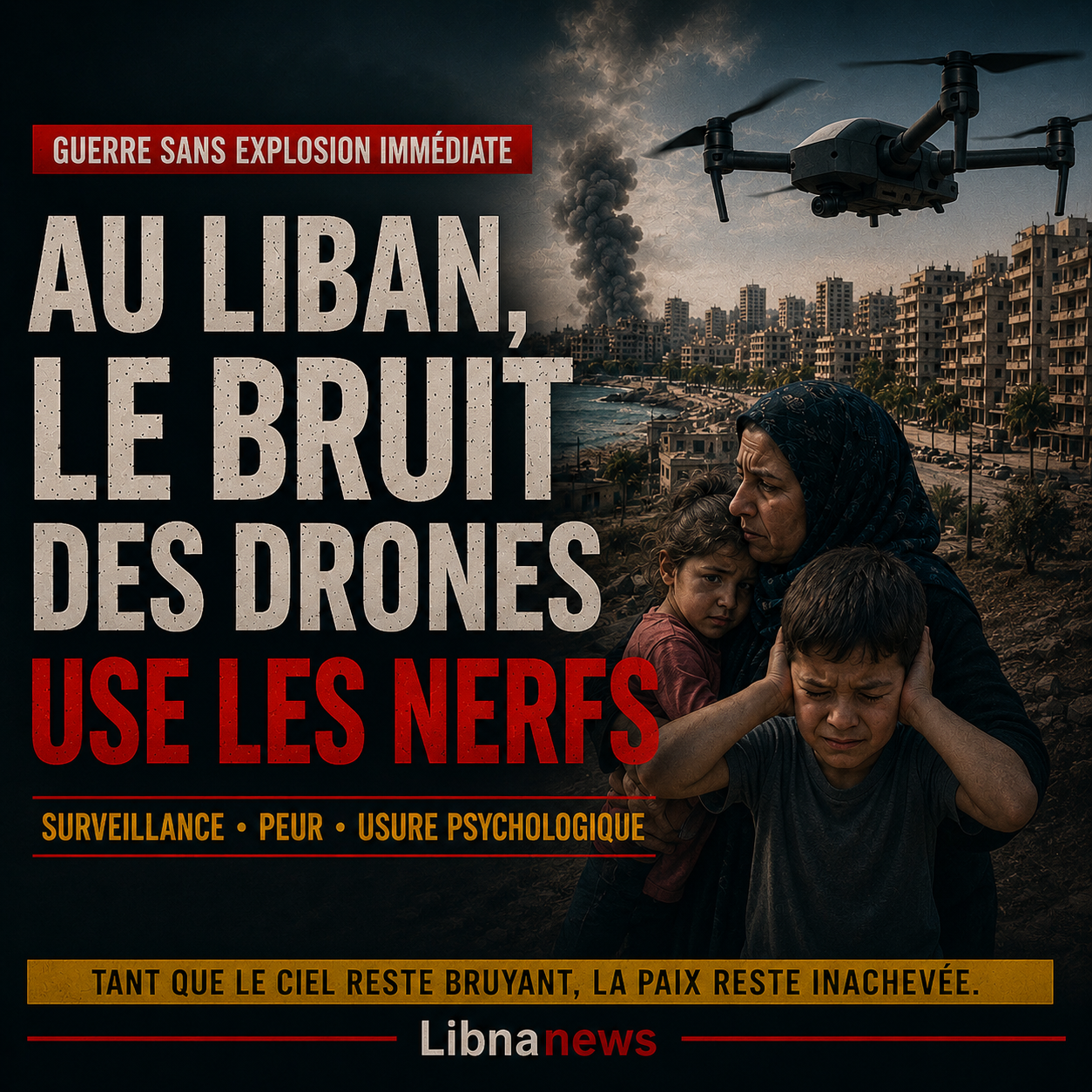
In Lebanon, drone noise became a presence before being an information. It arrives before the alerts, before the press releases, before the balance sheets. It crosses the windows, covers the conversations, wakes up the children, accompanies the meals and follows the inhabitants until the nights when no strike takes place. In the south, in the southern suburbs of Beirut, in Tyre, Nabatiyah, Saida or in villages close to the Blue Line, buzzing calls for a war without immediate explosion. It recalls that the sky remains under surveillance, that the territory remains vulnerable and that apparent calm can break at any time. Psychological warfare does not always begin with an explicit threat. It can hold in a regular sound, impossible to stop.
This noise uses nerves because it turns waiting into a test. A missile hits in seconds. A drone can stay for hours. He does not say whether he observes, if he targets, if he transmits, if he will leave or if he announces an attack. This uncertainty produces a continuous alert state. Residents learn to recognize engine variations, low passages, sudden breaks, returns over a neighbourhood. Sometimes they joke about holding. They give nicknames to drones, talk about pulsating, mustic, tumbler, or Humor exists. It does not suppress fatigue.
A sound war in everyday life
The drone is not just a military tool. It becomes a component of the soundscape. In Lebanon, people are already aware of the noises of crisis: explosions, fighter jets, ambulances, generators, sirens, motorcycles, distant shots, evacuation messages and panicked telephone calls. The drone adds something else. He doesn’t always come up. It persists. It installs like a wire over the houses and changes the perception of time. An hour under drone seems longer than an ordinary hour, because every minute remains open on the possibility of a strike.
This sound war affects the simplest gestures. A mother hesitates to send her child to buy bread. A driver reduces his movements. A merchant closes earlier. A teacher speaks louder to cover the noise. A family reduces the volume of television to check if the drone is approaching. Some people even say they are worried when the sky suddenly becomes silent, as if the absence of the noise predicted a more dangerous phase. This inversion is one of the signs of mental wear and tear. The noise is scary. Silence too.
In several locations in the South, drones accompany evacuation orders, targeted strikes and prolonged overflights. The inhabitants cannot therefore dissociate the sound from the experience lived. Noise is not neutral. It refers to hit cars, houses destroyed, roads cut off, relatives displaced. Even when nothing happens, it recalls what can happen. The body reacts before reasoning: muscle tension, sleep interrupted, heart accelerated, irritability, headache, fatigue, loss of appetite or sudden anger.
Sound monitoring and permanent threat
Audible monitoring is distinguished by its duration. A strike creates a shock, then a post-crash phase. The drone creates a threat that continues unsolved. This permanent threat prevents a complete return to routine. We can work, cook, study or drive under drone, but we do it with some of the attention captured by the sky. This forced attention is exhausted. It reduces the capacity for concentration, changes family relationships and transforms the home into an observed space.
The feeling of being watched weighs almost as much as the fear of being struck. The inhabitants know that drones collect images, spot movements, follow vehicles, control roads and sometimes precede attacks. They don’t know what’s seen or how it’s interpreted. In villages where civil life is mixed with the presence of parties, combatants, displaced persons, relief workers and municipal services, this uncertainty becomes heavy. Going to a ceremony, transporting an injured person, reopening a business or joining a field may seem trivial. Under drone, every movement seems to be misunderstood.
Such monitoring can also be seen as a form of territorial domination. Even when no foreign troops enter a village, the aircraft in the sky reports that an external power observes and can act. For many southern Lebanese, it is a remote occupation. She doesn’t control the streets with checkpoints. It controls the mental space through the sky. She told the people that their return, sleep and work remained conditional. The ceasefire, in these circumstances, is not only measured by the absence of strikes. It also measures the disappearance of this sound presence.
Children, first presentations
Children are the first affected. They often understand the danger without being able to name it. They hear adults silence, run to phones, close flaps, talk about evacuation or check roads. The buzzing becomes a signal associated with family fear. Some kids are asking if the drone will bomb. Others stop playing, hide, cry at night or refuse to sleep alone. Smaller ones can resume regression behaviours: pee in bed, need to be worn, nightmares, anger, silence or excessive attachment to a parent.
School doesn’t always protect. In the exposed areas, courses were disrupted by displacement, closures, the use of school buildings as shelters and fear of travel. Even when classes resume, children arrive with war in their heads. A motorcycle noise, a slammed door or an airplane can trigger a reaction. Teachers must manage tired, anxious, absent or irritable students. They must also manage their own fear. The drone then becomes an invisible pedagogical presence: it reduces concentration, shortens patience and weakens learning.
Teenagers react differently. Some ironize, shoot, publish, challenge fear. Others sleep badly, lose confidence in the future or talk about starting. The permanent threat can break the projection. Why study, prepare an exam or look for a job if the village can be evacuated the next day? This question is not always said. She moves into behavior. It feeds a social fatigue that exceeds the only area of the strikes.
Women, the elderly, workers: differential effects
Displaced women or women living near exposed areas face special burdens. They must reassure children, manage take-away business, maintain food, monitor information, care for the elderly and sometimes decide whether the family should leave. The noise of drones adds constant pressure to this domestic organization. In collective shelters, lack of privacy further exacerbates tensions. A mother can hardly rest if she listens to heaven while watching her children. Sound warfare thus reinforces an already heavy mental burden.
Older people often live the drone through the memory of previous wars. Reactive buzzing of memories: invasions, bombings, occupations, hasty departures, houses destroyed. Some refuse to leave their village. Others will no longer have the strength to leave. Their fear is mixed with a feeling of fatigue. They have experienced several cycles of war and know that the return never completely erases what has been experienced. The drone, therefore, not only produces anxiety about the present. He wakes up a long story.
Workers suffer another form of wear and tear. Drivers, farmers, first aid workers, teachers, traders and delivery agents must continue despite the sky. They can’t always stop on each overflight. A farmer must check his land. A paramedic has to leave. A delivery man must reach a road. An employee has to go home. The drone turns these journeys into risk calculations. This constant pressure can reduce economic activity, but also create guilt. The one who stays at home loses an income. Whoever comes out exposes his life.
When the drone mimics distress
Recent testimonies in the South have reported a more worrying dimension: the alleged use by drones of distress sounds, including child screams, aid calls or sirens. This information was reported by a British media specialist in the Middle East, based on stories of residents and rescue workers. They should be treated with caution until an independent investigation has established each case. But their simple circulation already worsens the psychological climate. If a resident no longer knows whether a cry is real or broadcast by a device, confidence in human signals breaks.
The effect is formidable. In a society where local self-help plays an essential role, a call for help normally forces one to go out, look at and help. If this call can be a trap, the natural reaction becomes suspicious. Relief workers, neighbours and families are hesitant. Fear is no longer just about hitting. It deals with the manipulation of solidarity reflexes. Such a practice, if confirmed, would be a highly targeted psychological war: using the sound of vulnerability to control civilian movements.
Even without these extreme cases, the sounds of war change confidence. A siren, voice message, drone noise, telephone call or remote explosion can create a chain reaction. Social networks amplify this dynamic. The videos circulate quickly, sometimes without context. The inhabitants compare sounds, seek confirmations, send warnings. Information becomes necessary, but it can also prolong fear. We don’t leave the war on our way home, because she’s still on the phone.
Mental health already weakened
Lebanon faces this sound war with a weakened mental health system. The economic crisis has reduced the resources of families, hospitals, schools and associations. Psychologists, psychiatrists, social workers and specialized educators cannot cover all needs. Medicines are expensive. Consultations remain difficult for poor households. Travel complicates access to services. The war thus arrives on a ground already exhausted by the financial collapse, the explosion of the port, the pandemic, precariousness and political crises.
International organizations warn of an increase in anxiety, depression and post-traumatic disorders in displaced and exposed populations. Humanitarian actors believe that a large part of the population already shows signs of psychological distress. Displaced women, children, the elderly, the injured, rescue workers and families who have lost a loved one are particularly vulnerable. The drone is not the only cause. It acts as a constant reminder. It prevents the nervous system from coming down. It keeps people in an alert zone.
This fatigue can become collective. In a building, if several families sleep badly, tensions increase. In a school, if children get anxious, the class slows down. In a business, if the owner monitors the sky, the activity drops. In an displaced family, if no one knows when to return, conflicts are increasing. Mental health is therefore not an individual case. It determines social cohesion, ability to work, education, road safety, domestic violence and confidence in the future.
Helpers and caregivers in the face of exhaustion
The first aid workers live a special exhibition. They intervene after the strikes, transport wounded, respond to warnings, cross controlled roads and hear drones during their missions. Their stress is double. They must protect themselves while protecting others. They must distinguish a real emergency from a possible danger. Sometimes they must act while the sky remains active. The drone noise can therefore become a professional signal, combined with the possibility of a second strike or vehicle targeting.
Caregivers are also under constant pressure. Hospitals in the South, Nabatiyah, Tyre, Saida or Beirut must absorb the wounded, displaced, chronic patients and ordinary emergencies. Medical staff sometimes sleep on site, for fear of roads or lack of relief. Drone noise around hospital areas adds additional tension. Even when the facility is not targeted, the threat affects the teams. An exhausted caregiver makes more mistakes. An anxious nurse sleeps less. A doctor under pressure must announce deaths to families already displaced.
The psychosocial response must therefore include stakeholders. Too often, the devices focus on children and families, with reason, but forget those who work on the front line. Firefighters, paramedics, nurses, doctors, social workers, teachers and volunteers need space for decompression, rotation, psychological support and clear supervision. A society at war depends on its relief workers. If they collapse, civil protection weakens.
What can the state do?
The state cannot silence drones alone. However, it can reduce civilian impotence. The first answer is public information. Residents should be given clear instructions: what to do in the event of an overflight, how to report an incident, what numbers to call, what roads to avoid, how to check a rumor, how to protect children from violent images. The absence of information leaves the field to the most anxious interpretations. Reliable information does not suppress fear. She’s giving me some clues.
The second answer is community psychosocial support. Schools, municipalities, clinics, social centres and associations must have teams trained to identify signs of distress, organize speech groups, accompany children and guide serious cases. It is not about psychiatrizing the entire population. The aim is to prevent normal fear from becoming lasting suffering. Simple interventions include routines, supervised games, breathing, age-appropriate information, quiet spaces, support for parents, and follow-up with displaced children.
The third answer is the creation of safe spaces. In less exposed areas, centres can accommodate children, women, the elderly or families in need of rest. These spaces must be really accessible, not just advertised. They must offer electricity, water, activities, consultations and information. They must also respect dignity. A safe space is not a repository of displaced persons. It is a place where there is a minimum of control.
Limiting the effect of noise without trivializing war
At the family level, some measures can help. Maintain routines, limit exposure to typing videos, talk to children with simple words, avoid false promises, prepare an emergency bag without dramatizing, sleep away from windows when the risk is high, share tasks between adults, seek support and recognize fatigue. These actions do not replace security. They reduce the disruption effect. They allow families to regain some control over what they can still control.
However, one must avoid a trap: to banish noise. Telling the inhabitants that they have to get used to drones amounts to normalizing an abnormal situation. Adaptation is necessary to survive. It must not become political acceptance. A child who learns to sleep under drone is not a protected child. A mother who recognizes the engines is not reassured. A village that works despite the overflight does not live normally. Psychological warfare works precisely when the exception becomes routine.
The regional ceasefire, if it really includes Lebanon, must therefore address the issue of drones. A halt to the continuous overflight strikes will not be enough to restore civilian life. The people of the south and the southern suburbs will not only demand that missiles cease. They will demand that the sky cease to be an instrument of pressure. The Finul, the Lebanese army, the mediators and American guarantees will have to include overflights, surveillance drones, armed drones and sound incidents in the monitoring of violations. Without this, the war will continue in the nerves.
Fatigue that can survive the ceasefire
The end of the strikes, if it occurs, will not mean the immediate end of fear. The bodies keep reflexes. Children react to sounds similar to those of war. Adults keep checking the news. Displaced families sleep badly even after their return. The rescuers are reliving certain scenes. Older people remain concerned at every plane. Mental health needs time, stability and recognition. It does not repair itself by communiqué.
Lebanon must therefore integrate the psychological dimension into the post-war period. Reconstruction cannot be limited to walls, roads and water systems. It must include schools, families, caregivers, social workers and communities. Donors will have to finance this component, often less visible and less spectacular. Authorities will also need to collect data, train teams and coordinate interventions. The country does not lack only concrete. He lacks silence, sleep and internal security.
Above the villages, the noise of the drones reminds us that the ceasefire will be judged in concrete details. A night without buzzing. A class where children stay focused. A rescuer who leaves without listening to the sky. A family that opens its windows without waiting for an alert. As long as these actions remain impossible, the war will not have left the Lebanese daily.