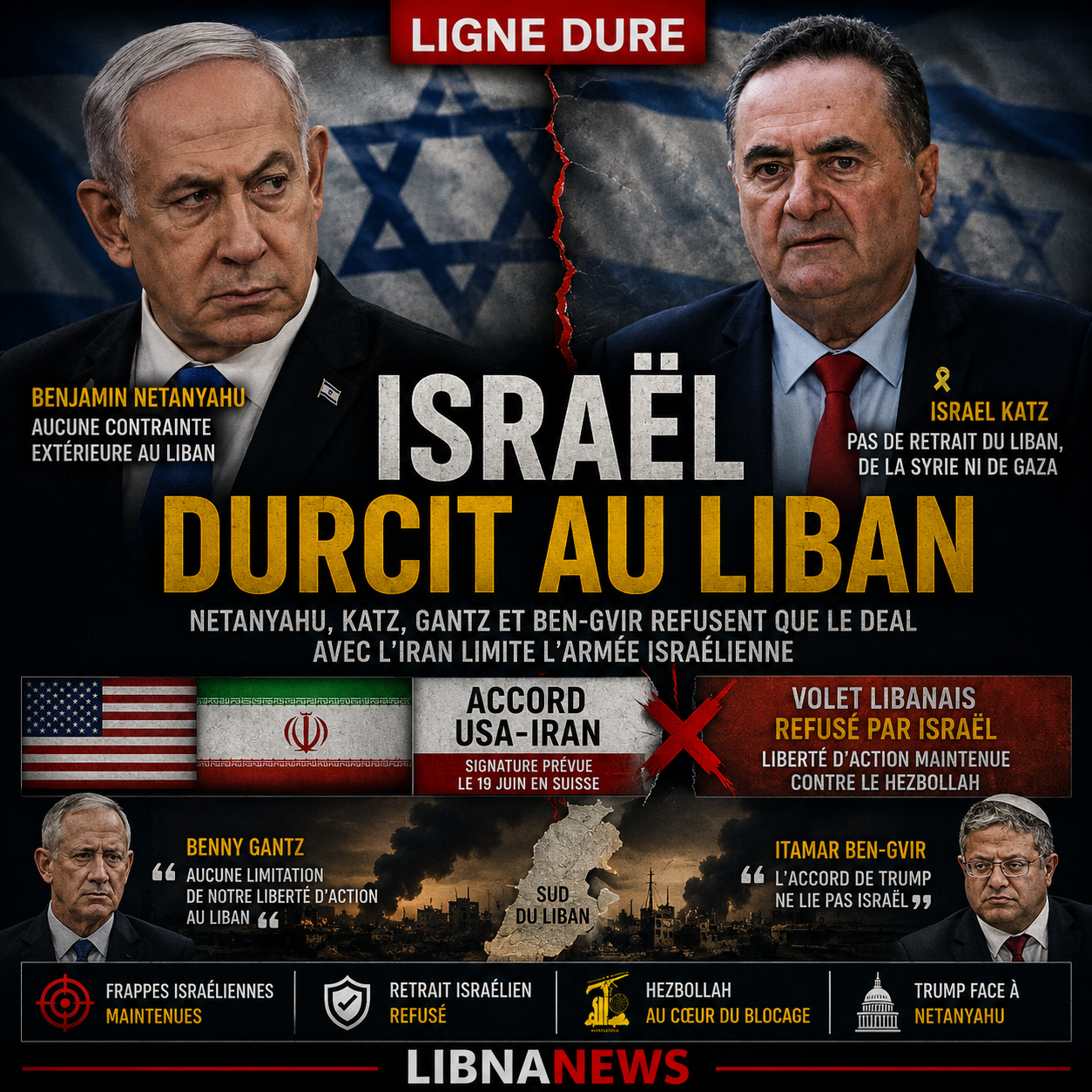
The Israeli refusal of the Lebanese part of the US-Iran agreement is no longer limited to a diplomatic reservation. It becomes a political line assumed in Tel Aviv. Benjamin Netanyahu, Israel Katz, Benny Gantz and Itamar Ben-Gvir converge on a central point: Israel does not want the compromise between Donald Trump and Tehran to reduce its freedom of action in Lebanon. The Lebanese front thus appears to be the main test of the strength of a still fragile regional arrangement.
Since the announcement of a framework agreement between Washington and Tehran, the Israeli government has increased the signals of distrust. The message targets both Iran and the United States. Tel Aviv claims that its security in the north cannot depend on a negotiated text without it, nor on a ceasefire that would leave Hezbollah with military capabilities near the border. This position turns Lebanon into an immediate point of friction between Trump and Netanyahu.
A regional agreement, a targeted Israeli refusal
The compromise announced between the United States and Iran seeks to suspend the regional war and reopen the Strait of Ormuz. It postponed the heaviest cases, including Iran’s nuclear power and sanctions, to a later stage. But its most explosive aspect, for Israel, concerns the cessation of hostilities on Iran-related fronts, including Lebanon. Tehran presents this judgment as a condition of credibility. Tel Aviv sees it as a direct constraint.
Benjamin Netanyahu therefore sought to dissociate the Iranian file from the Lebanese file. According to reports from the Israeli press, he explained to Donald Trump that Israel did not consider itself bound by the Lebanon clause. He also reported that the army would remain in its current positions and continue operations against Hezbollah infrastructure. This reading amounts to accepting, at best, partial de-escalation with Iran, without recognizing in Lebanon the same regime of military suspension.
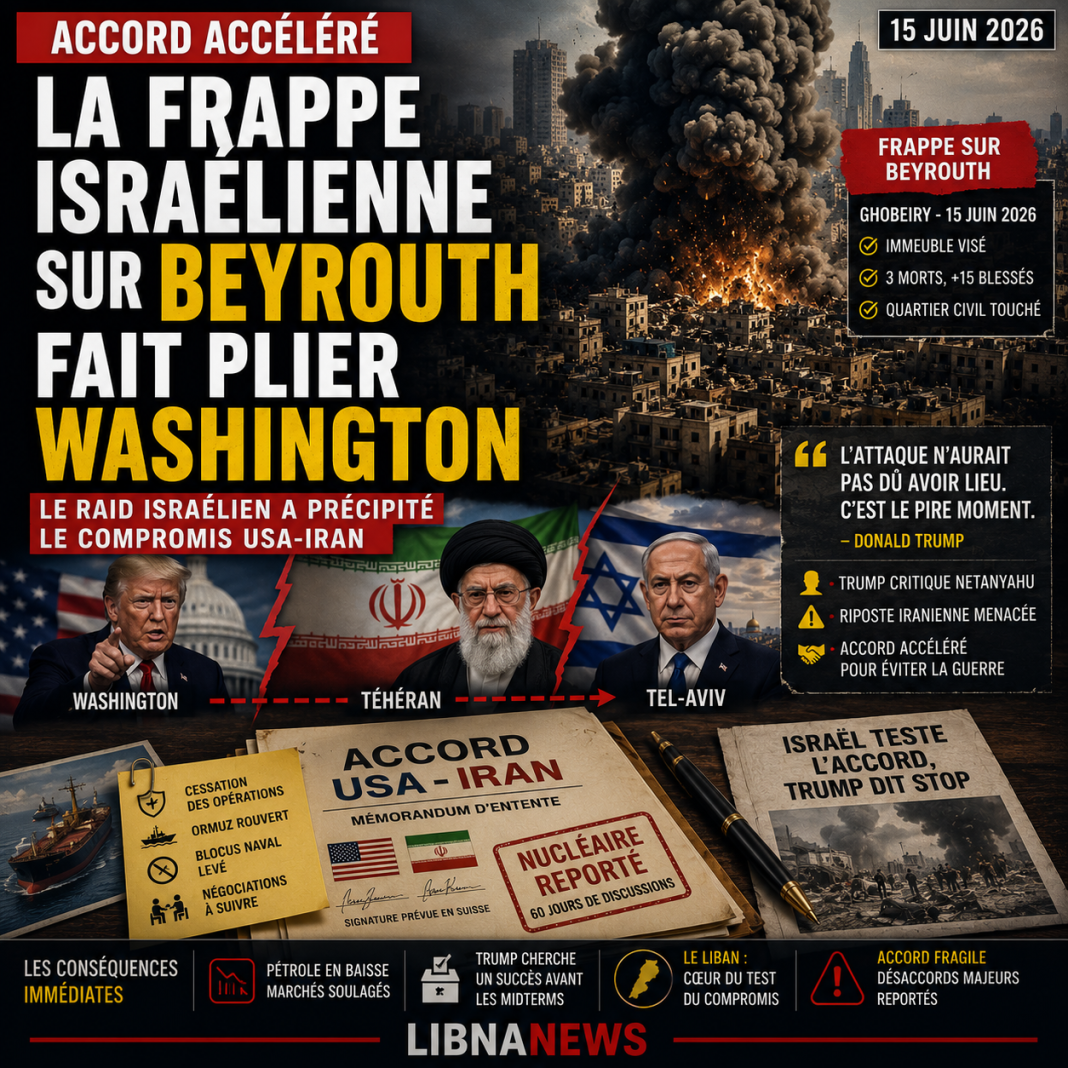
This refusal comes after several weeks of escalation. Israeli strikes on the southern suburbs of Beirut and operations in southern Lebanon have already weakened the discussions. Washington is trying to avoid an Iranian response that would fail the compromise. Israel, for its part, refuses to let settle the idea that an American agreement with Iran could produce an automatic freeze of its operations against Hezbollah.
USA-Iran agreement: Lebanon as a red line
The Israeli formula is based on a repeated notion by political and military leaders: freedom of action. For Netanyahu, it means that the army must be able to strike any target deemed threatening, even after a regional arrangement. For Katz, it translates into an explicit refusal to withdraw. For Gantz, it becomes a safe consensus marker beyond government alone. For Ben-Gvir, it is used to challenge any subordination to an American decision.
Israel Katz formulated the clearest position. The Israeli Defense Minister said the army would not withdraw from areas in Lebanon, Syria and Gaza. He added that this line was shared with Netanyahu and that it had been exposed to American officials. In its logic, these positions are presented as safe areas to protect the Israeli border and localities.
This choice places Israel in a bid against the American calendar. Trump wants to post a crisis exit. Netanyahu wants to prevent an exit from the crisis from leading to a military limitation in the north. Both objectives are not necessarily compatible. A comprehensive ceasefire requires minimum discipline from all parties. On the contrary, the Israeli doctrine claimed in Lebanon is based on the maintenance of a permanent right of strike.
Netanyahu facing Trump, an open tension
The exchanges between Donald Trump and Benjamin Netanyahu took an unusually tense tone. After an Israeli strike against Beirut, the US President publicly released his irritation. According to an American media outlet, Trump estimated that this operation almost derailed the signing of the deal with Iran. He blamed Netanyahu for the timing, a few hours away from a diplomatic stage deemed decisive.
This American anger shows that disagreement is not only about substance, but also about tempo. For Washington, every strike in Lebanon could give Tehran a reason to delay, harden or suspend its commitment. For Israel, every pause imposed on Lebanon may offer Hezbollah an operational respite. The same military event thus produces two opposite readings: diplomatic obstacle for Trump, security necessity for Netanyahu.
However, the Israeli Prime Minister avoided turning the dispute into a public break with the White House. He knows that American support remains vital in military, diplomatic and financial terms. But it is seeking to include a major reservation in the interpretation of the agreement. His message is clear: Israel can accept Washington to speak in Tehran, but it will not accept that this negotiation will set the rules for its action in Lebanon.
Katz hardens the doctrine of presence
The Israeli Katz statement confirms the shift from a logic of point operations to a logic of lasting presence. By saying that Israel will not withdraw its forces despite current or future pressure, the Minister of Defence gives the army a broad political mandate. He’s not just talking about a response. He speaks of occupation of positions considered necessary for Israel’s security.
This position weighs heavily on Lebanon. It means that South Lebanon may remain under constant military pressure, even if a regional agreement enters into force. It also weakens Beirut’s efforts to portray the ceasefire as a framework for restoring sovereignty. The Lebanese government can demand Israeli withdrawal and respect for its borders, but the balance of power is being played out between Washington, Tehran and Tel Aviv.
Katz adds a direct threat to Iran. If Tehran attacks Israel because of the events in Lebanon, Israel promises a strong response. This sentence summarizes the architecture of the arm of iron. Lebanon becomes an Israeli ground of action, an Iranian criterion of confidence and an American risk for the survival of the agreement. The more Israel insists on its freedom of manoeuvre, the more Iran can challenge the real scope of the compromise.
Gantz and Ben-Gvir, two registers for the same line
The sequence shows that the Israeli challenge to the Lebanese side is not just from the toughest ministers. Benny Gantz, a figure in the security centre and a former military leader, also refused any restrictions on freedom of action in Lebanon. He warned that a withdrawal that could endanger northerners should not be accepted. Its position gives Netanyahu indirect support in substance, even if political rivalries remain.
Gantz presents the emerging agreement as a possible strategic failure. He believes that in the coming years Israel will have to wage diplomatic, military and legal battles to safeguard its interests. This formulation broadens the debate. It does not only challenge a clause. It suggests that the agreement with Iran could redefine the strategic environment to the detriment of Israel, giving a form of indirect protection to Tehran’s regional allies.
Itamar Ben-Gvir adopts a more frontal register. The Minister of National Security states that Trump’s agreement does not bind Israel. It insists on the sovereignty of the Israeli State and refuses the idea of subordination to the United States. His speech aimed at the nationalist and religious electorate, which feared any concession. He pushed Netanyahu not to appear as the leader who would have let Washington frame the war in Lebanon.
Controversy around American mediators
The crisis is not limited to the relationship between Netanyahu and Trump. It also affects US intermediaries involved in regional discussions, including Steve Witkoff and Jared Kushner. Israeli and pro-Israeli critics have been criticizing them for several months for their past or present business ties with Gulf actors, including Qatar. In the current climate, these suspicions fuel the idea that US mediation would give too much weight to Doha and not enough to Israeli security demands.
However, there is a need to distinguish between established facts, political criticism and unconfirmed attacks. The economic or diplomatic ties mentioned in the press are not sufficient to prove an illegitimate influence on the content of the agreement. Similarly, there is no reliable source consulted to assign Netanyahu, Katz, Gantz or Ben-Gvir an anti-Semitic formula presenting Witkoff and Kushner as « two Jews bought ». This expression circulates in hostile comments, but it cannot be treated as an official quotation.
The political fact is real: part of the Israeli debate seeks to delegitimize mediation channels through Doha, Islamabad or other regional capitals. This strategy aims to weaken the agreement before its implementation. By targeting mediators, opponents of the compromise no longer only discuss the text. They attack the trading chain itself, implying that Israel’s security would have been negotiated by actors too close to Qatar.
Hezbollah at the Heart of Israeli Refusal
For Israel, Hezbollah remains the main justification for the refusal to withdraw. Israeli officials claim that the movement maintains infrastructure, firing capabilities and networks in southern Lebanon. They argue that any cease-fire that does not deal with these capabilities would leave the threat to Galilee and border communities intact. This argument allows Tel Aviv to present its military presence as defensive, despite Lebanese criticism of sovereignty.
Hezbollah, for its part, refuses any arrangement that would enshrine an Israeli presence. He called for an end to the aggression and the withdrawal of Israeli forces. This position feeds the blockage. Israel refuses to leave without guarantees. Hezbollah refuses guarantees that would resemble surrender. The Lebanese government is trying to defend a state line, but it does not control the military parameters of the front alone.
In this context, the US-Iran agreement creates more ambiguity than it solves. It may impose a regional break, but it does not address the issue of effective control of southern Lebanon. It can reduce the risk of direct war between Washington and Tehran, but it does not neutralise local causes of escalation. It is precisely this grey area that Israel seeks to exploit by declaring that it is not bound by the Lebanese clause.
Netanyahu’s Calculation
Netanyahu is moving on a narrow line. If he challenges Trump too openly, he risks damaging the relationship with his main ally. If he accepts American reading too clearly, he exposes himself to an internal offensive by his right-wing partners and his security opponents. The current auction allows him to hold both ends: he does not break with Washington, but he asserts before his opinion that the agreement with Iran will not dictate the conduct of the war in Lebanon.
It also responds to Israeli political constraints. Israel’s north remains a major issue for displaced families, border communities and parties accusing the government of allowing Hezbollah to re-establish a threat. Any form of withdrawal or suspension of strikes would be immediately judged against this fear. Netanyahu cannot appear to have exchanged security from the north for a Trump-led nuclear compromise.
There is, however, a risk of overbidding. If Israel continues its strikes in Lebanon after the agreement enters into force, Iran will be able to claim that Washington does not control its ally. If Tehran reacts, even in a limited way, the deal can waver. If Washington puts pressure on Netanyahu, the crisis will become public. Lebanon is thus at the centre of a device where each actor tests the other’s margin.
A fragile agreement before its implementation
The Trump-Iran compromise is still a framework, not a consolidated peace. It announces technical negotiations, a 60-day window and discussions on nuclear, sanctions and regional safeguards. Lebanon arrives in this sequence as an immediate case. Unlike nuclear power, it cannot be referred to a group of experts. Strikes, displacements and military positions require daily decisions.
This is why the Israeli position is wider than the only northern front. By refusing Lebanon’s withdrawal, Israel is testing Trump’s ability to impose discipline on his allies. By maintaining the Lebanese clause, Iran is testing Washington’s ability to produce concrete effects. By calling for the cessation of hostilities, Beirut is trying to turn a regional agreement into national protection. None of these objectives fully coincide.
The day of 15 June therefore shows an unstable architecture. The US-Iran deal exists as a de-escalation horizon, but Israel is seeking to limit its application in Lebanon. Netanyahu, Katz, Gantz and Ben-Gvir do not speak with the same vocabulary, but they converge on a refusal: no external constraint should prevent the Israeli army from acting against Hezbollah. The next step will depend less on statements than on movements on the ground, possible strikes in South Lebanon and the expected signature of the text in Switzerland.