





International law is central to the Palestinian issue. It is invoked by the United Nations, human rights organisations, international courts, the European Union and many states. He described occupation, condemned settlements, supervised detention, prohibited forced transfers and imposed protection for civilians. Yet, in Palestine, this international law remains largely ineffective. Decisions exist. Reports are accumulating. Sanctions remain limited. Violations continue. The gap between the standard and its application has become one of the most lasting features of the conflict.
This gap is reflected in two major issues: Palestinian prisoners and settlements in the West Bank, including East Jerusalem. In the first case, human rights organizations denounce administrative detention, secret procedures, ill-treatment and the high number of persons detained without trial. In the second, the international community reiterates that settlements are illegal, but budgets, roads, outposts and real estate projects continue. The problem is therefore not the absence of law. It is the absence of sufficient political restraint to transform this right into protection.
Abundant but not binding international law
However, the legal framework is dense. The International Court of Justice issued a major advisory opinion in July 2024 on the consequences of Israeli policies in the Occupied Palestinian Territory. It concluded that Israel’s continued presence in that territory was illegal and that the Israeli State should put an end to it as soon as possible. The UN General Assembly then called for the end of this presence within one year. These texts have given States a clear legal basis. They also recalled that third parties should not recognize or assist a situation considered illegal.
In practice, the effect remains limited. The advisory opinions of the International Court of Justice have an important legal and political weight, but they are not alone transformed into withdrawal, sanctions or trade control. They depend on the States. States, however, act in different interests. Some want to preserve their alliance with Israel. Others defend the Palestinian right to self-determination, but are reluctant to use economic instruments. Some vote in UN resolutions, then maintain trade agreements, military cooperation or normal political relations. This dissociation emptys the norm of part of its strength.
The International Criminal Court has reached another stage with arrest warrants targeting Benjamin Netanyahu and Yoav Gallant for alleged war crimes and crimes against humanity. This decision was symbolically strong. She recalled that leaders allied to Western powers could also be targeted by international criminal justice. But again, implementation depends on the States parties to the Rome Statute. As long as the leaders concerned remain out of reach, the decision mainly results in diplomatic constraint. It limits certain movements. It increases the pressure. It does not end contested policies.
Palestinian prisoners: the norm against secrecy
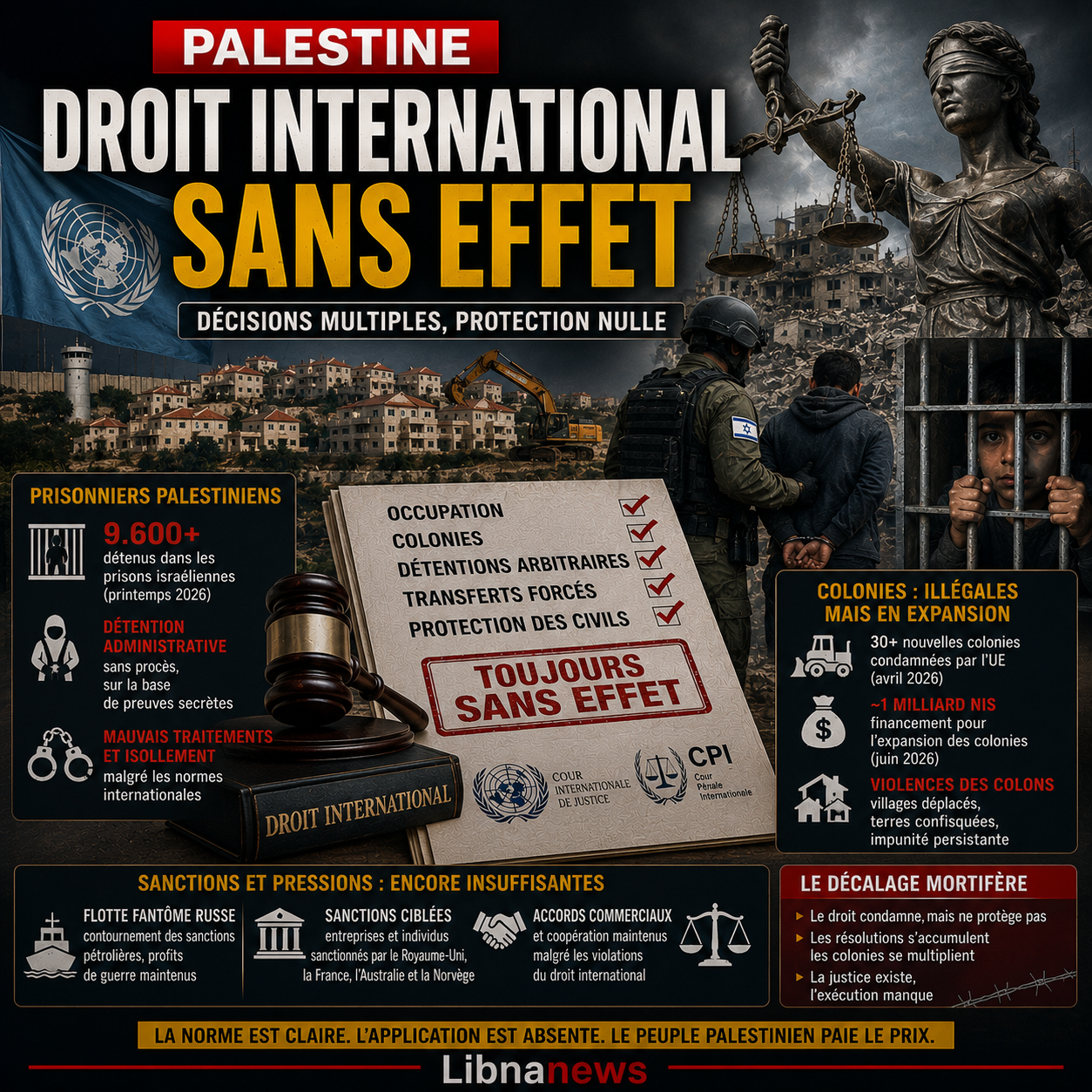
The prisoner file illustrates the practical impotence of the law. Palestinian and Israeli human rights organizations reported more than 9,600 Palestinians and Arabs detained in Israeli prisons in the spring of 2026. These include children, persons arrested in the West Bank, detainees in Gaza and a significant number of persons in administrative detention. This procedure allows a person to be detained without trial on the basis of often classified elements. The Israeli authorities describe it as a security tool. Human rights organisations see this as an exceptional mechanism that has become a mass practice.
The difficulty lies in secrecy. An administratively detained person does not always know the evidence against him. His lawyer can’t always access the file. Detention may be renewed. The judge often examines information that the defence cannot fully challenge. International law allows security measures in strict circumstances, but requires safeguards, effective control and the prohibition of arbitrary action. When the procedure becomes prolonged, opaque and repeated, it moves away from the exception to become a form of punishment without trial.
The case of Palestinian doctors detained after Israeli operations in Gaza has increased international attention. Media and medical organizations reported the prolonged detention of hospital officials without clear public charges, as well as harsh conditions of detention. These cases affect a sensitive aspect of humanitarian law: the protection of medical personnel. Israel claims to fight against the use of civilian infrastructure by armed groups. Human rights defenders respond that uncharged arrests, incommunicado detention and isolation cannot become a general response. The question goes beyond each individual case. She questions the treatment of those who perform civilian functions in a war.
Prisoners are also a Palestinian political issue. Every affected family lives the right as a distant abstraction. International procedures are moving slowly. Visits, care, information on detainees and remedies depend on more immediate mechanisms. When these mechanisms are blocked, the international standard does not protect the prisoner. It produces a vocabulary, not always a way out. This is one of the reasons for Palestinian anger: law exists mostly after the fact, in reports, while detention is in the present.
Colonies: known but standardized illegality
The other great example is colonies. The majority international position is stable: Israeli settlements in occupied territory are illegal under international law. The European Union, the United Nations, the International Court of Justice and several States repeat this. The transfer of a civilian population from an occupying Power to an occupied territory violates applicable rules. The settlements also fragment the West Bank, change demography, reduce Palestinian territorial continuity and make it more difficult to reach a two-State political solution.
Yet, expansion continues. In April 2026, the European Union condemned an Israeli decision establishing more than 30 new settlements in the occupied West Bank. In June, a project of about 1 billion shekels to finance settlement expansion was forwarded to the Israeli security cabinet. Israeli organizations opposed to colonization have alerted infrastructure, roads, connections and temporary housing to consolidate settlements. So the colony is not just a built house. It is a system of roads, budgets, permits, safety and public services.
The settler violence adds an extra layer. Recent reports refer to partially or totally emptied villages, forced displacement, intimidation, destruction of property and attacks on Palestinian communities, especially Bedouin. Israel often presents such violence as isolated acts or claims to prosecute them where evidence exists. On the contrary, human rights organisations speak of an environment of impunity and indirect political support. The debate therefore focuses on the responsibility of the State: does it allow, protect, finance or organize a sustainable transformation of the ground?
Again, international law is not lacking. What is missing is the cost of its violation. As long as the products of the colonies circulate, as long as the enterprises participate in the infrastructure of the occupation, as long as the politicians undergo only verbal condemnations, illegality becomes manageable. She doesn’t disappear. She’s normalizing herself.
The European Union between prudence and contradiction
The European Union illustrates this contradiction. It formally defended the two-state solution, condemned the settlements and recalled the illegality of the occupation. It also has an association agreement with Israel, based in particular on respect for human rights and democratic principles. In theory, this framework can serve as a lever. In practice, Member States remain divided. Some call for suspension or deep revision of the agreement. Others want to preserve cooperation with Israel or avoid measures that would be perceived as a strategic break.
This division explains the weakness of the concrete effect. The Union may condemn an Israeli decision, issue statements and finance humanitarian aid to Palestinians. But it struggles to move to commercial conditionality. Colony products are not always prohibited. Not all European companies are subject to strict control when they are involved in settlement-related activities. Weapons, technology, financing, insurance and services remain very sensitive areas. Words are common. Instruments are not.
Recent measures, however, show partial tightening. The United Kingdom, with several allies including France, Australia and Norway, has imposed sanctions on companies and individuals accused of financing or facilitating settler violence in the West Bank. London also recommended that its companies avoid settlement-related activities. These measures are a change. But they remain targeted. They do not constitute a comprehensive trade embargo on settlements. They do not cover the whole political architecture that allows expansion. Human rights organisations therefore consider them insufficient.
The European problem is also that of traceability. To enforce the law, it is necessary to know where products come from, which companies operate in settlements, which services finance infrastructure and what investments support occupation. Without traceability, the distinction between Israel within its recognized borders and settlements becomes blurred in commercial practice. This confusion benefits the status quo. It allows governments to condemn the occupation while allowing economic flows to support it indirectly.
Powerful courts, weak enforcement
International tribunals have strengthened the Palestinian legal record, but they do not have an enforcement force comparable to that of States. The International Court of Justice establishes obligations and clarifies the law. The International Criminal Court has individual responsibilities. The United Nations commissions of inquiry document the facts. Special rapporteurs alert violations. But none of these mechanisms can send a force to stop colonization, release prisoners or impose a withdrawal. They depend on State cooperation, national sanctions, domestic courts and diplomatic pressure.
This dependency gives an advantage to powers protected by strong alliances. Israel enjoys the political, military and diplomatic support of the United States. Washington may criticize certain Israeli decisions, but it remains opposed to several coercive measures in international fora. This protection affects the Security Council and European calculations. It creates an asymmetry: the right can be clear, but power can delay its effect. The Palestinians then see legal decisions pile up without changing their daily lives.
It should also be recalled that international law is slower than fait accompli. A colony can expand in a few months. A road can be built in a few weeks. A family can be moved in one day. An international procedure takes years. Even when it ends, it often arrives after the transformation of the terrain. That is why colonial expansion is so politically effective. It produces a reality which the law then condemns, but which it struggles to reverse. The occupation becomes an administered, funded and protected fact.
Penalties, traceability, conditionality: possible tools
Yet the tools exist. The first is the prohibition of trade with colonies. It would prevent the importation of settlement products and prohibit companies from providing services that directly support their maintenance or expansion. Such a measure would not cover trade with Israel within its recognized borders. It would cover the legal distinction between Israeli territory and occupied territory. It would give an economic effect to an already affirmed political position.
The second tool is mandatory traceability. States may require companies to identify their supply chains, partners, investments, property and settlement-related services. This obligation would allow consumers, customs authorities, banks and insurers to distinguish between what is within the recognized territory and what is occupied. Traceability is less spectacular than a sanction. It is often more effective. It makes circumvention more difficult and exposes private actors to legal and reputational risks.
The third tool is commercial conditionality. The European Union and other partners may link certain advantages, cooperation or programmes with respect to international law. This conditionality may include weapons, dual technologies, research, public funding or markets. It must be precise in order to avoid the accusation of a purely political measure. It must also be consistent. A state that condemns settlements but finances companies linked to their infrastructure weakens its own position.
The fourth tool is individual punishment. Political leaders, violent settler leaders, financing organizations, real estate companies and security actors involved may be subject to visa bans, asset freezes or financial restrictions. These sanctions do not replace a comprehensive policy. However, they can create a personal cost. They may also point out that impunity is not total. Their limit is their selectivity. If they only target performers and never policymakers, they remain symbolic.
Why the concrete effect remains limited
International law remains without concrete effect in Palestine for four main reasons. The first is the political protection enjoyed by Israel. The United States maintains a decisive influence, particularly in the Security Council. The second is the European division. The Union often shares the legal diagnosis, but not the desire to use the same instruments. The third is the fear of political cost. Many governments fear accusations of hostility towards Israel, tensions with Washington, internal reactions or economic consequences. The fourth is the absence of an automatic mechanism. Violations do not themselves trigger sanctions.
This situation produces a crisis of credibility. For decades, the Palestinians have understood that the occupation is illegal, settlements are illegal, civilians must be protected and prisoners must be guaranteed. Yet they see settlements spreading, detainees remaining without trial, villages emptying and businesses continuing their activities. The repetition of the norm without material change eventually weakens confidence in international institutions. It gives the impression that the law protects above all those who already have power.
The question was not whether international law was unnecessary. He’s not. It provides language, obligations, evidence, responsibilities and tools. It allows documentation, qualification and challenge. It also protects areas of mobilization for lawyers, NGOs, journalists, families of prisoners and diplomacy favourable to Palestine. But it remains incomplete without political will. In Palestine, the law exists. What is missing is the shift from qualification to consequence.
The next steps will tell if this situation changes. A ban on trade with settlements, a partial suspension of certain agreements, an obligation to trace, sanctions against those responsible for expansion, measures on arms and strict enforcement of the International Criminal Court’s mandates would change the cost of occupation. Otherwise, the statements will continue to coexist with the facts. Prisoners will remain the human example of this gap. The colonies will remain the territorial expression.