






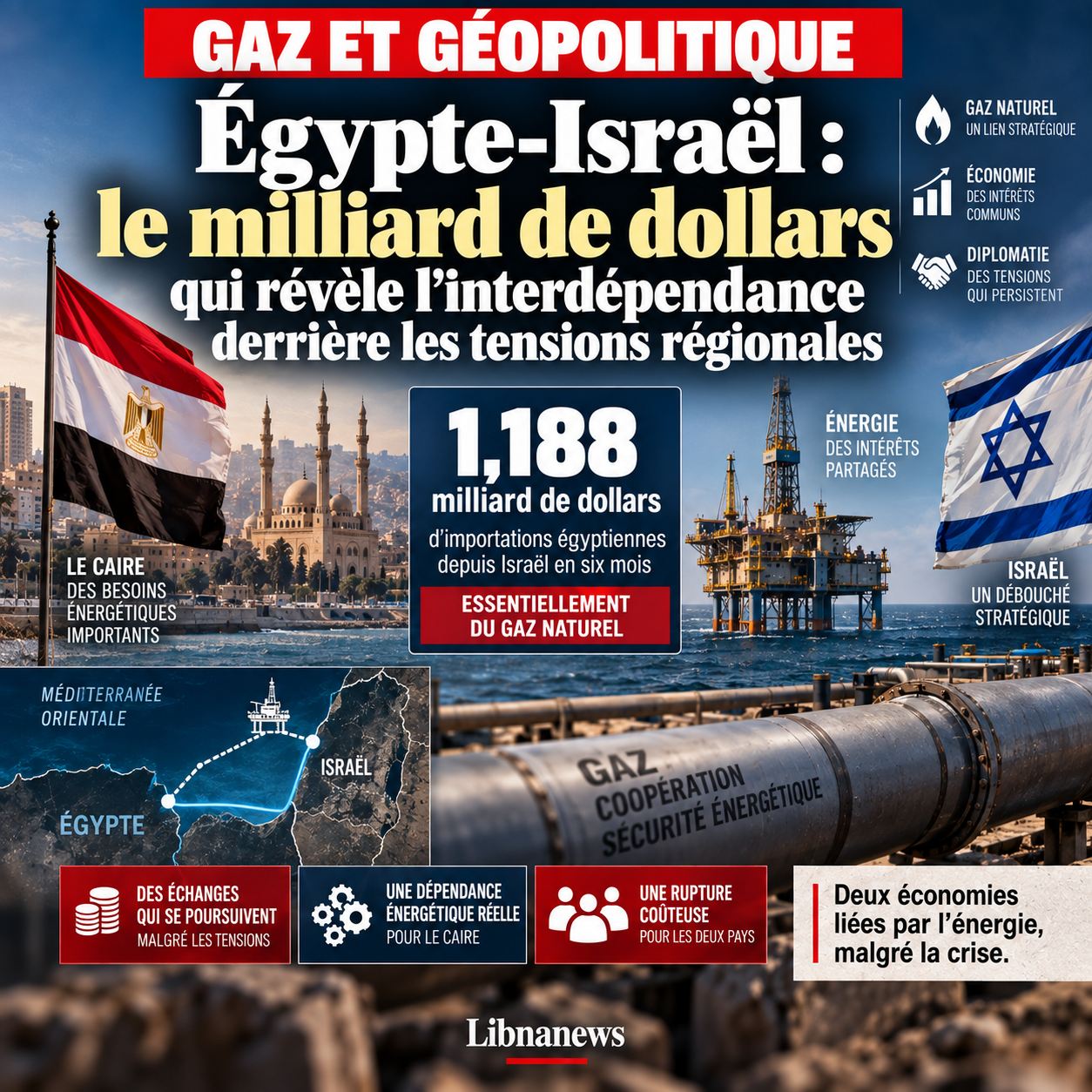
Politics and trade sometimes tell two different stories. While the region is undergoing a new phase of military confrontation and relations between Israel and its neighbours are under heavy strain, the trade between Egypt and Israel continues to show economic dependence that is difficult to ignore. Over a six-month period, Egyptian imports from Israel were reported to have reached $1.188 billion. A major part of this bill would be related to natural gas.
The figure is remarkable less by its size than by what it reveals. Egypt and Israel have long had formal diplomatic relations, but their economic cooperation is part of a political environment where every new regional crisis can put pressure on governments. Gas now adds an additional constraint: behind speeches, borders and diplomatic disagreements there is an energy infrastructure that physically links the two economies. Cairo can criticize certain Israeli decisions while still receiving Israeli gas; Israel can view Egypt as a difficult political interlocutor while also having an interest in preserving this market.
This relationship does not mean that the economy neutralizes politics. Rather, it shows that both dimensions can evolve simultaneously in the opposite direction. As tensions increase, energy dependence becomes more visible. And the more this dependency becomes, the more costly a complete political break becomes for both parties.
$1.188 billion in six months
The amount reported for the first six months gives a concrete measure of this relationship. With $1.188 billion in Egyptian imports from Israel, trade is no longer a marginal trade that can be interrupted without consequences. Natural gas would represent the bulk of these purchases, which gives the figure a very different meaning from that of an increase in imports of ordinary consumer goods.
Energy is a strategic product. It feeds industry, electricity generation and part of the daily operation of an economy. When supply depends on a neighbouring country, the trade relationship also becomes an issue of economic security. A cargo of manufactured goods can usually be replaced by another supplier at an additional cost. Rapid replacement of a large volume of gas depends on the availability of infrastructure, transport capacity and contracts.
The nature of imports therefore counts more than their gross value. The billion dollars do not simply reflect the existence of a market between two countries that have signed peace. It states that part of their economic infrastructure now operates in a logic of interdependence.
This evolution gives each regional crisis an additional dimension. A deterioration of relations no longer threatens only diplomatic contacts or traditional trade. It can affect an energy flow that the Egyptian economy needs and that Israel derives revenue from.
Gas has transformed political peace into a material relationship
For a long time, the Egyptian-Israeli relationship could be described as an essentially strategic peace. The treaty prevented the return to direct military confrontation, the two states maintained official relations and cooperated on certain security issues, but the societies remained largely distant from one another. Energy introduces another dimension: it creates links that no longer rely solely on chanceries.
A pipeline does not work according to the pace of political declarations. It requires contracts, operators, infrastructure, investment and planning. Once this architecture is built, its suspension immediately produces economic consequences. Relationships therefore become more difficult to interrupt than when they are based solely on easily substitutable exchanges.
For Egypt, imported gas meets energy and industrial needs. For Israel, the Egyptian market is a natural market because of its geographical proximity and existing infrastructure. Interests are shared without the need for both countries to be politically aligned on all regional issues.
This is precisely what makes the relationship interesting. Economic integration does not necessarily produce diplomatic convergence. Rather, it increases the cost of divergence.
Cairo must deal with two contradictory realities
The Egyptian position is particularly delicate. On the one hand, the state must defend its economic interests and ensure adequate energy supply. On the other hand, regional crises, especially Palestinian ones, exert strong political pressure on the relationship with Israel.
This contradiction is not only diplomatic. It also concerns public opinion. Energy cooperation can be economically sound while remaining politically sensitive when Israeli operations provoke a strong reaction in the Arab world. As the military environment deteriorates, the gap between economic necessity and political discourse becomes difficult to manage.
The $1.188 billion figure makes this gap visible. He recalled that the economic relationship continued even when the regional climate deteriorated. This does not mean that Cairo approves Israeli choices. This means that energy infrastructure and needs impose their own continuity.
This situation also reduces the space available for the most radical diplomatic actions. Any decision affecting the economic relationship in a sustainable manner should be assessed not only on the basis of its political impact, but also on the basis of its domestic cost. A supply disruption could affect the Egyptian economy, while a disruption of the Egyptian market would also cost Israel.
Interdependence does not therefore eliminate conflict of interest. It transforms the way it can be managed.
Israel also needs Egyptian continuity
Dependence is not necessarily one-way. Israel owns the exported resource, but energy production needs markets. Infrastructure is profitable when volumes sold remain high and relatively predictable. Egypt’s proximity makes it a particularly important partner.
A neighbouring market has several advantages. Distances are shorter, infrastructure can be linked more easily and the relationship can be part of long-term contracts. Losing this market would require looking for other markets and, depending on the volume concerned, adapting export channels.
Cairo therefore also has a lever. It was not necessarily sufficient to change the major strategic Israeli decisions, but it recalled that economic cooperation was generating interests on both sides.
This is one reason why the relationship can survive periods of acute tension. Everyone has political reasons to criticize the other, but also economic reasons to keep certain circuits open.
The energy relationship then functions as a partial stabilizer. It does not guarantee the absence of a crisis, but increases the price of a complete break.
Energy dependency is never comfortable
For Egypt, however, there is a clear risk. A large supply from a country with which relations can be strongly affected by a regional crisis creates vulnerability. The greater the share of the Israeli gas in the energy equation, the more internal consequences can result from any external disruption.
Energy security is precisely about preventing a political, military or technical event in a supplier from paralyzing a significant part of the economy. States therefore generally seek to diversify their sources, develop domestic production and have alternative solutions.
The import figure should be read from this angle. It demonstrates the economic utility of the Israeli gas, as well as the importance of the supplier. Dependence becomes problematic when the buyer cannot quickly replace the missing volumes.
The risk is not necessarily a political decision to interrupt exports. A war may affect a facility, infrastructure or production conditions. A safe disturbance may be sufficient to alter flows. Vulnerability therefore exists even if Governments wish to maintain cooperation.
For Cairo, the question is not simply whether the Israeli gas is economically interesting. It is to determine what proportion of its needs can reasonably depend on such a volatile environment.
Energy creates diplomacy of necessity
This constraint explains why some relations between States survive differences which, in another context, would have caused a greater rupture. Energy imposes a form of pragmatism. Governments can maintain opposing political positions while protecting the mechanisms essential to their economies.
This diplomacy of necessity is particularly visible in the Middle East. Political alliances and energy circuits do not always overlap. A country may be in conflict with another on a case while depending on it for a resource, trade route or infrastructure.
Egypt and Israel offer a particularly clear illustration here. Their energy relationship should not be interpreted as a disappearance of their differences. Rather, it creates a floor under the relationship: a set of material interests that a crisis must pass before causing a complete rupture.
This floor becomes stronger as the amounts increase. A trade of tens of millions of dollars can be sacrificed to send a political signal. A flow of more than 1 billion over six months, concentrated in an essential resource, requires a much more complex calculation.
Diplomacy must then take into account the power stations, industry and consumers as well as the press releases of the foreign ministries.
The paradox of a region at war but still interconnected
The Egyptian-Israeli case also reveals a wider reality. Regional wars often give the image of a Middle East fragmented into waterproof blocks. The economy tells a different story. Oil, gas, electricity, ports and trade routes continue to create dependencies between countries whose political positions can be very distant.
Another example is the Strait of Ormuz. Gulf states can be politically opposed to Iran while depending on a maritime environment that Tehran can disrupt. The Red Sea also links very different economies that suffer all the consequences of a disruption to Bab al-Mandab.
The gas between Israel and Egypt belongs to this same geography of interdependence. Political borders remain essential, but they no longer correspond perfectly to economic borders.
This reality sometimes reduces the risk of rupture, because everyone would have too much to lose. But it can also become a source of vulnerability. When a crisis touches a strategic node, its consequences quickly spread to countries that are not directly involved in the confrontation.
Regional integration is not necessarily synonymous with peace. It can simply mean that war costs more to everyone.
Gas becomes a national security factor
The strategic value of this relationship is fully apparent when considering the role of energy in internal stability. An economy facing supply difficulties can suffer shortages, rising production costs and additional pressure on public finances. The consequences end up directly affecting households.
For a government, energy security becomes a component of national security. It is not enough to have contracts. We must ensure that volumes can be delivered in several crisis scenarios.
This requirement naturally leads to diversification. Egypt has an interest in developing its own resources as much as possible and in preserving several supply routes. But diversification requires time, investment and infrastructure. Meanwhile, existing flows continue to influence decisions.
The billion dollars imported in six months should therefore not be read only as trade statistics. It also measures part of the dependency that decision-makers need to integrate into their calculations.
Every crisis with Israel implicitly raises the same question: how far can the political relationship be strengthened without compromising an energy interest that has become important?
Cooperation that can also give Cairo a regional role
This dependency, however, has a diplomatic counterpart. The more Egypt is integrated into the regional energy architecture, the more important its stability becomes for its partners. Cairo is therefore not only in the position of a vulnerable buyer.
Its territory, infrastructure and geographical location give it a weight in the energy balance of the eastern Mediterranean. This position can strengthen its role as mediator on other issues, although it obviously does not guarantee that its positions will be followed.
Energy thus adds a dimension to political relations. Israel had an interest in preserving a stable economic partner. Egypt has an interest in avoiding a disruption that would threaten its supplies. Both countries therefore have a cooperation channel whose value increases precisely when political relations become difficult.
This mechanism does not necessarily produce confidence. It produces mutual interest, which is different but sometimes more lasting.
The real risk: interdependence becomes unilateral dependence
All at stake for Cairo is ultimately to maintain the balance between economic benefit and strategic vulnerability. Importing Israeli gas can be rational if conditions are favourable and the resource complements a diversified energy architecture. The situation becomes more problematic if the Egyptian economy no longer has sufficient alternatives in case of interruption.
The $1.188 billion figure alone does not measure this physical dependence. An import value does not directly account for Israel’s share of total consumption. Nor is it possible to determine how long Egypt could compensate for an interruption from other sources. The documents available do not provide these elements.
However, they show that the commercial relationship is important enough not to be considered peripheral. It’s already strategic information.
The next step, therefore, will be to observe whether trade continues to look at how Egypt seeks to reduce the risks associated with their importance.
Behind the speeches, infrastructure continues to function
This is probably the main teaching of these figures. International relations never consist solely of official declarations. They are also based on pipes, contracts, investments and daily needs. Such infrastructure can survive deep political crises because its interruption would have an immediate cost.
Egypt and Israel can therefore go through a period of tension while maintaining substantial energy cooperation. This paradox is only apparent. Governments divide their relations when they find it interesting. They can oppose one case and cooperate on another.
But the more essential this cooperation becomes, the more it weighs on everyone’s freedom of action.
The billion dollars of Egyptian imports over six months reveal precisely this transformation. The peace treaty had prevented the return to direct war. Gas now adds another layer to the relationship: that of economic interdependence that is sufficiently important for any political crisis to be calculated in terms of energy.
In an area where straits, gas pipelines and sea routes have become instruments of power, this link could count almost as much as diplomatic declarations. The relationship between Cairo and Israel is no longer limited to what their leaders say about each other. It is also a measure of what continues to flow between them when policy moves forward.