





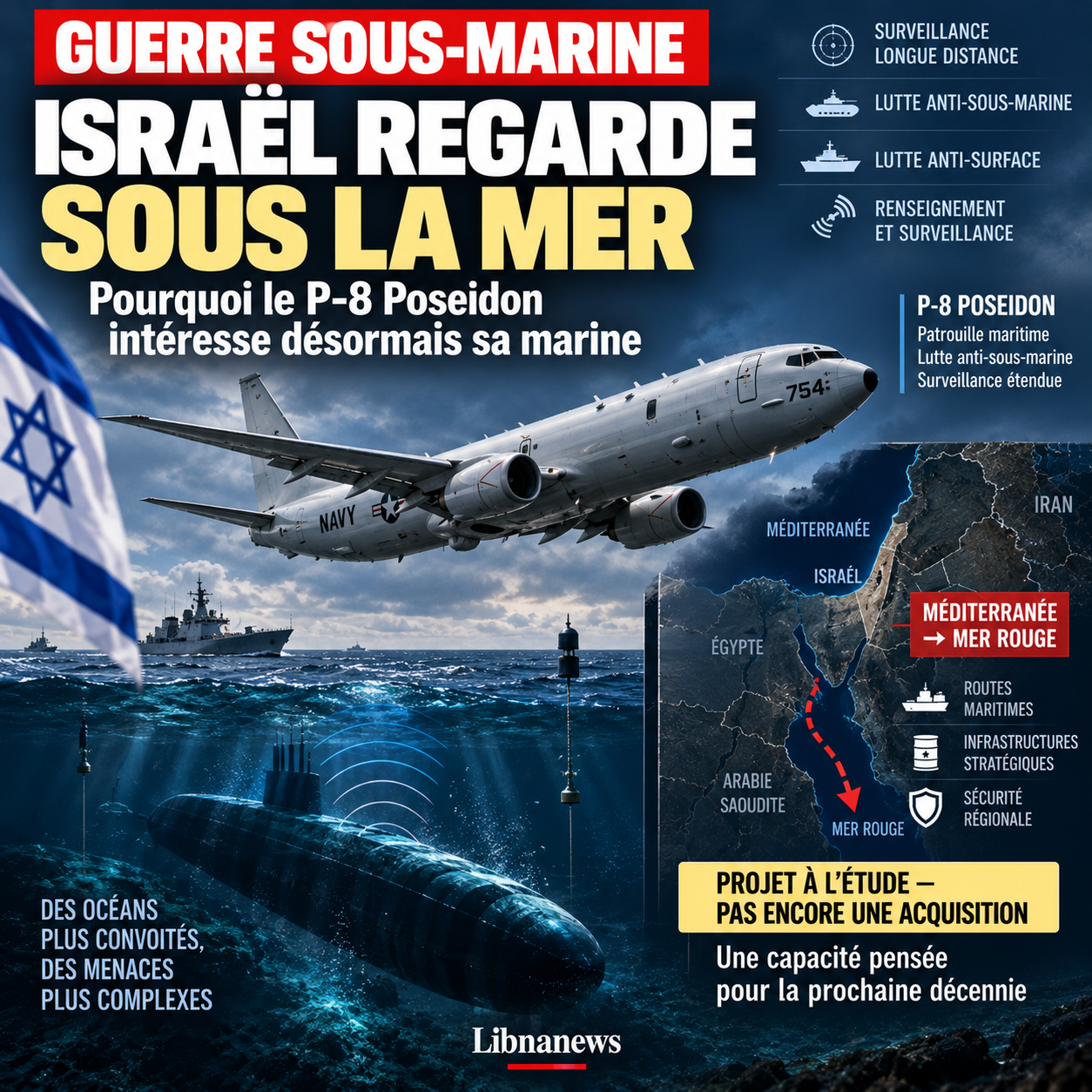
The Israeli navy is considering a significant change in its naval capabilities. Its commander, Eyal Harel, reportedly recently met with a senior Boeing officer to examine the acquisition of P-8 Poseidon, American aircraft specialized in maritime surveillance and anti-submarine warfare. The proposal would be seriously reviewed by the Israeli Ministry of Defence and could be incorporated into the Navy’s strategic plan for the next decade.
Behind this acquisition project appears a deeper transformation. Israeli maritime security is no longer limited to immediate approaches to its Mediterranean coasts. The monitored space is widening towards the Red Sea, as regional war increases the importance of maritime routes, energy infrastructure and threats that may evolve below the surface. Interest in Poseidon thus suggests a willingness to have a much wider monitoring capacity, capable of searching for and tracking vessels over long distances rather than relying solely on ships and coastal means.
However, the project must be repositioned to its proper level. It is studied, not yet presented as a definitively concluded acquisition. Above all, the available information does not identify a specific underwater threat that would trigger this reflection. Interest lies elsewhere: Israel seems to want to adapt its navy to an environment where surface control is no longer sufficient and where underwater space is becoming a growing element of regional competition.
From the Israeli coast to a much larger maritime theatre
For a long time, the main Israeli maritime concerns could be considered from the eastern Mediterranean: coastal protection, port defence, monitoring maritime approaches and securing strategic infrastructure. This geography remains essential, but it is no longer sufficient to describe the current theatre. The Red Sea, the passages linking the different maritime areas and the extension of the regional confrontations now force the staffs to reason for much greater distances.
This development appears at a time when maritime routes have become instruments of strategic pressure. The confrontation with Iran has placed the Strait of Ormuz at the centre of the global economy. Further south-west, Bab al-Mandab and the Red Sea remain directly exposed to the consequences of the Yemeni conflict and the Houthis military capabilities. The same crises affecting oil and commercial transport therefore also affect the needs of the regional marines.
For Israel, this expansion of theatre creates a simple operational difficulty: a warship cannot be everywhere. A frigate or corvette effectively monitors an area, but its speed and radius of action impose limits. A maritime patrol aircraft can quickly cover much larger areas, inspect several areas during the same mission and transmit its information to other units.
It is precisely this scale change that P-8 Poseidon represents.
Poseidon is not just a surveillance aircraft
The P-8 is designed from a platform derived from the Boeing 737, but its mission is not that of a commercial aircraft. It belongs to the category of maritime patrol aircraft, whose role is to monitor large sea areas and, depending on configuration and mission, to search for surface or submarine vessels.
This distinction is essential to understand Israeli interest. Coastal radars, drones or conventional surveillance aircraft can observe a significant part of surface activity. Underwater research responds to another logic. A submarine’s advantage is precisely its discretion. Identifying it requires combining different sensors and following clues that may be incomplete.
A specialized aircraft allows for the rapid extension of the search area. It can reach a remote area well before a surface building and help build a larger maritime image. This capacity becomes more valuable when the areas to be monitored are no longer limited to the tens of kilometres around the national coast.
Poseidon’s interest therefore indicates that Israeli reflection is less on the acquisition of a new aircraft than on the creation of a new layer of maritime surveillance. The aircraft would become part of a network comprising already existing marine, aviation, intelligence and detection capabilities.
Why anti-submarine warfare changes the nature of a marine
The presence of an underwater threat profoundly transforms naval computing. On the surface, a building can generally be detected remotely by several means. Underwater, the situation is different. Uncertainty about the position of a submarine is sometimes enough to change the behaviour of an entire fleet.
This is where the strategic effect of underwater warfare lies. It is not necessary for a submarine to attack to produce a consequence. The possibility of its presence may force the adversary to mobilize ships, aircraft and sensors to secure an area. It can slow down operations and impose additional precautions around sensitive infrastructure.
Having a specialized maritime patrol aircraft reduces some of this uncertainty. It obviously does not make the maritime space transparent. Anti-submarine warfare remains one of the most complex missions of the naval forces. But it makes it possible to multiply the means available to search for, identify and monitor suspicious activity.
For Israel, the issue could become particularly important if its maritime strategy continues to expand geographically. A marine essentially focused on coastal defence does not have the same needs as a force that must follow the evolution of several connected theatres.
The Mediterranean is no longer a secondary space for energy
The transformation of the energy landscape has also increased the strategic value of the sea. Offshore infrastructure has added new assets to ports and waterways to protect. An offshore energy facility cannot be defended exactly as a terrestrial infrastructure. It is isolated, visible and depends on maritime and technical networks that extend beyond its immediate perimeter.
In such an environment, surveillance must start long before a threat reaches the infrastructure itself. The objective is to understand maritime activity on an area large enough to detect an anomaly and have the time to respond.
The possible acquisition of a heavy maritime patrol capacity would logically fit into this approach. It would make it possible to link infrastructure defence with regional surveillance rather than just proximity protection.
However, the information available does not indicate that energy protection is the decisive motivation for the Poseidon project. It is part of the strategic context in which the evolution of maritime surveillance is gaining more value. The same device can respond to several missions, which explains precisely the interest of a versatile platform in a region where threats are rapidly changing.
Red Sea forces Israel to look much further
The other major transformation is to the south. The Red Sea has become a theatre of confrontation in its own right. The Houthis demonstrated their ability to disrupt navigation and make maritime safety an instrument of regional war. The fighting in Yemen, tensions around Bab al-Mandab and the importance of trade through the road have changed military priorities far beyond Yemen.
For Israel, the difficulty is geographical. Monitoring of the Red Sea involves significant distances and a different configuration from that of the Mediterranean. A device built solely around the coastal defence becomes less suitable when events several hundred kilometres away can have a direct impact on national security or on commercial roads.
A long-range patrol aircraft responds precisely to this constraint. It allows the rapid movement of surveillance capabilities between several areas and the monitoring of the development of a theatre without permanently maintaining a large number of ships.
The purchase project therefore suggests a doctrinal evolution: Israel seems to reflect on its maritime security as a regional continuum. Eastern Mediterranean and Red Sea would no longer be two almost separate spaces, but two parts of the same strategic environment.
Iran remains the background of this transformation
Impossible to understand this evolution without putting it back in confrontation with Iran. Tehran and Washington negotiate while maintaining strong military and economic pressure. The Strait of Ormuz remains a central lever of this confrontation, while Iran’s allies and partners extend the scope of risks on several fronts.
For Israel, therefore, the maritime issue cannot be separated from the regional Iranian strategy. But we must avoid extrapolation that the available information does not allow: there is no evidence that the P-8 project would respond to the appearance of a particular Iranian submarine or to a specific threat recently detected.
The logic seems more structural. When rivalry with a regional power is long-term, staff prepare their capabilities for several scenarios rather than for a single incident. The next decade counts more than next week.
Moreover, this makes the possible inclusion of Poseidon in the Navy’s strategic plan for the coming years significant. Israel would not only seek an urgent response to the current crisis. He would prepare a tool to remain operational long after it.
A meeting with Boeing that reveals the stage of reflection
The meeting between Eyal Harel and a senior Boeing manager allows us to situate the project at an already more advanced stage than just abstract reflection. The Navy Commander is looking at an existing platform and the possibilities it would offer. A source at the Israeli Ministry of Defence described the proposal as being seriously studied.
This does not mean that an order is imminent. Major military programmes take several stages: definition of need, operational evaluation, budget arbitration, negotiations with the supplier and, where US equipment is concerned, appropriate political and administrative procedures.
The question of cost will necessarily be important. A maritime patrol aircraft is not limited to the purchase price of the aircraft. Crew training, fleet maintenance, systems integration into existing networks and construction of a doctrine of employment are required. A small, poorly integrated fleet can become expensive without producing the full advantage expected.
Israel will therefore have to determine whether the need warrants the creation of a sustainable naval capability or whether other means can fulfil part of the missions at a lower cost.
The American choice would also strengthen military integration
The American origin of the platform also has a strategic dimension. Israel was already using many American equipment and maintained deep military cooperation with the United States forces. The acquisition of a device used in U.S. marine devices would potentially facilitate certain forms of interoperability, although the precise modalities would depend on the systems chosen.
This dimension counts in a theatre where the United States itself maintains a significant naval and air presence. Maritime surveillance does not stop at national borders. The information collected by several platforms can gain more value when it contributes to a common operational image.
The choice of the P-8 could therefore meet two complementary objectives: to strengthen a clean Israeli capacity and to integrate it into an already widely structured technological environment around the United States.
Again, this possibility should not be transformed into an acquired decision. But the meeting with Boeing and the study of the project show that the reflection is not about a theoretical concept of maritime patrol. It covers a specific platform, already associated with an existing military doctrine and ecosystem.
A new race for sensors rather than missiles
Interest in Poseidon finally reveals a more general evolution of modern war. Military power no longer depends solely on the number of missiles, ships or combat aircraft. It increasingly depends on the ability to know what happens before the opponent.
Detecting, identifying, tracking and transmitting information then makes it possible to use other military means more effectively. In the maritime field, this logic is particularly important because the spaces are large and the targets can be difficult to locate.
A maritime patrol plane is therefore first and foremost a tool for the knowledge of theatre. His interest lies as much in what he sees as in what he might possibly engage.
This logic explains why the geographical extension of Israeli theatre increases the value of this type of platform. The larger the area to be monitored, the more critical the ability to move sensors quickly becomes.
The submarine as a weapon of uncertainty
The underwater question gives this transformation its most strategic dimension. A visible opponent can be followed. An opponent whose position is unknown requires that he monitor many places at once. It is precisely this uncertainty that makes anti-submarine warfare expensive and demanding.
In a region where energy infrastructure, trade routes and naval forces are becoming increasingly important, reducing this uncertainty becomes a goal in itself. Poseidon is of interest to Israel because it offers a possible regional response to this problem.
The project also shows that the staffs are already thinking beyond the present war. The crises of Ormuz, the Red Sea or Yemen may end or change shape. The military capabilities built today will remain for decades.
This is why the possible decision will be more significant than an additional purchase in a weapons catalogue. It would indicate that the Israeli Navy now considers long-range underwater surveillance to be a sufficiently important mission to warrant a specialized capability.
From coastal defence to regional surveillance
If the programme succeeds, the most important transformation will therefore not be technological but geographical. Israel would have a tool to enable its navy to look much further than its own coasts and contribute to surveillance from the eastern Mediterranean to more distant theatres.
This reflects the transformation of the regional war itself. The fronts are no longer perfectly separated. An attack in Yemen may affect navigation in the Red Sea. A crisis with Iran can disrupt Ormuz and world energy prices. An infrastructure located in the Mediterranean can become a strategic objective in a confrontation that has begun elsewhere.
The military response is therefore to link theatres as closely as crises already connect them.
The P-8 Poseidon would not change the naval balance of the Middle East alone. Its possible acquisition would nevertheless point to something more lasting: Israel no longer only thinks about protecting its coastline. It prepares an architecture capable of monitoring a regional maritime space in which the most important threat could be precisely that which is not yet seen.