






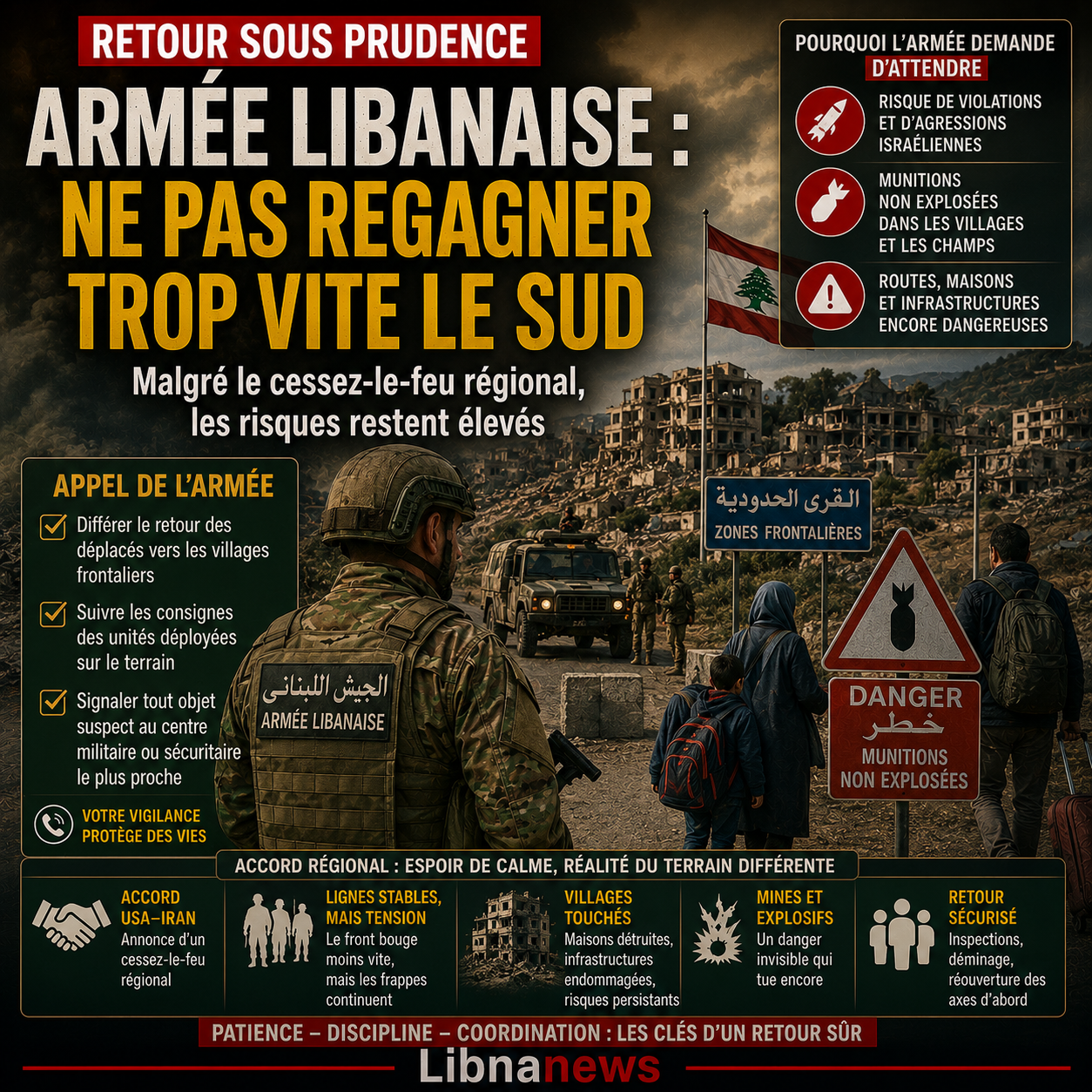
The Lebanese army calls on the people of the South not to return too quickly to the border villages, despite information about a regional ceasefire. The communiqué highlights two immediate risks: Israeli violations and unexploded ordnance. In a still unstable region, the return of internally displaced persons now depends on military instructions, field inspections and the real evolution of the agreement announced between Washington and Tehran.
The Lebanese Army is stopping returns
The Lebanese Army called on the displaced inhabitants of the South to postpone their return to border villages and localities, despite reports of a ceasefire in the region. The mid-day communiqué issued by the Directorate of Orientation placed civilian safety first. He asked the families to follow the instructions of the units deployed on the ground and not to give in to the emergency of return. This warning comes as the announced agreement between the United States and Iran feeds the hope of a de-escalation, but does not dispel the immediate risks in the bombed areas.
The warning of the Lebanese army responds to a very concrete situation. Southern roads are not all safe. Some houses have been affected. Fields, gardens, school approaches or secondary roads may contain explosive remnants. The military authorities also mention the danger of Israeli violations and attacks. The message therefore aims to curb spontaneous returns, which could multiply after the announcement of a regional agreement presented as a possible cessation of military operations on several fronts, including Lebanon.
The communiqué does not dispute the political importance of the diplomatic sequence. It only recalls that an announced ceasefire does not immediately create the material conditions for a return. Between the declaration of an agreement, its implementation, monitoring and effects on the ground, several steps remain necessary. This distinction is essential for the inhabitants of border villages. Their security depends less on diplomatic formulas than on the real situation in the streets, houses, orchards and points still exposed to fire, drones or incursions.
The tone of the press release remains sober. The army doesn’t dramatize. Nor does it give a normalization signal. It requires patience, discipline and vigilance. This line reflects a difficult responsibility. Lebanese institutions must accompany the hope of a calming without encouraging dangerous travel. They must also preserve the confidence of families, often exhausted by weeks of bombing, displacement and waiting, while every rumor of calm can trigger a massive movement towards the South.
South Lebanon: The danger of unexploded ordnance
The most immediate risk comes from unexploded ordnance. The army asks civilians to report suspicious objects to the nearest military or security centre. This instruction is not secondary. After repeated bombardments, projectiles can remain active in houses, courtyards, olive groves or rural roads. Children can confuse them with ordinary debris. Farmers can discover them by inspecting their land. A quick return, not framed, increases the risk of serious accidents.
These dangers prolong the war after the silence of the weapons. Although the strikes stopped, the territory remained marked by explosives, unstable buildings and damaged infrastructure. Families returning may be without water, electricity, access to care and sufficient administrative presence. In several villages in the South, damage assessment takes time. Army units must secure the axes, identify areas at risk and coordinate alerts with security forces and local authorities.
The caution requested by the Lebanese army also has a military dimension. The communiqué explicitly refers to the risk of Israeli violations and attacks. This means that the institution does not regard calm as acquired. Israel has already stated that it will not withdraw its forces from positions it deems necessary for its security. Israeli officials have also defended the maintenance of freedom of action against Hezbollah. This position creates a major gap with the Lebanese and Iranian reading of the agreement, which includes the cessation of operations in Lebanon.
South Lebanon thus becomes the first test of the regional agreement. On paper, a cessation of hostilities must reduce pressure on civilians. On the ground, residents can only return if the axes are open, if the bombings really stop and if the border areas do not remain under direct threat. The Army communiqué is part of this gap between the announcement and execution. It recalls that sovereignty is measured not only in the texts, but also in the capacity to protect the inhabitants.
A massive return would complicate security
This line of caution also protects deployed units. A massive and disorderly return would complicate their work. At the same time, soldiers should manage traffic, alerts, complaints, suspicious device discoveries and possible military incidents. In partially destroyed villages, the presence of civilians makes security operations more complex. It limits the scope for patrolling and may expose families to areas that have not yet been inspected.
Municipalities in the South often share this concern. They know the pressure of the inhabitants, who want to check their house, collect documents, feed animals or resume farming. But they also know that the return must be organized. Mayors and local councils must have accurate information on roads, damaged neighbourhoods and areas still prohibited. Without coordination with the army, each individual move can create a collective risk.
The humanitarian dimension remains central. Displaced persons do not live only an abstract expectation. They face the cost of short-term housing, the loss of income, the disruption of children’s schooling and the fatigue of foster families. Many want to come home from the first positive announcement. This reaction is understandable. But it can become dangerous if it precedes the military and technical assessment of the affected areas. The military communiqué seeks to curb this impulse without denying the suffering of the displaced.
The issue of unexploded ordnance requires a simple pedagogy. Don’t touch an unknown object. Don’t move it. We mustn’t photograph him closely. Children should not be allowed to play in rubble or fields before inspection. It is necessary to move away, mentally mark the location and alert the competent authorities. These actions can avoid death and injury in the first days of a return, when vigilance declines because the fighting seems to have stopped.
The regional agreement is not enough yet
The Lebanese army must also deal with a limited institutional environment. Lebanon is facing an economic crisis that has weakened government administration, public services and reconstruction capacities. Securing dozens of affected communities requires resources, fuel, specialized teams, reliable communications and coordination with humanitarian agencies. The call to patience therefore also reflects an operational constraint. Return cannot be decreed. It must be prepared, village by village, sometimes street by street.
The announcement of an agreement between Washington and Tehran nevertheless changes the political climate. It gives the Lebanese authorities an argument to demand the cessation of Israeli attacks and the protection of civilians. Nabih Berri welcomed the inclusion of a binding clause to end the aggression against Lebanon. This reading reinforces the official demand for sovereignty. But it does not cancel military prudence. Even when a diplomatic framework is favourable, the army must check what is happening on the contact line.
The Israeli position maintains uncertainty. The refusal to withdraw announced by Israeli officials means that border areas can remain prohibited or dangerous. Residents may encounter dams, cut roads or observational areas. Overflights, warning shots or targeted strikes remain possible scenarios if the Israeli army believes a threat exists. In these circumstances, the return cannot only keep pace with political announcements.
The army’s appeal is also addressed to the media and social networks. In times of uncertain cease-fire, the information circulates quickly. Unchecked messages can announce the opening of a road, the withdrawal of a force or the safety of a village. These rumours can cause dangerous displacement. By asking to follow the instructions of the military units, the army seeks to impose a single reference source on the ground. This informational discipline becomes a component of civil protection.
Instructions to adapt village by village
The role of UNIFIL and international actors could become more important in the coming days. If the cease-fire is confirmed, the monitoring of violations, humanitarian access and security of returns will need to be coordinated. Lebanon will need technical support for mine clearance, identification of explosive remnants and infrastructure assessment. But this aid will not replace the primary responsibility of the Lebanese authorities. The Army communiqué recalls that law and order begins with respect for local orders.
For the inhabitants, the practical question is simple: when to go home and how to get home. The answer cannot be uniform. Some locations may be less exposed. Others remain close to military positions or bombed areas. Main roads can be cleared while agricultural roads remain dangerous. Houses may seem intact but contain unstable debris or ammunition. The army must therefore transmit differentiated instructions, adapted to the reality of each sector.
This method requires regular communication. A single press release will not be enough if the situation changes rapidly. Residents will need clear announcements about accessible villages, recommended schedules, prohibited areas and procedures for suspicious discovery. Local authorities will have to relay this information without changing it. The media will have to avoid headlines that give the impression of an authorized general return while the army is calling precisely for restraint.
Caution does not prevent the preparation of return. On the contrary, it is the first step. Families can collect their documents, contact their municipality, follow official channels and wait for instructions from the army. Farmers can prepare an inventory of needs, but they should not engage on uninspected land alone. Owners can report damage by planned lanes without going to damaged buildings before authorization.
The Lebanese Army facing a grey phase
The political timetable reinforces this requirement. The formal signing of the announced protocol still needs to specify the modalities of application, guarantees and monitoring mechanisms. Until these elements are known, the Lebanese authorities must manage an interim phase. She is often the most dangerous. Fighters can test the limits of calm. Civilians can believe the war is over. The administrations must act without all diplomatic guarantees. The army’s call comes exactly in this grey zone.
This caution also concerns relief. Ambulances, municipal teams, electricity technicians and telecom operators will have to access the affected areas before a massive return. Their work restores essential services, identifies threatening buildings and secures assembly points. If the inhabitants return before these teams, they can find themselves isolated, without a network, without water and without rapid evacuation capacity in case of renewed fire. A safe return therefore begins with the passage of technical services, not with the influx of families.
The military communiqué is finally national in scope. It recalls that the southern border is not confined to the inhabitants concerned. It urges the entire Lebanese State, its credibility and its ability to impose a minimum order in a transitional period. In a country where distrust of institutions remains strong, clarity of instructions becomes a political issue. A prescribed instruction can avoid accidents. An ignored instruction can fuel a new crisis.
The issue goes beyond individual security. A poorly organized return can complicate the political stabilization of the South. If civilians are injured by explosive remnants or affected by a violation, public anger will increase. If families find themselves trapped in unserviced villages, the authorities will be charged with unpreparedness. If rumours replace official instructions, confidence in the state will deteriorate further. The army is therefore trying to prevent a secondary crisis, which could immediately follow the military crisis.
Finally, the directional management statement sets out a line of responsibility. The announced ceasefire is not yet a live guarantee. Border villages are not yet ordinary spaces. Displaced families are not invited to renounce their return, but to put them in a secure schedule. The next indicator will be patrols, inspections, reopened roads and early reports of suspicious vehicles handled by specialized units.