





The announcement of an agreement between the United States and Iran triggered a wave of cautious international reactions. Western capitals, Arab countries and multilateral organizations see this as an opportunity for de-escalation, without ignoring the shadows of the text. Lebanon concentrates a large part of the questions. Several actors welcome the inclusion of the Lebanese front in the ceasefire, but Israel already refuses any reading that would limit its military action against Hezbollah.
A favourable European reaction, but framed
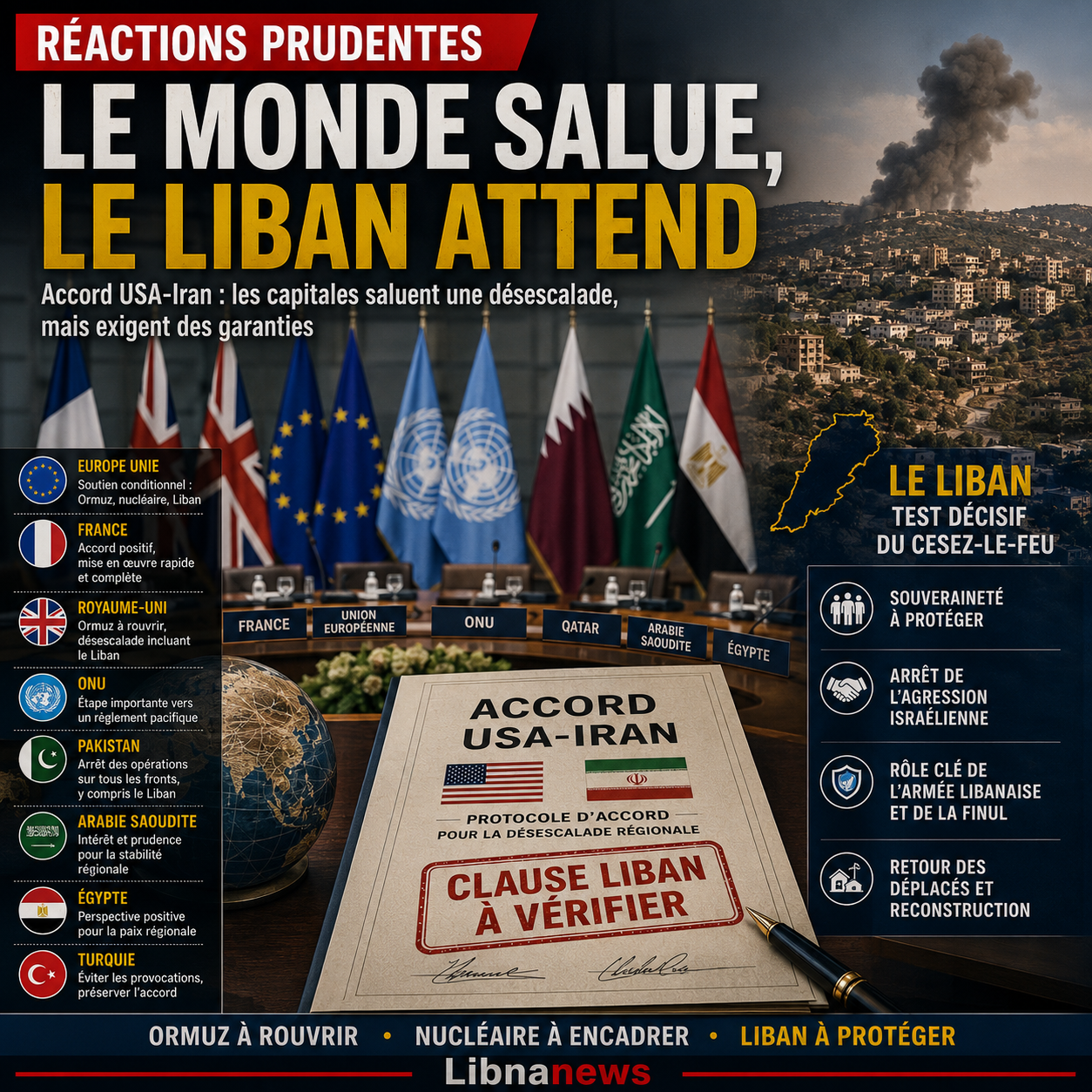
The first European reaction was collective. The United Kingdom, France, Germany and Italy welcomed the Memorandum of Understanding. The four countries discussed a moment of opportunity to restore regional stability and stabilize the world economy. They did, however, frame their support with three requirements. The Strait of Ormuz must reopen unconditionally. Iran must not obtain nuclear weapons. Lebanon ‘ s sovereignty must be protected by a robust ceasefire.
This triptych sums up the Western approach. Europeans do not reject the outstretched hand between Washington and Tehran. On the contrary, they want to associate. But they refuse too fast normalization, which would leave aside Iran’s nuclear programme, maritime safeguards and the Lebanese file. Their support therefore remains real, but conditional. It aims to transform a political announcement into a verifiable process, while the final text has not yet been made public in all its details.
USA-Iran agreement: Paris links Ormuz and Lebanon
France has chosen a balance line. Paris welcomed the agreement as the result of a diplomatic effort to which several mediators contributed. Emmanuel Macron insisted on the rapid and complete implementation of the text. It also linked the agreement to freedom of navigation in the Strait of Ormuz, which France considers essential for energy security and global trade. This maritime priority does not erase Lebanon. It adds to him in the same regional security reading.
For Paris, Lebanon remains a separate issue, but it can no longer be isolated from the Iranian-American confrontation. French diplomacy has for months supported Lebanese sovereignty, the role of the State and the need to prevent a complete collapse of the South. The inclusion of Lebanon in the agreement therefore gives France a new lever. It may call for the cessation of hostilities, while continuing to refuse the instrumentalization of Lebanese territory by regional actors.
London insists on de-escalation in the North
The United Kingdom takes a very close position. London stresses first the reopening of the Strait of Ormuz and the safety of commercial navigation. The UK Government sees the agreement as a way to reduce global economic risk, including energy prices, maritime insurance and supply chains. But it also recalls that de-escalation must include Lebanon. A prolonged war in southern Lebanon could cause the new diplomatic sequence to fail.
The British position is also marked by a more direct criticism of the Israeli escalation in Lebanon. Prior to the announcement of the protocol, the British chief of diplomacy had described some Israeli operations as dangerous and disproportionate. This assessment gives particular weight to the London reaction. The United Kingdom is not merely celebrating peace between Washington and Tehran. He requested that Lebanese security should not be sacrificed in the name of a limited arrangement in the Gulf.
The European Union wants a verifiable framework
The European Union is expanding the framework further. The President of the European Commission stressed the rapid implementation of the agreement and freedom of navigation. Brussels sees the protocol as a gateway to broader negotiations on peace and security in the Middle East. The European logic is clear: the agreement is only valid if it simultaneously reduces military, economic and humanitarian risks. Lebanon is entering this equation through the stability of its borders and the protection of its civilians.
The EU also has an institutional concern. It supports the Lebanese State, the Lebanese Army and the United Nations Interim Force in Lebanon. It fears that the maintenance of Israeli military zones in southern Lebanon will weaken any State authority. She also fears that Hezbollah will use uncertainty to preserve its positions. Brussels therefore prefers a controlled, verifiable and compatible ceasefire with Lebanese sovereignty. This line seeks to avoid two impasses: a lasting Israeli occupation and a return to the armed status quo.
Berlin and Rome add the weight of UNIFIL
Germany and Italy have each strengthened this reading in their own way. Berlin welcomed a breakthrough capable of reviving the world economy and opening a safer phase in the Middle East. Rome thanked the mediators, including Qatar and Pakistan, and expressed its readiness to support an international naval arrangement in the Strait of Ormuz. Italy also recalled the need for a cessation of hostilities in Lebanon, where it had an old commitment through UNIFIL.
This Italian precision is not secondary. Italy remains one of the European countries most directly involved in the stability of southern Lebanon. His presence in the UN mission gives him a field reading. For Rome, the US-Iran agreement must therefore protect maritime routes, but also reduce military pressure around Lebanese villages. If the strikes continue, the credibility of the international mission and the security of foreign contingents will be immediately tested.
UN welcomes step towards settlement
The United Nations welcomed the agreement as an important step towards a peaceful settlement. The Secretary-General sees this as a chance for an immediate and permanent ceasefire, as well as a framework for further negotiations. This reaction is in line with the usual United Nations policy of supporting any de-escalation, recalling international law and calling for the protection of civilians. For Lebanon, the United Nations message means that the Lebanese clause must be applied within a framework that respects sovereignty and international obligations.
Pakistan gives Lebanon a central place
Pakistan occupies a separate place. Prime Minister Shehbaz Sharif was the first to announce the agreement. He claimed that Washington and Tehran had agreed to the immediate and permanent cessation of military operations on all fronts, including in Lebanon. This formulation gives the Lebanese file a central reach. Islamabad does not present Lebanon as an annex point, but as one of the areas where peace must produce concrete results.
Pakistan’s role is changing the perception of the agreement in the Arab and Muslim world. He gave Tehran a diplomatic exit less dependent on Washington. It also allows the United States to go through a mediator capable of speaking to several regional actors. For Beirut, this mediation has a direct effect. It makes it more difficult for an American reading to forget Lebanon, since the mediator explicitly included this front in his initial announcement.
Qatar, Saudi Arabia, Egypt: Arab prudence
Qatar is also cited as a key player in mediation. Doha welcomed the agreement as a step towards peace and regional dialogue. His diplomacy emphasizes de-escalation, indirect channels and the ability to speak to opposing parties. In the Lebanese case, Qatar can play a useful role if discussions are to clarify the implementation of the ceasefire, security guarantees and reconstruction assistance.
Saudi Arabia observes the agreement with interest and caution. Riyadh wants to avoid a long war between Iran and the United States, because such a war directly threatens the security of the Gulf, the oil roads and the economic plans of the kingdom. A stabilization of the Strait of Ormuz therefore serves its interests. But Lebanon remains a sensitive issue for Saudi Arabia. Riyadh supports the strengthening of the Lebanese state and refuses that the country remains dominated by confrontation between Israel, Iran and Hezbollah.
Egypt also welcomed the prospect of an agreement. Cairo sees it as an opportunity to strengthen regional stability and reduce the risk of the conflict spreading. His reading includes Lebanon, but it does not limit it. Egypt follows at the same time Gaza, the Red Sea, the Gulf and energy security. It therefore supports a global de-escalation, provided that local fronts are not left without a control mechanism.
Ankara warns about the risks of sabotage
Turkey welcomed the agreement as an important development for regional peace. Ankara stressed the need to avoid provocations before the formal signing of the text. This warning is aimed at all actors able to torpedo the arrangement. It also concerns Lebanon. An Israeli strike, Hezbollah response or border incident could provide a pretext for those who refuse to de-escalate. Turkey therefore calls for political and military discipline during the transitional period.
Japan and Australia have brought reactions more distant from the Lebanese theatre, but useful for understanding the global scope of the agreement. Tokyo insists on the security of the Strait of Ormuz, on which a significant part of its energy supply depends. Canberra welcomes the possibility of de-escalation and explicitly mentions the impact of the war in Lebanon. These reactions show that the Lebanese front is no longer a local issue. It influences the global reading of regional risk.
Economic relaxation, but not yet strategic
Markets responded quickly. Oil prices declined after the announcement, while Asian and European stock markets welcomed the prospect of a resumption of flows in the Strait of Ormuz. This financial relaxation, however, does not guarantee peace. It reflects an expectation. Investors bet on the drop in geopolitical risk. But this expectation can turn if Lebanon remains an active theatre or if Israel maintains its operations despite the announced clause.
Lebanon, a fragile link in the agreement
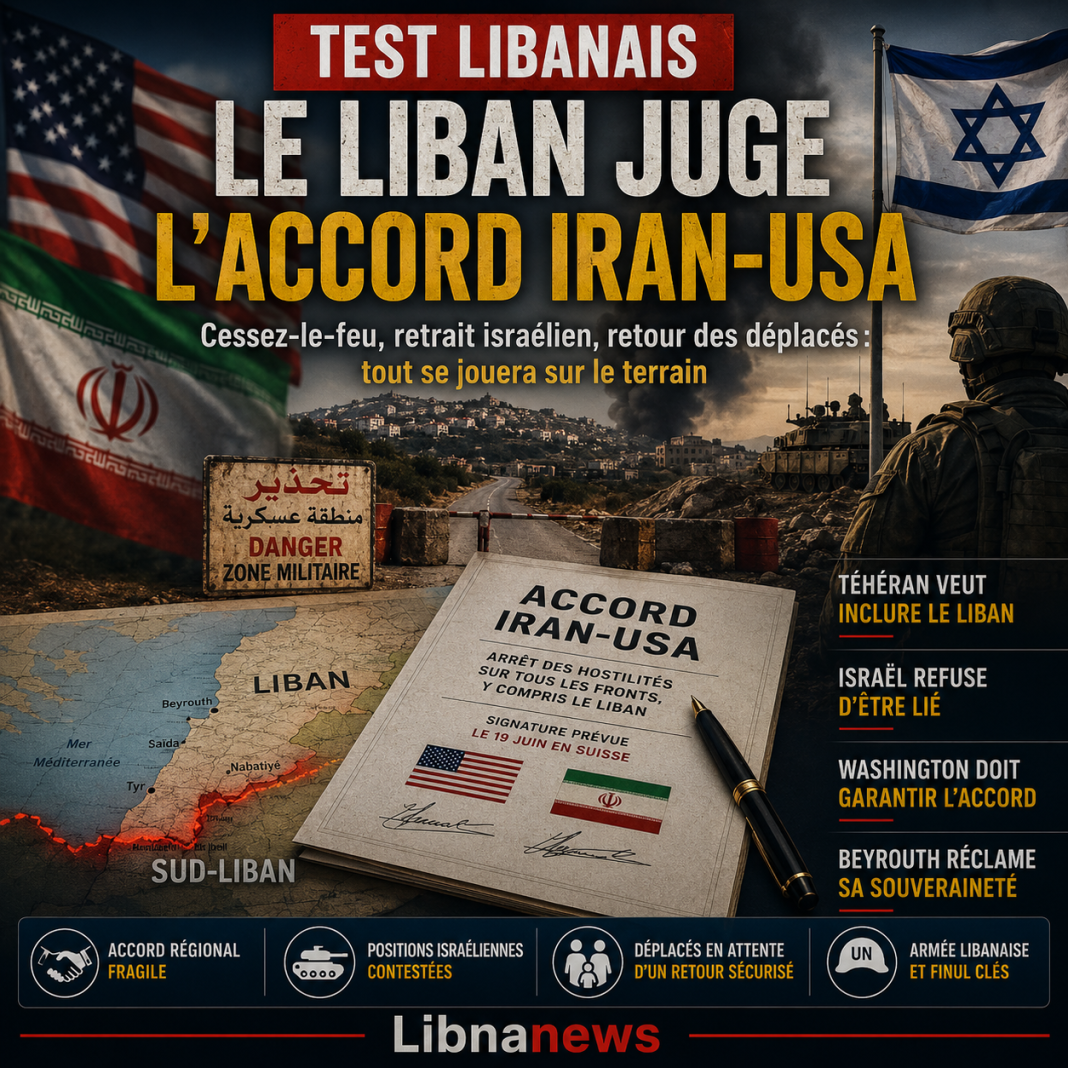
Lebanon therefore appears to be the most fragile link in the agreement. The mediators claim that the ceasefire applies to all fronts. Tehran confirms that Lebanon is part of the whole. Lebanese officials, including Nabih Berri, thank the signatories for including a binding clause to end the Israeli aggression. But Israel is already challenging this interpretation. Its Minister of Defence refuses to withdraw from the occupied areas in southern Lebanon and claims to maintain freedom of military action.
This divergence threatens implementation. European and Arab capitals can support the agreement, but they do not all have the same levers on Israel, Iran and Hezbollah. Washington remains the central actor, as Israel relies heavily on its military and diplomatic support. If the US administration wants to defend the credibility of the protocol, it will have to specify whether the Lebanese clause is binding on its Israeli ally or only on the parties officially signatories.
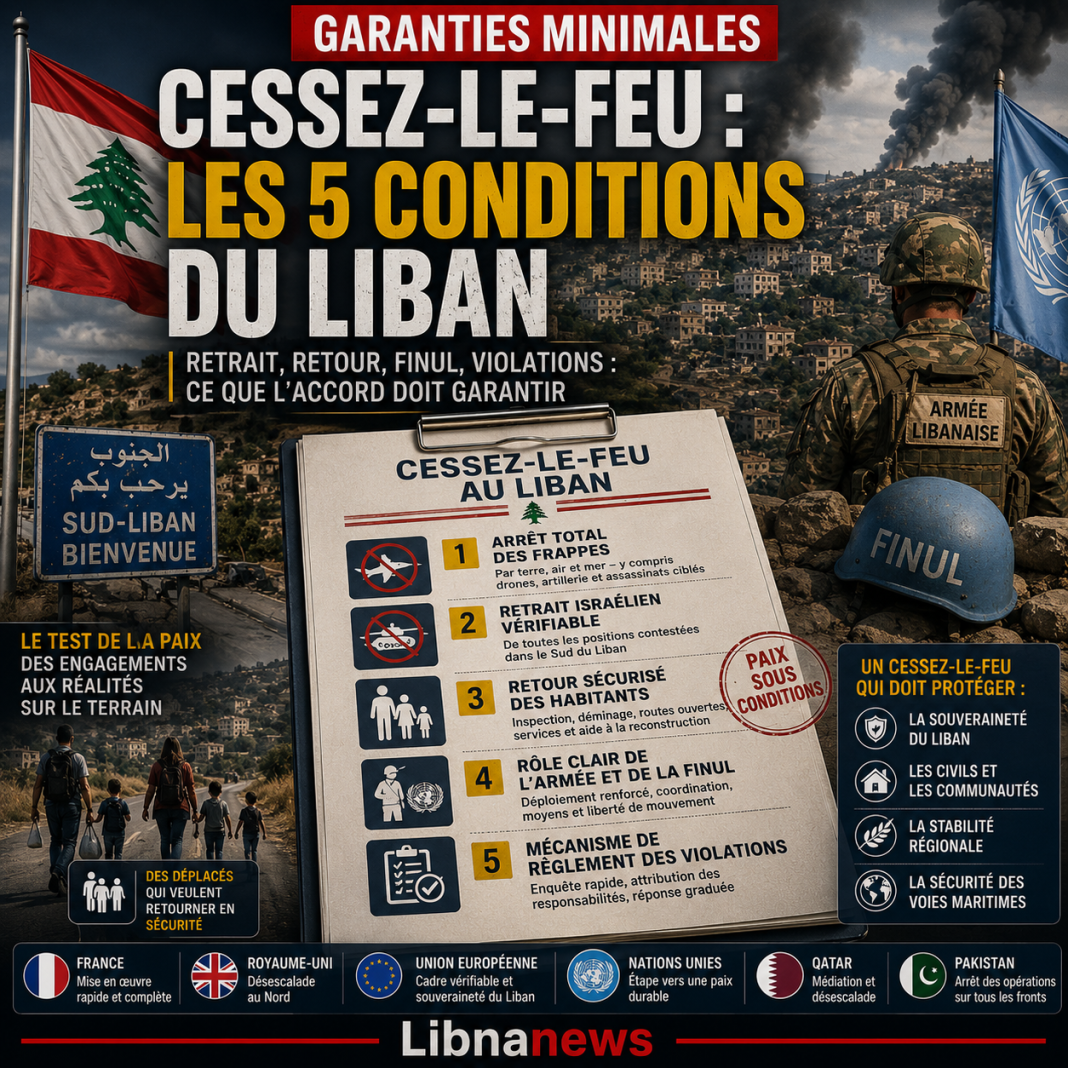
The Lebanese authorities face an opportunity and a risk. The opportunity is to internationalize the demand for Israeli withdrawal and cessation of strikes. The risk is that Lebanon will become a mere subject of negotiation between Washington, Tehran and Tel Aviv. International reactions widely recognize Lebanese sovereignty. But this recognition must be translated into a timetable, monitoring and safeguards. Without this, the displaced inhabitants of the South will remain uncertain.
The caution of Southern municipalities illustrates this discrepancy. After the announcement of the agreement, several local councils asked the displaced not to return too quickly. This attitude shows that diplomacy is not enough to create security. The locals want to know whether the roads are safe, whether the houses are still standing, whether the strikes have really stopped and whether the Israeli army will retreat. The international response will be judged on these concrete responses.
In the immediate future, the global consensus is based on a simple formula: to welcome the agreement, to demand its rapid implementation, to reopen Ormuz, to continue nuclear discussions and to protect Lebanon. This convergence is important, but it remains fragile. Each capital plans its priorities. Europeans talk about navigation, nuclear power and Lebanese sovereignty. The Arab countries speak of regional stability and de-escalation. The UN speaks of international law. Lebanon speaks of stopping aggression. Israel speaks of freedom of action.
The budgetary question will follow soon. If the cease-fire holds, Beirut will demand assistance for infrastructure, roads, electricity networks and destroyed housing. Chanceries favouring the agreement will then have to move from political support to funding. This will depend on security, but also on the Lebanese reforms expected by donors. A regional agreement can open a door. It does not replace an administration capable of identifying damage, coordinating aid and reassuring the inhabitants.
The signature announced in Switzerland must therefore clarify what international reactions still leave open. Future discussions will need to clarify the scope of the Lebanese clause, the role of mediators, the place of UNIFIL, United States safeguards and verification mechanisms. International support exists. It is wide, but not yet operational. The first test will not take place in diplomatic communiqués. It will take place in southern Lebanon, in Israeli positions, in destroyed villages and on the roads used by the displaced.