





The US-Iran deal announced on the night of Sunday to Monday puts Lebanon back at the center of a regional bargaining which no actor yet controls all the effects. Presented in Washington as a diplomatic success, described in Tehran as a recognition of several Iranian demands, the memorandum of understanding must end hostilities on all fronts, reopen the Strait of Ormuz and open a second sixty-day round of negotiations. However, its full text has not been published. This absence already feeds on competing readings, particularly on Lebanon, where Israel has been claiming for months a freedom of military action that Iran, Hezbollah and some of the mediators say they refuse.
An announcement accelerated by the Israeli raid on Beirut
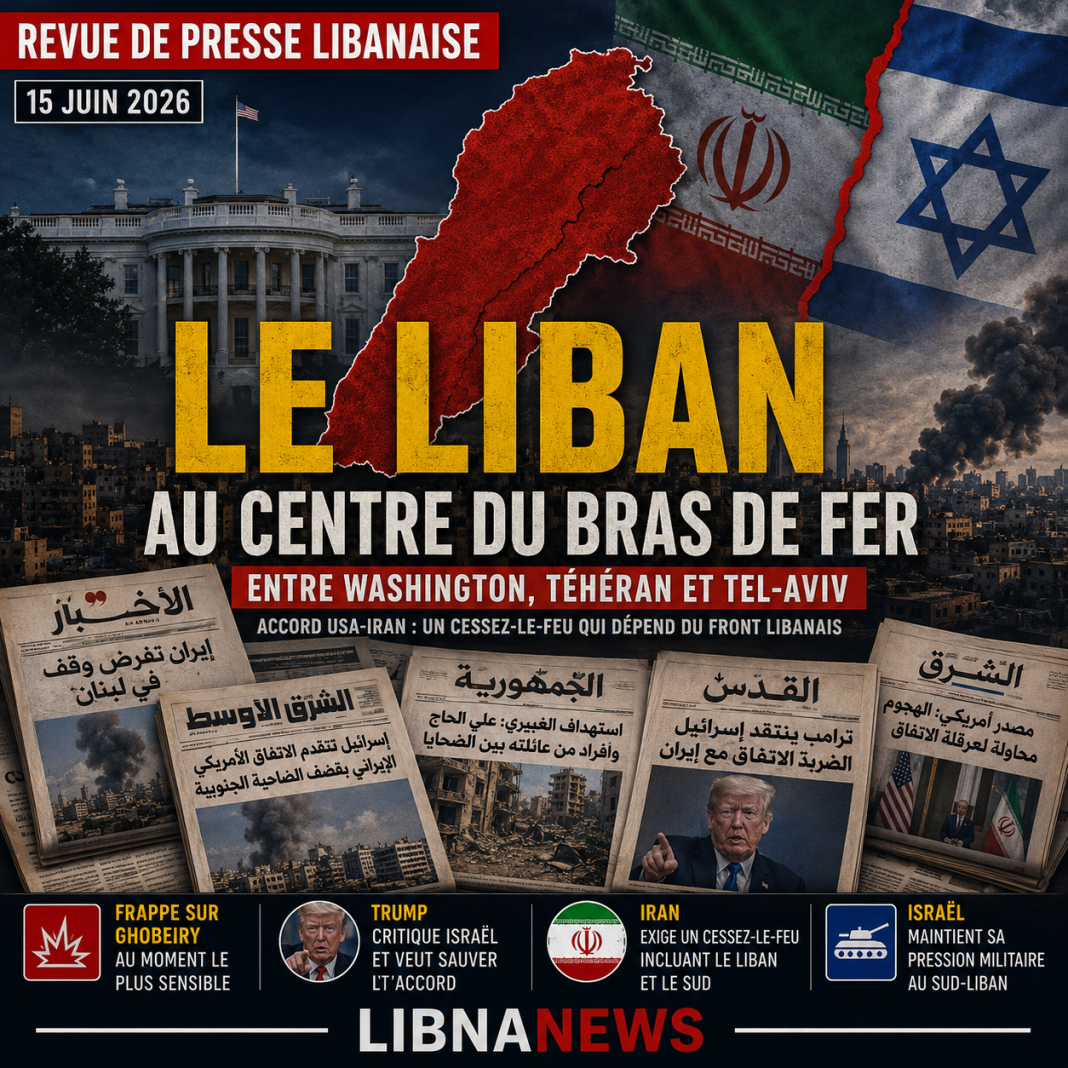
Chronology weighs heavily in the interpretation of the US-Iran agreement. On Sunday, 14 June, Israel struck the southern suburbs of Beirut, in the Ghobeiry area, as Washington, Tehran and the mediators sought to lock the last terms of the protocol. The first available information indicates a targeted building in a dense area, close to an axis leading to Rafic Hariri International Airport. The reports from the press and Lebanese sources indicate at least three deaths and several injuries. Israel claimed to be targeting Hezbollah positions in response to gunfire or attacks from Lebanon.
This raid almost derailed the diplomatic sequence. Tehran accused Washington of not being able, or unwilling, to detain Israel. Iranian officials suggested that a response was still possible. At the same time, Donald Trump publicly criticized the Israeli operation’s schedule. The U.S. president did not only dispute the military opportunity of the raid. He mostly denounced a strike carried out a few hours after an agreement which he wanted to present as imminent. This reaction showed that the Lebanese file was not peripheral. It was one of the most sensitive tests of compromise.
USA-Iran agreement: what is confirmed
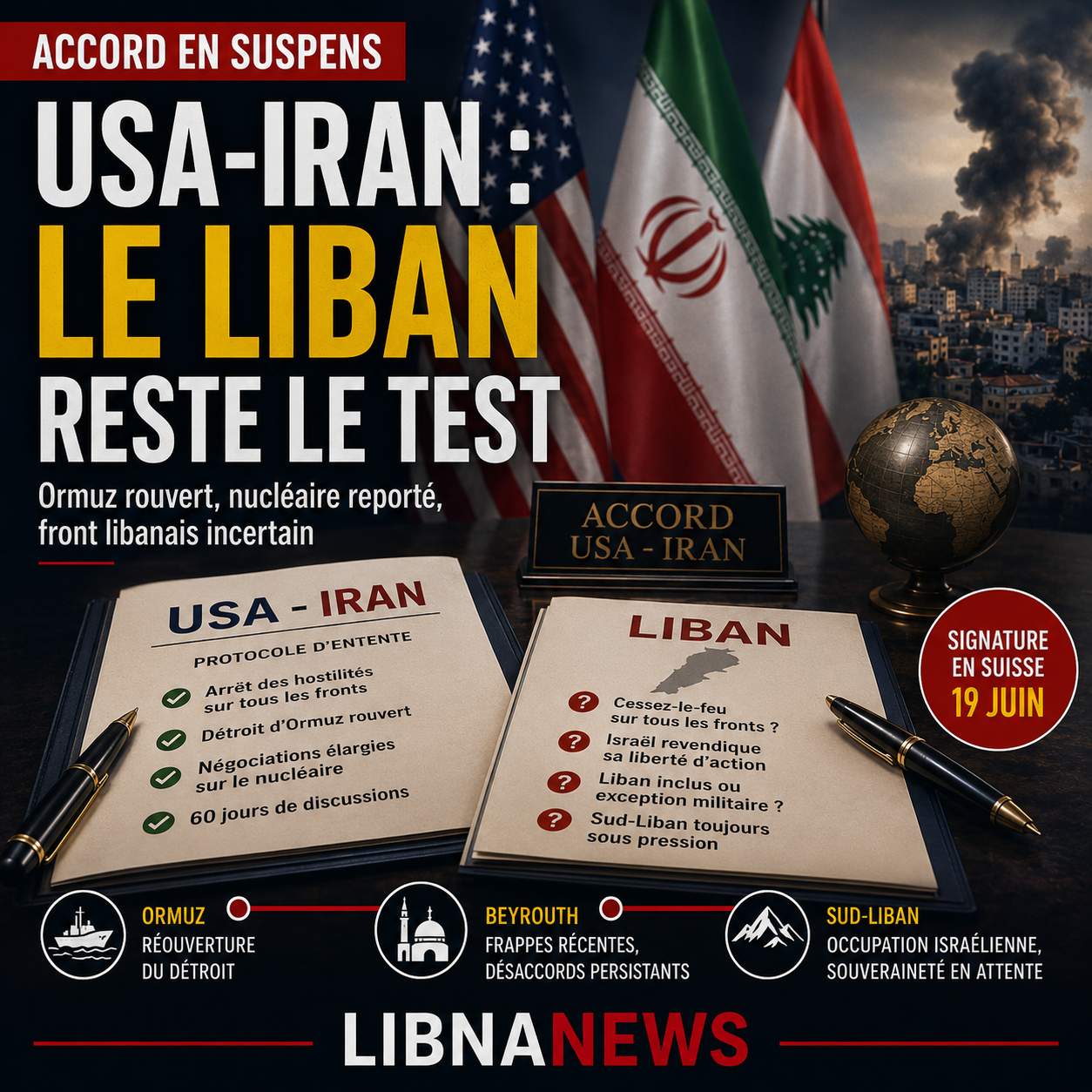
The confirmed elements draw a framework agreement, more than a final treaty. The memorandum is to be signed in Switzerland on Friday, 19 June, following an announcement by the Prime Minister of Pakistan, whose country played a mediation role. Washington and Tehran then confirmed the existence of the compromise. The core of the text is threefold: the cessation of military operations, the reopening of the Strait of Ormuz and the launching of broader nuclear negotiations, sanctions and regional safeguards.
According to Iranian and Pakistani reading, the cessation of operations concerns all fronts, including Lebanon. The secretariat of the Iranian Supreme National Security Council has indicated that war and military operations must cease permanently from Monday evening. This formulation is of direct relevance to Beirut, as it links the fate of the Lebanese front to the agreement between Washington and Tehran. It also aims to prevent Israel from considering Lebanon as an operational exception.
American reading seems more cautious. Donald Trump highlighted above all the end of the US naval blockade against Iranian ports and the reopening of Ormuz. He presented the agreement as completed and called for the oil to circulate. US officials also insist on further negotiations on Iran’s nuclear programme. They argue that the process should prevent Iran from acquiring nuclear weapons. But at this stage, Washington does not seem to have publicly detailed the precise mechanism that would impose this result.
American concessions at the heart of the debate
The question of American concessions is central. A version of the draft, reported by a news agency based on statements by an Iranian official, mentions several substantial measures. The United States would agree not to impose new sanctions before the final agreement. They would pave the way for exemptions from oil sanctions, allowing Tehran to sell crude oil and collect revenue. They would also accept the release of approximately $25 billion of Iranian assets frozen through various financial mechanisms.
The same draft refers to the gradual lifting of US and UN sanctions after a final agreement. It also provides for a reconstruction and development plan for Iran, prepared by Washington with regional allies, and then discussed with Tehran within sixty days. These provisions, if confirmed in the signed text, would represent significant economic gains for the Islamic Republic. They explain the criticisms of those who believe that Iran would have obtained a significant counterpart after blocking Ormuz and placing a direct risk on the world economy.
The White House presents the whole as a de-escalation agreement and not as a capitulation. It highlights the end of a costly conflict, the fall in oil prices and the opening of a diplomatic nuclear channel. His critics replied that Washington had agreed to return to a status quo close to the pre-war status quo, without immediate guarantee of nuclear dismantling. The argument is politically explosive in the United States, where rising energy prices had increased pressure on Donald Trump and the Republican camp.
Nuclear back to later
On nuclear, the US-Iran agreement remains voluntarily incomplete. According to the Iranian version of the project, Tehran would undertake not to produce or acquire nuclear weapons. Iran would maintain the current status of its programme during the interim period. It would refrain from increasing uranium enrichment and expanding its facilities. The stock of highly enriched uranium would be discussed in the final agreement. Tehran would defend a dilution on its soil, under control to be defined.
The American version is more ambitious in its stated objectives. American officials say they want to end with the dismantling of Iran’s military nuclear programme and the destruction or evacuation of the most sensitive stocks. This difference in vocabulary is not secondary. For Washington, the agreement must be presented as a step towards a strategic neutralisation of the nuclear threat. For Tehran, it must be seen as a recognition of the right to a civil programme, framed but not humiliating.
The 60-day delay becomes the real danger zone. During this period, each party will be able to claim that it has gained time without having given in to the essentials. Israel, which did not participate in the discussions, fears this ambiguity. His Government believed that any economic relief granted to Iran before nuclear clarification would strengthen Tehran and its regional allies. This concern also feeds the Israeli will to keep hands free in Lebanon.
Lebanon, including front or separate front?
The Lebanese point concentrates the contradictions. Pakistan states that the agreement terminates military operations on all fronts, including in Lebanon. Iran uses this formula. It allows Tehran to tell its allies that it has not sacrificed Hezbollah in a bilateral compromise with Washington. It also makes it possible to impose the idea that de-escalation cannot be limited to the Gulf, nuclear and Iranian ports.
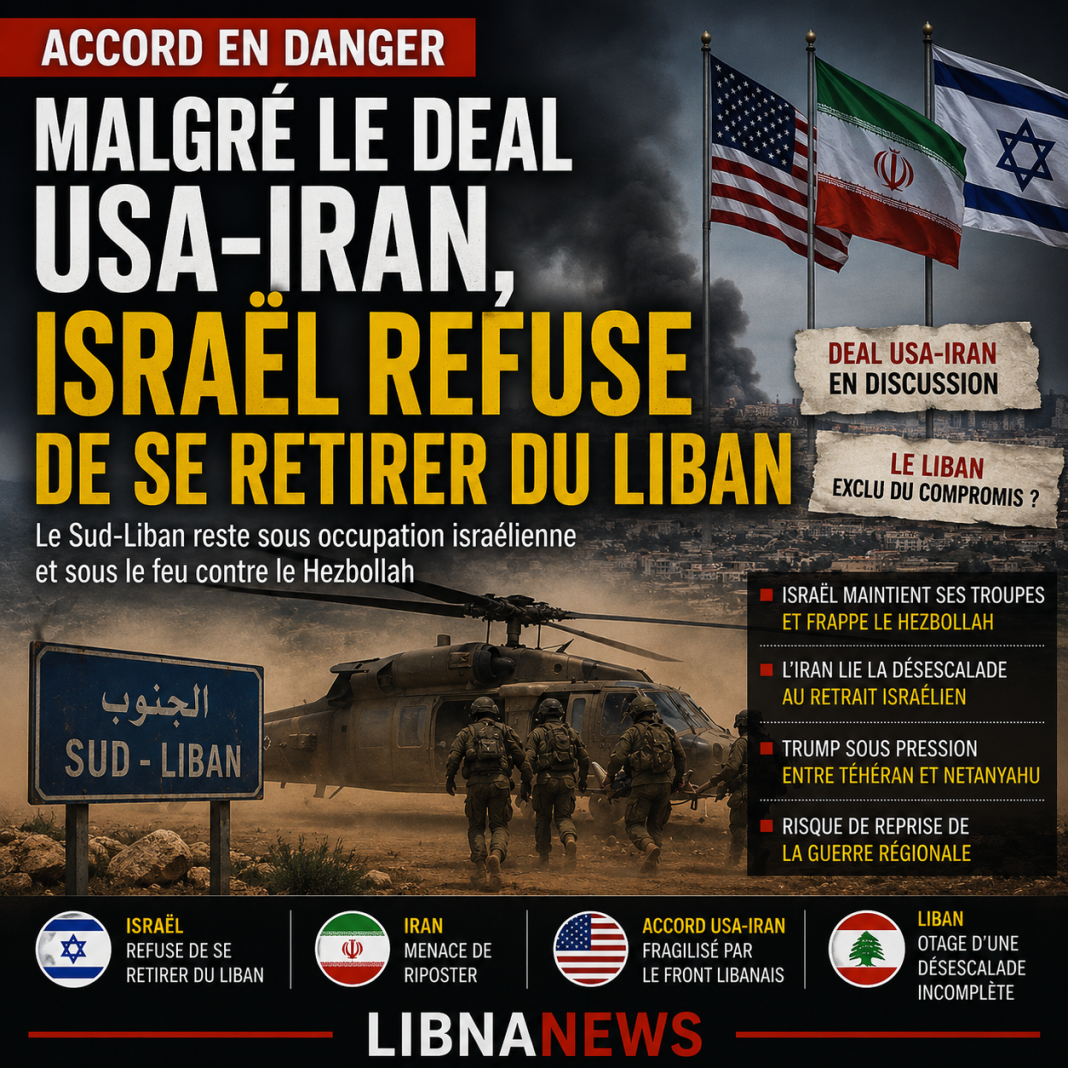
Israel stands for an opposite reading. Since the beginning of the indirect negotiations, its leaders have reiterated that they will not accept a truce that would prevent the Israeli army from striking in Lebanon. Their argument is based on the security of northern Israel and the need to reduce Hezbollah’s capabilities. With this in mind, the Lebanese front would not fall under an agreement between the United States and Iran. It is reported to be based on an Israeli-Lebanese power ratio and the armed presence of Hezbollah south of the Litani River.
This divergence creates an immediate flaw. If Lebanon is included, Washington will have to exert real pressure on Israel to limit, suspend or control its operations. If Lebanon is excluded, Iran will be able to assert that the United States has not respected the spirit of the agreement. Hezbollah may also consider that the regional truce does not protect its cadres or positions. The risk is then that of an agreement applied in the Gulf but contested on Lebanese ground.
Israel faced with unusual US constraint
The tension between Donald Trump and Benjamin Netanyahu gives this sequence a new political dimension. The US president blamed the Israeli Prime Minister for hitting Beirut at the worst moment. According to several media, he described him as a difficult partner and felt that Israel should recognize the American role in his security. These words do not mean a strategic break. Rather, they indicate that Washington refuses to let Israel set the tempo of a regional war that threatens American interests alone.
For Israel, the dilemma is narrow. Opposing Donald Trump in the face could be costly, especially if the deal lowers energy prices and calms markets. But accepting a limitation in Lebanon could be perceived, in Tel Aviv, as a retreat from Hezbollah and Iran. Israeli officials hostile to compromise are already denouncing an inadequate agreement on missiles, uranium stockpiles and Tehran regional networks.
The Ghobeiry raid is therefore signal value. It shows that Israel intends to recall its ability to act in Lebanon even before the Swiss signature. He also tests the American reaction. If Washington passes, Lebanon’s inclusion will remain theoretical. If Washington raises the tone, Israel will have to arbitrate between its military freedom and its alignment with its main ally. For Beirut, this uncertainty is a direct threat, since every diplomatic ambiguity can result in a strike or a response.
Ormuz, the other heart of compromise
The Ormuz Strait remains the lever that made the agreement urgent. This maritime route concentrates a major part of world oil and gas flows. Its partial closure, mine risks, attacks on shipping and the US naval blockade against Iranian ports have affected prices and supply chains. In announcing the reopening of the passage, Donald Trump wanted to send a message to markets as much as to regional capitals.
The project includes reopening to commercial vessels. According to the Iranian version, the American blockade would be lifted as soon as it was signed and then completely dismantled within 30 days. Washington insists on freedom of navigation and the absence of tolls. That shade counts. Tehran wants to show that it retains a role in the organization of the passage. Europeans, on the other hand, refuse any restrictions, any rights of passage imposed or any ambiguity on maritime traffic.
The French reaction follows this logic. Paris welcomed the agreement, while calling for an urgent, unconditional, unrestricted and toll-free reopening. France, together with the United Kingdom, said that it was preparing a defensive and independent maritime mission to reassure commercial traffic and participate in mine clearance. Emmanuel Macron also wants to make the Evian G7 a forum for discussion on the consequences of the compromise, support for Lebanon and Iran’s expected nuclear and ballistic safeguards.
The role of Europeans and the question of sanctions
France, the United Kingdom, Germany and Italy welcomed the memorandum, while laying a clear condition: Iran must never acquire nuclear weapons. The four countries say they are ready to work with Washington, Tehran and the International Atomic Energy Agency. They also expressed their willingness to lift certain sanctions in response to clear and verifiable measures by Iran on its nuclear programme.
This European position has two objectives. The first is to avoid a resumption of the war, whose energy impact would directly affect European economies. The second is not to let the United States and Iran define the future regional security framework alone. Europeans want to return to the game by Ormuz, by nuclear power and by Lebanon. The explicit mention of Lebanese sovereignty in the European declaration shows that Paris seeks to link regional de-escalation with the strengthening of the Lebanese State.
This approach remains fragile. Europeans do not have the military capacity to impose a ceasefire on Lebanon alone. They can accompany the maritime reopening, support the Finul, support the Lebanese army and influence the debate on sanctions. But decisive arbitration will take place between Washington, Tel Aviv and Tehran. This is where the US-Iran agreement will be judged, not in its announcement, but in its ability to change military behaviour.
For Beirut, a window and a danger
Lebanon can draw two immediate consequences from this diplomatic night. The first is that a regional ceasefire really including its territory would offer a window to the Lebanese State. Beirut could call for halting strikes, consolidating sovereignty in the South and strengthening international support for its institutions. Such a sequence would also enable the issue of occupied areas, violations of airspace and the protection of civilians to be brought back to the centre.
The second consequence is more worrying. If the agreement remains unclear, Lebanon will become the place where each camp will test the limits of the text. Israel could continue its strikes by claiming to target Hezbollah and not Iran. Hezbollah could respond by claiming that the truce was violated. Iran could reserve the right to respond, either directly or by interposed allies. Washington would then be forced to choose between defending its agreement and protecting Israeli freedom of action.
It now depends on the written terms and their guarantees. The 19 June signature will have to say whether Lebanon is covered by a robust ceasefire, or only mentioned in a political formula. It should also specify who verifies the violations, who arbitrates the incidents and what consequences apply in the event of a strike. In the immediate future, the inhabitants of Beirut and South Lebanon remain suspended from this grey zone, between the announcement of a regional peace and the reality of a still active front.