

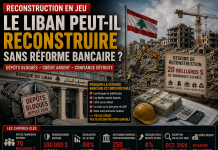
Can Lebanon rebuild without bank reform?
Lebanon can repair some emergencies without complete banking reform, but it cannot rebuild sustainably without a credible financial system. Locked deposits, lack of credit, defaulting state, FATF's grey list and donor distrust are all the same. International aid can finance targeted projects, but national reconstruction requires sound banks, a loss settlement law and a clear hierarchy of responsibilities.
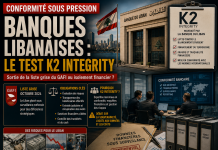
Lebanese banks: compliance under pressure
Lebanese banks have been facing increasing compliance pressure since Lebanon's inclusion in the FATF grey list. The contract between the Bank of Lebanon and K2 Integrity formally aims to strengthen the fight against money laundering, fraud and the financing of terrorism. But the case raises concerns about cost, the real role of the US firm, access to data and the risk of surveillance perceived as financial supervision.

Lebanon: already compromised tourist summer
Lebanese tourism approaches the summer with reservations in decline, hotel cancellations, deferred tickets and suspended events. The war broke a season that had to support foreign exchange, employment and consumption. The diaspora remains a base, but is more hesitant about air and security risks. Foreign visitors turn away faster. A lasting ceasefire can limit losses without ensuring a real recovery.
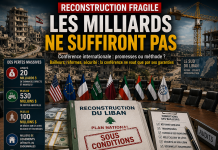
Reconstruction of Lebanon: conference or fragile promise?
The reconstruction of Lebanon will not only depend on an international conference. The needs are immense: housing, agriculture, roads, hospitals, schools, heritage and basic networks. But donors will set their conditions: banking reform, transparency, border control, security in the South and guarantees against hijacking. For Beirut, the challenge is to turn promises into methods, before reconstruction is captured by parties, parallel networks or external interests.

Exports to Arabia: economic and political test
The recovery in exports to Saudi Arabia exceeds trade. It provides an opportunity for Lebanese farmers, manufacturers and transporters, but it is above all a test of sovereignty. Riyadh wants to check that the Lebanese State can control its cargoes, fight the Captagon and prevent its infrastructure from being used by illegal networks. For Beirut, the Saudi decision opens a fragile economic, political and diplomatic window.
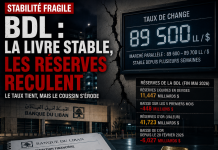
BDL: the stability of parity that should cause concern to the population
The BDL has a book stability around £89,500 for a dollar, but its liquid reserves continue to decline. At the end of May 2026, they reached $11.447 billion, down by $448 million since the beginning of the year. Gold has also fallen by more than 6 billion since 28 February. This monetary stability remains fragile without transparency, banking restructuring and debt reform.

Lebanese airports: AIB traffic is in dull and risky financial bet in Qolayaat
The traffic at Beirut airport fell sharply, with a 34.2% decrease in the number of passengers over the first five months of 2026. At the same time, the Lebanese government is relaunching the Rene Mouawad airport in Qolayat, Akkar. This decision responds to an old demand from the North, but it can also exacerbate public finances if it adds fixed costs to a shrinking air market.

Lebanese banks: deposits are falling further
Resident bank deposits fell by £2,710 billion over the week ended May 21, 2026. This contraction is mainly due to a decrease in foreign currency deposits equivalent to $45.5 million. The increase in book deposits is mainly based on overnight accounts, while savings are declining. The signal remains a concern for a banking system that has not regained the confidence of depositors.

Loss of war in Lebanon: bill explodes to $20 billion
The loss of war in Lebanon would already exceed $20 billion since 2024 and could reach $25 billion if hostilities continued. Over 61,000 dwellings were reported to have been totally or partially damaged between March and early May 2026. Reconstruction is expected to be all the more difficult as the state remains in default, the banking sector is not restructured and the international aid available remains limited to the extent of the needs.

The MEA faces the end of the monopoly
The end of the MEA monopoly marks a turning point for Lebanese aviation. Granted from the late 1960s and extended in 1992 and 2012, exclusivity protected the national company from crises and market risks. Its expiry can open the way for new Lebanese operators, at more competition and at more accessible prices. But without a strong regulator, transparency and fair access rules, opening up could create new rents instead of a modern market.
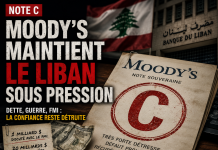
IMF, debt, war: Moody
Moodys keeps Lebanon under strong financial pressure. The Agency estimates that rapid IMF assistance of up to $1 billion would not change sovereign note C without debt restructuring or a comprehensive stabilization programme. War, the decline in tourism, massive displacement and the pressure on the balance of payments aggravate a crisis whose causes remain primarily institutional and political.

The S&P 500 and the LRB Cycle Index
The YRO Cycle Index analyses S&P 500 as an advanced financial cycle, between chance, trend and maturity. By combining liquidity, real rates, valuations and investor behaviour, it sheds light on the excess signals, the high risks and the current market position in contemporary American financial history in the long term.

René-Mouawad Airport: the test of truth from 6 June
The Lebanese authorities are relaunching René-Muawad airport in the north, but the contracts, the companies selected and the viability of the project raise public questions.
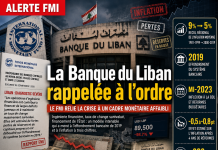
Bank of Lebanon: IMF’s severe reminder
An International Monetary Fund document on the independence of the central banks puts the Bank of Lebanon at the heart of the economic crisis. The IMF links financial engineering operations, maintaining an overvalued exchange rate, losses of reserves and the banking collapse of 2019 to an insufficiently protected monetary framework. For Lebanon, reform is not limited to a technical issue: it involves the budget, banks, governance and public transparency.



