

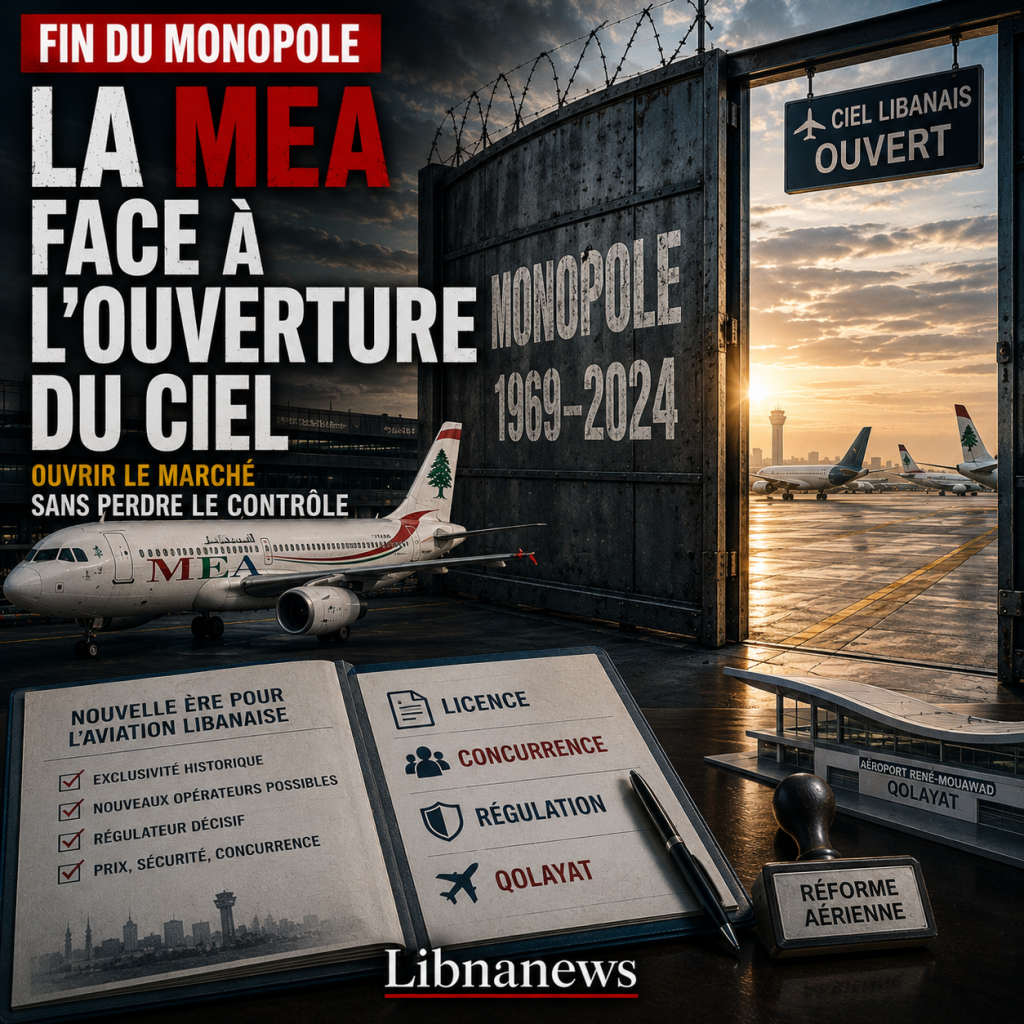
A historical exclusivity is coming to an end
The end of the MEA monopoly opens a major issue for Lebanese aviation. For more than half a century, Middle East Airlines has enjoyed exclusive rights over scheduled passenger air travel from and to Lebanon. This regime was originally justified by the need to protect a national company weakened by the war, the destruction of aircraft and the absorption of another Lebanese operator in difficulty. It was then extended several times, until it became a central element of the Lebanese air model. Its disappearance does not only mean the possible arrival of new Lebanese carriers. It obliges the state to rethink competition, regulation, prices, security, employment and the role of a historically strategic company.
The subject is sensitive because MEA is not an ordinary business. It is the national company, a symbol of continuity in a country marked by wars, financial collapse and periodic isolation. It maintained flights when other foreign companies reduced or suspended their routes. It allowed Lebanon to remain connected to its diaspora and international markets. But this strategic function does not meet all the criticisms. The monopoly also limited the emergence of competing Lebanese operators, reduced price incentives and maintained confusion between national protection, commercial rent and lack of modern regulation.
The question therefore is not whether the MEA should be defended or weakened. The real question is how to move from a protected system to an organised market. Unprepared opening can destabilize a national company that is still useful in the country. An indefinite extension of exclusivity can maintain high rates, excessive dependence and a closed market. Between these two risks, the state must build an air policy. This is precisely what has often been lacking in Lebanon: clear rules, an independent authority, a strategy of progressive competition and transparency on costs and benefits.
Why the monopoly was granted
The origin of the exclusive regime dates back to the late 1960s. After the difficulties of Lebanon International Airways and in a context of security shock, the state asked MEA to assume a national responsibility. The company absorbed obligations that exceeded strictly commercial logic. In return, the Council of Ministers granted him an exclusive right to operate scheduled air passenger transport. This protection should prevent the market from breaking up and give the national company time to consolidate.
The basis of the scheme was also associated with Decree-Law No. 28 of 5 August 1967 on civil aviation organisation and operating permits. In this context, the State retained a central role in granting air transport rights. The logic was that of a strategic sector, where competition was not seen as an end in itself. Lebanon, like many states at that time, linked its air sovereignty to the existence of a strong national carrier capable of providing regular routes, even when immediate profitability was not guaranteed.
In 1992, the Council of Ministers renewed this exclusivity for 20 years. This decision came after the civil war, in a phase of gradual reconstruction and normalization of trafficking. The country needed to restore a company capable of reconnecting, reorganizing its network and representing Lebanon in bilateral agreements. Protection could still be defended as a remedy. But it was already creating a problem: what had been presented as a transitional was becoming a sustainable pillar.
In 2012, the Council of Ministers extended exclusivity for another 12 years, starting in September 2012. This decision maintained MEA as the sole Lebanese company authorized to operate scheduled passenger transport from and to the country. The justification was based on the protection of the national company, its return to profitability, its role in the economy and the need to maintain continuity of service. But the extension also delayed market opening while the region was already experiencing an increase in low-cost companies, Gulf carriers and hybrid models.
Protection becomes an annuity
The monopoly protected the MEA. He also shaped the market. By preventing the emergence of other regular Lebanese passenger carriers, the State has concentrated national capacity in the hands of a single actor. Foreign companies continued to operate in Lebanon on the basis of bilateral rights and permits granted, but no competing Lebanese company could develop in the same regular segment. This distinction is important. The market was not completely closed to foreign flights. It was closed to direct Lebanese competition against MEA.
This architecture produced several effects. The first is the stability of the national company. The MEA was able to restructure, preserve a fleet, develop subsidiaries, maintain jobs and join an international alliance. The second is addiction. Lebanon has linked its national connectivity to a single local operator. The third is the price. In a protected market, competitive pressure on tariffs remains limited, especially in periods of high demand, such as holidays, summer, religious holidays or diaspora returns.
MEA advocates argue that tariffs do not depend solely on the monopoly. They depend on fuel, insurance, taxes, security costs, regional risks, market size and seasonality. That argument is true. Lebanon is not a simple market. Companies face a high risk. Wartimes reduce supply and increase costs. But competition remains an essential mechanism for price discipline. Without a national competitor, part of this discipline disappears.
The monopoly also delayed the debate on low-cost companies in Lebanon. Projects could have emerged, particularly to serve the diaspora, regional lines or certain secondary destinations. They were blocked by the exclusive regime. The MEA itself has considered, at times, commercial responses to low cost pressure. But when a protected operator announces its own adaptation, it is not yet competitive. This is an internal diversification. Consumers benefit fully from an open market only when they can choose between several genuinely independent operators.
What changes the end of exclusivity
The end of the monopoly does not mean that new companies will appear immediately. Creating an airline requires capital, aircraft, crew, licensing, traffic rights, insurance, maintenance contracts, reservation systems, ground assistance agreements and technical supervision. In a crisis Lebanon, these conditions are difficult to meet. Investors will look at political stability, airport security, the cost of financing, demand and the quality of the regulator before committing.
The most immediate effect is legal and political. The State can no longer simply respond to any request by the existence of an exclusive right. It must define criteria. Who can apply for a Lebanese air carrier licence? What financial guarantees are required? What level of operational security is required? How to protect passengers in the event of bankruptcy? What public service obligations can be imposed? What relationship between the new operators and Beirut airport? What place for Qolayat? These questions replace the simple logic of monopoly.
Openness can have positive effects. It can reduce certain prices, especially on the most frequent connections. It can push the MEA to improve its offer, service, schedule and rate segmentation. It can create jobs in operations, maintenance, reservation, marketing, ground assistance and ancillary services. It can also attract private capital in an area where Lebanon still has an asset: a large, mobile diaspora attached to direct links with the country.
But openness also carries risks. A market that is too small or too unstable can attract fragile operators. Poorly regulated competition can lead to a temporary price war, followed by bankruptcies and a return to concentration. Undercapitalized companies can compromise service quality or safety if the regulator is not strong. Politically linked actors can seek licenses as new rents. The end of a public or semi-public monopoly can then produce several disguised private monopolies.
The crucial role of the regulator
Market opening therefore requires an independent, funded, professional civil aviation authority capable of imposing standards. It’s the central point. Air competition only works if safety remains non-negotiable. Licences should not be distributed for political reasons. Companies must demonstrate financial strength, aircraft compliance, crew training, quality of maintenance and ability to comply with international rules. An open market without a robust regulator would be more dangerous than a framed monopoly.
This requirement takes on a particular dimension in Lebanon. The Civil Aviation Regulator recently launched a safety audit of the MEA, following concerns expressed by pilot organizations about conflict operations and incident reporting practices. The company rejected the charges and states that its operations are based on risk assessments coordinated with the authorities. But the episode recalls a reality: Lebanese aviation is observed by pilots, insurers, international partners and passengers.
Opening up to new operators will make this monitoring even more important. If the state allows several companies without strengthening the regulator, it will move the problem. It is not enough to allow competition. Equal access to slots, ground services, maintenance, catering, terminals, traffic rights and infrastructure must also be guaranteed. Much of the Lebanese air ecosystem is historically linked, directly or indirectly, to MEA and its subsidiaries. This reality will have to be addressed in order to avoid formal but effectively locked competition.
The issue of ground services is essential. A new entrant may obtain a licence but remain dependent on actors controlling assistance, maintenance or certain services at the airport. If these services are dominated by the incumbent operator or its subsidiaries, the market will not be really open. Access rules must therefore be clear, tariffed, published and monitored. The regulator should prevent discrimination, administrative delays and artificially high costs.
MEA must prepare for competition
The MEA can come out reinforced by a well-conducted opening. A protected company often ends up confusing commercial security with acquired rights. A company facing competition must better segment its rates, improve its service, optimize its costs and defend its brand. The MEA has many advantages: a long experience, a fine knowledge of the Lebanese market, a loyal clientele, experienced crews, a presence in the SkyTeam alliance and a recognized role in times of crisis. These assets do not disappear with the end of the monopoly.
But the company will have to accept a new discipline. Passengers will compare more. High prices in high season will be harder to justify if competitors offer alternatives. Low or underserved destinations may become opportunities for other operators. Business travelers, students and the diaspora will demand more flexibility. The MEA will also need to clarify its model: to remain a conventional network company, to develop a low-cost subsidiary, to strengthen premium links, or to combine several segments without blurring its identity.
Employment must be treated seriously. Monopoly advocates often invoke employee protection. That’s a legitimate argument. A sudden opening can put pressure on costs and working conditions. But maintaining a monopoly is not a sustainable social policy. An open market can create more jobs if traffic increases. It may also reduce certain internal pensions. The transition must therefore lay down rules on safety, training, qualifications, crew rights and working standards, in order to avoid competition by the least-so-called social.
The consumer must be at the centre of change. For years, Lebanese have complained about the high cost of tickets, especially during summer and holidays. The end of the monopoly can improve this situation, but it does not mechanically guarantee low prices. The price will depend on the number of operators, airport costs, fuel, demand, insurance, taxes and stability. The state must avoid promising an immediate and general decline. Rather, it will have to create the conditions for real competition, which can gradually produce gains for passengers.
Qolayat, competition and public finances
The opening of the market also comes at a time when the government is relaunching the René-Mouawad airport in Qolayat, Akkar. This project is presented as a second air gate in the country and as an instrument for the clearing of the North. It can become a competitive laboratory if new operators find lower costs, available niches and a regional customer base. But it can also become a source of loads if global traffic does not follow. The Beirut airport recorded a 34.2% decrease in the number of passengers in the first five months of 2026.
This data requires caution. Opening the market and opening a second airport in times of contraction can create opportunities, but also illusions. If new operators only move part of the existing traffic from Beirut to Qolayat, the net effect will be limited. If the State finances infrastructure, access, services and guarantees without sufficient traffic, public finances will bear a new burden. Air competition must not become a pretext for multiplying costly projects without a verifiable economic model.
Qolayat can be useful if its model is distinct. It could target regional flights, low-cost airlines, northern customers, a portion of the diaspora and targeted connections. But this model requires full transparency on the contract, state share, private investment, expected revenues and guarantees. The end of the MEA monopoly must not open up a period of distributed licences without strategy or competing platforms financed by insufficiently controlled public funds.
The link with public finances is direct. The Bank of Lebanon holds a major share of the MEA. The state, banks, depositors and the company are therefore evolving in an interlocked institutional space. Any transformation of the air sector indirectly affects public assets, jobs, revenues and political balances. A misthought opening could reduce the value of the historical operator without producing real benefit for passengers. On the contrary, a well-thought-out opening could increase traffic, boost efficiency and strengthen the country’s connectivity.
The risk of false liberalisation
The worst case scenario would be false liberalization. On paper, exclusivity ends. In fact, new entrants face administrative barriers, high access costs, unavailable slots, services dominated by the incumbent or opaque political decisions. The consumer would then see no change, while the official speech might claim that the market is open. This scenario would preserve annuities while weakening confidence in reform.
Another bad scenario would be unguarded opening. Undercapitalized operators could enter the market, offer aggressive fares, accumulate losses, and then disappear leaving passengers and employees in difficulty. Political alliances could capture licences. Conflicts of interest could shift to ground services or airport contracts. In this case, the end of the monopoly would not produce a modern market. It would produce a new clientelist fragmentation.
The right scenario requires a roadmap. The government must first clarify the legal status of the end of exclusivity. It must publish the conditions for obtaining a licence. It must strengthen the regulator. It must clearly separate the functions of operator, owner, controller and political decision-maker. It must ensure non-discriminatory access to infrastructure. It must regulate the rights of passengers. It shall also provide for continuity rules in the event of an operator’s failure.
MEA, for its part, must be treated as a strategic asset, not as an untouchable privilege. It must be protected against unfair competition, but not against competition itself. It needs to publish more information on its performance, costs, subsidiaries and strategy. It must prepare for its adaptation to a more open market. Eternal protection eventually weakens the companies it claims to defend. Competitive discipline, when well regulated, can make them more effective.
A Test Reform for the Lebanese State
The end of the MEA monopoly will be a governance test. She would say whether Lebanon could move from a model of privilege to a model of rules. She would say whether the government could protect a national interest without closing the market. She will say whether the civil aviation authority can act as an independent regulator. She will tell if new projects, including Qolayat, meet a strategy or a logic of symbols. She will finally say whether Lebanese passengers can get more choices without sacrificing safety.
The country needs more open aviation, but not improvised deregulation. It needs competition, but also a strong regulator. He needs to preserve the MEA, but not maintain an annuity. It needs Qolayat, perhaps, but only if the project relies on transparent figures. It needs more accessible prices, but without promising miracles in a market that is subject to war, insurance and weak public finances.
The moment is therefore decisive. The decline in traffic in Beirut, the security audit of the MEA, the revival of Qolayat and the expiration of exclusivity form a single sequence. Lebanese aviation can no longer operate on inherited arrangements. It must choose between extending a protection that has become contested, opening up without preparation, or finally building a regulated market. It is this third path that will determine whether the end of the monopoly becomes a useful reform or a new chapter of institutional confusion.




