

A reconstruction already out of reach
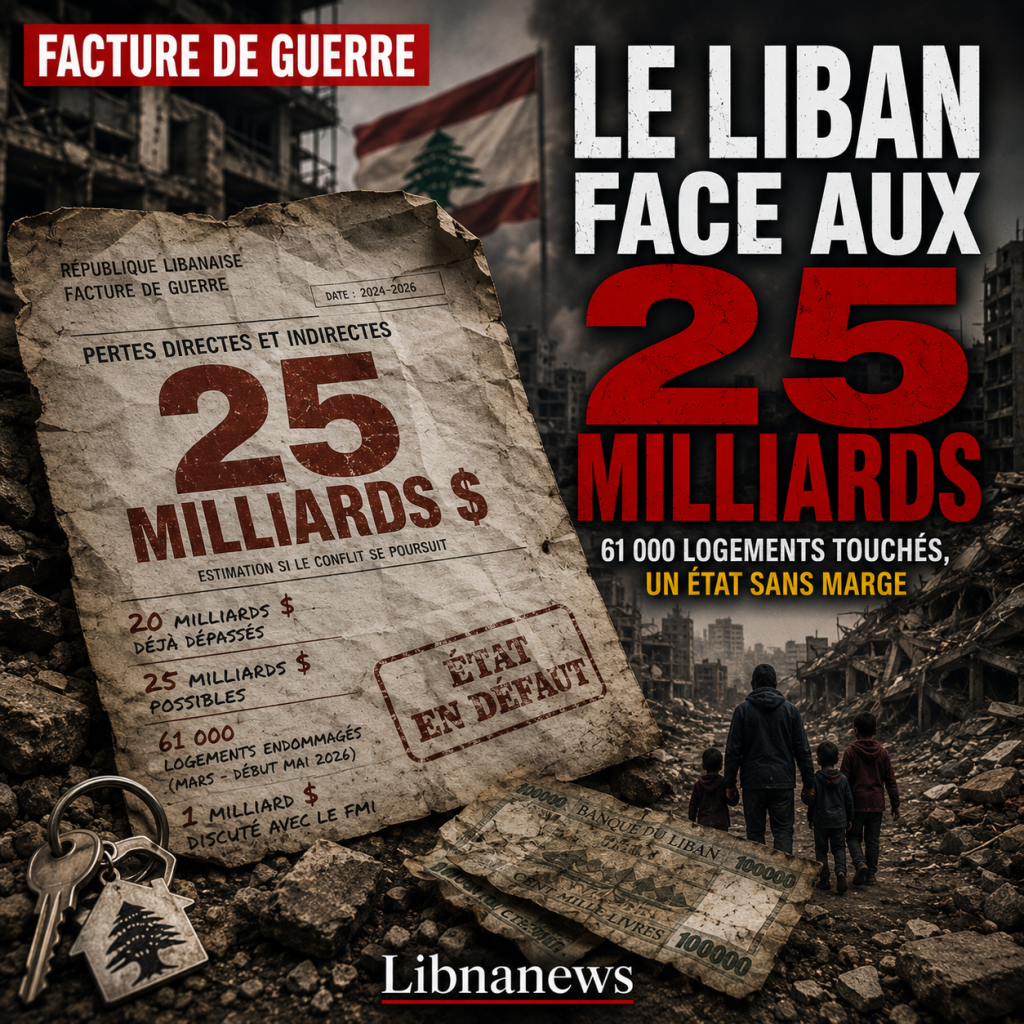
Lebanon is entering a phase in which war is no longer only measured by strikes, displacement and visible destruction. It is now measured in billions of dollars, uninhabitable housing, reconstruction infrastructure and weakened productive sectors. Theloss of war in Lebanonit would already exceed $20 billion since 2024 and could reach $25 billion if hostilities continued. This figure is not only a future invoice. It describes a country whose economic, fiscal and social capacities are already under way.
The data is all the more burdensome as Lebanon has not recovered its financial base since the collapse of 2019. The state remains in default. Debt is not restructured. The banking sector is not sanitized. Deposits remain blocked or amputated. Public services operate with reduced means. In this context, reconstruction is not a classic post-war project. It arrives in a state with no budgetary margin, no normal market access and no full programme with the International Monetary Fund.
Damage is not limited to destroyed buildings. They affect consumption, investment, trade, tourism, agriculture, health, education and government revenues. Over 61,000 dwellings were reported to have been totally or partially damaged between March and early May 2026. South Lebanon, which accounts for about a quarter of national economic activity, is a major contributor to the shock. The central question therefore becomes simple: how can we finance the reconstruction of a country already ruined before the war is over?
National invoice figures
| Indicator | Estimate or data |
|---|---|
| Direct and indirect losses since 2024 | Over $20 billion |
| Possible losses if conflict continues | Nearly $25 billion |
| Housing totally or partially damaged | Over 61 000 |
| Period of housing valuation | March-early May 2026 |
| Weight of South Lebanon in national activity | About a quarter |
| Agriculture, construction and industry | 16% of GDP in 2024 |
| Education and health | 19% of GDP in 2024 |
| Quick aid discussed with IMF | Up to $1 billion |
| Construction budget Hazmieh-Chtaura | About $8.5 million |
Loss of war in Lebanon: beyond the ruins
The $20 to $25 billion bill must be read with caution, but it gives an order of magnitude. It reduces direct losses, such as destroyed homes, roads, networks and equipment, and indirect losses, such as uncollected revenues, cancelled investments, interrupted business activity and lost tourist seasons. These two dimensions are inseparable. A destroyed house is a loss of property. But it is also a family trip, a rehousing expense, a loss of schooling, a stoppage of activity and additional pressure on the host regions.
Housing is the first visible shock. More than 61,000 damaged units mean tens of thousands of households facing work, temporary relocation or lasting loss of wealth. In a country where bank savings were largely destroyed by the financial crisis, many families cannot rebuild by their own means. Insurance rarely covers such damage under sufficient conditions. Private and community aid can fill some emergencies, but it does not replace a national reconstruction programme.
This creates a major social risk. Housing is not just an asset. It provides access to school, work, care and family networks. When a village is damaged or emptied, local economic activity stops. Small businesses lose their customers. The artisans lose their jobs. Farmers lose their labour or access to land. Municipalities are losing revenue. Displaced families defer their expenses to daily survival. The reconstruction of housing then becomes a condition for economic recovery, not a mere humanitarian project.
Infrastructure adds a second layer of loss. Roads, water systems, power lines, schools, health centres, municipal buildings and productive facilities must be evaluated, secured and repaired. The authorities are working with international institutions to update assessments using satellite images and advanced mapping technologies. This method is useful because it allows for damage to be objected to and avoids reconstruction based solely on local statements or political estimates. But mapping doesn’t fund. The country can know exactly the extent of the losses and remain unable to pay them.
Derisory public means to meet needs
The contrast with ordinary infrastructure projects is striking. The Hazmiah-Chtaura axis rehabilitation project, considered strategic, has a budget of approximately $8.5 million. This amount is important for a national road. It becomes tiny when faced with a war bill exceeding 20 billion. The gap illustrates the disproportion between the available administrative means and the magnitude of the needs. Even useful, validated and relatively modest projects may be absorbed by the general urgency of reconstruction.
South Lebanon is at the centre of this equation. The region accounts for about a quarter of national economic activity. This weight means that the destruction of the South does not remain regional. It affects supply chains, agricultural markets, trade, transport, consumption and household incomes throughout the country. When such an important region slows down, it is the national economy that loses an engine. The effects are transmitted to Beirut, Bekaa, Mount Lebanon and diaspora markets.
The productive sectors are particularly vulnerable. Agriculture, construction and manufacturing have little flexibility to move around. These sectors together accounted for 16 per cent of gross domestic product in 2024. They depend on land, workshops, machinery, stocks, roads and workers present on site. Destruction, displacement and logistical disruptions reduce production capacity. A stopped factory does not lose only a week of income. It loses customers, contracts, inventory and sometimes machines that are difficult to replace.
Services are not spared. Education and health accounted for 19% of GDP in 2024. The war disrupted schools, moved students, overloaded hospitals and moved patients away from their care centres. Teachers, doctors, nurses and administrative staff can be moved themselves. Private institutions see their income decline when families can no longer pay. Public institutions need to accommodate more needs with already limited budgets. Loss becomes human, economic and institutional.
Tourism, currency and balance of payments
Tourism adds another transmission channel. Arrivals at Beirut airport fell by 40.2 per cent over the first five months of 2026, while total traffic fell by 34.2 per cent. This decline confirms that war also destroys incomes that do not appear in the rubble. Each cancelled tour withdraws expenses in hotels, restaurants, transport, shops and services. The diaspora, which plays an essential role in the entry of currencies, can postpone its stays. Expatriates can continue to send money, but their on-site expenses are lower when travel decreases.
The balance of payments is therefore under increased pressure. Lebanon imports massively essential goods, including energy, medicines, food and equipment. It partially offsets these outings by transfers, services and expenses of visitors. As tourism flows decline and oil increases imports, the external deficit becomes more difficult to finance. Reconstruction will temporarily exacerbate this need, as it will require the import of materials, machinery, fuel and equipment.
This external dimension makes international aid indispensable, but it does not guarantee anything. The available support remains limited in view of the magnitude of the losses. Humanitarian aid can feed displaced families. A military envelope can strengthen an institution. Emergency IMF financing can support liquidity and social spending. But none of these instruments cover an invoice of $20 to $25 billion. Lebanon must therefore arbitrate between social emergency, physical reconstruction, economic recovery and financial reform.
The risk is to reproduce past mistakes. The country has already undergone costly, sometimes rapid, but often opaque reconstructions. Public procurement, compensation, expropriation, family support and construction contracts can become sources of clientelism. An emergency-funded reconstruction, without clear cadastre of damage, without publication of beneficiaries and without independent control, can fuel new diversions. War destroys property. Bad reconstruction can destroy the remaining trust.
Transparency as a financing condition
Transparency should therefore be a priority. The authorities must publish a damage map, criteria for compensation, amounts allocated, sources of financing and companies selected. Municipalities must be involved but controlled. International organizations can help verify needs, but the state must remain responsible. Families must be able to track their records. Aid must be traceable. Without these guarantees, reconstruction risks becoming a new area of political competition, where the best represented regions get faster than others.
The issue of public funding is even more difficult. The Lebanese State cannot be in debt normally. Eurobonds are in default. The sovereign note remains at the lowest. The IMF programme has not yet produced a comprehensive solution. Under these conditions, any budget promise must be seriously examined. The state can announce plans. He can rarely finance them alone. A credible reconstruction must combine donations, concessional loans, diaspora contributions, Arab funds, international institutions and private participation. But this combination will require strong governance, which partners have been demanding for years.
The banking sector cannot play its former role. Prior to the crisis, banks largely financed the state and part of the economy. Today, they cannot massively revive credit for reconstruction without resolving their own losses. Households that had spared money in banks no longer had their capital under the same conditions. Enterprises do not have access to normal credit. This lack of domestic financing turns each site into a liquidity problem. Even when an owner wants to rebuild, he may not have access to the necessary funds.
The Bank of Lebanon is also facing a limit. It can preserve apparent monetary stability, but it cannot sustain reconstruction without creating new imbalances. Foreign currency reserves remain valuable. Using them to support reconstruction imports without a clear fiscal framework would expose the country to further erosion of its margins. Lebanon has already paid the price of a confusion between monetary policy, public financing and bank bailout. Reconstruction should not become a pretext to repeat this model.
The risk of clientelist reconstruction
The political dimension of reconstruction will be inevitable. The most affected areas will seek prompt compensation. The parties will want to show that they protect their bases. Donors will want to condition their assistance. Citizens will demand justice and equality. The army and public institutions will be asked to secure areas, demine, reopen roads and allow assessments. Tensions around southern Lebanon will further complicate operations, as rebuilding under threat of new strikes reduces the effectiveness of any programme.
The calendar counts as much as the money. A reconstruction launched before a durable ceasefire can be destroyed again. A delayed reconstruction too long can fix displacement, empty villages and permanently impoverish families. The state will therefore have to organize phases. First emergency: shelter, water, health, food, temporary schools. Then the minimum rehabilitation: roads, networks, public buildings, partially damaged dwellings. Then heavy reconstruction: destroyed neighbourhoods, productive infrastructure, collective facilities and revival of economic activities.
Only material reconstruction should also be avoided. Repairing the walls without reviving income will not be enough. Farmers will need access to land, seeds, machinery and markets. Traders will need working capital. Industrialists will need electricity, parts and credit lines. Schools will need teachers and budgets. Hospitals will need staff and medication. Economic reconstruction must accompany physical reconstruction from the outset.
Lebanon can still turn this crisis into a moment of clarification. A precise valuation of losses, a transparent compensation mechanism, effective coordination with donors and public financial reform can restore minimal credibility to the state. But the country can also sink into the opposite scenario: successive announcements, scattered aid, clientelist reconstruction, implicit debts and frustration of the victims. The difference will be made in the coming months, when damage figures have to become budgets, contracts and controlled yards.
The bill of war in Lebanon is therefore not limited to a spectacular amount. It reveals the weakness of a state that must rebuild when it has not finished repairing its financial crisis. The 20 billion already exceeded and the 25 billion possible are not just destruction figures. They measure the gap between the country’s needs and its real capabilities. The authorities are now working to refine assessments with international institutions, while displaced families, municipalities and businesses are waiting to know whether the next step will be an organized reconstruction or a new expectation without funding.




