

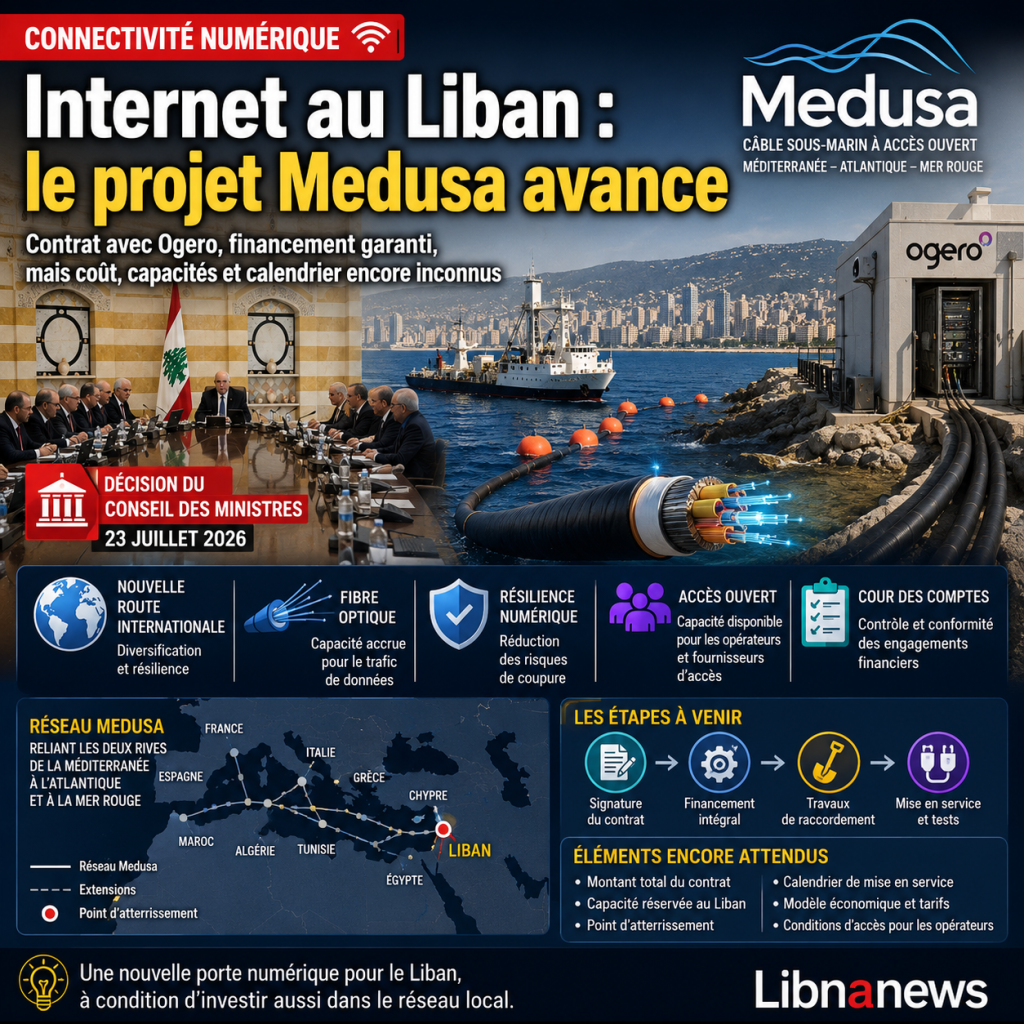
The Lebanese Council of Ministers asked the Ministry of Telecommunications to sign the contract for the Medusa project with the cable company and the Ogero public body. It also instructed the Ministry of Finance to guarantee the necessary appropriations for the full financing of the operation. Adopted on 23 July 2026, this decision is intended to allow Lebanon to join a new underwater fibre optic infrastructure linking several shores of the Mediterranean. However, it is entering a decisive phase, as the contract, its cost, the connection schedule and the capacity reserved for the country have not yet been presented to the public.
The Government indicated that it had followed the recommendations of the Court of Auditors. This statement gives the dossier a particular administrative and financial dimension. It shows that the executive had to regulate the procedure before authorizing the signature. The Medusa Internet project is therefore not a technical decision. It commits public funds, the national operator, the supervisory ministry and several control mechanisms. Its effectiveness will depend as much on the quality of the cable as on the contractual conditions retained by the State.
Medusa Internet project takes a political step
The decision of the Council of Ministers does not mean that the new liaison is already operational in Lebanon. It authorised the continuation of the process and asked the Ministry of Telecommunications to conclude the necessary agreement. The signing of the contract will be the next formal step. The connection work, installation of equipment and testing will then follow.
The government record does not specify the expected date for commissioning. Nor does it give the location of the future landing point of the cable on the Lebanese coast. This information is essential as it determines the needs for civil engineering, security and connection to the terrestrial network.
The Government did not disclose the total contract amount. He only asked the Ministry of Finance to insure the credits covering the entire project. This formulation suggests that funding was not yet fully secure at the time of the session.
The lack of figures prevents the assessment of the budgetary effort requested by the State at present. Nor is it possible to compare the cost of connection with expected revenues, potential savings or tariffs for other international routes.
The Ministry of Telecommunications will therefore have to publish the main features of the agreement. The public must know the duration of the contract, the capacity acquired, the payment arrangements and the maintenance obligations. The exact share of Ogero should also be clarified.
A submarine cable to diversify Lebanese roads
Undersea cables carry the bulk of international digital communications. They link national networks to major data exchange centres. Their capacity influences the amount of traffic a country can send or receive, but also the strength of its connections with the outside world.
Medusa was designed as an open-access system linking the Mediterranean to the Atlantic and eventually to the Red Sea. Its first architecture covers several European and North African countries. Extensions east of the Mediterranean were then announced.
For Lebanon, the main interest lies in diversification. An additional route reduces dependence on a limited number of historical connections. It can offer a folding solution when a cable is broken, accidentally broken or maintained.
This redundancy does not eliminate all risks. Two cables can take nearby routes or depend on the same terrestrial installations. A resilience policy must therefore examine the entire chain, from the seabed to central and data centres.
The choice of landing point plays an important role here. A separate station can enhance safety if it does not share all its equipment with existing infrastructure. Conversely, excessive concentration in the same location can maintain a point of vulnerability.
The future connection must also provide for scalable capabilities. Data consumption increases with video, cloud services, digital payments, artificial intelligence and professional usage. Capacity adapted to current needs may become insufficient a few years later.
Ogero at the heart of the national system
Ogero operates a large part of the fixed telecommunications infrastructure in Lebanon. The organisation manages the core network, central offices, national links and international points of connection. Its association with the Medusa project therefore appears to be operationally logical.
Yet its exact role remains to be defined. Ogero may act as operator of the landing station, manager of the acquired capacity or transport supplier to operators and access providers. It may also combine several of these functions.
This concentration imposes transparent rules. Access providers must be able to know the conditions for using the new capacity. Wholesale tariffs must be predictable and applied according to identical criteria.
Government-funded infrastructure must serve the entire market under clearly established conditions. It must not create an annuity or favour certain actors. The department will therefore need to specify the cable access regime.
Ogero must also have the necessary human and technical resources. Operation of an underwater link requires specialized teams, ongoing monitoring and rapid procedures in the event of an incident.
The financial situation of the organization is another issue. The monetary crisis reduced the value of income earned in books and complicated the maintenance of equipment. Tariff adjustments have improved some revenues, but needs remain significant.
The Medusa project will have to be integrated into a sustainable financial plan. The State must avoid financing the initial acquisition without providing for operating costs, licences, energy, safety and technical renewals.
The Court of Auditors and the contract framework
The Council of Ministers expressly indicated that it was acting in accordance with the recommendations of the Court of Auditors. This clarification suggests that the project was subject to a prior review of the procedure or financial conditions.
In particular, the Court’s control aims to protect public funds and to verify compliance with commitments. In a complex technical market, this intervention may require the administration to better define its needs and justify the choice of the contractor.
The government decision does not detail the comments made. It also does not specify whether certain clauses have been amended. Publication of a summary of these recommendations would enhance understanding of the file.
Several points deserve special attention. The contract must indicate the capacity reserved for Lebanon, the commitment period, the availability guarantees and penalties for delay. It must also allocate responsibility during a breakdown.
The price must be analysed throughout the agreement. A limited entry cost may be accompanied by high operating costs or future capacity increases. Conversely, a larger initial investment can offer a better long-term control.
Foreign exchange risks must also be identified. International contracts are often denominated in dollars or euros, while some of the sector’s revenues are collected locally. A large monetary variation can increase the actual cost of the project.
New capacity does not guarantee better flow
The arrival of an additional cable can increase the international bandwidth available. However, it does not guarantee that each subscriber will immediately benefit from a faster Internet.
The quality of service depends on several segments. After its arrival on the coast, traffic must pass through the national network, central offices, distribution equipment and the last link to the user. Blocking one of these segments limits the final flow.
In many areas, copper lines remain an obstacle. Their performance varies according to the distance, the state of the cable and the quality of the installations. The deployment of fibre to buildings or homes is progressing unevenly.
Power cuts also affect telecommunications. Central offices and active equipment need stable power supply. Batteries and generators reduce interruptions, but maintenance is expensive.
The Medusa Internet project must therefore be part of a broader programme. The country needs to modernize the land network, secure energy from technical sites and improve maintenance.
Access providers will also need to purchase sufficient capacity for their subscribers. A new link may remain underused if wholesale prices are too high or if commercial distribution does not follow.
The actual benefit should be measured with simple indicators. Authorities may publish the total capacity available, its utilization rate, latency to major international centres and the frequency of interruptions.
Public funding at the centre of questions
The Department of Finance was given the task of providing the necessary funding for the entire project. This decision comes at a time when public resources remain constrained and several sectors require urgent investment.
The government will have to explain the source of funding. Appropriations may come from the budget, from the telecommunications sector, from external financing or from a combination of resources.
The use of telecommunications revenues seems possible, as this sector has long been an important source for the Treasury. However, this option requires clear management of funds and a distinction between current expenditure and investment.
Debt financing would involve the State over a longer period. It should then be compared to the revenue generated by the sale of capacity. The project can be cost-effective if demand increases and tariffs cover expenses.
Authorities should avoid presenting funding as a mere technical expense. An international liaison is a strategic asset. It can support digital services, data centres, e-commerce and export activities.
This economic value does not exempt a precise calculation. The project must have a business plan. It must estimate traffic, revenues, maintenance costs and future requirements.
Transparency is all the more necessary as the Council has requested funding for the entire operation. The final amount and timetable will have to appear in budget documents or implementing decisions.
Digital Sovereignty Issue
International connectivity directly affects sovereignty. A country that depends on few external roads remains vulnerable to breakdowns, regional tensions and decisions by foreign actors.
The addition of a cable improves the room for manoeuvre, but sovereignty is not limited to the property of a fibre. It also concerns station control, data security in transit and the ability to react to a cut.
Lebanon will have to define who can access sensitive equipment. Landing stations require physical controls, monitoring systems and intrusion protection.
Cybersecurity must complement physical security. Network management systems may be targeted by attacks. Operators must limit access, record operations and maintain continuity plans.
Contracts must also specify the jurisdiction applicable in case of conflict. They must define the conditions for the resolution of disputes and the rights of the State over the acquired capacity.
The diversity of partners can strengthen autonomy. It avoids dependence on a single supplier or road. It also allows better trading conditions to be negotiated.
However, the government will have to maintain coordination with other connected countries. Undersea cables function as shared infrastructure. Their repair and evolution require cooperation between operators.
Possible benefits for the digital economy
A more robust international connection can support companies that work with foreign customers. IT services, digital creation and outsourcing depend on stable access to global platforms.
Banks and payment systems also use secure connections. Interruptions can delay operations and increase risks. Better redundancy reduces exposure to certain failures.
Universities and research centres need to transfer large volumes of data. Increased capacity can facilitate their participation in international scientific networks.
Another possibility is the development of data centres. These facilities require reliable electricity, diversified connectivity and a stable regulatory framework. Medusa will not be enough to create this market, but it can become a component.
Digital utilities will also benefit from a more robust network. The government has initiated a digital transformation project separately. Administrative platforms should remain accessible and exchange data with services hosted abroad.
The impact on prices is not automatic. An increase in capacity may reduce the unit cost of traffic, but this decrease must be passed on to suppliers and then to consumers.
The public authority shall follow this transmission. It will be able to compare the evolution of wholesale rates, packages and quality. Without this monitoring, the gains could remain concentrated in a few players.
The risk of a gap between the cable and the local network
The main operational risk lies in a gap between the international infrastructure and the national network. Lebanon could acquire a large capacity without being able to distribute it effectively.
The terrestrial fibre must link the landing station to the main traffic centres. It must take several routes to prevent a local cut from neutralizing the new link.
Central offices must be constantly modernized and fed. Metropolitan networks must absorb the increase in traffic. The last connection to the homes remains decisive.
The ministry will have to present a mapping of the complementary investments. This mapping shall indicate the priority areas, the work required and the time frame.
Coordination with municipalities will often be essential. The deployment of fibre requires authorisations, road works and access to urban infrastructure.
Mobile operators are also involved. An increasing part of Internet traffic is via cellular networks. Their antennas must have sufficient collection links to use international capacity.
Medusa can therefore become a catalyst, but only if investment continues on earth. The government must avoid a limited approach to announcing the connection.
Information still awaited
The decision of 23 July sets a clear direction: the Ministry of Telecommunications must sign the contract, Ogero must be associated and the Ministry of Finance must cover the project.
However, several data are still missing. The total cost was not announced. The capacity reserved for Lebanon remains unknown. The timing of commissioning and the landing point are not specified.
The government must also explain the economic model. It should indicate who will sell the capacity, at what price and according to what access rules.
The text of the Court of Auditors’ recommendations would provide useful guidance. It would help to understand the guarantees added before government approval.
Citizens and businesses will mainly expect measurable effects. A reduction in interruptions, improved rates and more consistent rates would give concrete content to the decision.
The next milestone will be the signing of the contract. This will be followed by actual funding, connection work and integration into the Ogero network. The publication of these steps will determine whether the Medusa Internet project becomes a real new digital gateway for Lebanon or an international capacity still difficult to transmit to users.




