

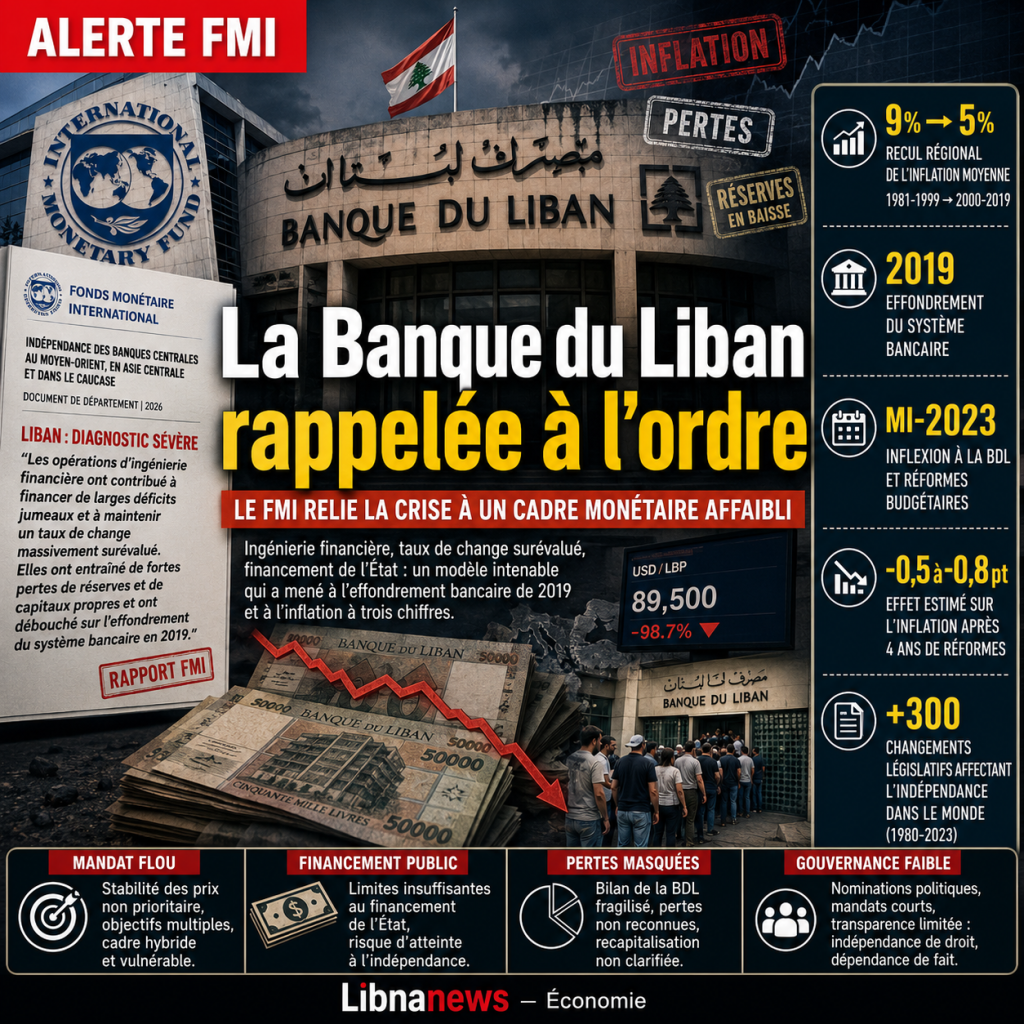
The International Monetary Fund places the Bank of Lebanon at the centre of the economic debate. In a paper on the independence of central banks in the Middle East, Central Asia and the Caucasus, the institution does not treat Lebanon as a mere case among others. It is the most extreme example of a weakening of the monetary framework, when the central bank, the budgetary power and the banking system end up carrying the same imbalances. The diagnosis is known, but it takes on a new scope: without real independence, without a clear mandate of price stability and without strict limits to state financing, no lasting stabilisation can be guaranteed.
The heart of the case is the Bank of Lebanon. The document does not formulate a comprehensive Lebanese programme. It does not replace a financial agreement, a banking law or a restructuring strategy. But it gives a precise reading grid of the crisis. Lebanon has not only suffered from a shock of confidence, excessive debt or political paralysis. It also paid the price of a monetary policy used to prolong an unsustainable model, maintain an overvalued exchange rate, finance twin deficits and delay adjustments. It is this link between monetary independence, fiscal discipline and inflation that structures the IMF’s analysis.
Lebanon in a regional diagnosis
The document is based on a regional observation. In the Middle East and Central Asia countries, average inflation declined from around 9 per cent between 1981 and 1999 to 5 per cent over the next two decades, until the pandemic. This decline was accompanied by the gradual strengthening of central bank independence, especially after 2000. The IMF does not say that this independence explains everything. Globalization, productivity gains, exchange rate regimes and fiscal policies have also played a role. But the institution establishes a net association: the more independent central banks better manage inflation and are more resilient to shocks.
The message applies first to countries with an explicit objective of price stability. Economies that have adopted inflation targeting, particularly in the Caucasus and Central Asia, have responded faster after the pandemic. They have raised their rates, stabilized expectations and prevented price increases from settling down on a sustainable basis. Countries with a credible currency anchor have also improved inflation when their reserves and institutions support parity. Lebanon, for its part, appears in the category of more hybrid, more vulnerable and less effective monetary frameworks in the face of the crisis.
This category is not neutral. It brings together countries where monetary policy often depends on several objectives at a time, without a clear hierarchy. Central banks can focus on exchange rate stability, economic financing, budget support, bank liquidity and price stability. When everything becomes a priority, nothing really is anymore. Lebanon illustrates this drift. The Bank of Lebanon has long served as a pillar of a system based on the attraction of foreign currency deposits, the defence of parity and the indirect financing of a state unable to correct its deficits.
| IMF Document Benchmark | Number or finding |
|---|---|
| Average ME&CA inflation, 1981-1999 | About 9% |
| Average Inflation ME&CA, 2000-2019 | About 5% |
| Countries with annual inflation above 40% in 1994 | 57 |
| Countries with annual inflation above 40% in 2023 | 15 |
| Estimated effect of an increase in independence after one year | -0.5 to -0.6 point of inflation |
| Estimated maximum effect in the fourth year | -0.5 to -0.8 point of inflation |
| Legislative changes affecting independence in the world, 1980-2023 | Over 300 |
| Legislative changes affecting independence in the ME&CA region | About 50 |
What the IMF explicitly says about Lebanon
The most direct passage of the document concerns so-called financial engineering operations. The IMF believes that this program has helped fund large twin deficits and maintain a massively overvalued exchange rate. According to the institution, this strategy resulted in significant losses of reserves and capital in the central bank. It also led to the collapse of the banking system in 2019. The wording is severe, as it links pre-existing monetary choices to the systemic breakdown that Lebanese depositors are still experiencing.
The document adds a key point. Unsustainable monetary and fiscal policies would have continued until mid-2023, when the change of direction at the Bank of Lebanon and some fiscal reforms changed the framework. Before this inflection, the rapid depreciation of the pound, three-digit inflation and the additional erosion of foreign exchange reserves continued to impoverish households. The IMF therefore does not present the crisis as a concentrated accident in 2019. It describes a longer process, fuelled by the refusal to recognize losses and the absence of orderly adjustment.
For Lebanese, this analysis confirms a daily experience. The currency has lost most of its value. Wages have been disconnected from prices. Bank deposits remained blocked, converted or paid according to moving rules. Households have borne an inflation tax without a vote, without transparent debate and without sufficient protection. The IMF document gives an institutional name to this mechanism: insufficient or poorly protected monetary independence makes it possible to confuse the central bank, the needs of the state and the losses of the financial system.
Bank of Lebanon: legal independence, de facto dependence
The IMF distinguishes between legal independence and de facto independence. Legal independence is a matter of formal legislation, statutes, mandates and limits. De facto independence depends on practice, governance, appointments, transparency and the real relationship with political power. This distinction is crucial for Lebanon. A central bank may have significant paper allocations, but may remain exposed to pressure from government, Parliament, banks, political groups or budgetary emergencies. Conversely, a credible institution must be able to explain its decisions, be accountable and refuse certain requests.
The report identifies four dimensions of independence. The first is functional: the central bank must be able to continue its mandate without prior government validation. The second is operational: it should not be instructed by a public or private actor. The third is financial: it must have sufficient resources, a clean budget, recapitalisation rules and mechanisms for distributing profits that do not make it dependent on the Treasury. The fourth is personal: leaders must have secure mandates, with clear criteria for appointment and revocation.
Lebanon must read these criteria in the light of its crisis. The question is not to give the Bank of Lebanon more power without control. It is to define a strict, controllable and limited mandate. An independent central bank must not become a state in the state. It must be protected from political injunctions, but it must also publish reliable information, present audited accounts, explain its objectives and assume the results of its policy. Independence only works if it advances with responsibility.
Governance, mandate and limits to public funding
The IMF regional table shows that the central banks in the Middle East and Central Asia have made progress in several areas. Monetary policy rules, financial independence and reporting obligations have improved. But the document also highlights persistent weaknesses. Appointments of governors and councils often remain too dependent on the executive. The terms of office of Council members may be too short. The mandatory presence of government representatives in decision-making bodies may weaken autonomy. Price stability objectives are not always a clear priority.
These points speak directly to the Lebanese debate. The credibility of the Bank of Lebanon will not only be rebuilt through a change of governor or a circular. It will depend on a more robust institutional framework. The method of appointment must reduce the logic of political division. The responsibilities of the central board must be clarified. Conflicts of interest must be prevented. Accounts must be published according to recognized standards. Losses must be identified and processed in a legal framework. Without this architecture, the risk remains of reproducing the same behaviours in a different form.
IMF also insists on limits to government financing. This is one of the pillars of its Central Bank Independence Index. A central bank becomes less independent when it lends too easily to the state, buys public securities on the primary market or finances deficits without strict conditions. The institution recognises that exceptions may exist in the event of war, disaster or extreme shock. But they must be temporary, provided by law, with short maturity, appropriate rates and an explicit exit strategy.
This recommendation is important for Lebanon. The Lebanese State has long lived beyond its means, while the central bank and the commercial banks were absorbing its financing needs. Public debt, external deficits and the defence of the exchange rate eventually formed the same system. Monetary independence cannot therefore be isolated from the budget. A more independent Bank of Lebanon will not be enough if the Treasury remains undisciplined, public accounts remain opaque and bank losses remain politically untouchable.
Long reform, not immediate promise
The document also recalls that improving monetary independence does not mechanically improve public finances. Rather, it contributes to better macroeconomic results, which can then help the budget. In other words, the Bank of Lebanon cannot repair the state alone. It can stabilize expectations, limit inflation and restore confidence. But it cannot replace credible taxation, controlled public spending, bank restructuring or a growth strategy. The Lebanese risk would be to transfer to the central bank a mission that only a political and budgetary agreement can assume.
The IMF also figures the time frame for reform. The effect of strengthening the independence of central banks is not immediately apparent. Empirical results show that an increase in a standard deviation from the independence index is associated with a fall in inflation of about 0.5 to 0.6 percentage points after one year. The effect reached its peak around the fourth year, with inflation below the reference scenario by 0.5 to 0.8 points. The message is clear: laws do not produce credibility overnight.
For Lebanon, this temporality is politically difficult. The population expects rapid results after years of loss. Companies want exchange rate stability. Depositors are seeking clarification of their assets. Governments need salaries that can retain skills. But monetary reconstruction requires a long sequence: to recognize losses, restructure the banking sector, secure the balance sheet of the central bank, ban dangerous financing, modernize governance and restore credible communication with the public.
The road map Lebanon can draw from it
The report proposes a general roadmap. It begins with the revision of the legal framework. The central bank must have a clearly priority price stability mandate. It must have the necessary instruments to implement its policy. Relations with the government must be codified. State funding opportunities must be limited and regulated. The Bank of Lebanon would therefore need a reform that would not merely add symbolic safeguards, but legally prevent the repetition of the mechanisms that led to the crisis.
The second priority is financial independence. A central bank whose losses are not dealt with, whose recapitalisation depends on political arbitrage and whose balance sheet remains unreadable cannot play its full role. The IMF recommends clear rules for capitalization, provision, profit distribution and loss coverage. In Lebanon, this is a sensitive node. The accumulated losses in the financial system will not disappear by accounting silence. They must be distributed according to a law, with explicit treatment of the responsibilities of the State, banks and large depositors.
The third priority is governance. The report focuses on competency-based appointments, transparent criteria, long-term mandates beyond electoral cycles, and councils with non-executive members capable of overseeing leadership. This logic aims to reduce personal dependence on political power. For the Bank of Lebanon, it means moving out of a model where a governor’s reputation can replace institutional mechanisms. A strong institution is not based on a man, but on rules that survive men.
The fourth priority is transparency. The IMF highlights the importance of annual reports, audited financial statements, data publications, monetary policy releases and communication with different audiences. Lebanon has suffered from a massive readability deficit. Households did not know how losses were calculated. Markets did not know what exchange rate rule would prevail. Banks have applied restrictions without capital control laws. Restoring confidence therefore requires regular monetary speech, which is verifiable and limited to specific objectives.
This communication requirement should not be confused with a public relations strategy. A central bank that communicates well does not try to convince by slogans. It explains its assumptions, instruments, constraints and possible errors. It publishes data that enable the public, Parliament, economists and markets to judge it. In the Lebanese case, this exercise will be all the more delicate as confidence has been destroyed by years of promises of stability that preceded the collapse.
A project beyond the Bank of Lebanon
The IMF document also calls for caution in the face of new mandates. Central banks are increasingly being asked about climate, digital finance, cryptocurrency, payment systems and financial inclusion. These topics are important. But the institution warns that they should not distract central banks from their fundamental responsibilities: price stability and financial stability. For Lebanon, the hierarchy of priorities remains even more urgent. Before expanding missions, the core of the monetary mandate must be restored.
This reading puts the Bank of Lebanon in a broader debate. The Lebanese crisis not only revealed technical mistakes. She outlined a mode of economic government. The state borrowed, banks collected, the central bank arranged, and losses remained hidden. The stability displayed was based on increasing fragility. When the flows reversed, the whole building ceded. The IMF suggests that an independent central bank should have had stronger safeguards to resist this mechanism. It should also have made the costs of the strategy more visible.
The document does not release other actors. On the contrary, it shows that monetary policy cannot be effective in an environment dominated by budgetary needs, conflicts of interest, weak statehood and poor banking governance. Lebanon will therefore not resolve its crisis by changing only the Bank of Lebanon law. It will also have to deal with public debt, bank losses, the protection of small depositors, taxation, public enterprises and the quality of statistics. Monetary independence is a condition. It is not a complete program.
Finally, the political significance of the report lies in its sobriety. The IMF does not propose a spectacular denunciation. It aligns mechanisms, data and comparisons. But their application in Lebanon is heavy. It means that frontal stability can become destructive when it is based on an unrealistic exchange rate, growing reserves and increasingly costly financial transactions. It also means that reconstruction will require more than a cyclical improvement in the pound or a one-time fall in inflation.
The next step will be in the texts, but also in their application. A credible reform of the Bank of Lebanon should clarify the mandate of price stability, prohibit ordinary state monetary financing, publish a sincere photograph of the balance sheet, define the governance of the central board, regulate relations with the Ministry of Finance and make independent audits mandatory. This project will affect powerful interests. He would say whether Lebanon only wanted to temporarily stabilize its currency, or rebuild the institutions that should have prevented its collapse.




