






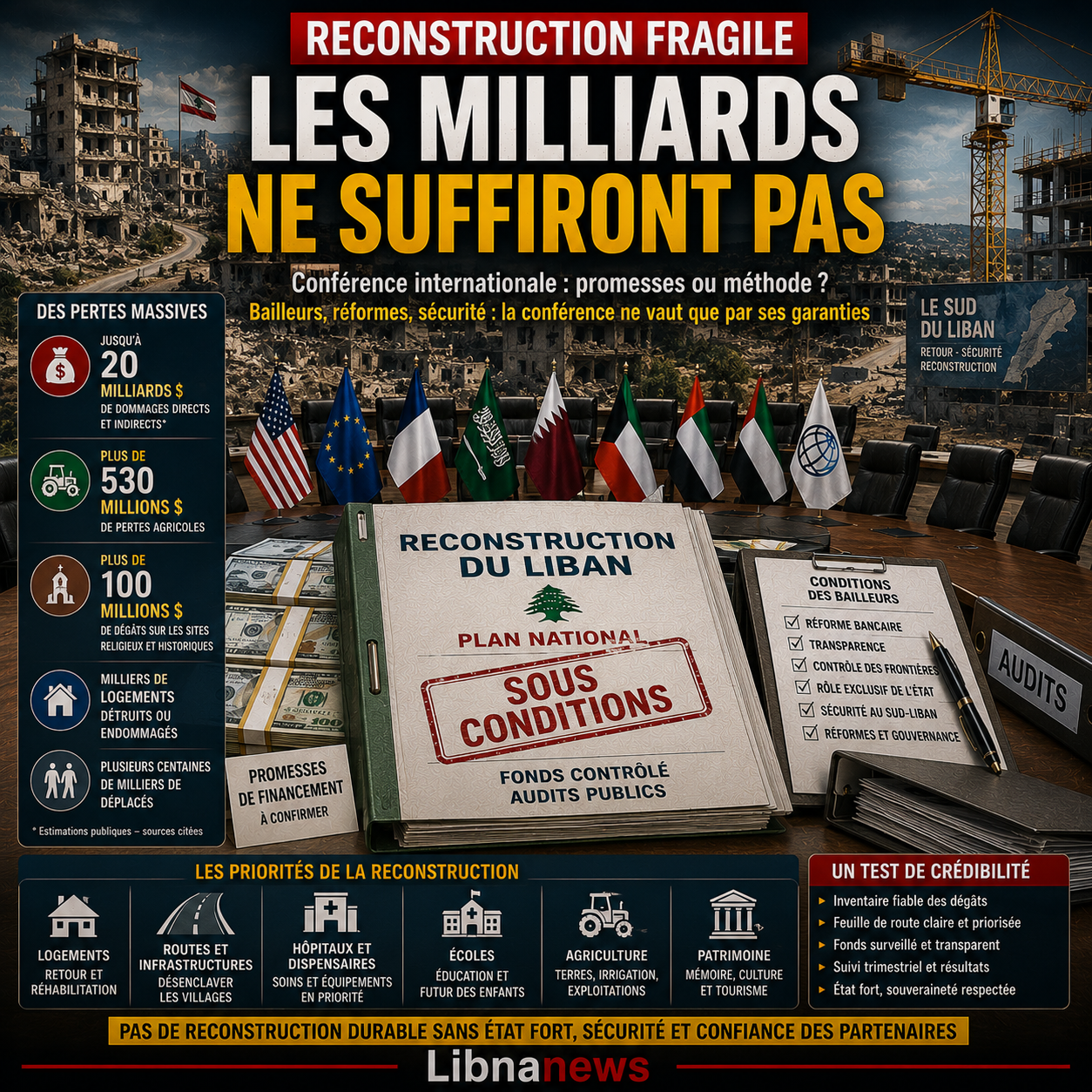
Lebanon approaches the idea of an international reconstruction conference in a fragile position. The war has expanded needs, but it has not erased the old conditions imposed by donors: banking reform, transparency, border control, the role of the State and security guarantees. The Iran-USA agreement announced on the night of 14-15 June can open a window. It can reduce strikes, facilitate the return of displaced persons and provide a framework for the mobilization of aid. But an international conference will not be enough if it turns into a general promise, without a financing mechanism, without a reliable assessment of the damage and without agreement on the areas where the money will be spent.
The question is therefore less whether Lebanon will get promises than who will accept them. Destruction affects housing, roads, schools, hospitals, water systems, electricity, agricultural land, heritage and small businesses. Available figures vary according to the perimeters selected. Public estimates suggest up to $20 billion in direct and indirect damage to the ongoing war. The agricultural cost already exceeds $530 million. The damage to religious and historical heritage in some areas of the South is estimated at over $100 million. These amounts give an order of magnitude. They don’t say how to pay yet.
Losses already quantified but still incomplete
| Area | Available estimate | The reconstruction issue |
|---|---|---|
| Direct and indirect damage to the ongoing war | Up to $20 billion | Housing, infrastructure, economic losses |
| War of 2024 | At least $8.5 billion | Comparison basis for donors |
| Agriculture | Over $530 million | Land, income, farms, irrigation |
| Direct agricultural damage | Over $41 million | Equipment, crops, equipment |
| Religious and historical sites affected | Over $100 million | Heritage, local memory, future tourism |
The reconstruction of Lebanon does not start with a conference. She starts with proof. Donors want to know what has been destroyed, where, by whom, to what extent and according to what priorities. For this reason, the Lebanese National Council for Scientific Research has taken a new place in the mapping of damage. Its databases, satellite images, records and cross-referenced information must help the State document the destruction. This documentation is not only technical. It will be used to negotiate with partners, defend reparation claims, set budgetary priorities and reduce the risk of double funding or diversion.
An international conference should therefore be based on verifiable figures. Lebanon can no longer appear before donors with vague estimates, unconsolidated municipal lists or competing political demands. It needs a national inventory, updated, classified by sector and emergency. Totally destroyed dwellings are not treated in the same way as partially damaged houses. A strategic road is not the same calendar as an agricultural road. A hospital, school or pumping station must be rebuilt before less priority public buildings. This hierarchy will determine the credibility of the Lebanese case.
Agriculture, housing, heritage: visible emergencies
Farm losses are one of the most urgent issues. They are not limited to burned fields. They include inaccessible land, unmaintained trees, lost crops, destroyed greenhouses, damaged irrigation systems, dead or displaced animals and missed incomes. Estimates cited by the Ministry of Agriculture indicate more than $530 million in losses, including more than 41 million direct damage. More than 10,000 farms have reportedly been affected, while a significant proportion of the country’s agricultural land has suffered damage or disruption. In the South, agriculture is not only economic. It conditions the return of families.
A village rebuilt without arable land remains a dependent village. A repaired house does not help a family if olive grove, tobacco, citrus, vegetables or orchards no longer produce. Agricultural reconstruction must therefore be integrated with housing and roads. It requires rapid aid, seeds, plants, fuel, pumps, irrigation repairs, compensation for lost seasons and demining operations. It also requires mapping of contaminated or burned soil. Without this, rural families risk returning to repaired homes, but to a dead local economy.
Housing will be the other visible priority. Images of razed or partially emptied border villages have already marked the opinion. Destruction is not just about buildings. They destroy titles of use, family businesses, workshops, stocks, furniture, archives and sometimes memories that anchor a family in a place. The housing census should distinguish between total destruction, heavy damage, emergency repairs and hazardous buildings. It will also have to avoid the mistakes of previous reconstructions: late aid, opaque criteria, competition between parties, unfulfilled promises and lack of follow-up.
The question of heritage must not be relegated. In Tyre and other parts of the South, religious and local officials reported significant damage to ancient churches, historic sites and cultural buildings. These destructions exceed the material cost. They affect village memory, denominational diversity and the future tourism economy. Only housing and road reconstruction would be lacking. Heritage restoration must be integrated into a broader strategy, involving municipalities, religious authorities, experts, Unesco if necessary, and specialized donors. The preservation of memory is also part of the return.
Roads, hospitals, schools: rebuilding ordinary life
Public infrastructure will form the basis of any conference. Roads, bridges, water systems, pumping stations, electricity, telecommunications, hospitals, clinics and schools must be classified by emergency. The risk is to announce a large plan without sequence. But the needs are not worth it. A road that allows an ambulance to access a village must pass before an urban beautification project. A school that allows the resumption of classes must pass before an administrative room. A water station serving several villages must pass before scattered repairs. Donors will facilitate the funding of clear, verifiable and phased projects.
Hospitals and clinics require special attention. The war has increased pressure on a health system already weakened by the economic crisis. Institutions must manage the wounded, chronic diseases, the needs of displaced persons and the psychological effects of war. In rural areas, a closed clinic can keep elderly people or poor families away from regular care. An international conference should therefore include an immediate health component: rehabilitation of centres, essential medicines, generators, ambulances, support for mobile teams and psychosocial care. The return of the inhabitants will be sustainable only if the care follows.
Another indicator of normality is schools. The war interrupted classes, displaced students, transformed some buildings into places of reception and aggravated the stress of teachers. Rebuilding a school does not only mean repairing walls. Transport, textbooks, examinations, equipment, electricity, water and teaching teams must be restored. Displaced children need stability. Parents, too. A conference that ignores education would leave reconstruction incomplete, as families do not return to a village where children cannot return to a normal year.
Conditions of donors
Donors will impose three major conditions. The first concerns reforms. The International Monetary Fund and several partners reiterate that sustainable growth requires banking restructuring, a credible fiscal framework, debt management and governance reforms. Reconstruction cannot be separated from this crisis. A country whose banks no longer perform their functions cannot effectively mobilise credit, guarantees, insurance and savings. Donors can finance projects, but they will not replace a paralyzed financial system. The reconstruction of Lebanon will therefore soon come up against the banking issue.
The second condition concerns transparency. Donors will not agree to channel funds into opaque channels. Since the explosion of the port of Beirut and the financial crisis, part of international aid has bypassed the State to go through separate agencies, NGOs or mechanisms. This method met a real mistrust. It has also weakened the state’s ability to become the central actor again. The current challenge is to create a hybrid mechanism: the state sets priorities and carries sovereignty, but spending is controlled by audits, public tenders, dashboards and independent audits.
The third condition concerns security. No lessor will want to rebuild infrastructure exposed to a new immediate war. This issue refers to the ceasefire, the Israeli withdrawal, the role of the Lebanese army, the Final and the debate on Hezbollah’s weapons. Arab and Western partners will ask who guarantees that the rebuilt villages will not be bombed again. They will also ask whether aid could strengthen partisan networks or parallel structures. Reconstruction becomes a matter of sovereignty. It cannot be sustainable if the State does not control security, borders or aid channels.
Arab countries, diaspora and controlled funds
The role of the Arab countries will be decisive. Saudi Arabia has reopened the door with exports, but is awaiting evidence of Captagon, borders and political stability. Qatar can play a financial or diplomatic role, especially after its participation in regional mediation channels. Kuwait, the Emirates and other partners can contribute if an Arab position is structured. But these countries will not return to old practices without guarantees. They want a reliable state, identified projects and minimal security. The reconstruction could be the place for an Arab return from Lebanon, or the revealing of its persistent distrust.
The Lebanese diaspora can also play a role, but it cannot bear the bill alone. Family transfers are already helping thousands of households. They finance repairs, rents, care and education. But a national reconstruction requires structured funds, insurance, public procurement and infrastructure plans. The diaspora can contribute to local funds, municipal projects, schools, clinics or agricultural initiatives. However, it will need transparency. After years of banking crisis, many Lebanese from abroad refuse to send money to circuits they do not control.
The Lebanese State must therefore propose a credible financial architecture. An option would be the establishment of a reconstruction fund under Lebanese authority, with international oversight, public audits, multi-stakeholder governance and regular reporting of expenditures. The fund could categorize projects by emergency, receive Arab and Western contributions, finance municipalities under conditions, and involve independent experts. It should avoid two pitfalls: becoming a party-controlled political body, or becoming a totally external mechanism that humiliates the state and reinforces the logic of guardianship. The balance will be difficult.
Who guarantees that money does not finance a new crisis?
The issue of municipalities will be central. Mayors are aware of needs, roads, houses, displaced families and local priorities. But many municipalities lack money, staff and technical expertise. Some are also caught in partisan balances. An international conference should provide direct support to municipalities, but with controls. Local projects must be validated by national criteria, published, monitored and evaluated. People need to know why one school is repaired before another, why one road is a priority, and to whom to report an irregularity.
Nor should reconstruction ignore justice. Documenting the damage can be used to get help. It can also be used to establish responsibilities. Data collected by Lebanese agencies can feed into legal processes, claims for compensation or international files. This dimension must not paralyse the urgency, but it can strengthen Beirut’s position. A State that seriously documents its losses shows that it is not just asking for money. It also calls for recognition, protection and guarantees against repetition.
The greatest political risk is that of competing reconstruction. If the state delays, Hezbollah, parties, NGOs, religious networks, diaspora and foreign powers will fill the gaps. Such mobilization can help families. It can also further fragment the country. Each actor will fund its areas, clientele or priorities. The state will appear as a secondary window. Reconstruction will then become a competition of influence. This is precisely what international partners say they want to avoid, but that they can cause if they bypass too much state.
A useful international conference should therefore be less spectacular than rigorous. It must not only announce a global amount. It must produce a method. A withdrawal and security schedule. An inventory of damage. List of priority projects. A controlled fund. Criteria for municipalities. An agricultural component. A housing component. A health and school component. An anti-corruption mechanism. A link with banking reform. A channel for the diaspora. A quarterly monitoring mechanism. Without these elements, the conference risks becoming a fragile promise, greeted one day, challenged the next day, forgotten in a few months.
The final question remains that of the guarantee. Who guarantees that money will not finance a new crisis? Donors can impose audits. States may condition their donations. Agencies can monitor tenders. But the decisive guarantee must come from Lebanon itself. It presupposes a state that speaks with one voice, an army capable of holding the ground, justice capable of sanctioning, restructured banks, controlled borders and officials ready to publish the expenses. If these conditions progress, an international conference can become a turning point. If they remain suspended, the villages of the South will see delegations, promises and some reparations coming, while the real reconstruction will still await an authority capable of protecting it.