

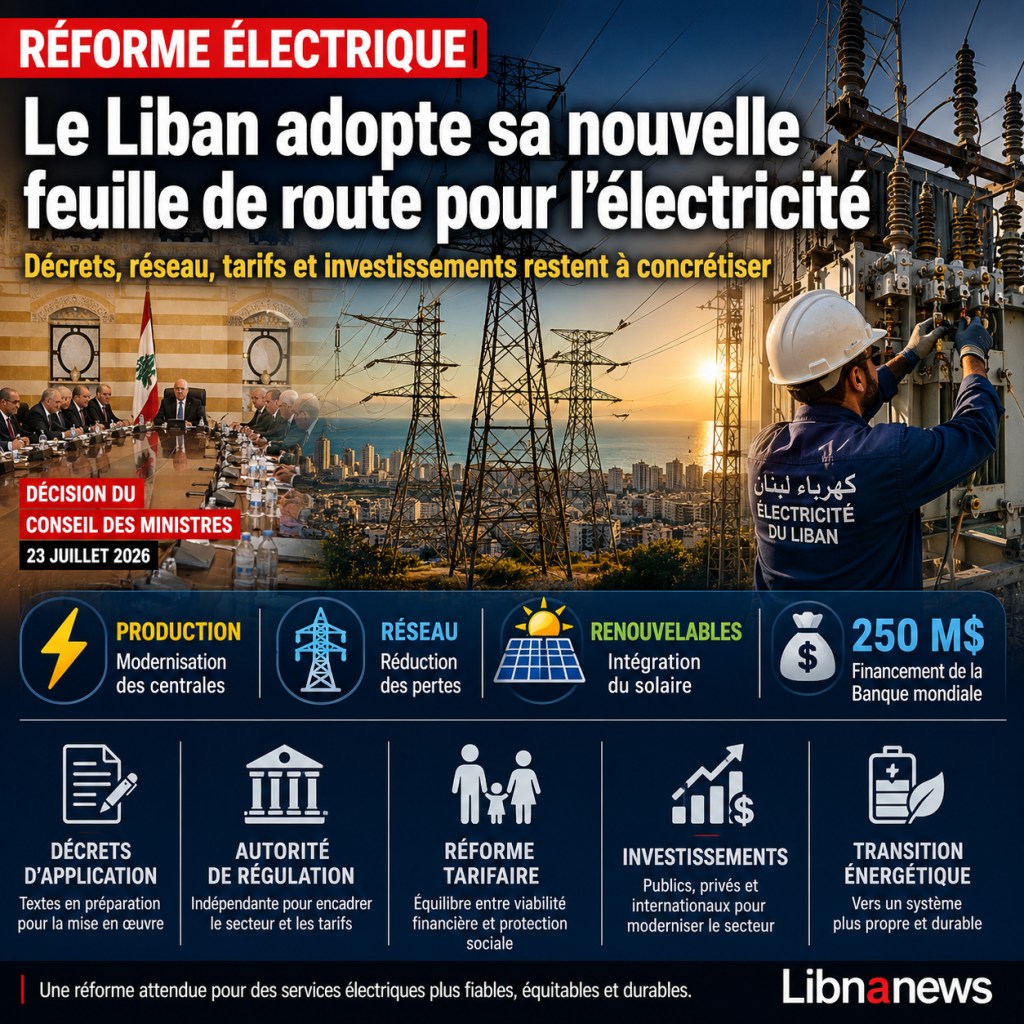
On 23 July 2026, the Lebanese Council of Ministers approved the public policy paper submitted by the Ministry of Energy and Water for the electricity sector. The Government also requested the preparation of the decrees necessary for its implementation. This decision places electricity again at the centre of the economic agenda, after years of shortages, public deficits and dependence on private generators. However, the detailed content of the document has not yet been made public. The targets, timing, planned investments and monitoring mechanisms therefore remain to be specified.
The decision announced at the end of the meeting is not yet an applied reform. It validates a government policy framework and opens a regulatory phase. The ministries and agencies concerned will now have to transform the general guidelines into decrees, contracts, budgets and procedures. This will be a decisive step. Lebanon has already adopted several plans for electricity, without succeeding in restoring a continuous service or placing the public operator on a sustainable financial path.
An approved policy sheet, but not yet detailed
Information Minister Paul Morcos said that the issue had occupied an important part of the discussions in the Council of Ministers. According to the official report, the government approved the sheet submitted by the Minister of Energy and requested the issuance of the corresponding decrees. No full presentation of the text was accompanied by this announcement.
This lack of detail limits at this stage the evaluation of electricity policy. The public is not yet aware of the targets for production, feeding hours, loss reduction or financial balance of electricity in Lebanon. Nor did the government announce the overall cost of the proposed measures.
Several questions remain open. Does the sheet include new power plants, conversion to gas, increased use of solar power or electricity purchases from neighbouring countries? Does it set a timetable for modernising the transport network? Does it organise the intervention of private producers? Does it provide tariff protection for modest households?
These elements shall be included in the implementing texts or in the accompanying technical documents. Their publication will make it possible to distinguish the measures which can be implemented immediately from the medium-term objectives. It will also verify whether the available funding covers the commitments announced.
The choice to go through decrees shows that several provisions require a precise regulatory basis. These laws will have to distribute responsibilities between the Ministry of Energy, Electricity of Lebanon, the Ministry of Finance and the supervisory bodies. They will also have to lay down the procurement rules and the obligations of any private operators.
Electricity sector policy in response to crises
The Lebanese electricity system has suffered for decades from a gap between demand and public supply. Even before the financial crisis of 2019, the cuts were regular. The monetary collapse, foreign exchange shortages and rising fuel costs further reduced production capacity.
Electricity in Lebanon was no longer able to provide stable food. Households and businesses compensated by subscriptions to neighbourhood generators and then private solar installations. This shift avoided a complete shutdown of many activities, but it created a multi-speed system.
Consumers with dollar revenues were able to finance expensive panels, batteries or subscriptions. The most fragile households have reduced their consumption or experienced long periods without current. Companies have integrated the cost of private energy into their prices, which has fuelled tensions over purchasing power.
The sector also weighs on public finances. For years, the State has covered losses of electricity in Lebanon, including by financing fuel purchases. Tariffs, which had been frozen for a long time, did not reflect actual costs or changes in international prices.
Tariff reform was initiated after the crisis, but it is not enough to restore balance. A higher rate will only generate revenue if the billing is regular, the meters work and the invoices are actually collected. Quality of service also plays a central role in accepting payment.
Production, network and collection: three related projects
The reform cannot be limited to increasing the amount of electricity produced. An additional power plant does not resolve network losses, unpaid losses or irregular connections. Conversely, improved collection is not enough if supply remains low and unpredictable.
The first project concerns production. Lebanon relies heavily on aging thermal power plants and imported fuels. This dependency exposes the country to variations in world prices, funding difficulties and logistical disruption.
The use of natural gas is often presented as a less costly and polluting option than some currently used fuels. However, implementation requires import infrastructure, supply contracts and financial guarantees. It also depends on the regional context.
The second project concerns transport and distribution. Old equipment, saturated lines and poorly maintained posts cause technical losses. Investments should target areas where the network cannot absorb additional production or properly integrate new renewable capacity.
The third project concerns non-technical losses. Illegal connections, fraud and unpaid invoices reduce the revenue of the public operator. Their processing requires reliable meters, inspection teams and political support for control measures.
These three dimensions must move forward together. A credible policy must combine production, network and commercial governance. It should also include public indicators to monitor results.
Funding of $250 million
In October 2024, the World Bank approved funding of $250 million for a project on renewable energy and strengthening the Lebanese electricity system. Its objective is to help restore cleaner, more reliable and more efficient network services.
This funding is an important lever, but it does not cover all the needs of the sector. It must support targeted investments and support certain reforms. Disbursements generally depend on procedures, procurement plans and follow-up requirements.
The international project can finance network work, equipment or renewable capacity. It can also contribute to institutional strengthening. However, its effectiveness will depend on alignment between the lessor’s priorities and the policy paper approved by the government.
The Council of Ministers should avoid duplication of programmes. Each investment must correspond to a specific function: production, transport, distribution, counting or management. Inadequate coordination could lead to the financing of equipment without addressing obstacles to its use.
The amount of $250 million was also mentioned during the exchange between the Minister of Information and journalists after the meeting. The reported response seemed to be associated with digital transformation. The Council has separately approved a loan of $150 million for this issue.
Clarification of the amounts is necessary. Funding of $250 million relates to the electricity project previously approved by the World Bank. The 150 million loan announced at the 23 July session aims to digitize public services. The two programmes do not meet the same objectives.
The expected place of renewable energies
The rapid expansion of solar panels has profoundly altered the energy landscape in Lebanon. In the face of cuts and the cost of generators, households, businesses, hospitals and institutions have installed their own systems.
This progress reduced the pressure on the network for some hours. It has also created a dispersed electrical capacity, financed directly by consumers. The phenomenon has developed faster than the regulatory framework.
The new electricity policy will have to incorporate this reality. It will have to set standards for installations, batteries, connections and safety. It will also have to define the conditions under which producers can inject surplus over the network.
Large-scale solar development requires lines capable of transporting the electricity produced. It also requires additional storage mechanisms or means of production for periods without sun.
The authorities should avoid the energy transition exacerbating inequalities. Households that cannot buy their own equipment should not be excluded from a modernised public system. Collective projects, municipal facilities or appropriate funding mechanisms can reduce this gap.
The issue of tariffs remains linked to this development. The more large consumers leave the grid partially thanks to solar, the more likely the public operator is to lose revenue. Poorly designed pricing could shift an increasing share of fixed costs to the least equipped subscribers.
A regulatory authority at the heart of the system
Governance is one of the main tests of reform. The sector has long been managed by a concentration of decisions in the Ministry and in the public operator. International partners have regularly called for more independent regulation and more separate responsibilities.
A regulatory authority must be able to regulate licences, monitor tariffs, monitor the quality of service and arbitrate certain relations between operators. Its effectiveness depends on its independence, its means and the transparency of its decisions.
The mere creation or activation of an authority does not guarantee its functioning. It must have experts, a budget and access to sector data. It must also publish reasoned decisions and regular reports.
The regulatory framework should specify the relationship between this authority, the Ministry of Energy and Electricity of Lebanon. The Ministry determines public policy. The regulator shall apply the rules and monitor the market. The operator produces, buys, transports or distributes electricity according to the chosen model.
A clear separation reduces conflicts of interest. It also improves investor confidence. Private companies are reluctant to finance infrastructure when rules can change without a predictable procedure or when the public body combines several functions.
Rates and social protection: the sensitive balance
The financial recovery of electricity in Lebanon requires more regular revenues. However, the government will need to avoid a limited approach to raising tariffs. Households already pay several energy bills, between the public network, generators and private equipment.
The actual cost must be compared with the number of hours provided. A higher public bill may become acceptable if it replaces a significant portion of the expense spent on generators. It will be more difficult to withstand if the diet remains weak.
A social mechanism can protect basic consumption. It can take the form of a progressive tariff, a subsidized tranche or targeted aid. Its funding must be explicit so as not to recreate a hidden deficit.
The authorities must also deal with arrears accumulated by certain public administrations and institutions. The state cannot ask households to pay regularly while allowing its own agencies to delay their settlements.
Transparency of invoices will be essential. Subscribers must be able to understand the quantity consumed, the tariff applied, taxes and any fixed charges. The challenge procedures must also work.
The installation of modern meters can improve billing. It can reduce estimates and facilitate monitoring of consumption. However, it raises issues of cost, data protection and maintenance.
The private sector under conditions of transparency
The approved policy could further open the sector to private producers. This participation can accelerate investment when the state lacks capital. It can also introduce new technical skills.
Private use does not automatically guarantee lower prices. It depends on contracts, risks transferred and conditions of competition. A poorly negotiated agreement may involve the state on high payments for several years.
Tendering will therefore have to be public and competitive. The award criteria, tenders received and contracts signed must be subject to scrutiny. Tariff clauses must be compatible with the system’s capacity to pay.
The Government will also have to define the role of electricity in Lebanon. The establishment may remain a central buyer, network manager or integrated operator. Each model has risks and requires different rules.
Decentralised production adds another dimension. Municipalities, cooperatives or business groups can develop local facilities. Their connection requires a uniform technical and commercial framework.
Unorganized opening could further fragment the system. A framed opening could, on the contrary, diversify supply and reduce dependence on a few plants.
Decrees as the first political test
The adoption of the document by the Council of Ministers gives the government a common political basis. The first test will now be the speed of preparation of the decrees requested.
These texts must be sufficiently precise to enable implementation. They must not only incorporate general principles. They will have to set deadlines, designate responsible authorities and define control mechanisms.
Parliament could also be called upon to intervene if certain measures required legislative change. The distinction between what falls under a decree and what requires a law will need to be clarified.
The publication of the full text of the sheet would enhance transparency. It would allow experts, trade unions, businesses and consumer associations to examine the choices chosen.
The government will also have to present a funding table. It should distinguish between loans, grants, private investment and own resources for electricity in Lebanon. It should specify the cost of each phase.
Finally, a public calendar would help measure progress. Authorities could set quarterly or annual targets on feeding hours, collection, losses, network work and renewable capacity.
A reform judged on current hours
For citizens, success will not be measured by the number of documents adopted. It will depend on the available electricity hours, the stability of the voltage and the total cost paid each month.
Companies expect a predictable supply to reduce the use of generators. Hospitals, schools and public services need direct current to function normally.
Gradual improvement can already produce economic effects. Each additional hour provided by the public network can reduce fuel costs, noise and pollution associated with generators.
The credibility of electricity policy will therefore depend on visible results. The government will have to explain any differences between objectives and delivery. It will also need to publish regular production and revenue data.
The decision of 23 July opens a new sequence, but it does not end the uncertainties. The full content of the sheet, the decrees, the timetable and the first public procurements remain expected. Their publication will show whether the government has adopted an operational program or only a new direction in an area where plans have often followed one another without restoring the current trend.




