

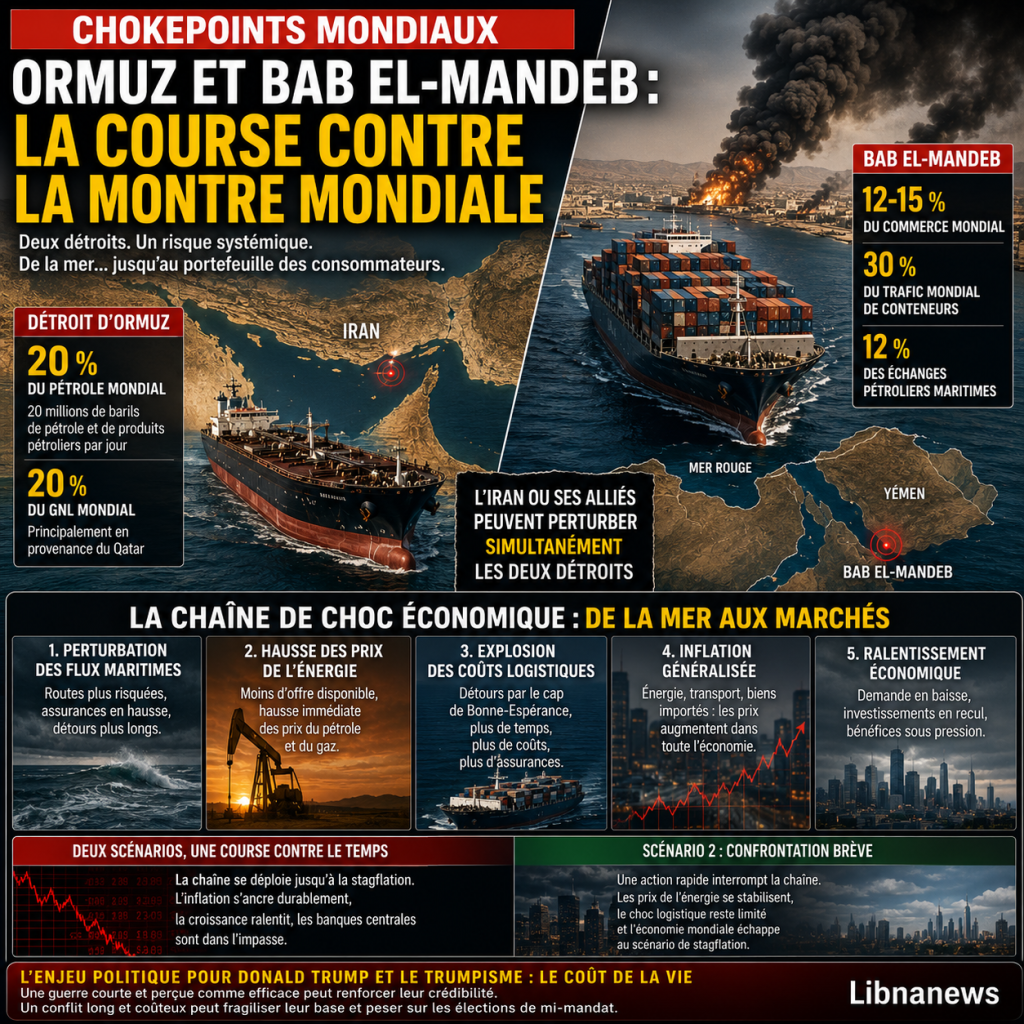
- Iran, directly or via the Houthis, can disrupt simultaneously Ormuz and Bab el-Mandeb, triggering a global causal chain: disorganization of marine flows → energy shock → explosion of logistical costs → inflation → economic slowdown.
- The combination of the two straits blocks adjustment pathways, transforming a regional disturbance into a global systemic shock.
- Two scenarios: either a prolonged conflict allowing the whole chain to spread to stagflation, or a brief confrontation that quickly interrupts the transmission of the shock and limits the economic impact.
The Straits of Ormuz and Bab al-Mandeb are not mere maritime passages: they are bottlenecks on which the global economic balance depends. Today, Iran’s ability — directly or via its Houthis allies — to simultaneously disrupt these two chokepoints poses a major systemic risk. This risk follows a specific causal chain: disturbance of marine flows → rise in energy prices → explosion in logistics costs → generalised inflation → economic slowdown, i.e. the conditions of a stagflation.
Tehran does not legally control these waterways, but it can disrupt their functioning: making crossings more risky, increasing insurance costs, diverting flows and, at worst, causing de facto closure. In other words, even without formal control, it can trigger the first link in this chain: the disruption of maritime flows.
The Ormuz Strait is the world’s main energy lock. Approximately 20 million barrels of oil and petroleum products were transported daily in 2024, accounting for nearly 20 per cent of global consumption of petroleum liquids. It also sees nearly 20 per cent of the world’s liquefied natural gas trade, mainly from Qatar. Any disruption in Ormuz therefore immediately results in a tension on the world energy supply — the first step towards higher prices. (U.S. Energy Information Administration)
Bab el-Mandeb connects the Indian Ocean to the Red Sea, then the Suez Canal and the Mediterranean. Prior to the recent disruptions, this route was home to about 12-15 percent of world trade and about 30 percent of container traffic, as well as about 12 percent of marine oil trade. Its disruption affects not only energy, but all trade flows — the second link in the chain, that of logistics costs. (UNCTAD)
The combination of the two straits is decisive because it prevents adjustment mechanisms. If Ormuz becomes risky, part of the Gulf oil can be redirected to the Red Sea via Saudi pipelines. But if Bab al-Mandeb is also disturbed, this alternative disappears. The ships must then bypass Africa by the Cape of Good Hope. This detour lengthens journeys by several weeks, immobilizes more capital and greatly increases transport and insurance costs. In some cases, it adds nearly a month and several million dollars per trip. This is where the marine disturbance is transformed into a logistical shock. (Reuters)
From there, transmission to the real economy becomes mechanical. First, rising energy prices increase production costs in industry, agriculture and services. Secondly, the increase in logistics costs increases the transport of intermediate and final goods. Together, these two effects fuel so-called « cost » inflation. This inflation is broadly dollar-denominated, increasing its impact on countries whose currencies are depreciating.
Third stage of the chain: impact on economic agents. Households are losing their purchasing power as a result of rising energy prices and imported goods. They reduce their consumption. Companies, for their part, face a double constraint: rising costs and declining demand. Their margins are compressing, their investments slow down and their profits are revised downwards.
Step four: financial dissemination. Markets integrate these deteriorating prospects. Valuations decline as profit expectations decline and interest rates remain high to contain inflation. As the International Monetary Fund points out, the rise in raw materials acts as a negative supply shock, combining inflation with economic slowdown. (IFM)
The end of this chain is stagflation. Growth slowed down as demand and investment contracted, while inflation remained high due to energy and logistical costs. Central banks then find themselves in a stalemate: supporting activity would mean lowering rates, but containing inflation requires keeping them high. A persistent increase in oil could prolong this monetary tension and have a lasting impact on the economy. (Federal Reserve)
That’s why we’re involved in a race against time. Two scenarios are emerging. In the first, the conflict settles: the disruption of the chokepoints continues, the causal chain unfolds entirely and inflation is permanently anchored in the world economy. In the second, an intense but brief confrontation quickly interrupts this chain, limiting the rise in energy prices and preventing the shock from spreading to logistical costs and inflation.
However, this second scenario remains uncertain. A war can be launched quickly without being controlled for its duration, especially since Iran has strategic depth and regional relays capable of prolonging pressure.
The stakes are also political for Donald Trump and trempism. Their promise of a strong and protective America will be judged on the basis of the cost of living — the last link in the economic chain. A short and perceived effective war could interrupt the transmission of the shock and strengthen their credibility. Conversely, a long conflict, by allowing the whole chain — energy, logistics, inflation, slowdown — could weaken their base and affect the mid-term elections. (USAGov)
Military, economic and electoral times converge. The longer the conflict persists, the stronger each link in the chain becomes and spreads in prices, investment decisions and consumer behaviour. The question is therefore no longer only military: whether the crisis will be contained before this cumulative dynamic — from the sea to the markets — settles on a lasting basis.




