





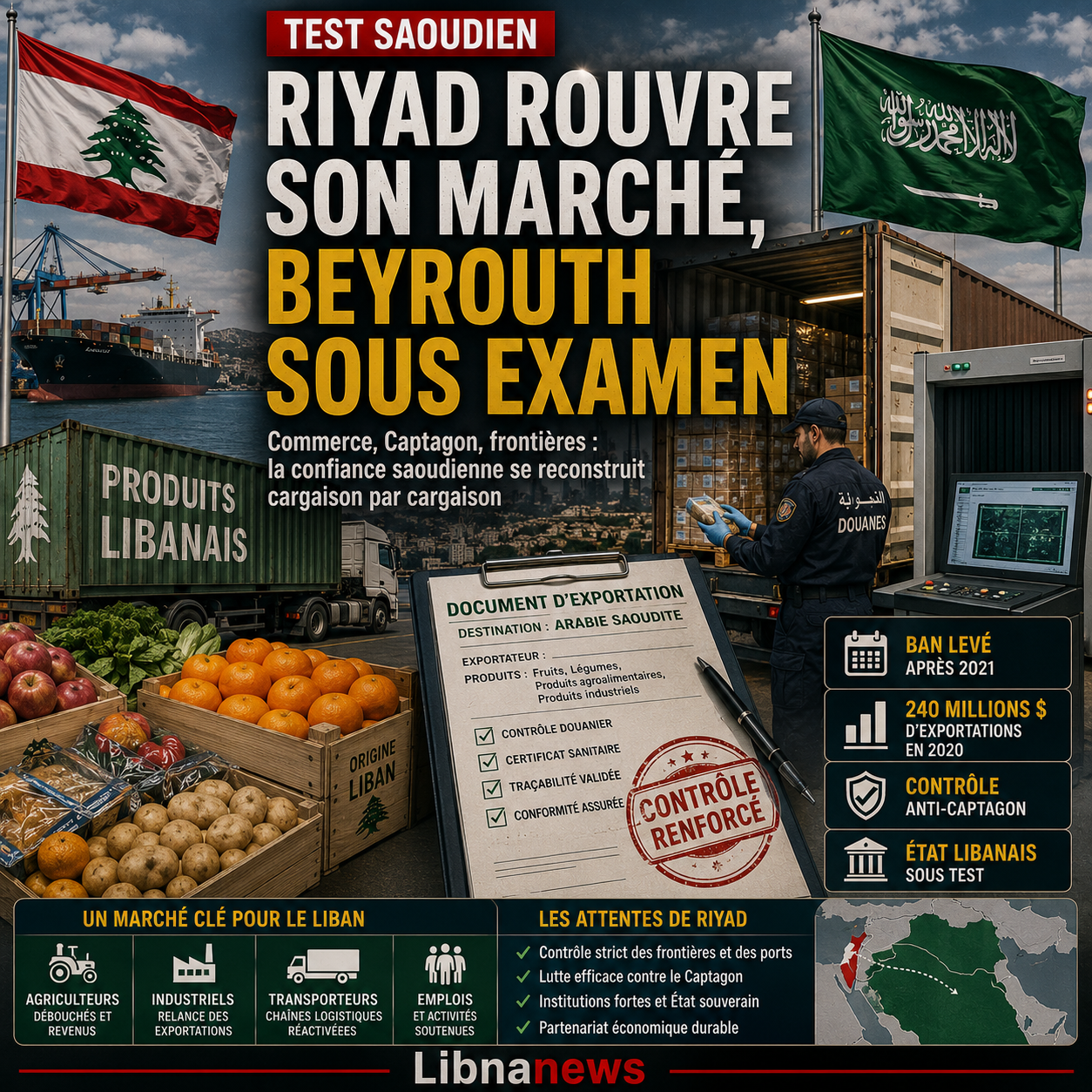
The resumption of exports to Saudi Arabia opens a decisive sequence for Lebanon. Riyadh lifted the ban on Lebanese products since 2021, after years of diplomatic crisis, suspicions of trafficking in Captagon and breach of trust with Beirut. The decision provides an expected opportunity for farmers, industry and carriers. But it is not just a commercial gesture. It tests the ability of the Lebanese State to control its borders, ports, cargo and roads. It also measures the seriousness of the new power, as the country seeks to reconnect with its Arab environment and to break out of economic isolation.
The signal is all the more important as it intervenes in a region affected by the announced agreement between the United States and Iran. As Lebanon seeks a lasting ceasefire in the South, Israeli withdrawal and reconstruction guarantees, Riyadh returns with a concrete issue: trade. Saudi Arabia does not yet promise a massive cheque or complete normalization. It starts by reopening a market. This choice is revealing. For the Saudis, aid to Lebanon must go through state proof. Exports to Arabia therefore become a political review. Every container, every certificate, every customs check will tell whether Beirut can become a reliable partner again.
Key numbers in the folder
| Indicator | Number or date | Issue |
|---|---|---|
| Beginning of Saudi ban | 2021 | Commercial breakdown related to Captagon and political distrust |
| Crisis seizure | More than 5 million pills | Captagon hidden in grenades, according to press reports |
| Lebanese exports to Arabia in 2020 | Approximately $240 million | Important market for Lebanese producers |
| Lebanese exports to Arabia in 2019 | $246 million | World Bank data, before the banking shock |
| Resumption decision | 10 june 2026 | Saudi gesture after the requests of Joseph Aoun and Nawaf Salam |
A commercial decision, a political message
The Saudi decision was announced after a meeting between the Saudi Foreign Minister and Prime Minister Nawaf Salam. It responded to a request made by President Joseph Aoun and the head of the Lebanese government. The Saudi communiqué emphasized the positive steps taken by Beirut to rebuild State institutions and Lebanese cooperation in the commitments requested. The vocabulary counts. Riyadh is not just about fruits, vegetables, agri-food products or industrial goods. He talks about trust, institutions and guarantees. The resumption is therefore conditional in its mind, even if the announcement marks an official lifting of the blockage.
Lebanon welcomed the decision as a contribution to the recovery of the economy. This reaction is logical. Before the ban, Saudi Arabia was one of the main markets for Lebanese products. Exports to the kingdom amounted to approximately $240 million in 2020 according to data cited by a news agency. Other public estimates reported a level close to $230 million and placed Riyadh among the top destinations for Lebanese products. For a private currency economy, weakened by the banking crisis and affected by the war, this market return can provide a breath of oxygen.
However, the benefit will not be automatic or immediate. Producers must reconstitute contracts. Carriers must reactivate logistics chains. Saudi importers must regain confidence. Authorities must harmonize health, customs and security procedures. Farmers also have to deal with the losses caused by the war in the South and the high cost of inputs. A commercial border is not only reopened by political decision. It is reopened by inspections, invoices, deadlines, controls and the ability to deliver compliant products on a regular basis.
The Captagon, the heart of the Saudi test
Captagon’s file remains the heart of the test. In April 2021, Riyadh banned Lebanese fruits and vegetables after the discovery of Captagon pills hidden in a shipment of grenades. The measure was then extended to all Lebanese imports, in a context of political crisis and tensions around the influence of Hezbollah. The episode had ruined the credibility of the Lebanese export chain. He had also shown that the problem was not just a matter of final customs. Traffickers could exploit ports, roads, warehouses, commercial documents and multi-stage control loopholes.
Riyadh therefore awaits a State capable of preventing fraud before the departure of cargoes. This involves operational scanners, targeted inspections, detector dogs, cooperation between customs, army, security forces, justice and economic ministries. This also involves tracking export companies, brokers, carriers and warehouses. A system that controls only the exit point may miss upstream networks. Combating Captagon requires a complete chain, from production to boarding. The Saudis will not only judge promises. They will judge the number of incidents avoided.
The fall of the former Syrian regime changed part of the regional traffic environment, but it did not remove the risk. Networks between Syria, Bekaa, border areas and trade routes to the Gulf have long been established. Several Arab and Western States have accused Syrian actors and Hezbollah-related networks of playing a role in this illegal economy, which Hezbollah has denied. Lebanon cannot solve the problem alone. However, it can prove that it no longer allows its infrastructure to be used as a gateway. This is Riyadh’s central demand.
Farmers and industrialists await the return of the Gulf
For farmers, the reopening of the Saudi market is an old expectation. Producers of fruit, vegetables, citrus fruits, apples, grapes, potatoes or processed products have lost a high-value outlet. The Saudi market offered volumes, prices and regularity that the local market could not absorb. Its closure pushed producers to less profitable destinations, caused surpluses and increased reliance on intermediaries. In several regions, including the Bekaa and the North, recovery can improve margins, revive packaging chains and restore interest in Gulf crops.
Industrialists are also involved. The Saudi crisis not only affected agricultural products. The extension of the ban had penalised processed food products, certain manufactured goods, packaging products, consumer goods and value-added goods. For Lebanese companies, the Gulf was a natural, culturally close and solvent market. The recovery offers the possibility of rebuilding a commercial presence, but industrialists will also have to prove their compliance. Standards, packaging, dates, certificates of origin and traceability checks will become both political and economic.
Transporters and logisticians are also waiting for a revival. Prior to the successive crises, trade to the Gulf provided for trucking companies, freight forwarders, brokers, packagers, cold storage and small service companies. The land route through Syria and Jordan had already been weakened by the Syrian war. Maritime costs then increased. Saudi recovery will not be enough to remove these obstacles, but it can justify investments in the cold, sorting, certification and digital tracking of cargo. It is an important lever to modernise part of the export chain.
Riyadh tests the state more than the market
However, the political scope goes beyond trade. By reopening its market, Riyadh sends a message to President Aoun and the Salam government. The kingdom wants to support a Lebanese state capable of taking over its institutions, without offering a blank-sing to the political system. The gesture is therefore calibrated. It rewards efforts and encourages orientation. It does not address the issue of arms, Hezbollah, borders and financial reform. It enables Beirut to show a concrete result to an opinion tired of war and crisis. It also gives Riyadh a means of weighing without returning from the outset with massive budgetary aid.
This method corresponds to Saudi prudence. The kingdom long considered that its support for Lebanon had been neutralized by the rise of Iranian influence and by the State’s inability to control strategic decisions. He now returns in stages. The first door is commercial. The next may be diplomatic, financial or reconstruction-related, but it will depend on evidence. Riyadh observes Beirut’s ability to secure exports, to cooperate against drug trafficking, to control crossing points and to reduce the margins of action of illicit networks. Trade thus becomes an instrument of valuation.
The decision also comes at a time when southern Lebanon is awaiting a verifiable ceasefire. This coincidence creates additional pressure. Arab partners will not finance a country whose territory remains open to war. Exporters will not be able to stabilize their contracts if strikes disrupt roads, ports or insurance. Investors will not come back if sovereignty remains a concept discussed. The resumption of exports to Arabia cannot therefore be separated from the debate on national security. It depends on the State’s ability to enforce the same rule on economic borders and military borders.
A recovery that does not bring Lebanon back to 2020
Beirut will have to avoid the mistake of presenting the Saudi decision as an automatic return to the pre-crisis. The Lebanon of 2026 is no longer 2020. Banks are no longer functioning normally. Deposits remain blocked. Producers lack credit. Infrastructure has deteriorated. Insurance is more expensive. Trade routes have changed. Regional competitors have taken part of the abandoned markets. Returning to Saudi Arabia will therefore require a strategy. Priority products must be identified, chains secured, small farms helped, certifications accompanied and the image of the Lebanese label protected.
This strategy should start with a single unit for exports to the Gulf. It could bring together the Ministries of Economy, Agriculture, Industry, Finance, Interior, Customs, Security Services, Chambers of Commerce and Professional Organizations. Its role would be to monitor sensitive cargoes, unify certificates, issue clear procedures and respond promptly to Saudi alerts. Lebanon has often suffered from administrative dispersion. On this file, dispersion would be dangerous. Only one major incident could be enough to close the window.
Transparency must accompany recovery. Serious exporters have an interest in stricter controls because they pay the price of fraud by others. Approved company lists, regular audits, digital tracking of lots and public sanctions against offenders can protect the sector. The agricultural and industrial unions will have to accept this discipline. It will cost time and money. But it is the price of access to a market where confidence has been broken. Without traceability, Lebanon will remain vulnerable to collective suspicions.
Expected social effects in productive regions
Recovery can also have social effects. A successful agricultural export does not only benefit the owner of an orchard. It supports seasonal workers, drivers, packaging stations, mechanics, packaging suppliers, small traders and rural families. In a country where poverty has spread since the financial crisis, this chain counts. It can bring foreign exchange to marginalized regions and reduce pressure on a saturated local market. But these gains will depend on the ability to avoid capture by some major intermediaries. Small producers must be integrated, otherwise recovery will above all strengthen the actors already organised.
Finally, the State will have to link this openness with the fight against the illegal economy. Captagon is not just a security file. It also thrives on poverty, lack of alternatives, areas of lawlessness and political protections. Repressing traffic without offering legal opportunities leaves a void. Relaunching agriculture, supporting cooperatives, facilitating productive credit and reopening markets can help reduce the attractiveness of illicit channels. Saudi recovery can therefore become a tool of economic sovereignty, provided that it is conceived as such.
The diplomatic issue is equally clear. If Lebanon passes this test, it can ask for more. He may plead for a wider return of Gulf tourists, Saudi or Arab participation in reconstruction, investment in infrastructure and support for the army. If the test fails, the decision of June 10 will remain an isolated gesture, quickly closed by mistrust. Riyadh doesn’t need to threaten publicly. It is enough to slow down authorisations, strengthen controls or discourage importers. In an asymmetrical relationship, trust is lost faster than it is rebuilt.
The recovery of exports to Arabia is therefore less a reward than a probationary period. It gives Lebanon a chance to prove that its institutions can function together, that its borders can be controlled and that its productive economy can regain its place in the Arab world. The first trucks, the first containers and the first validated certificates will have political value. They will say whether the Lebanese State can turn a Saudi opening into a lasting relationship, or whether the old flaws will take over at the same time as the country seeks to finance its reconstruction and Arab return.