

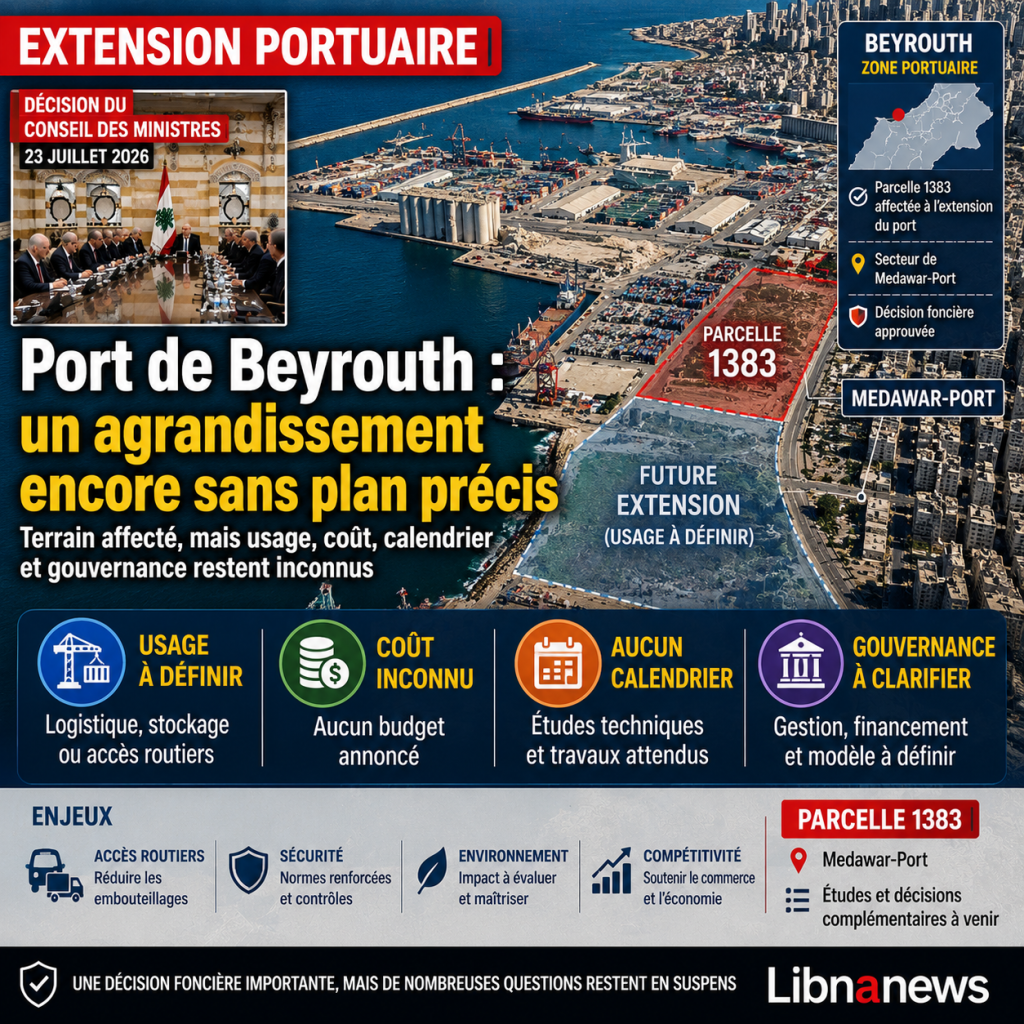
On 23 July 2026, the Lebanese Council of Ministers approved the allocation of Parcel No. 1383, located in the Medawar-Port area, for a project to extend the port of Beirut. This land decision paves the way for an increase in the port right-of-way, but it does not yet measure its operational scope. The Government did not communicate the exact area mobilized, the function planned for the ground, or the cost of future work. Nor did he present a timetable. The extension of the port of Beirut will therefore have to be clarified by technical studies, a financing plan and a governance framework which are still expected.
The decision comes in a period of revival of the projects related to the main port platform of the country. Almost six years after the explosion of 4 August 2020, the site continues to provide an essential share of Lebanese imports. However, it must modernize its facilities, improve its access and clarify its institutional organization. The allocation of a new parcel can meet certain logistical needs. It also raises urban, environmental and security issues in an area directly adjacent to densely populated neighbourhoods.
A plot reserved for the extension of Beirut port
The Government has adopted a specific land measure. He agreed to allocate parcel 1383 of Medawar-Port to the extension of the port facility. However, the report submitted after the meeting did not provide any details of the previous status of the land or of the activities that could be installed there.
Land allocation alone is not a work permit. It provides space for a specific purpose and allows the administrations concerned to continue preparing the project. Additional decisions will be required before any construction.
The authorities must first specify the boundaries of the plot and its exploitable area. They will then have to determine whether the land will accommodate warehouses, handling facilities, access routes, customs space or container equipment.
These uses meet different needs. A logistics area requires buildings, networks and traffic areas. A new entrance door requires suitable roads and control devices. A storage area involves safety standards related to the nature of the goods.
The government will also need to indicate which institution will receive field management. The port of Beirut remains administered in an old interim framework. The assignment could be entrusted to the current managing body or integrated into a future port authority.
The absence of such clarification does not reduce the importance of the decision. However, it shows that the project is still at an initial administrative stage. Its real dimension will depend on the documents that follow.
An essential port for Lebanese foreign trade
The port of Beirut plays a central role in the supply of Lebanon. It deals with containers, food products, raw materials, equipment and many goods destined for the national market.
Much of the country’s needs are important. The port performance therefore directly influences the cost of the products. Long delays, bad organisation or unpredictable costs can affect businesses and consumers.
The port also serves Lebanese exporters. Industrialists and farmers need regular connections, rapid procedures and adequate storage capacity. An effective platform can reduce costs and improve access to foreign markets.
The extension of the port of Beirut must therefore be examined according to measurable needs. Authorities must identify current flows, saturation periods and inadequate equipment. They must also assess the likely development of traffic.
An increase in area does not automatically lead to an increase in productivity. Performance depends on the organisation of terminals, lifting equipment, computer systems, customs controls and truck traffic.
The project should therefore be based on a capacity study. This will have to show whether the port really lacks space or whether it must first reorganise the areas it already uses.
This distinction is important. A costly extension could be avoided if a better organisation makes it possible to exploit existing surfaces. Conversely, additional land may become necessary if existing facilities prevent modernization.
What use for Parcel 1383?
The announced assignment does not specify the function of the parcel. Several scenarios may be considered, but none can be considered confirmed in the absence of a detailed official document.
The land could be used to improve internal traffic. Port entrances and exits are constrained by truck passage, controls and proximity to urban axes. A new route could reduce some congestion.
The plot could also host logistics activities today dispersed. The consolidation of inspections, formalities and waiting areas can speed up the exit of goods.
Another hypothesis concerns storage. Ports need separate spaces depending on the nature of the cargo. Containers, bulk products and dangerous goods do not meet the same standards.
Finally, the allocation could be linked to a future broader master plan. The port is preparing several development projects, including improving its access and its connection to internal logistics platforms.
These possibilities will have to be separated by a formal study. The Commission should present the objectives, volumes concerned and variants examined. It will also have to explain why Parcel 1383 is the best choice.
Land costs must also be established. Even when land is owned by a public entity, its transfer of use is an economic decision. It can change the value of neighbouring sectors and limit other urban projects.
An extension related to site reconstruction
The project cannot be separated from the reconstruction initiated after the explosion of 4 August 2020. The deflagration destroyed the grain elevators, damaged the docks and ravaged part of the facility. It also caused considerable damage in nearby neighbourhoods.
The port has resumed its activities, but this continuity does not mean that its institutional and physical reconstruction has been completed. Some repairs have responded to urgent needs. Other projects require a sustainable vision.
Several proposals have been submitted since 2020. They cover the rehabilitation of docks, the modernization of equipment, the reorganization of storage and the improvement of safety standards.
International partners have also supported studies. They stressed the need to involve physical work in management reform. Their approach is based on the idea that reconstruction limited to buildings would duplicate previous frailties.
The extension of the port of Beirut must therefore be integrated into a master plan. Without this framework, land decisions and work may accumulate without consistency.
A management plan must set out the purpose of each area. It must distinguish between commercial terminals, logistics spaces, security facilities and areas that may be open to other uses.
It must also foresee the evolution of flows for several decades. A port infrastructure is not built to respond to a single period of traffic. It must be able to adapt to technological and commercial changes.
Governance as a condition for a credible extension
Governance remains a key issue in the port of Beirut. Infrastructure has been managed for decades by an interim committee. This has often been presented as an obstacle to a clear division of responsibilities.
A reform must distinguish between public ownership, regulation, terminal operation and the activities of private companies. It must also define financial control mechanisms.
Several international studies have recommended a model in which the port authority manages land and general infrastructure, while operators operate certain terminals under transparent concessions.
This model, often referred to as the owner port model, is not an automatic solution. Its effectiveness depends on the quality of contracts, competition and the independence of the regulator.
The allocation of Parcel 1383 directly raises this question. Who will decide on its use? Who will finance the equipment? Who will collect the income? Which institution will control the contracts?
The government will have to respond before the work begins. An extension financed by public funds must be subject to regular calls for tenders and checks.
Publication of contracts will also be necessary. It will provide information on the duration of concessions, investment bonds and revenue-sharing mechanisms.
Governance reform can finally facilitate external financing. Donors and investors are looking for a stable framework, verifiable accounts and an authority to enforce the rules.
Funding remains unknown
The Council of Ministers has not announced any budget for the extension. He did not indicate whether the project will be financed from the revenues of the port, the Treasury, a loan or a private partnership.
Yet this information is essential. Lebanon has limited public resources and must meet many reconstruction needs. Each investment must therefore be justified by a clearly identified economic return or service.
The port can finance part of the work thanks to its revenues. However, this option requires transparent accounts and multi-annual programming. Revenues must cover routine maintenance while allowing new investments.
An international loan could provide additional funding. It would nevertheless hire the State or port authority over several years. Repayment conditions should be compared to expected revenues.
The use of a private operator would reduce the initial state investment. It would create exploitation rights in return. A poorly balanced contract could limit public revenues or give an excessive advantage to a concessionaire.
Funding must therefore be decided after the technical study. It would be premature to choose an assembly before knowing the function of the terrain and the cost of the equipment.
The financial plan should include indirect expenditures. Access routes, networks, clean-up, safety and studies can represent a significant part of the total cost.
The issue of road access and urban traffic
The port is in the heart of a dense urban area. The districts of Medawar, Quarantine, Mar Mikhaël and Gemmayze are directly affected by its activity.
Trucks transporting goods use already loaded axes. They cause slowdowns, noise and emissions. Queues can also disrupt local movements.
An extension likely to increase traffic must therefore provide for new circuits. Heavy goods vehicles should not be directed to inappropriate streets or residential areas.
The project should be coordinated with municipal authorities, security forces and the Ministry of Public Works. It will have to define routes, schedules and waiting areas.
The creation of an internal logistics platform could reduce part of the pressure. Containers could be transferred to a dry port prior to distribution. This requires an efficient road or rail connection.
Projects announced in 2026 include a better connection between the port, the Bekaa and the Syrian border. They include the idea of a logistics corridor and an inland dry port.
The Beirut extension should be compatible with these projects. It should not unnecessarily increase the concentration of goods on the coast if certain operations can be displaced.
The rail network, which is now inactive, could also enter into a long-term reflection. A rail link would reduce truck movements, but would require major investment.
Security of goods as a priority
The 2020 explosion showed the consequences of dangerous storage and a failing chain of responsibility. Any port extension must therefore put security at the forefront.
Authorities must identify the nature of each commodity on the site. Hazardous substances require separate areas, reporting procedures and ongoing monitoring.
Warehouses must meet standards for ventilation, fire-fighting systems and safety distances. Teams must be trained to respond quickly.
Coordination between the port, customs, army, security forces and civil defence must be formalized. Each organization must know its role and have access to the necessary information.
Digital systems can strengthen control. A common platform can track the arrival, storage and exit of cargoes. It can also report goods that remain in the port for too long.
Security also depends on the speed of judicial and administrative proceedings. A seized cargo must not remain in place without a decision for several years.
The future use of Parcel 1383 should therefore be subject to risk analysis. This study should precede any authorization for storage or construction.
An Environmental Impact to Measure
Port activities produce air emissions, noise, waste and polluted water. An extension may increase these nuisances if it does not incorporate reduction measures.
An environmental impact assessment will have to consider work and future operation. It should cover air quality, soil, coastal waters and traffic.
Soil pollution is a particular risk in old industrial areas. Before construction, samples may be required to identify hydrocarbons or toxic substances.
The work must also limit dust dispersion. Worksites near inhabited areas require regular monitoring and supervised schedules.
The port can reduce its footprint by electrifying certain equipment, using efficient lighting and developing solar energy. Electric dock connections may also limit the use of auxiliary engines on ships.
Ship waste management needs to be strengthened. The port must have adequate facilities to avoid illegal discharges at sea.
A modern extension should include these equipment from the design stage. Adding them after work would increase costs and reduce their efficiency.
The relationship between the port and the city
The port of Beirut borders areas whose history and economic activity are closely linked to the coastline. Its extension thus revives the debate on the relationship between infrastructure and the city.
Since 2020, residents have been calling for more transparency on reconstruction plans. They also want to preserve access to the site’s memory and reduce nuisances.
The port authority must maintain secure areas, but this does not prevent a consultation on the boundaries, traffic routes and uses of neighbouring areas.
Parcel 1383 could alter local balance. Its development must take into account residential buildings, craft activities and existing urban projects.
A public consultation would provide an opportunity to present the alternatives and collect comments. It would not replace the State’s decision, but could identify neglected constraints.
The plan must also take into account the memory of the explosion. The damaged silos and neighbouring areas remain associated with the 4 August victims and destruction.
Any transformation of the site must therefore distinguish between commercial needs, security requirements and the preservation of places of memory.
An extension to coordinate with other ports
Lebanon does not only have the port of Beirut. Tripoli, Saida and other maritime facilities can participate in a national strategy.
The excessive concentration of flows in a single infrastructure increases the vulnerability of the country. A breakdown, accident or conflict can disrupt much of the imports.
The development of Beirut must therefore be coordinated with that of Tripoli. Both ports can perform complementary functions depending on the types of goods, the areas served and the land routes.
A national strategy must avoid redundant investment. It must allocate capacity according to realistic forecasts and not institutional rivalries.
The Council of Ministers will have to clarify whether the Beirut extension is part of a national port scheme. This clarification would make it possible to assess its interest beyond the capital.
Cooperation between ports can also enhance the continuity of services. Compatible systems, common customs rules and shared digital procedures would facilitate the transfer of flows in the event of a crisis.
The extension must therefore fulfil a clearly defined national function. It cannot be studied solely at the scale of the plot concerned.
Future decisions expected
Land allocation is the first visible act of the project. The next steps will need to clarify its content.
The government should first publish a land record and a location plan. These documents would provide information on the boundaries of the land and its relationship to existing facilities.
A feasibility study will then have to compare several uses. It should include traffic forecasts, construction costs and expected revenues.
The environmental study should assess the effects on neighbouring neighbourhoods and coastal areas. It will have to propose measures to reduce nuisances.
The government will also have to stop the governance model. He shall designate the contractor, the supervisory authority and any operator.
Funding can only be set after these steps. The authorities will then have to publish the budget, the sources of funds and the timetable.
The call for tenders will be another test. It will have to ensure real competition and allow control of technical and financial proposals.
The decision of 23 July gives the port of Beirut a possibility of extension. It does not yet say what will be built on Parcel 1383. Studies, consultations and implementation texts will now have to show whether this land meets an established logistical need and whether it can be developed without replicating the management and security weaknesses revealed since 2020.




