





Can Lebanon rebuild without bank reform? The issue goes beyond the technical debate between government, the Bank of Lebanon, commercial banks and the International Monetary Fund. It is a condition for the country’s ability to finance destroyed housing, closed roads, schools, hospitals, agricultural land and war-affected public networks. The regional ceasefire announced between Washington and Tehran can open a stabilization window. It can encourage international aid. It does not regulate the central lock: a country whose banking system no longer lends, whose deposits remain largely blocked and whose state remains in default cannot lead to lasting reconstruction.
Reconstruction requires long money, traceable payments, guarantees, insurance, credit, tendering and a minimum relationship with donors. Lebanon still operates on a cash economy, driven by diaspora transfers, small private channels and household adaptation. This model made it possible to survive. It does not allow the reconstruction of a country. Donors can finance targeted projects. Arab countries can help villages, roads or the army. The World Bank may approve envelopes. But without banking reform, these flows will remain fragmented, costly and politically vulnerable.
Reconstruction and finance: two inseparable dossiers
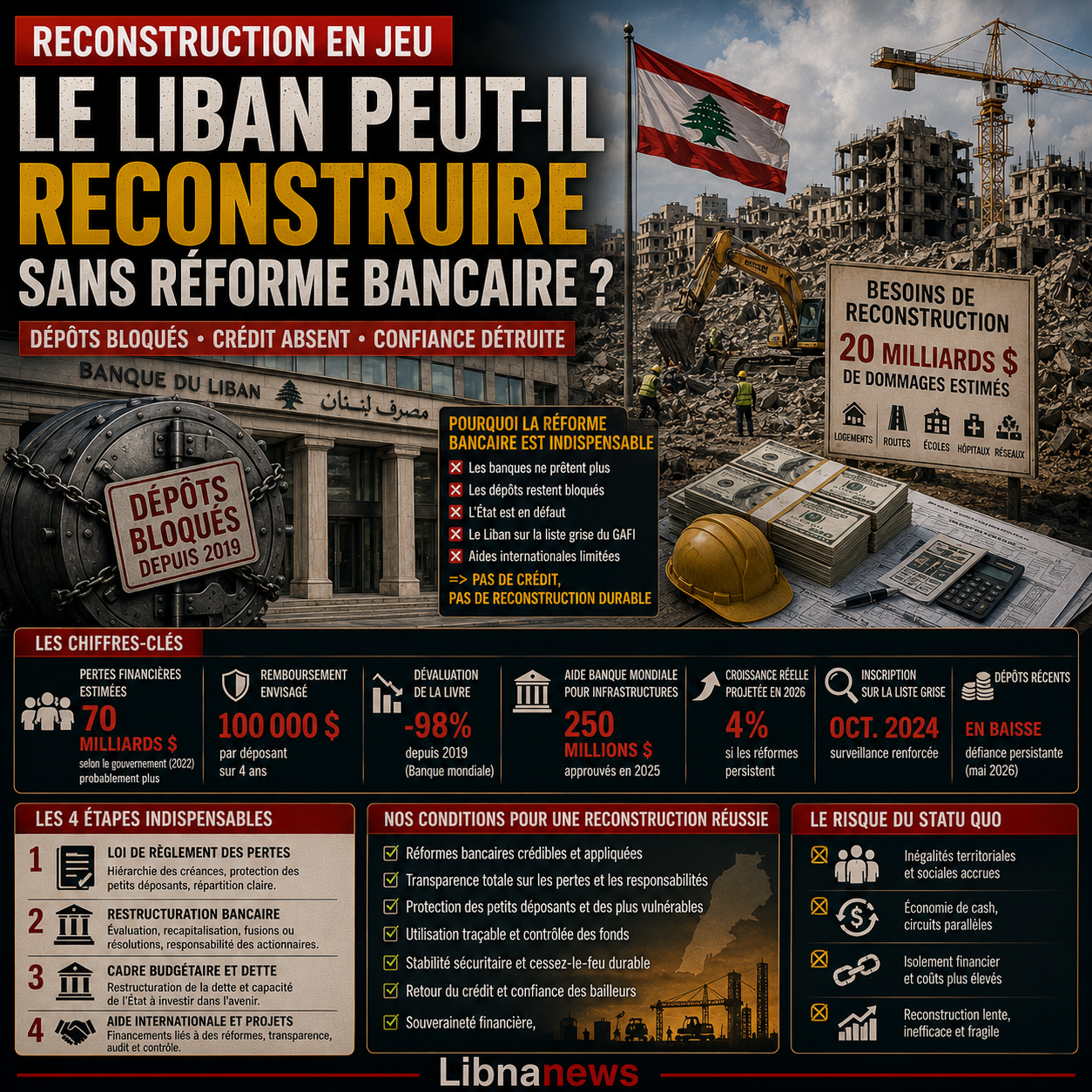
The war has increased already massive needs. Destruction affects housing, public infrastructure, agriculture, water and electricity systems, schools, clinics and local roads. Official and media estimates refer to up to $20 billion in direct and indirect damages related to the recent conflict. This figure remains to be consolidated, as the land is not fully accessible and indirect economic losses are still evolving. However, it gives the order of magnitude of the problem. The reconstruction is not just about repairing a few buildings. It requires a national capacity to plan, pay, control and maintain.
This capacity depends on the financial system. A rebuilt road requires companies, bank guarantees, regular payments, material imports and insurance. A repaired house requires advances, estimates, transfers and sometimes credit. A farm that revives its production needs liquidity, equipment, seeds and market access. A municipality that repairs a water system must be able to manage funds, account and pay suppliers. When banks do not lend, each project becomes an arrangement on a case-by-case basis. The strongest actors survive. The smaller ones are stuck.
Lebanon already has an example: emergency international aid can come, but it often goes through separate circuits. After the explosion of the port of Beirut, and after the waves of conflict, donors frequently bypassed institutions that were considered weak or not transparent. This method responds to real mistrust. It allows for the rapid financing of certain needs. But it also weakens the state, multiplies windows and reduces national coherence. Sustainable reconstruction cannot be based solely on emergency channels, NGOs, international agencies and partisan networks. It must recreate a credible public financial and banking system.
Financial freeze figures
| Indicator | File number or status | The issue of reconstruction |
|---|---|---|
| Estimated financial losses after the 2019 crisis | About $70 billion according to a government estimate of 2022, probably more today | Determine who pays: State, Bank of Lebanon, banks, large depositors |
| Reimbursement envisaged in a bill | Up to $100,000 per depositor over four years | Aims to protect small depositors and restore minimum confidence |
| Book devaluation since 2019 | About 98 per cent according to World Bank | Reduce savings, complicate contracts and increase imports |
| World Bank assistance for war-affected infrastructure | $250 million approved in 2025 | Useful but insufficient to meet global needs |
| Real growth projected in 2026 | 4% if reforms persist, according to World Bank | Fragile growth, conditional on reform and stability |
| Registration on the FATF grey list | Since October 2024 | Accurate compliance and complicate international transactions |
| Recent bank deposits | New weekly decrease in resident deposits reported in May 2026 | Shows continued distrust of the banking system |
These figures show a major discrepancy. Reconstruction needs are in billions. Available funding comes in much more limited tranches. Deposits remain at the heart of the crisis. As long as applicants do not know what they can recover, according to what timetable and rules, trust does not return. Banks cannot become normal lenders again. Companies cannot plan. Households keep their money out of the system. Reconstruction is then financed by cash, family helpers and external donations, which limits its scope.
The first lock: blocked deposits
The blocking of deposits remains the central trauma. Since 2019, hundreds of thousands of accounts have lost their normal access to savings. Withdrawals were limited, converted at unfavourable rates or organized by successive circulars. This has destroyed the trust agreement between banks and depositors. It also paralyzed financial intermediation. A bank that does not return old deposits cannot easily attract new deposits. A bank that does not attract deposits cannot lend. A creditless economy is slowly rebuilt, unevenly and often informally.
The draft law on financial institutions attempts to address this impasse. It is intended to distribute losses among the State, the Bank of Lebanon, commercial banks and depositors, while protecting small accounts as a matter of priority. According to reports, the government is seeking to guarantee a repayment path of up to $100,000 per depositor, with a time frame. IMF called for improvements, including a clearer hierarchy of claims. That is essential. Without hierarchy, each seeks to transfer losses to the other. Banks want to limit their liability. The state wants to avoid crushing public finances. Depositors refuse to pay for the bankruptcy of a system they have not controlled.
Reconstruction depends on this clarification. An owner whose savings are blocked cannot repair his house. An entrepreneur whose capital is trapped cannot buy machines. A municipality that cannot access stable accounts depends on one-off aid. Donors themselves are reluctant to inject funds into an economy where the bank balance sheet remains unreadable. Regulating deposits does not mean paying back everyone immediately. This means establishing credible rules, protecting small depositors, recognizing losses and preventing powerful ones from recovering before others.
The second lock: banks without credit
The second lock is the lack of credit. Reconstruction requires a banking sector capable of financing businesses, households and communities. However, the Lebanese banks remain largely outside their normal economic function. They manage accounts, commissions, transfers and limited transactions. They no longer fully play the role of transforming savings into productive credit. This deficit weighs on each sector. Building cannot develop without financing. Agriculture cannot modernise farms. Industry cannot import equipment. Shops cannot absorb shocks.
This lack of credit favours actors who already have cash. Diaspora-assisted households can repair. Companies with dollar revenues can invest. Political or Community networks can finance their areas. The others are waiting. Reconstruction then becomes socially unequal. It can strengthen clients, dependencies and regional gaps. A banking reform is therefore not just a matter of balance sheets. It is a condition of fairness. Without functional banks, access to reconstruction depends on proximity to a landlord, a family abroad or a party.
However, credit recovery cannot precede the consolidation of balance sheets. Lending with insolvent banks would be like rebuilding on sand. Banks must be valued, recapitalised, merged, liquidated or restructured according to their actual situation. Shareholders must absorb losses before ordinary depositors are penalized. Managers responsible for abusive practices must be audited. The assets of the Bank of Lebanon must be valued with transparency. This process is painful. It is also indispensable. An artificially maintained banking sector will not finance reconstruction. He’ll stop her.
The third lock: the defaulted state without margin
The third lock concerns the state. Lebanon has remained excluded from international capital markets since its 2020 default. Its public finances have improved in some respects thanks to the abrupt adjustment of expenditure, the increase in certain revenues and the partial dollarization of payments. But this apparent improvement must not be misleading. The State has reduced its service capacity, investment and social spending. It does not have sufficient budgetary margin to finance reconstruction, recapitalize banks, protect the poorest and support the army at the same time.
The IMF therefore called for a medium-term fiscal framework and a restructuring of sovereign debt. This request is not abstract. Donors want to know whether the State can assume commitments over several years. Companies want to know if public contracts will be paid. Citizens want to know whether taxes will fund services or only the losses of the past. A reconstruction financed by uncovered budget promises would soon become a new payment crisis. Lebanon has already seen too many unfunded commitments.
The debate on the allocation of losses therefore joins the tax debate. If the State takes too many bank losses at its expense, it risks sacrificing the costs of reconstruction, health, education and infrastructure. If banks and large depositors assume a stronger share, they will resist politically and legally. If small depositors pay, the social crisis will worsen. There is no painless solution. But there are better solutions than others. The principle must be clear: to protect small depositors, to involve shareholders, to clarify public responsibilities and to preserve the State’s capacity to rebuild.
The link with international donors
Donors will not finance massive reconstruction without a reform programme. The IMF, the World Bank, European countries, Gulf countries and Arab institutions are looking at the same set: banking reform, debt, governance, anti-money laundering, border control, transparency in public procurement and security stability. They can act before a full agreement, as the World Bank’s envelope for war-affected infrastructure has shown. But the large amounts will expect guarantees. Donors do not want to finance a system that does not know where the losses are, does not control its banks and does not clearly publish its expenditures.
This conditionality is sometimes perceived in Lebanon as interference. It is also the result of a long loss of confidence. International partners have seen reforms announced and blocked. They saw bank secrecy protect disputed transfers. They saw the losses denied or displaced. They have seen successive governments fail to adopt a coherent plan. Reconstruction will therefore be more monitored than previous ones. Every dollar requested must be justified. Each project should be monitored. Every channel will have to be controlled. This framework can be cumbersome. It can also protect citizens from recapture of funds.
The Arab countries will have a similar position. Saudi Arabia has reopened trade through exports, but is waiting for a state capable of controlling its borders and fighting the Captagon. Qatar, Kuwait or the Emirates may participate in reconstruction if the guarantees exist. No one will want to finance infrastructure that could be destroyed by a new war or used in opaque circuits. Arab support will therefore also depend on financial and banking reform, but also on security control. Economic confidence is not separated from sovereignty.
The trap of a reconstruction in cash
Without banking reform, Lebanon faces reconstruction in cash. This scenario is already visible. Families receive dollars from relatives abroad. Contractors request direct payments. Suppliers prefer cash. Municipalities depend on donations. NGOs finance ad hoc repairs. The parties intervene in their areas. This method can quickly repair some damage. She doesn’t create a system. It makes costs difficult to control. It favours intermediaries. It exposes aid to embezzlement. It complicates taxation and keeps the country on the list of risk economies.
A reconstruction in cash also produces territorial inequality. Villages with a powerful diaspora are moving faster. Those who depend on the state are waiting. Families close to organized networks receive support. The others must go or go. Companies able to import directly restart. The little ones are stuck. This logic can transform reconstruction into a factor of national fragmentation. Lebanon does not lack only money. There is a lack of a fair and verifiable channel to use.
The return to normal banking channels will not take place overnight. It’ll take time. But the country can start with dedicated accounts, transparent funds, clean banks for certain projects, international guarantees and controlled electronic payments. It can create a reconstruction fund with a permanent audit, linked to banks capable of complying with strict rules. It can protect the aids from punctures on old deposits. It may require reconstruction funds not to be absorbed by past bank losses. This separation is vital. Donors will refuse to see their money used to fill bank holes.
The necessary sequence
The most credible sequence consists of four stages. The first is the Financial Loss Settlement Act. It must define the hierarchy of claims, the protection of small depositors, the contribution of bank shareholders, the role of the State and that of the Bank of Lebanon. It should also include audits and redress mechanisms. Without this law, everything else remains suspended. Lebanon will continue to operate with an unrecognized crisis.
The second stage is banking restructuring. Sustainable banks must be recapitalised. Unviable banks must be merged or resolved. Managers and shareholders must be subject to strict criteria. New capital must be real, not just accounting. The sector must become smaller, more transparent and more useful to the economy. It is not about saving banks for themselves. It is about saving the banking function.
The third stage is the restructuring of public debt and the budgetary framework. The state must know what it can pay, what it must negotiate and what it can invest. Reconstruction requires capital expenditures. It also requires public services. A state that devotes its entire margin to the past cannot rebuild the future. Taxation must be fairer, more efficient and less dependent on indirect taxes on poor households.
The fourth stage is external assistance. It must come after the first steps of reform, not in their place. Donors can finance urgent projects during the transition. But the large envelopes must be linked to indicators: adopted legislation, evaluated banks, funds created, published audits, transparent public procurement, anti-corruption controls, the role of the army in reconstruction areas and the stability of the ceasefire. This link between money and reform is not a punishment. It’s an insurance against the recurrence of the crisis.
Can we start before the complete reform?
Lebanon cannot wait until all banking reform is completed to repair a road, reopen a school or help a homeless family. The urgency of reconstruction must therefore be distinguished from its sustainable phase. The emergency can be financed through grants, agencies, municipalities and targeted envelopes. It must meet the vital needs: clearing, shelter, water, electricity, care, schools, basic agriculture. This phase can move forward with exceptional mechanisms, but it must already be transparent.
Sustainable reconstruction, however, cannot circumvent the banking system indefinitely. Building neighbourhoods, reviving sectors, financing SMEs, repairing heavy infrastructure and creating jobs require credit, guarantees and institutions. That is where reform becomes inevitable. Without it, the emergency will continue without ever becoming revived. Lebanon will rebuild in pieces, without restarting its economy. The risk is that the same villages are half repaired, the same roads promised, the same schools supported by donations, without a national plan.
This distinction should guide public discourse. To say that banking reform is essential does not mean abandoning the victims. To say that we must help those affected now does not mean to forget reform. Both must move forward together. The government must present a two-track road map: one for reconstruction emergencies, one for financial regulation. Citizens must understand the link between their homes and their depots. Donors must see that immediate aid is not used to push back difficult decisions.
The political risk of postponement
Deferral of banking reform has a direct political cost. It fosters distrust of the state, strengthens parallel circuits and gives parties the opportunity to replace institutions. In the South, if the state does not finance reconstruction, Hezbollah and its social networks will fill part of the void. In other regions, the diaspora, NGOs or local leaders will play this role. This can be useful in the short term. It can also weaken the idea of national reconstruction. Each actor becomes the reconstructor of his space. The state becomes a spectator.
The postponement also weakened the position of Joseph Aoun and Nawaf Salam. Both leaders want to restore public authority, talk to donors and reintegrate Lebanon into its Arab and international environment. They won’t be able to do this if the bank file stays blocked. The partners will ask them the same thing: where are the losses? Who pays? Which banks survive? How to protect applicants? How can we prevent the reconstruction money from disappearing? Without answers, Lebanese economic diplomacy will remain fragile.
Finally, banks must measure the risk of their own resistance. Defending their interests is legitimate. Blocking reform is less. The longer the time passes, the more the real value of serode deposits, the more the economy gets used to cash and the more unnecessary banks become. A banking sector that refuses sanitation can survive administratively but lose its social function. The reconstruction could then take place without him, through international circuits and private cash. It would be a defeat for the banks and the state.
Lebanon can therefore start rebuilding without complete banking reform. He cannot succeed in rebuilding without her. Emergency repairs may precede laws. Donations may precede credits. Families can repair before the balance sheets are cleaned up. But a national reconstruction that is sustainable, equitable and financed on a large scale requires a standing back banking system. It also requires a State capable of telling the truth about losses. As long as this truth is rejected, every promise of reconstruction will remain fragile, suspended on a question that the country has avoided since 2019: who pays for bankruptcy, and according to what rules?