

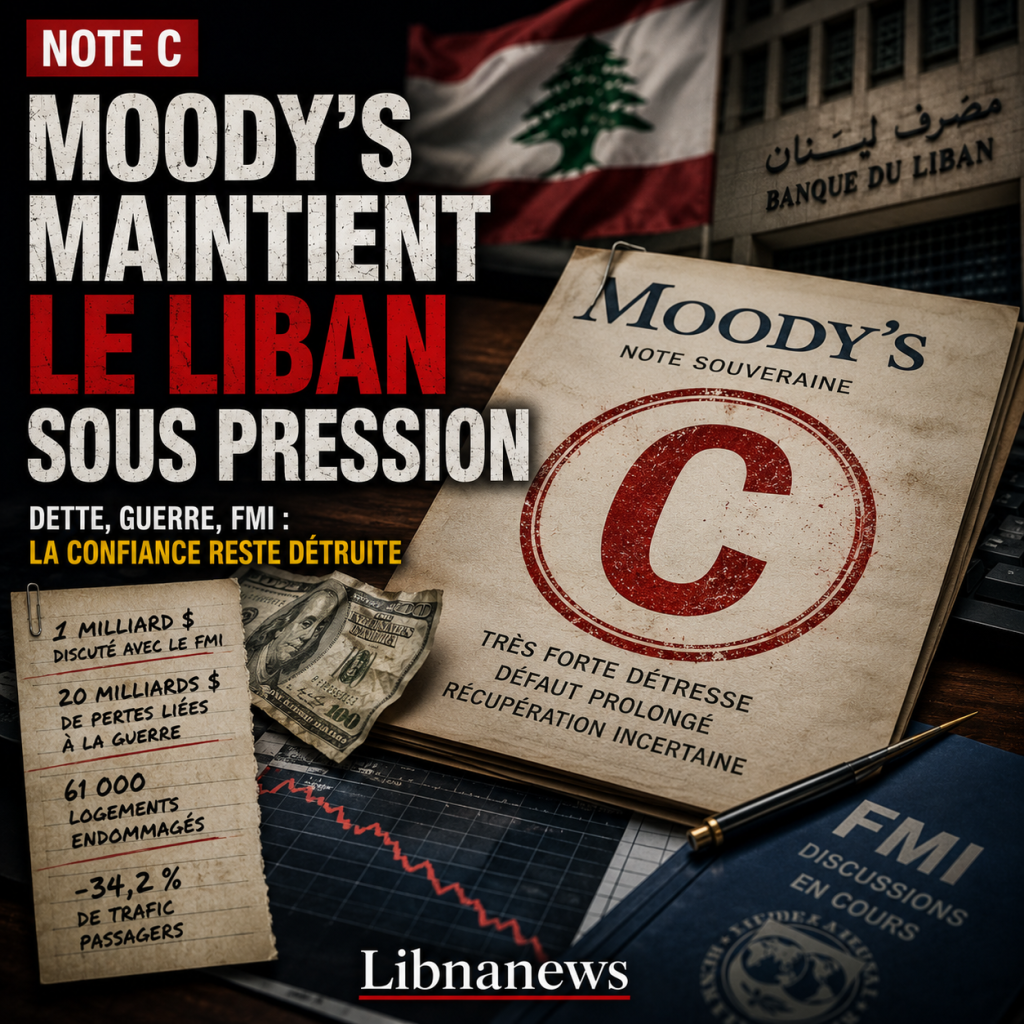
A C note that summarizes the Lebanese impasse
Lebanon remains trapped in an equation that diplomatic announcements are no longer enough to move. In a new reading of the sovereign situation, Moodys keeps the country in the lowest area of credit risk. The Agency leaves little ambiguity: as long as there is no concrete progress on debt restructuring or a comprehensive stabilization programme, Lebanon’s Note C should not evolve. The possible resumption of discussions with the International Monetary Fund can open a window. It does not replace the decisions that the Lebanese authorities have rejected for years.
The subject goes beyond financial technique. The sovereign note measures the minimum confidence that a State can still inspire its creditors. In the Lebanese case, this confidence remains destroyed by the sovereign default, the banking crisis, the lack of clear distribution of losses and the paralysis of reforms. The war with Israel and regional tensions aggravate an already very weakened situation. They affect households, infrastructure, tourism, balance of payments and government revenues. Lebanon is therefore not only poorly noted because it has been lacking. It is because it still has not produced a credible path to get out of the defect.
Moodys Lebanon thus becomes a political as well as economic indicator. The Agency acknowledges that discussions with the IMF could involve rapid financing of up to $1 billion. This assistance would cover budgetary support and humanitarian expenditure. But the agency immediately reports the limit of such a mechanism. Emergency financing can relieve cash flow. It can support immediate social needs. It can also restore a minimal link with international financial institutions. It does not alone repair a state that has not restructured its debt.
Key figures for diagnosis
| Indicator | Data mentioned |
|---|---|
| Sovereign note Moody | C |
| Quick financing discussed with IMF | Up to $1 billion |
| Persons displaced by conflict | More than one million |
| Agriculture, construction, industry | 16% of GDP in 2024 |
| Education and health | 19% of GDP in 2024 |
| Declining passenger traffic at the airport | -34.2% over 5 months |
| Arrivals at the airport | -40,2 % over 5 months |
| War-related losses | Over $20 billion |
| Possible losses if conflict continues | Nearly $25 billion |
| Damaged housing | Over 61 000 |
IMF aid will not be enough
The message is hard for Beirut. He says diplomacy, truce and humanitarian aid can stabilize a crisis. They do not restore credit. A country can receive fresh money and remain insolvent. It can sign political communiqués and remain unable to raise normal funding. It can display exchange rate stability and continue to lose reserves. It is this dissociation between the appearance of calm and the absence of reform that feeds Moody’s caution. Lebanon remains judged on unfulfilled acts, more than on repeated promises.
The level C assigned by Moodys refers to a debt in very high distress. This is not a classic warning. This is the expression of prolonged default and uncertain recovery for creditors. In a country that has suspended payment of its Eurobonds, this rating reflects a simple reality: markets do not have a clear plan for repayment, restructuring or loss hierarchy. Creditors do not know what share of the debt will be recognized, what instruments will be proposed, or what budgetary capacity will support the restructured securities.
The main problem is therefore not the lack of diagnosis. Lebanon has accumulated it. The authorities have been aware of the IMF’s requirements since the 2022 technical agreement, which has never been validated by the Fund’s Board of Directors. The main lines remain: restructuring public debt, reforming the banking sector, unifying accounts, improving governance, strengthening fiscal transparency and restoring the credibility of the Bank of Lebanon. What is missing is the political translation of these objectives. Groups that are expected to absorb losses continue to return the invoice.
The absence of restructuring affects the entire economy. It prevents the state from returning normally to markets. It blocks bank resolution. It keeps applicants in prolonged uncertainty. It feeds a bypass economy where households, businesses and administrations adapt to collapse instead of exiting. Moodys points out that a renewed IMF commitment would be positive at the margin, but the sustainable improvement of the credit profile would depend on structural reforms and debt resolution.
A war that destroys the bases of recovery
The war has further reduced the room for manoeuvre. The escalation between Lebanon and Israel this year was a significant negative shock on domestic activity. More than one million people have left their homes to escape violence. This internal exodus is not only a human catastrophe. It disorganizes work, schools, care, shops and production chains. It shifts demand from one region to another. It deprives families of income. It imposes new burdens on the State and humanitarian organizations in a context of limited resources.
The least mobile sectors are the most exposed. Agriculture, construction and manufacturing cannot move their land, machinery or teams quickly. These activities together accounted for 16 per cent of gross domestic product in 2024. When a village is emptied, a destroyed field, a cut-off road or a damaged workshop, the loss is not limited to the affected building. It affects suppliers, carriers, daily workers, traders and local tax revenues. The war thus transformed territorial damage into a national slowdown.
Services have a similar effect. Education and health accounted for 19% of GDP in 2024. Population displacement disrupts schools, universities, hospitals and health centres. They move needs to already saturated regions. They require some families to delay care or interrupt training. They also weaken human capital, which remains one of Lebanon’s few competitive advantages. An economy is not only recovering with roads and banks. It needs trained workers, school children and a functioning health system.
Tourism is another vulnerability line. Moodys believes that arrivals have declined as a result of the conflict. Data from Rafic Hariri airport confirm this deterioration. In the first five months of 2026, the total number of passengers fell by 34.2% compared to the same period of 2025. Arrivals declined by 40.2%. This contraction directly affects hotels, restaurants, taxis, travel agencies, shops and services linked to the diaspora. It also reduces foreign exchange inflows, which are essential in a country highly dependent on the outside world.
Balance of payments: other fragility
The balance of payments therefore remains under pressure. Lebanon imports a lot of goods and finances part of its deficit through travel, diaspora transfers and income from services. When visitors hesitate to come, when expatriates delay their stay and when host countries are themselves affected by regional tensions, these flows become fragile. Moodys also highlights the risk of the oil shock. For an economy dependent on energy imports, rising oil prices result in a heavier current account deficit and higher transport costs.
It is in this context that IMF emergency financing can be useful. It can enhance liquidity, provide some budgetary space and help finance urgent social and humanitarian needs. It can also serve as a signal. A state that takes up language with the IMF shows that it accepts a form of surveillance and discipline. But this signal will be weak if the authorities use it to further delay the reforms. Lebanon has already shown that it can sign commitments in principle without passing the necessary legislative and administrative steps.
The risk is that of aid consumed without processing. A billion dollars may seem important in an exhausted country. He remains weak in the face of the crisis. War-related losses would already exceed $20 billion and could reach $25 billion if hostilities continued. Over 61,000 dwellings were reported to have been totally or partially damaged between March and early May 2026. In the face of such amounts, rapid support cannot finance reconstruction. It can only cushion a shock and preserve certain vital functions of the state.
A governance crisis above all
The real question therefore remains the hierarchy of priorities. Should the government first seek fresh money, or should it first restore the credibility of the reform framework? In fact, both aspects are linked. Without funding, the social emergency becomes unsustainable. Without reform, funding becomes a repeated infusion. The IMF can help stabilize. It cannot replace a national decision on bank losses, public debt, the accounts of the Bank of Lebanon and the responsibility of the actors who led the country to default.
The Lebanese case also shows the limits of the discourse on resilience. Since 2019, the population has adapted to an exceptional financial crisis. Companies have sought foreign currency revenues. Households reduced their spending. Expatriates supported their families. But this adaptation is not an economic strategy. It sometimes masks the absence of a state. Moodys recalls, by its rating, that creditors and institutions do not judge the ability of Lebanese to survive. They judge the state’s ability to govern, pay, reform and hold accountable.
Note C is therefore a severe mirror. It reflects a country that has allowed its default to continue without a settlement. It reflects a banking system that has not been restructured to match losses. It reflects governance that struggles to produce credible laws. It also reflects a safe environment that destroys the foundations of a recovery. The ceasefire, if it stands, can reduce some of the risk. It does not automatically change the sovereign trajectory. For Moodys, the decisive criterion remains the ability to convert Accalmia into a complete program.
This requirement also concerns official communication. Lebanese officials have often presented international openings as successes. A resumption of discussions with the IMF, a promise of help, a diplomatic visit or one-off monetary stability become elements of language. But the rating agencies look at the verifiable results. They expect sincere budgets, audits, restructuring, passed laws, institutions capable of implementing. Without these elements, the stabilization discourse remains fragile.
A narrow window for Beirut
There is a window. The war showed the cost of the lack of budgetary margin. It has also placed Lebanon on the international agenda, not out of confidence, but out of concern. The United States, Europe, the Arab countries and the IMF know that a further collapse of Lebanon would have regional consequences. This attention can provide funds, assistance and useful pressure. But it can also lock the country in a logic of permanent urgency, where each crisis justifies limited support without lasting transformation.
The Lebanese Government must therefore avoid misuse of the Moodys report. It should not only be seen as an external threat or unfair notation. He must read it as an inverted roadmap. All that prevents improvement is explicitly named: unsolved default, unrestructured debt, incomplete program, weak governance, external dependence, war shock, balance of payments pressure. This list is not new. Its repetition shows above all that the country has not dealt with the causes of its decommissioning.
For households, this situation results in persistent uncertainty. Wages remain fragile. Deposits remain blocked or amputated. Public services work badly. Transport, health and education costs weigh heavily. An improvement in the sovereign note would not change everything overnight. But it could accompany a gradual return of trust. Conversely, the retention in category C points out that the financial crisis is not behind the country. It continues to structure every economic decision.
The coming months will test Beirut’s ability to transform discussions with the IMF into action. The authorities will have to specify the content of the rapid financing, the possible conditions, the use of the funds and the link with a wider programme. They will also have to say how they intend to deal with debt and the banking sector. Moody The Agency expects concrete progress. The country thus enters a phase where the words available are almost exhausted, while the figures of war and debt continue to accumulate.




