





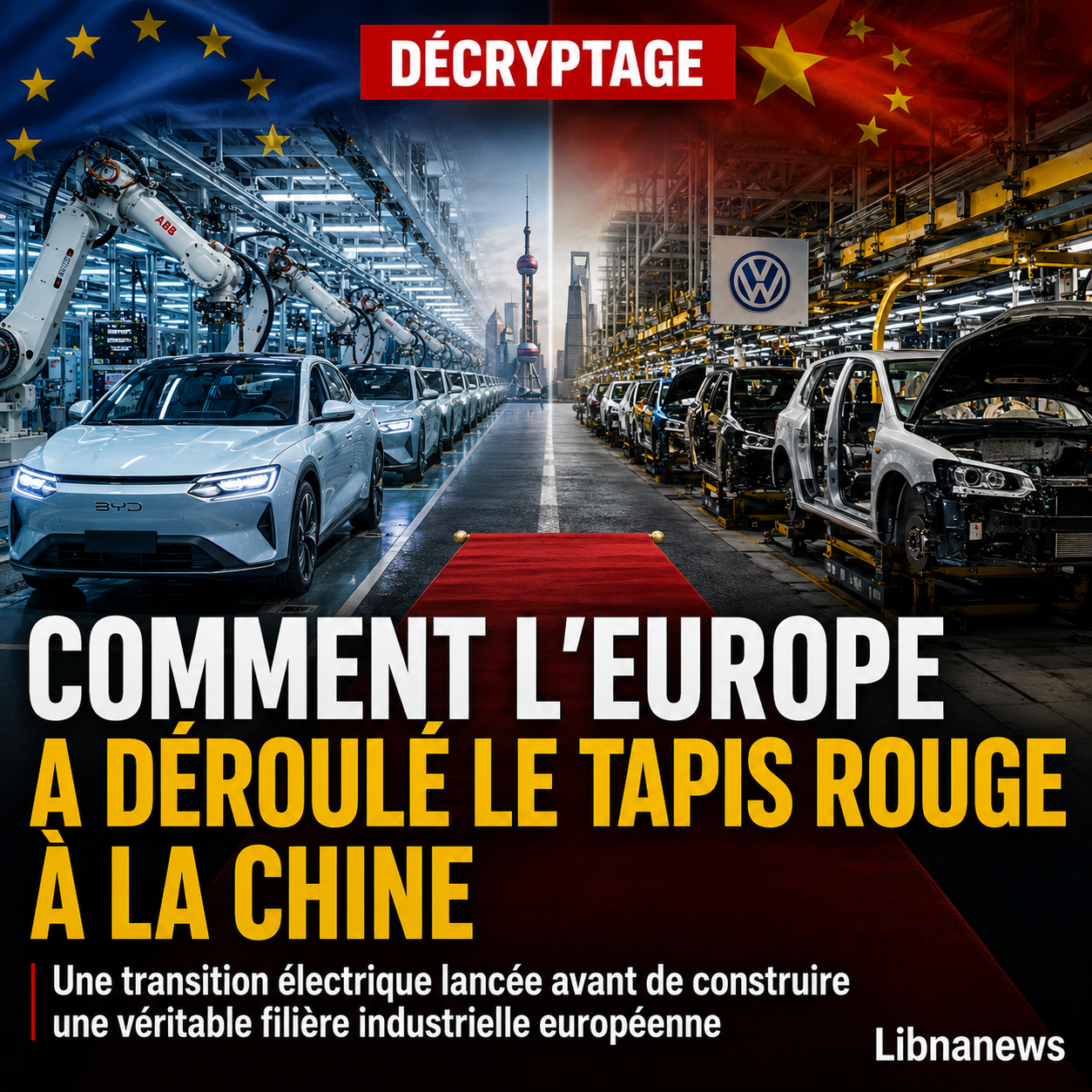
Europe wanted to take the lead in the automotive revolution. It is now likely to become one of the main import markets.
By deciding to speed up the transition to an electric car, European leaders pursued a legitimate objective: to reduce carbon emissions, to modernise the automotive industry and to prepare for the post-oil phase. But a major strategic mistake was made. Europe set the timetable for the transition before ensuring that it had the technology, industrial capacity, raw materials and infrastructure to drive it itself.
While Brussels was developing standards, China was building factories.
When Europe truly engaged its electricity industry, China already had a considerable lead. It had invested for years in batteries, supply chains, metal refining, embedded software and large-scale automotive production. It had also created a huge internal market allowing its manufacturers to produce more, reduce their costs and rapidly improve their vehicles.
By 2025, nearly 75% of the world’s electric cars were produced in China. The country also accounted for about six out of ten electric cars sold worldwide. It is no longer simply an emerging competitor: China has become the centre of gravity of the world’s electric car industry. (IEA)
A decided transition backwards
The problem is not that Europe has chosen electricity. This technological development was probably inevitable. The problem is that it organised the planned fall of the European thermal motor before building an electric line capable of replacing it in good conditions.
However, Europe had a considerable historical advantage in the traditional automobile industry. Its manufacturers controlled engines, transmissions, precision mechanics, safety and industrial engineering. Millions of direct and indirect jobs depended on this ecosystem.
But the electric car moves the value to other components. Battery, power electronics, semiconductors, software and digital systems are becoming increasingly important. On several of these elements, European industrialists had already fallen behind.
Instead of first filling this gap, Europe has created an obligation for rapid transformation. This resulted in a sharp increase in demand for a technology whose essential part of the value chain was already controlled externally.
The result was predictable: by stimulating the electricity market without having a sufficiently competitive European supply, it indirectly stimulated the sales of those who were ready before it.
China didn’t win by chance
The Chinese advance is not only based on lower wages. It is the result of a coherent industrial policy over several decades.
China supported its producers, protected its domestic market, facilitated their financing and invested heavily in charging infrastructure. It has mostly secured a large part of the battery chain, from raw material processing to cell assembly.
It also agreed to produce for a long time with reduced margins in order to gain in volume, experience and competitiveness. What some thought of Europe as a still imperfect industry has, in a few years, become a set of fast, innovative manufacturers capable of marketing attractive vehicles at prices that are hard to match.
Europe, for its part, remains heavily dependent on external suppliers, notably Chinese, for lithium-ion batteries and several critical components of the electric car. The European Commission’s own studies recognise this growing dependence. (JRC Publications)
The difference is fundamental: China treated the energy transition as an industrial battle. Europe too often treated it as a mainly regulatory problem.
European manufacturers caught up
European manufacturers now face several challenges at the same time.
They must continue to invest in the thermal and hybrid engines still required by a large part of the customer base, while devoting billions to the development of electric vehicles. They must meet increasingly demanding environmental standards, absorb high energy costs and face Chinese competitors with higher volumes and better integrated supply chains.
They also have to sell electric cars in a growing European market, but less quickly and evenly than expected. By 2025, all-electric vehicles still accounted for 17.4% of new registrations in the European Union, while hybrids accounted for 34.5%. The European consumer has therefore not rushed to the electrical whole as quickly as the planners imagined. (ACEA)
This situation places manufacturers in a delicate position. They must transform their factories and ranges without being sure that demand will keep pace. Meanwhile, Chinese companies arrive with models already developed, tested in a huge domestic market and often offered at lower prices.
Europe has thus created a strong constraint for its own manufacturers while offering their competitors an exceptional opportunity.
Customs duties, late admission of weakness
In the face of the growth of Chinese vehicles, the European Commission has finally opened an investigation into the subsidies granted by Beijing. It then imposed countervailing duties that could reach significant levels according to the manufacturers concerned. (EU Trade)
These measures may slow down some imports. However, they do not solve the underlying problem.
A customs duty may temporarily protect a market. He’s not building a battery plant. It does not reduce the price of energy. He doesn’t train engineers. It does not create raw materials. It does not automatically make a European car cheaper or more innovative.
The use of trade barriers shows above all that Europe was late in becoming aware of the imbalance that it had helped to create. It first accelerated the opening of a market in which China had a decisive lead. It now seeks to protect its industrialists from the consequences of the same openness.
Ecology without industry becomes a dependency
A climate policy cannot be sustainable if it destroys the industrial base that must make it possible.
Mass import of batteries, components and electric vehicles is not a true ecological sovereignty. This often involves shifting production, jobs and part of emissions outside Europe, while maintaining consumption on European territory.
Europe must therefore emerge from the artificial opposition between environment and industry. Without a strong industry, there will be no autonomous ecological transition, no skilled jobs and no technological sovereignty.
The real objective should not be to force Europeans to buy a specific engine on an administratively fixed date. It should be to make European industry capable of producing the cleanest, most efficient and most affordable vehicles, whether electric, hybrid or from new technologies.
Regulation can provide direction. It must not replace industrial strategy.
What Europe should have done
Before imposing such a radical transformation, Europe should have secured raw materials, developed competitive battery production, reduced energy costs, massively supported research and built a real European capital market capable of financing its industrial champions.
It should also have maintained more technological flexibility. The transition through hybrids, continuous improvement of thermal engines, synthetic fuels or other low-carbon solutions could have accompanied the transition, instead of artificially opposing the old world to the new.
The European Commission now itself recognises that the automotive industry risks losing market share due to its insufficient competitiveness in zero-emission vehicles. It announced new measures to support the European battery industry. But these decisions come after the Chinese advantage has been largely consolidated. (Mobility and Transport)
Do not confuse ambition and precipitation
Europe was right to prepare for the future. She was wrong to believe that the announcement of a goal was enough to create the industry capable of achieving it.
An economy is not only transformed by prohibitions, standards and deadlines. It is transformed by investment, production, innovation, training and control of supply chains.
China understood very early. It did not wait for the global electricity market to be fully developed to build its capacity. It built its capacity to dominate the market when it appeared.
Europe has done almost the opposite. It created the market before consolidating its offer. It therefore offered China the commercial space it needed to convert its industrial advance into market shares.
The paradox is cruel: in the name of climate sovereignty, Europe has strengthened its industrial dependence. In the name of modernisation, it has weakened some of its largest manufacturers. And in the name of competition, it has opened its doors to companies supported by a much more coherent national strategy than its own.
The urgency is not to abandon the energy transition. She’s taking her back.
Europe must stop choosing between ecology and industry. It must understand that, without European industry, European ecology will end up being manufactured in China.
Bernard Raymond Jabre