

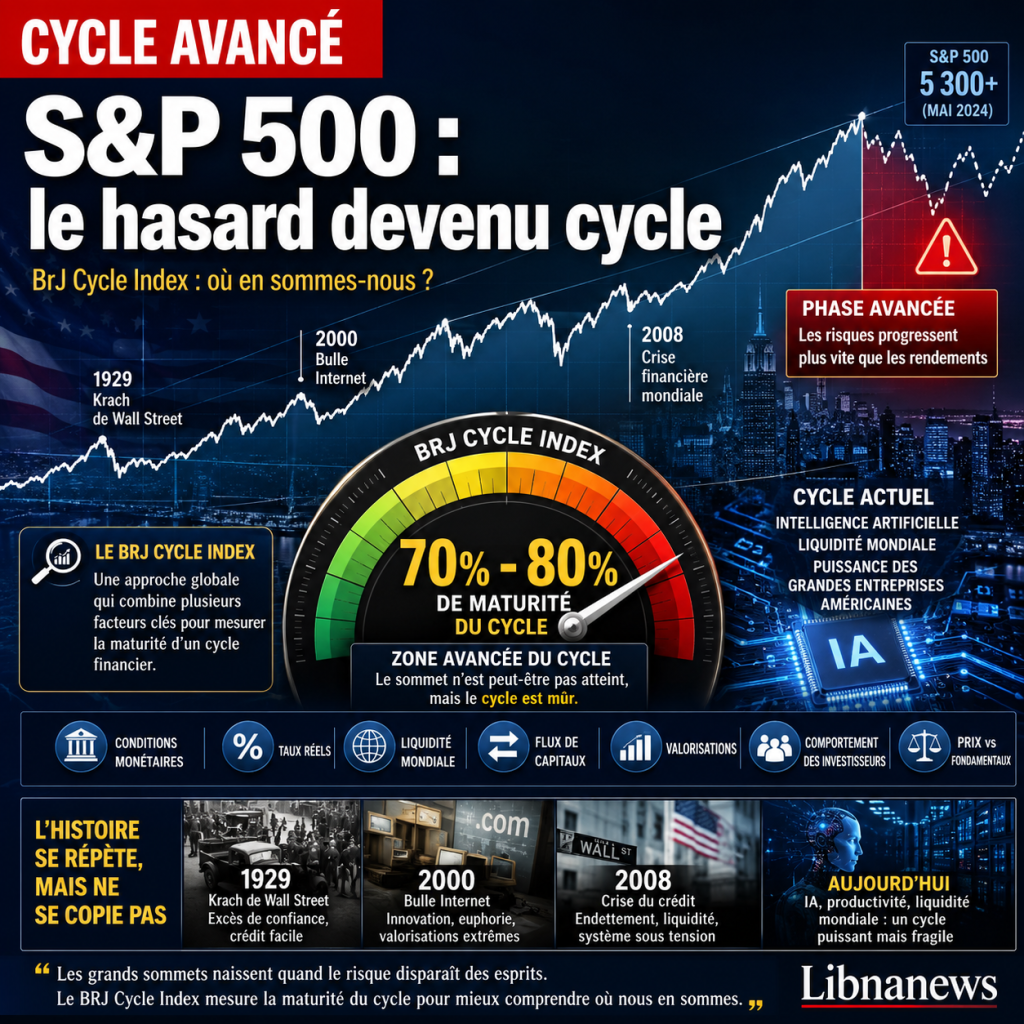
How chance becomes trend, then cycle
One of the most fascinating issues in modern finance is how millions of individual decisions end up producing market movements that sometimes seem chaotic and sometimes extraordinarily orderly.
In the very short term, markets look like a random walk. However, when investor behaviour is consolidated, trends appear. These trends, when they last long enough, eventually transform the economy itself and give rise to financial cycles.
The BRJ Cycle Index is based on the idea that no market can be understood through a single variable. It combines monetary conditions, real rates, global liquidity, capital flows, valuations, investor behaviour and differences between prices and fundamentals.
Its objective is not to predict the next daily movement, but to measure the degree of maturity of a cycle and answer the question: « Where are we in the cycle? »
S&P 500 is probably the best laboratory for this approach. For more than a century, several major cycles have marked its history: the 1920s, the Internet bubble of 2000, the credit crisis of 2008 and the current cycle carried by artificial intelligence, global liquidity and the power of large American companies.
As in 1929, a major innovation transformed the economy. As in 2000, this innovation affects information and productivity. As in 2008, the system remains highly dependent on liquidity and debt.
According to a reading inspired by the BRJ Cycle Index, the S&P 500 now appears to evolve in an area between 70% and 80% maturity of the cycle. This means that the market is probably in an advanced phase, without the definitive historic summit necessarily being reached.
History shows that the last phases of a cycle can be the most spectacular. However, they are also those where risks often progress faster than expected.
Large market peaks do not arise from a simple price level. They appear when confidence becomes excessive, when risk ceases to be perceived, and when investors begin to believe that traditional economic rules no longer apply.
The role of the BRJ Cycle Index is precisely to monitor this evolution and measure the growing maturity of a cycle, in order to help investors understand their position in a much broader financial history than daily fluctuations.




