





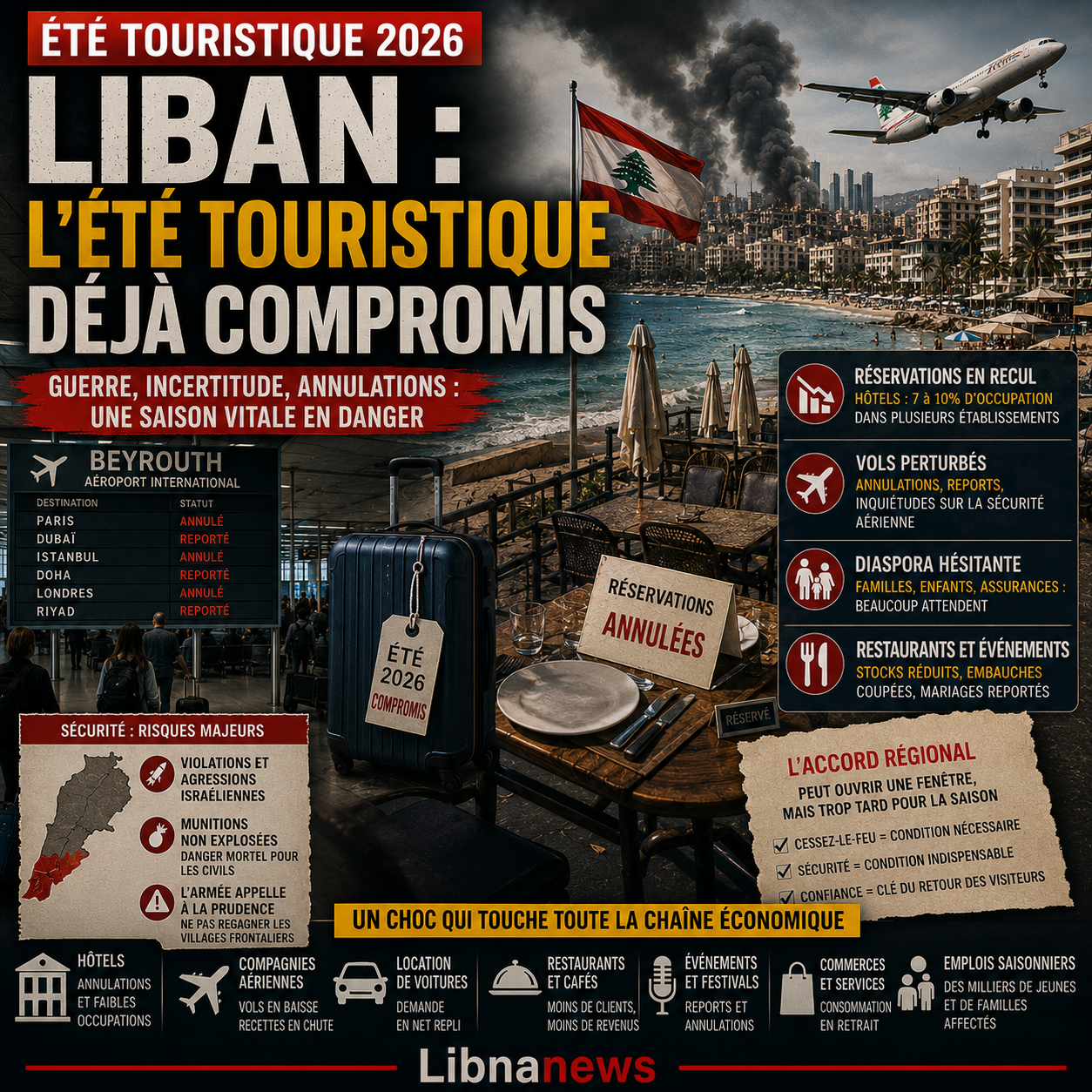
Lebanon approaches the heart of June with a formula that is already circulating among professionals: summer is over before it begins. Lebanese tourism was to be one of the few foreign exchange drivers in an economy that was still without credit, weakened by the banking crisis and dependent on diaspora transfers. The war changed the calendar. Hotel reservations are declining, airline tickets are delaying or cancelling, major events are hesitant, travel agencies are managing claims and restaurants are reducing their inventory. The regional agreement announced between Washington and Tehran can offer a window, but it comes late for a season that often decides several weeks before departures.
The shock not only affects hotels in Beirut or seaside resorts. It reaches a whole economic chain: airlines, taxis, car rental companies, caterers, cafes, bars, wedding halls, festivals, guides, guest houses, clothing shops, jewellers, hairdressers, florists and agricultural producers who feed the restaurant. A missed tourist season does not only mean fewer visitors. It means less currency, less temporary jobs, less cash in the regions and less confidence. For Lebanon, summer is not a comfort supplement. It’s part of its survival economy.
A broken season before the peak
The Lebanese tourist season is based on a short window. The weeks of June, July and August focus on arrivals of the diaspora, marriages, family returns, festivals, seaside stays, restaurant reservations and car rentals. Some of this demand is being prepared in advance, but it is often confirmed late, depending on airline tickets, insurance and security perception. This dependency at the last moment makes the sector very vulnerable to shocks. A strike in Beirut, an evacuation order in Tyre, a flight suspension or an embassy alert may be enough to break the momentum.
The current problem is one of cumulation. Professionals do not face one bad news. They face a succession of negative signals: strikes in the South, threats to Beirut, concerns around the airport, tensions between Israel and Hezbollah, uncertainty about the ceasefire, drone noise, airline caution and rising costs. Even when visitors do not give up completely, they wait. They book later, ask for flexible conditions, shorten their stay or choose another destination. For a hotel, this expectation is already worth losing. For a restaurant, it prevents hiring. For an event organizer, it makes risk-taking impossible.
However, Lebanese tourism had shown a rebound capacity. By 2025, the country had welcomed more than 1.63 million visitors, a significant increase over the previous year. This recovery remained fragile, mainly carried by the diaspora and visitors accustomed to Lebanese risk. It had not restored pre-crisis levels, but it had given some oxygen to hotels, restaurants and services. The war of 2026 threatened this rebound when it was to become a stronger recovery. This makes the current fall so dangerous: it breaks a dynamic before it is consolidated.
Airport, first border of trust
Tourism starts at Rafic Hariri International Airport. However, this front door remains at the heart of concerns. Regional tensions have disrupted passenger schedules, connections and confidence. Foreign companies have already avoided or suspended certain routes during periods of high tension. Middle East Airlines continued to provide an essential part of Lebanon’s external connection, but was itself placed under surveillance following concerns expressed by pilot organizations on flights operating near strike areas. The company claims to be acting on the basis of risk and guarantee assessments. For travellers, the mere fact that aviation safety becomes a public subject is enough to weigh.
The problem is not just the number of flights. It is the perception of risk. A member of the diaspora can agree to come to Lebanon despite the economic crisis. He will hesitate if the airport seems threatened, if the tickets become too expensive, if the companies multiply the schedule changes or if the return to his country of residence seems uncertain. The foreign tourist almost always has an alternative. He can choose Greece, Cyprus, Turkey, Spain, Portugal or Jordan. In a tense regional market, the safe destination often wins against the endearing destination.
The project to open René Mouawad Airport in Qolayaat, in the North, illustrates an attempt to diversify. It can reduce dependence on Beirut airport alone and offer an additional exit in times of crisis. But he won’t save in the summer of 2026. A new platform requires roads, companies, procedures, insurance, a perception of safety and time. For the current season, the verdict is still in Beirut. If the airport seems stable, some reservations can come back. If uncertainty persists, cancellations will continue to prevail.
Hotels, restaurants and events under pressure
Hotels are the first to measure the crisis. Occupational data reported in recent weeks place the occupation of several establishments in Beirut at very low levels, around 7 to 10 per cent in some periods, with some occasional upsurges. These figures do not describe all establishments, but they give the trend: international demand contracted before peak. Guest houses and furnished apartments can be more resilient thanks to the diaspora, family stays or more flexible prices. But they also suffer from lenientism. Customers ask to cancel until the last moment.
Restaurants are experiencing a different crisis. They depend on local traffic, expatriates, tourists and private events. When visitors postpone their journeys, the tables are emptied first on weekdays, then the weekends become more irregular. Establishments reduce inventories to avoid losses. They hire fewer seasonal workers. They limit investments in terraces, menus, renovations or special evenings. The sector had learned to survive in cash dollars, thanks to the diaspora and the clientele that continued to emerge despite the crisis. War reduces that margin.
Major events are even more exposed. Weddings, concerts, festivals, brand launches, congresses, summer parties and family gatherings require down payment, travel, service providers and planning. A security alert can ruin months of preparation. Many organizers prefer to postpone rather than risk a last-minute cancellation. The cost is not limited to the leased location. It affects caterers, musicians, technicians, photographers, florists, drivers, hotels and shops. Lebanese tourism functions as an ecosystem. When a marriage is cancelled, about ten trades lose a day of income.
Diaspora hesitates, foreigners move away
The diaspora remains the strongest base of Lebanese tourism. It comes for families, marriages, administrative procedures, properties, holidays with children and attachment to the country. It often accepts risks that the foreign tourist refuses. She knows the neighborhoods, roads, uses and periods of tension. But she is not indifferent to war. Families with children are more hesitant. Expatriates working in Europe, Africa, the Gulf or North America are afraid to stay blocked. Tickets are expensive. Insurance does not always cover conflict areas. Uncertainty on flights becomes a decisive obstacle.
Foreign visitors are withdrawing faster. Lebanon remains attractive by its gastronomy, nightlife, landscapes, heritage, beaches, mountains and culture. But it is competing with destinations perceived as safer. The war in the Middle East has already redirected some of the flows to southern Europe. Spain and Portugal, in particular, benefited from a postponement of demand when travellers avoided the region. Tourism is not waiting for diplomats to stabilize an agreement. He’s moving.
This difference between diaspora and foreigners weighs on income. The diaspora often resides with relatives or in family apartments. It spends on restaurants, shops and services, but it does not always fill hotels in the same way as traditional tourists. Foreign visitors, groups, Gulf travellers and organized stays have a more direct effect on hotel establishments, guides and tours. If their return is delayed, the sector can survive thanks to the diaspora, but it cannot regain a real level of season.
Tourism regions affected by ricochet
The crisis is not limited to Beirut. Batrun, Byblos, Kesrouan, Metn, Mountain, Bekaa, Chouf, North and rural tourism villages also depend on summer. Some places may even accommodate Lebanese visitors who avoid the South or more exposed areas. But this demand for substitution remains fragile. It depends on the feeling that the country as a whole remains practicable. When strikes hit Tyre or the southern suburbs of Beirut, international perceptions do not always distinguish between regions. Lebanon appears to be a destination at war, although some areas remain calm.
The South pays the heaviest cost. Tyre, its beaches, heritage, seaside restaurants and guest houses cannot attract normal customers in a context of evacuation and strikes. Border villages, religious sites, agricultural roads and small shops linked to local visitors remain paralysed. Even if a ceasefire is signed, it will take time to reassure. The return of tourists will not automatically follow the return of the inhabitants. It will require safe roads, accessible beaches, repaired hotels, open restaurants and a sustainable perception.
Mountain regions have a potential for resistance. Guest houses, trails, wine estates, local festivals and fresh tourism can attract a Lebanese or diasporic clientele. But this potential requires coordinated communication. Municipalities and providers cannot promise security if they do not have clear information. They can only offer flexibility, reduce prices or target visitors already present in Lebanon. This strategy limits losses, but it does not compensate for a weakened international season.
A social shock behind the tourist shock
Tourism is often presented as a leisure sector. In Lebanon, it is also a social shock absorber. It employs waiters, maids, receptionists, cooks, drivers, security officers, technicians, musicians, delivery agents, guides, vendors and seasonal workers. Many depend on a few months of activity to hold the rest of the year. A missed season means unpaid wages, lost extras, lost tips and families under pressure.
Young people are particularly affected. Students work in restaurants, hotels, cafes, events and beaches during the summer. Such income may finance university fees, transportation, equipment or family support. When institutions do not hire, the crisis becomes immediate. It leads some to seek a departure, to accept less paid jobs or to become more dependent on the family. Tourism, in this sense, is not just an industry. It is an income channel for a generation already experienced by the monetary crisis.
Suppliers are also subject to contraction. A restaurant that reduces its activity buys less vegetables, meat, beverages, bread, flowers, maintenance products and laundry services. An empty hotel consumes less electricity, but it mainly loses the necessary income for its employees and suppliers. A cancelled event reduces the orders of caterers, decorators, sound, taxis and photographers. Tourism summer feeds a networked economy. His collapse spreads quickly.
Ceasefire as a necessary but insufficient condition
The expected signature of the regional agreement may change the course, but it is not enough. For tourism professionals, the first condition is visible safety. There is a need for a long-term halt to strikes, a reduction in overflights, stable operation of the airport, practical roads and clear messages from the authorities. Visitors not only react to the signature of a text. They react to images, alerts, flight cancellations and family stories. A single strike in the southern suburbs or on the coast can cancel several days of renewed confidence.
The second condition is predictability. Hotels and restaurants can adapt to a low season if they know the level of demand. They can reduce teams, adjust prices and limit stocks. They suffer more when reservations change every two days. Hesitant visitors book late, cancel late and negotiate more. This uncertainty transfers risk to businesses. It obliges professionals to operate with less visibility, in a country where bank credit no longer absorbs shocks.
The third condition is communication. Lebanon must avoid contradictory messages. The authorities must inform about the airport, roads, areas to be avoided, safe areas, continued events and emergency procedures. Tourism professionals need a single contact. Visitors too. In the absence of reliable information, social networks and rumours fill the gap. A smoke video, a misunderstood alert or a local evacuation message can take a national dimension in a few minutes.
Can we save another part of the summer?
Part of the summer can still be saved if safety improves quickly. The diaspora can return in July or August if the flights stabilize and the ceasefire holds. Deferred events can be reprogrammed at the end of the summer. Mountain regions can attract short stays. Restaurants can find a local and diasporic clientele if fear recedes. But it would be misleading to talk about a complete return. International tourism is planning. Not all travellers who have chosen another destination will return. Canceled groups don’t get back together in a few days.
The sector will therefore have to aim for a loss-limiting season, not a recovery season. This strategy requires flexible offers, clear cancellation conditions, realistic prices, targeted campaigns on the diaspora already decided to come and coordination with airlines. Festivals must quickly announce what is maintained, postponed or cancelled. Hotels must avoid excessive promises. Restaurants must adjust without degrading their quality. In a crisis of confidence, transparency is better than facade optimism.
The State can help without great resources. It can speed up VAT refunds to the companies concerned, temporarily reduce certain charges, facilitate the process of events, support tourist municipalities, communicate on safe roads and coordinate with the airport. It may also ask Arab partners and diaspora countries not to unnecessarily tighten their warnings if the situation stabilizes. But he can’t buy trust. This will depend first on the security reality.
A vital sector, but too exposed
The current crisis reveals structural weakness. Lebanon depends heavily on a short and vulnerable season. Any war, political blockage, air alert or regional tension can erase months of preparation. The sector has adapted through flexibility, diaspora, cash payments and local offers. But this adaptation has its limits. A country cannot build a sustainable tourism strategy if each summer depends on a ceasefire negotiated abroad.
Lebanese tourism must therefore be rethought. There is a need to diversify markets, extend seasons, develop domestic tourism, strengthen event insurance, improve crisis communication, secure the airport, better coordinate municipalities and support small guest houses. The country has rare assets. It can offer sea, mountain, gastronomy, heritage, cultural life and hospitality in a small territory. But these assets require minimal stability. Without security, they become suspended arguments.
Summer 2026 will probably remain an amputated season. Professionals do not all admit publicly, as they still expect a few weeks of respite. But the low figures, cancellations, postponements of events and the hesitancy of travellers show that the shock has already taken place. If the ceasefire holds, part of the activity will return. If the strikes resume, the season will be lost even more widely. In hotels, restaurants and agencies, waiting is now a simple question: can Lebanon offer enough security to turn a compromised summer into a reduced summer?