

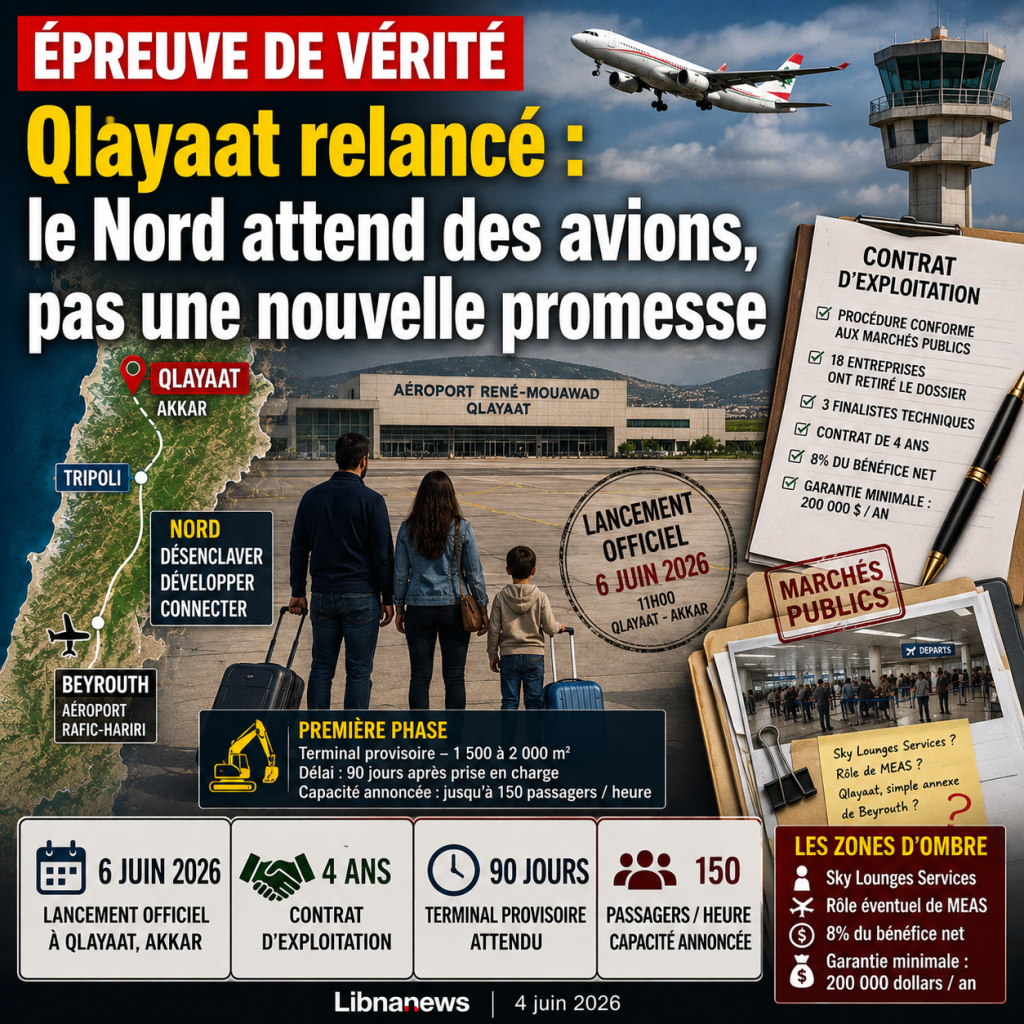
The Ministry of Public Works and Transport has announced the official launch of the development and operation project for the René-Muawad airport in Qlayaat. The ceremony is scheduled for Saturday, June 6, 2026, at 11 a.m., at the airport site in Akkar. The announcement feeds a real hope in the North, where this dossier has for decades symbolized the promise of a de-enclavement. But it also calls for a critical reading. The launch of a project is not a commercial opening. The questions already relate to the transparency of the contract, the identity of the selected companies, the technical capabilities of the site, the possible role of companies linked to the Beirut airport ecosystem and the risk of limiting Qlayaat to a secondary platform, rather than making it a genuine national tool.
René-Mouawad airport exits the promise register
The decision comes after years of promises, reports, political revivals and blockages. Qlayaat has long been presented as the obvious response to Lebanon’s dependence on Beirut’s Rafic Hariri International Airport. The argument was reinforced with security tensions, air disruptions and the periodic saturation of the capital’s platform. The government now wants to give a concrete signal. It states that it wants to reactivate a second civilian airport, support the economy of the North, create jobs and strengthen the capacity of Lebanese air transport. However, this ambition remains suspended from contractual and operational choices that need to be clarified.
So Saturday’s ceremony will have a double range. It will allow the authorities to show that the project is entering a visible phase. It will also offer the people of Akkar a political moment. But above all, it will open a period of public control. Available announcements refer to a limited first phase, a temporary terminal, a modest passenger capacity and a four-year operating contract. These elements can be a conservative approach. They may also reveal a revival too narrow in relation to regional expectations. The difference will depend on the publication of documents, adherence to standards and the ability to transform the site into a sustainable infrastructure.
A contract presented as transparent, but still unclear
The contract was awarded to Sky Lunges Services in a proceeding that the Department submitted as being in compliance with the Public Procurement Act. According to consistent economic information, 18 companies were reportedly awarded tender documents. Only three would have remained in competition after the technical evaluation. The other two qualified bidders would be LAT and Spot Jet Services. The contract is for a period of four years. It would provide the Government with 8 per cent of net income, with a minimum annual guarantee of $200,000. It would also include the construction and equipment of a temporary terminal within 90 days.
These figures draw a start-up operation, not a large, complete airport project. The temporary terminal referred to would be between 1,500 and 2,000 square metres. Its maximum capacity would be about 150 passengers per hour. The reported obligations would cover scanners, security and customs counters, arrival and departure doors, electricity, maintenance and services required for operation. The concessionaire would benefit from exemptions from certain charges for a period of up to two years, in return for the construction of the temporary building at its own expense. This architecture can speed up the launch. It also raises a simple question: does the state obtain sufficient counterpart for a strategic asset?
Key elements of the contract
| File item | Data available at this stage |
|---|---|
| Date of official launch | Saturday, 6 June 2026, 11 a.m |
| Location | René Mouawad Airport, Qlayaat, Akkar |
| Company retained | Sky Lounges Services |
| Applicants who obtained the documents | 18 enterprises |
| Technical finalists reported | 3 enterprises |
| Contract duration | 4 years |
| State share | 8 % of net profit |
| Minimum annual guarantee | $200,000 |
| Provisional terminal | 1,500 to 2,000 m2 |
| Time limit mentioned | 90 days after care |
| Announced capacity | Up to 150 passengers per hour |
The main economic parameters require special vigilance. A minimum income of $200,000 per year appears low if the airport generates parking, catering, advertising, lounges, handling, freight, refuelling or baggage handling services. This can be explained by the start-up costs and the risk borne by the operator. But the public cannot evaluate it without access to the contract. The concept of net profit, in particular, must be precisely defined. It depends on recognized expenses, depreciation, services invoiced between related companies and the scope of the income included in the calculation.
The table available at this stage shows a tighter model. The first is to restore the airport to a minimum of civilian operation. The first deadline is for an interim terminal and the capacity to receive a limited volume of passengers. The more ambitious phase should be a broader public-private partnership, possibly linked with the modernisation of Beirut airport. This is where the debate becomes political. If Qlayaat is thought of as a simple annex to the Beirut system, the Akkar risks receiving a showcase more than a lever. If, on the contrary, it is integrated into a balanced national strategy, it can become a hub of transport, freight and services.
On social networks, the questions concern the companies selected
Social networks quickly moved part of the debate to the selected companies. Internet users, local pages and economic observers asked who controls Sky Lounges Services exactly, what is MEAS’ place in the assembly and whether the project does not extend around Qlayaat the same networks already present at Beirut airport. These questions are not worthy of accusation. They reflect a need for transparency in a country marked by opaque public procurement, poorly controlled delegations and recurrent suspicions of conflict of interest. They must receive documented answers, not just general assurances.
Not all available public information on the identity of the assembly is identical. Economic media presented Sky Lounge as a link to the Monla group, led by Ziad Monla, and mentioned cooperation with Middle East Airport Services, an ecosystem-based company of Middle East Airlines. Other public presentations highlight Sky Lounges Services as a Lebanese private aviation service company, installed at the general aviation terminal at Beirut airport. This diversity of formulations warrants formal clarification. The department must publish the structure of the consortium, the economic beneficiaries, the main subcontractors and any capital or commercial links between the stakeholders.
The MEAS question deserves special attention. Prior to the award, a proposal for an over-the-counter contract with MEAS for the Qlayaat project would have been criticized and then abandoned in favour of a competitive procedure. The participation or association of MEAS in the project, even indirect, may be explained by its experience of airport services. It can also be a source of concern: should the second Lebanese airport be developed by the same actors who work around the first? This question is not ideological. It covers competition, management independence, quality of service and Qlayaat’s ability not to remain under Beirut’s economic control.
Transparency, the first political test of the project
The publication of the specifications therefore becomes a central issue. Citizens must be aware of the criteria that have eliminated 15 out of 18 candidates, the scores awarded to the three finalists, the composition of the assessment commissions, the details of the financial offers and the guarantees required. They must also know whether the members of the committees have declared their interests, whether the Public Procurement Authority has been seized of all the documents and whether the Court of Auditors has examined the contract before its entry into force. In such a symbolic case, legal compliance is not enough. We need a public readability.
The authorities argue that the procedure complied with the law on public procurement. This argument is important. It must be taken into account. But it must not close the debate. Lebanon is emerging from a long period of distrust of the state. Citizens are no longer content with a sentence on transparency. They want to see the documents. They want to understand why an actor wins, why others fail, and how the state protects its income. The ministry can turn the emerging controversy into an exercise of trust. It is sufficient to publish the non-confidential elements and to respond point by point to questions that have arisen since the announcement.
An infrastructure to certify, not just to inaugurate
Technically, the René-Mouawad airport has advantages but also constraints. Its track is long and its site has a real aeronautical history. The airport has already had limited civilian use and remains associated with a Lebanese Army base. So it doesn’t start from scratch. But a military base or an old civilian platform does not become a modern commercial airport by mere political decision. Marking, taxiways, navigation equipment, air control, firefighting, terminals, parking, baggage systems, passenger flows and security procedures must be certified.
Previous reports have already identified significant weaknesses in access, drainage, facilities, parking, signage and adaptation of buildings to civilian needs. Some data may have evolved since then, but they recall the extent of the necessary checks. The road from Tripoli to Qlayaat remains a major topic. An underserved airport does not produce the announced economic effect. Passengers watch the ticket price, but also the total travel time. Carriers look at the costs, but also the regularity of access, the safety of rotations and the availability of ground services.
The question of access goes beyond the comfort of travellers. It concerns logistics, freight, refuelling, emergencies and security. If Qlayaat is to become a tool for the North, the roads from Tripoli, Minieh, Denniyeh, Akkar and the border must be integrated into the project. Local authorities are also demanding work around the coastal road, lighting, parking and connections to the Tripoli port. Without this, the promise of development will remain partial. The airport can create activity, but only if the immediate environment is prepared.
Northern development: real potential, uncertain effects
The economic potential is real. The North has a large population pool, an active diaspora, a port in Tripoli, agricultural sectors, shops and a need for jobs. An airport can boost tourism, facilitate some travel, attract low-cost airlines and support light freight. It can also reduce the dependence on travel to Beirut for northerners. But these effects are never automatic. They depend on open lines, prices, frequencies, agreements with companies, customs services, security and the ability to ensure regular operation.
The model of low-cost companies should not be invoked as a magic formula. These carriers are looking for low charges, fast rotations, strict punctuality and a predictable market. They may be interested in Qlayaat if the site offers competitive costs and a sufficient passenger pool. They will turn away if infrastructure remains uncertain, access is difficult or the regulatory framework lacks stability. Therefore, no air route should be announced prior to verifiable trade agreements. The Lebanese experience shows that flight promises attract attention, but that only published authorizations really engage.
Freight offers another perspective. The proximity to the port of Tripoli and the agricultural areas of the North can support cargo activity, especially for high value added products or fast flows. But air freight requires a complete supply chain. We need warehouses, cold equipment, freight forwarders, sanitary inspections, fast customs procedures and regular customers. A simple passenger terminal is not enough. The project must therefore specify whether the first phase actually includes cargo, or whether this part is part of a later phase not yet funded.
Qlayaat, National Security and Civil Aviation
The security dimension cannot be ruled out. Qlayaat is located in a strategic area, close to the Syrian border and the north coast. This position can become an economic advantage if it opens up regional markets. It can also impose constraints of control, military coordination and surveillance. The coexistence between civilian use and the presence of the Lebanese army should be defined. Spaces, responsibilities, emergency procedures and access rules must be clear. An airport is a sensitive infrastructure. Any blurring can delay certifications or discourage companies.
The project also raises a national question. Lebanon needs an alternative in Beirut, but it must avoid creating an alternative illusion. A second useful airport is not limited to a few symbolic flights. It must be able to operate in normal times, accommodate passengers in reliable conditions and serve as a support if Beirut is experiencing disruption. This requires technical capacity, trained personnel, procedures compatible with international standards and coordination with civil aviation. The launch ceremony will give an image. The operational audit will provide the response.
A legitimate expectation, a timetable to be monitored
The people of Akkar are right to expect a lot from this project. They have long seen public promises concentrate elsewhere. On-site launch can give them a sense of repair. But this expectation also creates a political risk. If the state promises too much and delivers too little, the disappointment will be strong. The authorities must therefore distinguish between the stages: start of the construction site, validation of the contract, work on the temporary terminal, certification, first flight tests, commercial opening and then extension. This pedagogy will avoid confusing an administrative act with effective commissioning.
The good news is that the file is moving forward. The bad thing is that he is moving forward in a country where trust is lacking. The two realities must be said together. The competitive procedure, if confirmed and documented, represents progress in relation to a contested voluntary agreement. Mobilising a private operator can speed up the re-start. The 90-day calendar can create useful pressure. But the contract runs, the exemptions, the minimum income, the place of MEAS, the links with Beirut airport and the lack of comprehensive publication maintain a zone of doubt that the ministry must dispel.
The best answer would be full transparency before or immediately after the June 6 ceremony. The ministry could publish a summary contract sheet, specifications, evaluation criteria, list of bidders, finalists, obligations of the operator, expected revenues, control mechanisms and certification schedule. It could also clarify the status of Sky Lunges Services, its partners, its subcontractors and the guarantees of conflict of interest prevention. This would not slow down the project. She’d protect him.
Qlayaat can become a turning point for the North. It can also become a new example of a large advertised file without full execution. It’ll all depend on what happens next. Saturday’s appointment will be seen as a start, not as a result. In the following weeks, the equipment on site, the published documents, the opinion of the Court of Auditors, the answers to the questions about the companies selected and the first works of the terminal will tell whether René-Muawad airport finally enters into a real operating logic, or whether it remains a prisoner of the policy of successive launches.




